Saturday, May 4, 2019

Pacific media freedom and news ‘black holes’ worsen for World Press Freedom Day

World Press Freedom Day coverage on the Pacific Media Centre's Asia Pacific Report. Image: PMC screenshot
 By David Robie 

While Pacific countries have got off rather lightly in a major global media freedom report last month with most named countries apparently “improving”, the reality on World Press Freedom Day is that politicians are becoming more intolerant and belligerent towards news media and information “black holes” are growing.

The Pacific is at the milder end on the scale of media freedom violations – there are no assassinations, murders, gaggings, torture and disappearances.

But the global trend of “hatred of journalists [degenerating] into violence, contributing to an increase of fear” warned about by the Paris-based global watchdog Reporters Without Borders is being reflected in our region.

READ MORE: Pacific countries score well in media freedom index, but reality is far worse

Lack of safety for journalists is a growing concern for media organisations around a world where 80 journalists were killed last year, with 348 being jailed and 60 held hostage.

Friday, May 3, 2019

How a US-backed coup attempt failed in Venezuela

How A US-Backed Coup Attempt Failed In Venezuela from Rising Up With Sonali on Vimeo.
The Rising Up video on Venezuela.

By Rising Up with Sonali

A US-backed coup attempt in Venezuela has failed. On Tuesday April 30th, opposition leader Juan Guaidó, who has simply declared himself President, gathered in front of supporters along with another leader Leopoldo Lopez, and claimed that military generals were defecting from President Nicolás Maduro.

Tens of thousands of protesters were gathered in Caracas hoping for a downfall of Maduro’s government as US leaders like Vice President Mike Pence, and former Vice President Joe Biden, were tweeting their ardent support for the opposition.

There have been violent clashes with government security forces.

But Maduro declared that the attempt to sway military generals had failed. Mass protests in support of his regime took place elsewhere in Caracas.

In addition to the violence on the streets there is an information war taking place around Venezuela.

Rising Up talks to Lucas Koerner of Venezuela Analysis for an assessment of the crisis.

Sunday, April 21, 2019

The Assange arrest - a warning from history for journalists

Julian Assange being dragged from the Ecuadorean Embassy in London ... an emblem of the times.
Image: John.Pilger.com

 By John Pilger in London

THE GLIMPSE of Julian Assange being dragged from the Ecuadorean Embassy in London is an emblem of the times. Might against right. Muscle against the law. Indecency against courage.

Six policemen manhandled a sick journalist, his eyes wincing against his first natural light in almost seven years.

That this outrage happened in the heart of London, in the land of Magna Carta, ought to shame and anger all who fear for "democratic" societies. Assange is a political refugee protected by international law, the recipient of asylum under a strict covenant to which Britain is a signatory. The United Nations made this clear in the legal ruling of its Working Party on Arbitrary Detention.

But to hell with that. Let the thugs go in. Directed by the quasi fascists in Trump's Washington, in league with Ecuador's Lenin Moreno, a Latin American Judas and liar seeking to disguise his rancid regime, the British elite abandoned its last imperial myth: that of fairness and justice.

Imagine Tony Blair dragged from his multi-million pound Georgian home in Connaught Square, London, in handcuffs, for onward dispatch to the dock in The Hague. By the standard of Nuremberg, Blair's "paramount crime" is the deaths of a million Iraqis. Assange's crime is journalism: holding the rapacious to account, exposing their lies and empowering people all over the world with truth.

Tuesday, April 16, 2019

Don’t despair about Notre Dame - a rebuilt cathedral could be just as wonderful

The moment the spire collapses while flames are burning the roof of Notre-Dame Cathedral in Paris, France.
Image: AG Photographs via Flickr
By Claire Smith and Jordan Ralph
 

A wonderful icon has been largely destroyed by fire. However, we should not despair.

Part of the reason this loss is so upsetting is because we are immersed in a Western way of thinking that equates authenticity with preserving the original materials used to create an object or building.

But not all societies think like this. Some have quite different notions of what is authentic.

Iconic buildings such as the Catherine Palace in Russia and Japan’s historic monuments of Ancient Nara have been successfully restored, sometimes after great damage, and are today appreciated by millions of people.

Thursday, April 11, 2019

WikiLeaks' Assange arrested to enable US extradition 'for journalism' - act now

Stakeout at the Ecuadorean Embassy and Julian Assange's arrest - at 11min 06sec.
He gives a "thumbs up" sign. Video: Ruptly


By Caitlin Johnstone of Medium

WIKILEAKS founder Julian Assange has been arrested and taken into custody by the London’s Metropolitan police, just as WikiLeaks warned days ago was about to happen.

Assange’s lawyer Jen Robinson reports that his arrest is related to an extradition request from the United States, which the British government has until now refused to admit exists.

“Just confirmed: #Assange has been arrested not just for breach of bail conditions but also in relation to a US extradition request,” tweeted Robinson.

“From #Assange: The US warrant was issued in December 2017 and is for conspiracy with Chelsea Manning in early 2010,” Robinson added.

Thursday, March 14, 2019

Mike Treen: Stand up to Islamophobia - time to tell Trump-like demagogues to get lost!


An eye witness on Strickland Street, Christchurch, saw one of the suspects being apprehended by New Zealand police after today's attack on two mosques. She said police deliberately rammed the car. Video: RNZ


By Mike Treen, national director of Unite Union

After a beautiful day in which thousands of young people across Aotearoa marched for a better future, a chill has descended across this country.

Far-right murderers have shot innocent Muslims in their holy mosques and livestreamed it on Facebook and 4Chan.

The true face of fascism is revealed once again. This is what happens when you believe the lies that they merely want “free speech” to advocate their genocidal ideology.

They hate people of different ethnicities so much that they are prepared to commit terrorist crimes.

Now more than ever, we must stand up in our millions as the true people of Aotearoa, and fight racism, fascism and Islamophobia in all forms.

Monday, February 4, 2019

Venezuela under siege - some class reflections from Max Lane

Pro self-proclaimed "interim president" Guaido "Trumpeters" at a rally in Caracas. Image: TeleSUR
By Max Lane

IT IS necessary to understand that the conflict in Venezuela manifests a war between classes, not between factions of the one class, as in elections in "normal" bourgeois democracies.. The victor will not be inclined to give the other side a chance to come back into power "at the next election".

We cannot expect the Chavistas to play by "normal" bourgeois electoral rules while the other side tries coups, economic sabotage, actively supports a foreign state's economic sanctions, takes tens of millions from a hostile foreign state, attempts presidential assassination, and kills pro govt activists, while also owning all the private media.

Some expect the so-called liberal democratic rules of the game to be applied - but by one side only.

And what will be the result if the Venezuelan Bolivarian movement plays to lose and is defeated. Just remember two names: Pinochet and Suharto.

Saturday, February 2, 2019

Timor-Leste Press Council condemns ‘crime’ against public broadcaster

Timor-Leste Press Council president Virgílio Guterres (second from right) addresses the media briefing
at the council's office in Dili. Image: TLPC
From Pacific Media Watch in Dili

Timor-Leste’s Press Council (TLPC) has strongly condemned political interference in the country’s public broadcasting service (RTTL) newsroom where political-appointed advisers for the president of RTTL have interfered in its coverage.

During a press conference at the TLPC’s offices in Dili, chairperson Virgílio Guterres said it was the first political interference in RTTL’s newsroom since country’s restoration of independence.

“Press Council follows and is informed that after the recent change to the leadership of RTTL, bad interference in the newsroom has been happening. That is why the Press Council is concerned,” he said.

READ MORE: Bob Howarth’s report on Asia-Pacific united Press Councils

The condemnation was about political interference, but there was also physical interference in that certain advisors went in to the newsroom asking to change the news coverage,” Guterres told journalists.

Tuesday, January 22, 2019

Sacked head of Timor-Leste state broadcaster claims ‘political axe’

Ousted: Gil da Costa found out about his sacking through the news media. Image: RTTL
From Pacific Media Watch

The ousted president of Timor-Leste’s public television network says he has been sacked for political reasons.

Gil da Costa was removed this month from the post of chairperson of the board of directors of Timor-Leste Radio and Television (RTTL) following an audit undertaken by the government – and he had no knowledge of the result.

He has told the Portuguese news agency Lusa that his removal from office – which he first learned about on the news – was a political decision following the audit that was led by his successor.

“I heard from the news that I had been ousted. They did not even talk to me before or about any problem that existed,” Gil da Costa told Lusa yesterday.

Da Costa alleged that he was removed after the audit whose results he never knew without any prior information from the government and without having the opportunity to be heard or give any explanation.

Sunday, December 2, 2018

West Papuan 'independence day' - nationalist militia attack rally in Surabaya

A bloodied Papuan student attacked during yesterday's December 1 Free West Papua rally
in Surabaya, Indonesia. Image: Human rights sources
From the Pacific Media Centre

By Tony Firman of Tirto in Surabaya


A protest action by the Papuan Student Alliance (AMP) in Indonesia’s East Java provincial capital of Surabaya yesterday demanding self-determination for West Papua has been attacked by a group of ormas (social or mass organisations).

Police later raided Papuan student dormitories in the evening and detained 233 students in a day of human rights violations as Indonesian authorities cracked down on demonstrations marking December 1 – “independence day”, according to protesters.

The group, who came from a number of different ormas, including the Community Forum for Sons and Daughters of the Police and Armed Forces (FKPPI), the Association of Sons and Daughters of Army Families (Hipakad) and the Pancasila Youth (PP), were calling for the Papuan student demonstration to be forcibly broken up.

READ MORE: Surabaya counterprotest, 300 arrested in West Papua flag demonstrations

“This city is a city of [national] heroes. Please leave, the [state ideology of] Pancasila is non-negotiable, the NKRI [Unitary State of the Republic of Indonesia] is non-negotiable”, shouted one of the speakers from the PP.

At 8.33am, a number of PP members on the eastern side of Jl. Pemuda began attacking the AMP by throwing rocks and beating them with clubs. Police quickly moved in to block the PP members then dragged them back.

Tuesday, November 6, 2018

New Caledonia blockade tension fails to mar French PM’s talks on future

French security forces arrive in force to deal with protesters demonstrating over the independence vote
defeat near St Louis, Noumea. Image: Screenshot - Les Nouvelles Caledoniennes
By David Robie in Nouméa

French security forces moved in today to clean up the main road near an indigenous Kanak tribal area after a day of tension and rioting failed to mar a lightning visit by French Prime Minister Édouard Philippe and post-independence referendum discussions.

Philippe flew in yesterday morning from Vietnam for a day of meetings with political leaders, customary chiefs and voting commission officials to take stock of the historic referendum on Sunday.

While the people of New Caledonia voted to remain French with a resounding 56.4 percent of the vote, it was a lower winning margin than had been widely predicted in the face of an impressive mobilisation by pro-independence groups.

The yes vote was 43.6 percent but Kanak voters were already a minority of the restricted electorate for this vote that included Caldoche (settlers), descendants of a French penal colony for Algerian and Paris commune dissidents, and people of Asian and Wallisian ancestry.

A record 80.63 percent turnout with 141,099 voters in a largely calm and uneventful referendum day has opened the door for serious negotiations about the future of New Caledonia.

READ MORE - David Robie's analysis of the referendum:
Part 1: New Caledonia vote stirs painful memories – and a hopeful future
Part 2: Kanaky independence campaign rolls on ... encouraged by ballot result

Wednesday, October 24, 2018

A future in Pacific journalism in the age of 'media phobia' - USP media awards

Fiji Sun managing editor business Maraia Vula (middle) flanked by USP Journalism coordinator
Dr Shailendra Singh (left), joint winners Koroi Tadulala and Elizabeth Osifelo
and Professor David Robie (right). Image: Harry Selmen/Wansolwara
Keynote address by Pacific Media Centre director Professor David Robie at The University of the South Pacific Journalism Awards,19 October 2018, celebrating 50 years of the university's existence.

Kia Ora Tatou and Ni Sa Bula

For many of you millennials, you’re graduating and entering a Brave New World of Journalism … Embarking on a professional journalism career that is changing technologies at the speed of light, and facing a future full of treacherous quicksands like never before.

When I started in journalism, as a fresh 18-year-old in 1964 it was the year after President Kennedy was assassinated and I naively thought my hopeful world had ended, Beatlemania was in overdrive and New Zealand had been sucked into the Vietnam War.

And my journalism career actually started four years before the University of the South Pacific was founded in 1968.

Being a journalist was much simpler back then – as a young cadet on the capital city Wellington’s Dominion daily newspaper, I found the choices were straight forward. Did we want to be a print, radio or television journalist?

The internet was unheard of then – it took a further 15 years before the rudimentary “network of networks” emerged, and then another seven before computer scientist Tim Berners-Lee invented the World Wide Web and complicated journalism.

Friday, October 12, 2018

Paga Hill iconic human rights documentary banned from PNG festival

Activist lawyer Joe Moses as he appears in a Frontline Insight item about the Paga Hill struggle for justice
in Papua New Guinea. Video: Reuters Foundation
By Pacific Media Watch

An internationally acclaimed investigative documentary about Paga Hill community’s fight for justice from the illegal eviction and demolition of their homes in Papua New Guinea’s capital of Port Moresby has been banned from screening today at the PNG Human Rights Festival.

“The ban highlights the lingering limits on free speech in our country and the continued attempts to censor our story of resistance against gross human rights violations,” claimed Paga Hill community leader and lawyer Joe Moses, the main character in The Opposition film who had to seek exile in the United Kingdom after fighting for his community’s rights.

“This censorship comes as a deep disappointment for my community who have suffered greatly over the past six years.”

The Opposition tells the David-and-Goliath battles of a community evicted, displaced, abandoned – their homes completely demolished at the hands of two Australian-run companies, Curtain Brothers and Paga Hill Development Company, and the PNG state.

What was once home to 3000 people of up to four generations, Paga Hill is now part of the Asia-Pacific Economic Co-operation (APEC) summit “AELM Precinct” which will take place this November.

Saturday, September 22, 2018

John Pilger: 'Hold the front page. The reporters are missing'

John Pilger ... how "fearful 'democracies' regress behind a media facade of narcissistic spectacle".
Image: Media Lens

By John Pilger
Foreword to Propaganda Blitz published today.*

The death of Robert Parry earlier this year felt like a farewell to the age of the reporter. Parry was "a trailblazer for independent journalism", wrote Seymour Hersh, with whom he shared much in common.

Hersh revealed the My Lai massacre in Vietnam and the secret bombing of Cambodia, Parry exposed Iran-Contra, a drugs and gun-running conspiracy that led to the White House. In 2016, they separately produced compelling evidence that the Assad government in Syria had not used chemical weapons. They were not forgiven.

Driven from the "mainstream", Hersh must publish his work outside the United States. Parry set up his own independent news website Consortium News, where, in a final piece following a stroke, he referred to journalism's veneration of "approved opinions" while "unapproved evidence is brushed aside or disparaged regardless of its quality."

Although journalism was always a loose extension of establishment power, something has changed in recent years. Dissent tolerated when I joined a national newspaper in Britain in the 1960s has regressed to a metaphoric underground as liberal capitalism moves towards a form of corporate dictatorship. This is a seismic shift, with journalists policing the new "groupthink", as Parry called it, dispensing its myths and distractions, pursuing its enemies.

Thursday, August 16, 2018

Nuclear free and independent Pacific - how the zone began 33 years ago and what now?


From Pacific Media Watch


RADIO 531pi Breakfast Talanoa host Ma'a Brian Sagala has talked about the Rarotonga Treaty with Café Pacific publisher David Robie.
It was hugely significant for the Pacific. It was sort of like a threshold for the Pacific really standing up to the big powers and predated New Zealand’s nuclear-free law.
It was a huge step forward. It was not only a declaration against France, which was detonating nuclear weapons at the time, but also against the US and Britain that had also conducted many nuclear tests in the Pacific.
The South Pacific Nuclear Free Pacific Zone Treaty 33 years ago ushered in a radical era for the Pacific, which predated NZ’s own nuclear-free law.

The Treaty of Rarotonga formalise the Pacific nuclear-free zone on 6 August 1985 and New Zealand's own New Zealand Nuclear Free Zone, Disarmament and Arms Control Act followed two years later on 8 June 1987.

David also talks about the Rainbow Warrior’s humanitarian voyage to Rongelap to help the islanders move to another home across the Pacific Ocean. He is the author of the book Eyes of Fire about nuclear testing in the Pacific.

Saturday, August 4, 2018

‘Blacklisted’ Australian researcher detained in Indonesian airport

Researcher Belinda Lopez ... detained by Indonesian authorities in Bali's Denpasar airport.
Image: Belinda Lopez/FB
From Pacific Media Watch

AN Australian-based doctoral media researcher says she has been “blacklisted” by Indonesian authorities and refused entry to the country while embarking on a holiday in Bali.

Belinda Lopez, based at Sydney’s Macquarie University and who has researched human rights and other issues in Indonesia, says she is being detained in a room at Denpasar’s Ngurah Rai International Airport and she will have been held for 24 hours before being deported on a flight at 10pm tonight.

READ MORE: Australian student barred from Indonesia

A former journalist, she is doing a doctorate in Indonesian studies.

She was travelling to Bali, Jakarta and the Baliem cultural festival in Papua.

Monday, July 16, 2018

Contrasting accounts of Indonesian genocide and betrayal in West Papua


A local chief in red sunglasses and bra talks to his people about the dangers
of Indonesian administration plans for Okika region. Image: Peter Bang

BOOK REVIEW: By David Robie

TWO damning and contrasting books about Indonesian colonialism in the Pacific, both by activist participants in Europe and New Zealand, have recently been published. Overall, they are excellent exposes of the harsh repression of the Melanesian people of West Papua and a world that has largely closed a blind eye to to human rights violations.

In Papua Blood, Danish photographer Peter Bang provides a deeply personal account of his more than three decades of experience in West Papua that is a testament to the resilience and patience of the people in the face of “slow genocide” with an estimated 500,000 Papuans dying over the past half century.

With See No Evil, Maire Leadbeater, peace movement advocate and spokesperson of West Papua Action Auckland, offers a meticulously researched historical account of New Zealand’s originally supportive stance for the independence aspirations of the Papuan people while still a Dutch colony and then its unprincipled slide into betrayal amid Cold War realpolitik.

Friday, July 13, 2018

Nauru, Fiji and Pacific Facebook gags criticised in Asia-Pacific media freedom summit


Reporters Without Borders secretary-general Christophe Deloire talks about the global threat against journalists.
Video:
Café Pacific

By David Robie in Paris
WHEN Reporters Without Borders chief Christophe Deloire introduced the Paris-based global media watchdog’s Asia-Pacific press freedom defenders to his overview last week, it was grim listening.

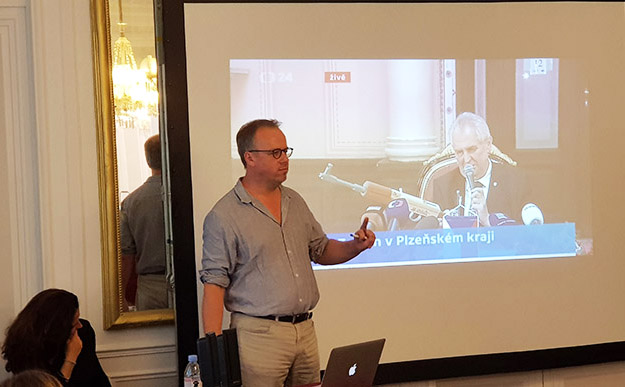
First up in RSF’s catalogue of crimes and threats against the global media was Czech President Miloš Zeman’s macabre press conference stunt late last year.

However, Zeman’s sick joke angered the media when he brandished a dummy Kalashnikov AK47 with the words “for journalists” carved into the wood stock at the October press conference in Prague and with a bottle of alcohol attached instead of an ammunition clip.

RSF’s Christophe Deloire talks of the Czech President’s anti-journalists gun “joke”.
Image: David Robie/PMC
Zeman has never been cosy with journalists but this gun stunt and a recent threat about “liquidating” journalists (another joke?) rank him alongside US President Donald Trump and the Philippines leader, Rodrigo Duterte, for their alleged hate speech against the media.

Monday, July 9, 2018

This week in history - the Rainbow Warrior bombing as told to ABC's Nightlife


Journalist, media educator and author David Robie ... Rainbow Warrior bombing reflections
after 33 years. Image: PMC
Pacific Media Watch Newsdesk
PACIFIC environmental and political journalist David Robie has recalled the bombing of the original Greenpeace flagship Rainbow Warrior 33 years ago in an interview with host Sarah Macdonald on the ABC’s Nightlife “This Week in History” programme.

Dr Robie, now professor of journalism and director of the Pacific Media Centre at Auckland University of Technology, wrote the 1986 book Eyes Of Fire: Last Voyage of the Rainbow Warrior that has been published in four countries and five editions.

LISTEN: Terrorism in Auckland in 1985

Wednesday, June 20, 2018

Former military chief warns PNG soldiers could be ‘outgunned’ in Mendi strife

Deadly MAG 58 Model 60-20 machine guns mounted on a cabin-top truck in the Southern Highlands.
Image: PNGAttitude
From Asia Pacific Report
A FORMER Papua New Guinea military commander has warned that he is “concerned, if not frightened” that the PNG Defence Force may be deploying police and soldiers in the troubled Southern Highlands province facing a deadly weapon.

Ex-Brigadier-General Jerry Singirok , a former commander of the PNGDF who arrested mercenaries deployed by the Sir Julius Chan government for the Bougainville war in the so-called Sandline crisis in 1997, has made his views known in independent media.

In an item published by PNG Attitude and EMTV journalist Scott Waide’s blog, Singirok described Prime Minister Peter O’Neill’s government response to last week’s Mendi riots as a “premature state of emergency” and a “cheap, reckless and knee-jerk option”.

His comments have come at a time when the nation has been shocked by the display of high powered assault weapons by protesters since last week’s Mendi rioting.

It is clear that the government’s guns amnesty last year did little to encourage people to surrender their weapons, reports Loop PNG.

>>> Popular Café Pacific Posts