Friday, May 7, 2010

PNG ombudsman the toast of media freedom

By David Robie in Brisbane

Five months ago, he was the target of would-be assassins. Now he is the magnet for politicians wanting to rein in the powers of his state corruption watchdog.

But Chronox Manek is one of the most popular public figures in Papua New Guinea and thousands of ordinary citizens flocked to a peaceful protest this week against a controversial draft law aimed at curbing his powers.

And he charmed his way to the hearts of freedom of speech and free media advocates gathered in Brisbane for the annual two-day UNESCO World Press Freedom Day conference marking May 3.

Manek, Papua New Guinea’s Ombudsman, is the scourge of the coalition government led by founding “father” Prime Minister Sir Michael Somare – and a problem for Opposition politicians as well.

However, many journalists and public activists see him as a courageous and determined campaigner against corruption by public figures.

More than 7500 citizens took part in Tuesday’s Port Moresby protest against legal amendments – the so-called Maladina Bill, named after the sponsoring MP Moses Maladina – they claim will undermine the Ombudsman Commission.

Corruption epidemic
After marching on Parliament House in Waigani, the demonstrators delivered a petition of 20,000 signatures demanding a halt to the legislation curbing the commission’s powers.
The petition follows several weeks of public protest and condemnation over what critics describe as serious erosion of governance in this country where corruption is an epidemic.

Maladina’s Parliamentary Committee into the Ombudsman Commission tabled amendments impacting on both the commission and the so-called Leadership Code governing conduct by politicians and top civil servants.

One of the critical changes block the commission’s current powers to freeze public funds suspected of being used for corrupt or improper purposes.

The bill also imposes a four-year time limit on investigations, effectively blocking the ability of the commission to probe historical corruption cases.

Another provision means that politicians and civil service heads that breach the Leadership Code will no longer be able to be tried in criminal courts.

The bill has passed two readings with unanimous parliamentary support in spite of the public criticism. However, although the last vote was 83 to nil in favour of the draft law, the Opposition now says that it had been misinformed over the provisions and is now opposed.

Prime Minister Somare, Treasurer Patrick Pruaitch and several prominent government figures are currently being investigated by the Ombudsman Commission.

'Speading misinformation'
Somare has accused the Ombudsman Commission of “spreading misinformation” about the bill, but the final reading has been delayed until July.

Transparency International recently ranked PNG as the 151st most corrupt out of 182 nations.

In Brisbane, Manek spoke in two freedom of information panels in the conference hosted by the University of Queensland.

While saying the free expression and free press provisions in Article 19 of the Universal Human Rights Declaration were enshrined in the country’s constitution and that the courts enforced these rights, he added there was a major problem.

“This is about the availability of records – it is very low priority for government business,” Manek said.

“It is all very well being entitled to the information, but in many cases the government is unable to supply it because of the poor state of official records.”

At the time of independence in 1975 and for several years later, the importance of records and information management had been in good health.

'Fell off the rails'
“But somewhere along the way it fell off the rails,” Manek said.

He said it was the duty of the government to provide basic information to its citizens and to build trust.

The role of the media was important too.

“The government uses the National Broadcasting Corporation with talkback and radio and television to get policies across to the public. That’s a good start,” he said.

“But with media freedom goes great responsibility for the news media.
“Freedom of the press is not a privilege, but a responsibility.”

The media could do more to get information before the public and “we need more investigative journalism”.

He challenged the upholders of the nation’s information policy to recruit “honest” people to rebuild the open culture.

Last December, Manek was left for dead after several gunmen opened fire on him outside his home, gangland style.

They blocked his car as he waited for his driveway gate to open and fired through the windscreen of his Nissan Patrol.

He was hit in the shoulder but he told The National newspaper after the attack that a point-blank shot aimed at his chest glanced off the vehicle door.

Photo of Chronox Manek by David Robie

Thursday, May 6, 2010

An open letter to the commodore

Bula Frank,

I AM sure you prefer being called by your first name, rather than being than being called coup leader. I know you see yourself as a saviour – but may I say that you seem to be a slow saviour. You move … snail slow towards democracy, vinaka. From 2006 to 2014 is tomorrow and then Election Day – a special day, which I hope will be long, prosperous and full of fair play to the people.

Your media decree is a genuine way to boost the economy. Over the next four years you will be able to make a considerable amount of money from media organisations by collecting F$100,000 from journalists when they refuse to disclose their sources about their news story with the person who said in a mild manner… that your policies
Encourage people to think carefully and restrain themselves from voicing their negative views of the army.
To pay your fines, senior journalists will be able to mortgage their homes, take their children away from school, postpone paying the doctor, ignore their donations to the church and cut back on the food budget.

But… Frank… I see you have been thoughtful of the needs of journalists and left a loophole. Non-payment of the $100,000 fine will allow any journalist to go to jail and be clothed and fed at state expense. Good thinking.

I am sure your self-appointed judges will ensure married journalists with children will get a priority to go to jail before young single reporters. Perhaps, you can lock up the junior journalists at the army barracks. Your men know to do that.

The numerous $500,000 cheques collected from the media organisations will mount up and you will soon have enough money to legally buy The Fiji Times. With a little bit of luck (or military strategy) by 2014 you will own all the media in Fiji except perhaps the internet.

Internet story
It will be sad for you to miss out on owning the internet. It is among your harshest critics and I know that sometimes the information is wrong and often offensive. But, then how else do the people of Fiji, and the rest of the world finds out about Fiji in all its black, white, grey and khaki colours?

A short story for you about the internet. During 2000 when George Speight had his coup, the big Fiji media of radio, TV and the newspapers were uncertain about how to deal with him. The limited information they could glean was crucial for the public to hear and crucial too for the outside world. Getting information out to the rest of the world was difficult.

At the time I was working at the Media Centre of the University of the South Pacific. We managed to record news reports from radio and TV. That information along with on-the-spot reporting by student journalists was forwarded several times a day through the internet to media organisations in New Zealand, Australia, the US and Britain. This process continued for many days even after the overseas journalists arrived. Some of those students now hold key media positions in Fiji.

I no longer teach journalism to students in Suva, but if I was, I would still be helping them understand, learn and practise the Fiji Code of Ethics. It’s a sound code. I would want them to be fearless and to ask questions on the many facets of the problems and needs of society.

Young journalism students could ask… why do you need so many years in power to develop a new Constitution?

I would encourage them to think on questions about how you are dealing with the growing number of poor people in Fiji. Various blogsites tell me the poor are now half the population. Why are there more poor people now than in 2006 – you and your soldiers have been in charge of the country for a long time?

I would get students thinking too, on why we need so many military men in key administrative posts. Hopefully, they are all working towards putting themselves out of work and replacing their jobs posts with civilians. Are they?

About elections
Student journalists may ask you questions on democratic practice? In New Zealand, there are elections every three years. When the voters dislike the government, they tell it to go … and the government goes. Helen Clark went, John Key will go too.

Citizens in Britain are in the middle of a cliffhanger election to decide who they will want to lead the country for the next few years. The citizens’ decision this week does not bode well for the present government, but then democracy is difficult.

I hope you agree with me? If not, what will happen after 2014 when a decision by a civilian elected government angers you or perhaps a junior officer who has modelled himself on your behaviour?

To close off the tutorial and leave students thinking, it would be useful for them to reflect on this recent statement on democracy.
Pacific Beat Story from Radio Australia March 2, 2010
Fiji's military backed regime has announced that any politician, who has played a role in the country's politics, since 1987, will be banned from contesting the promised elections in 2014. The announcement has been made by interim Prime Minister Commodore Frank Bainimarama ...
A reply would be appreciated. Please post it on your favorite blog site

Vinaka
Patrick Craddock
Aotearoa

Tuesday, May 4, 2010

Fiji censorship by 'legal camouflage'


ON World Press Freedom Day's eve in Brisbane, the Australian journalists union - Media, Arts and Entertainment Alliance (MEAA) - threw a party for Aussie hacks and the UNESCO flacks attending the two-day conference at the University of Queensland. A "South Pacific soirée" to be exact. Guest speaker Sean Dorney had to compete with a cacophony of riverside fireworks to be heard. The latest "press freedom" edition of the Walkley Magazine was launched there too. Along with a 13-page report card on the state of media freedom in Australia, the following article on Fiji was also published:

No colonel of truth in Fiji

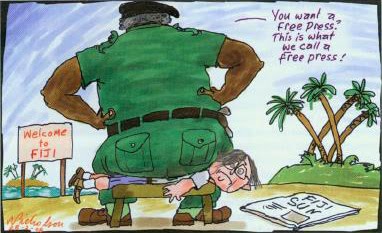
For a year, journalists in Fiji have had to live with censors posted in the newsroom. Now a new media decree threatens huge fines and and five years in prison for reports against the national interest. It's a dangerous precedent for the entire Pacific region, says David Robie. Cartoon by Peter Nicholson.

When an Indo-Fijian academic and former trade unionist turned up on Fiji’s shores from Hawaii by invitation to conduct a media industry “review” in June 2007, few took him seriously. Whatever Dr James Anthony’s expertise in other fields, news media was certainly not one of his strengths. Also, it had been decades since he had lived in Fiji and he seemed out of touch.

And then there was a niggling question about the legitimacy of his mission. He had been commissioned by then Fiji Human Rights Commission director Dr Shaista Shameem – no friend of Fiji news organisations – to study media freedom and the future of the industry in the Pacific country.

“Negative reactions of the media industry to human rights scrutiny in the public interest are not unique to Fiji,” Shameem said. “Other human rights commissions have faced similar obstacles – such as the South African Human Rights Commission.”

Anthony immediately clashed with local news media companies and the self-regulatory Fiji Media Council and they refused to cooperate with him. He persevered in an atmosphere of hostility and produced a 161-page report branded by his opponents as “racist” – for a sweeping claim that the industry was dominated by eight white expatriates – and “riddled with inaccuracy”.

Ironically titled “Freedom and independence of the media in Fiji”, the report was discredited and appeared to have sunk into oblivion. Yet now Anthony has come back into focus. His recommendations were adopted as the basis of a draconian draft decree widely regarded as a sinister threat to the future of a free press in Fiji and across the South Pacific.

Attorney-General Aiyaz Sayed-Khaiyum claimed the Media Industry Development Decree 2010 “takes the already established rules of professionalism, of media behaviour – or how they should behave – and gives it teeth”.

Decree 'teeth'
The “teeth” includes rolling Anthony’s primary proposals for a Singapore-inspired Media Development Authority and an “independent” Media Tribunal into this proposed law along with a radical curb on foreign ownership, wide powers of search and seizure and harsh penalties for media groups and journalists breaching the decree.

The authority and tribunal would be empowered to fine news organisations up to F$500,000 and to fine individual journalists and editors up to F$100,000 – or imprison them for up to five years – for violations of vaguely defined codes such as publishing or broadcasting content that is “against public order”, “against national interest” or “creates communal discord”.

Foreign ownership is retrospectively restricted to a 10 percent stake in any media organisation and directorships must only go to Fiji citizens who have been residing in the country for five of the past seven years, and nine of the past 12 months.

Many critics see this as a vindictive section aimed at crippling the Fiji Times, the country’s largest and most influential newspaper and owned by a Murdoch subsidiary, News Limited.
The regime wants to put the newspaper, founded at Levuka in 1869, out of business, or at least effectively seize control and muzzle its independent stance – seen by the military-backed government as “anti-Fiji”.

Two Australian publishers of the Fiji Times have been deported on trumped up grounds since military commander Voreqe Bainimarama staged the country’s fourth coup in December 2006. The High Court also imposed a hefty F$100,000 fine against the Fiji Times in early 2009 for publishing an online letter criticising the court for upholding the legality of the 2006 coup.

While international responses have focused on the serious impact for the Fiji Times group, the terms of the decree will also hit the country’s two other dailies – the struggling Fiji Daily Post (it hasn't been publishing lately), which has 51 per cent Australian ownership, and the Fiji Sun, which has taken a distinctly “pro-Fiji” (that is, pro-regime) stance but also has some expatriate directors.

John Hartigan, chief executive of the Fiji Times' parent company News Limited, warned the decree raised “important commercial issues” for the newspaper. “We have made representations to the Fiji authority to find a way to resolve these issues and are awaiting the outcome,” he said.

Mixed responses
The draft decree follows 12 months of “sulu censors” - so-called because of the traditional Fijian kilt-like garment some officials wear - keeping tabs on newsrooms after the 1997 constitution was abrogated by the regime in April last year and martial law declared.

Responses to the proposed law have been mixed within Fiji, but other media groups have strongly condemned it. Paris-based Reporters Without Borders criticised the regime for tightening its grip on media, noting that Fiji had fallen 73 places in its annual freedom rankings. Fiji is now placed 152nd out of 175 countries.

The Pacific Media Centre branded the draft decree as “draconian and punitive” and the Pacific Freedom Forum said it would “deal a death-blow to freedoms of speech”. The International Federation of Journalists criticised the regime for investing authorities with the power to define the meaning of “fair, balanced and quality” journalism.

Most Fiji journalists were reluctant to speak out publicly with their jobs potentially on the line. But many contributed postings to some of the 72 post-coup blogs about Fiji or shared insights with their Pacific colleagues on cyberspace networks.

Dangerous precedent
Other Pacific journalists see the draft law as a dangerous precedent for the region, one that could be emulated by unscrupulous politicians in other countries as a strategy to control the media.

Already the Suva-based Pacific Islands News Association (PINA) and its regional news cooperative Pacnews are facing a dilemma – to stay and risk being compromised, or to leave but have less lobbying influence on the regime. Vice-president John Woods, editor of the Cook Islands News, has called on the organisation to relocate out of Fiji, describing PINA as “dysfunctional” and “kowtowing” to the regime.

One Suva old hand who had been a star reporter at the time of the first two coups in 1987 admitted there were some good aspects to the decree, such as encouraging training and enforcing the codes of ethics: “But it simply continues the censorship – although now in a camouflaged form.”

Dr David Robie is an associate professor in AUT University’s School of Communication Studies, director of the Pacific Media Centre in New Zealand and editor of Pacific Scoop. He was formerly head of journalism at the University of the South Pacific in Fiji. His media blog is Café Pacific.