Sunday, June 2, 2019

Eric Tapakau, a skilful communicator who loved Bougainville

Eric Tapakau ... a trusted and respected voice and skilful communicator whose advocacy
and ability to connect with local people will be sorely missed. Image: BCL
By Denika Seeto, communications manager of Bougainville Copper Ltd

BOUGAINVILLE Copper Limited (BCL) lost both a dear friend and esteemed colleague with the untimely passing of Eric Tapakau on May 19 after a brief illness.

Tapakau, 44, was a highly regarded member of our Bougainville team having joined the company in September 2017 as media and communications adviser.

As a testament to his capabilities and leadership, he was quickly promoted to a senior project officer position just four months later.

One of Eric’s great qualities was his natural affinity with people and his ability to effectively engage with those at all levels of the community.

He was deeply committed to the betterment of Bougainville and its people and had earned widespread respect.

Saturday, May 4, 2019

Pacific media freedom and news ‘black holes’ worsen for World Press Freedom Day

World Press Freedom Day coverage on the Pacific Media Centre's Asia Pacific Report. Image: PMC screenshot
 By David Robie 

While Pacific countries have got off rather lightly in a major global media freedom report last month with most named countries apparently “improving”, the reality on World Press Freedom Day is that politicians are becoming more intolerant and belligerent towards news media and information “black holes” are growing.

The Pacific is at the milder end on the scale of media freedom violations – there are no assassinations, murders, gaggings, torture and disappearances.

But the global trend of “hatred of journalists [degenerating] into violence, contributing to an increase of fear” warned about by the Paris-based global watchdog Reporters Without Borders is being reflected in our region.

READ MORE: Pacific countries score well in media freedom index, but reality is far worse

Lack of safety for journalists is a growing concern for media organisations around a world where 80 journalists were killed last year, with 348 being jailed and 60 held hostage.

Friday, May 3, 2019

How a US-backed coup attempt failed in Venezuela

How A US-Backed Coup Attempt Failed In Venezuela from Rising Up With Sonali on Vimeo.
The Rising Up video on Venezuela.

By Rising Up with Sonali

A US-backed coup attempt in Venezuela has failed. On Tuesday April 30th, opposition leader Juan Guaidó, who has simply declared himself President, gathered in front of supporters along with another leader Leopoldo Lopez, and claimed that military generals were defecting from President Nicolás Maduro.

Tens of thousands of protesters were gathered in Caracas hoping for a downfall of Maduro’s government as US leaders like Vice President Mike Pence, and former Vice President Joe Biden, were tweeting their ardent support for the opposition.

There have been violent clashes with government security forces.

But Maduro declared that the attempt to sway military generals had failed. Mass protests in support of his regime took place elsewhere in Caracas.

In addition to the violence on the streets there is an information war taking place around Venezuela.

Rising Up talks to Lucas Koerner of Venezuela Analysis for an assessment of the crisis.

Sunday, April 21, 2019

The Assange arrest - a warning from history for journalists

Julian Assange being dragged from the Ecuadorean Embassy in London ... an emblem of the times.
Image: John.Pilger.com

 By John Pilger in London

THE GLIMPSE of Julian Assange being dragged from the Ecuadorean Embassy in London is an emblem of the times. Might against right. Muscle against the law. Indecency against courage.

Six policemen manhandled a sick journalist, his eyes wincing against his first natural light in almost seven years.

That this outrage happened in the heart of London, in the land of Magna Carta, ought to shame and anger all who fear for "democratic" societies. Assange is a political refugee protected by international law, the recipient of asylum under a strict covenant to which Britain is a signatory. The United Nations made this clear in the legal ruling of its Working Party on Arbitrary Detention.

But to hell with that. Let the thugs go in. Directed by the quasi fascists in Trump's Washington, in league with Ecuador's Lenin Moreno, a Latin American Judas and liar seeking to disguise his rancid regime, the British elite abandoned its last imperial myth: that of fairness and justice.

Imagine Tony Blair dragged from his multi-million pound Georgian home in Connaught Square, London, in handcuffs, for onward dispatch to the dock in The Hague. By the standard of Nuremberg, Blair's "paramount crime" is the deaths of a million Iraqis. Assange's crime is journalism: holding the rapacious to account, exposing their lies and empowering people all over the world with truth.

Tuesday, April 16, 2019

Don’t despair about Notre Dame - a rebuilt cathedral could be just as wonderful

The moment the spire collapses while flames are burning the roof of Notre-Dame Cathedral in Paris, France.
Image: AG Photographs via Flickr
By Claire Smith and Jordan Ralph
 

A wonderful icon has been largely destroyed by fire. However, we should not despair.

Part of the reason this loss is so upsetting is because we are immersed in a Western way of thinking that equates authenticity with preserving the original materials used to create an object or building.

But not all societies think like this. Some have quite different notions of what is authentic.

Iconic buildings such as the Catherine Palace in Russia and Japan’s historic monuments of Ancient Nara have been successfully restored, sometimes after great damage, and are today appreciated by millions of people.

Thursday, April 11, 2019

WikiLeaks' Assange arrested to enable US extradition 'for journalism' - act now

Stakeout at the Ecuadorean Embassy and Julian Assange's arrest - at 11min 06sec.
He gives a "thumbs up" sign. Video: Ruptly


By Caitlin Johnstone of Medium

WIKILEAKS founder Julian Assange has been arrested and taken into custody by the London’s Metropolitan police, just as WikiLeaks warned days ago was about to happen.

Assange’s lawyer Jen Robinson reports that his arrest is related to an extradition request from the United States, which the British government has until now refused to admit exists.

“Just confirmed: #Assange has been arrested not just for breach of bail conditions but also in relation to a US extradition request,” tweeted Robinson.

“From #Assange: The US warrant was issued in December 2017 and is for conspiracy with Chelsea Manning in early 2010,” Robinson added.

Thursday, March 14, 2019

Mike Treen: Stand up to Islamophobia - time to tell Trump-like demagogues to get lost!


An eye witness on Strickland Street, Christchurch, saw one of the suspects being apprehended by New Zealand police after today's attack on two mosques. She said police deliberately rammed the car. Video: RNZ


By Mike Treen, national director of Unite Union

After a beautiful day in which thousands of young people across Aotearoa marched for a better future, a chill has descended across this country.

Far-right murderers have shot innocent Muslims in their holy mosques and livestreamed it on Facebook and 4Chan.

The true face of fascism is revealed once again. This is what happens when you believe the lies that they merely want “free speech” to advocate their genocidal ideology.

They hate people of different ethnicities so much that they are prepared to commit terrorist crimes.

Now more than ever, we must stand up in our millions as the true people of Aotearoa, and fight racism, fascism and Islamophobia in all forms.

Monday, February 4, 2019

Venezuela under siege - some class reflections from Max Lane

Pro self-proclaimed "interim president" Guaido "Trumpeters" at a rally in Caracas. Image: TeleSUR
By Max Lane

IT IS necessary to understand that the conflict in Venezuela manifests a war between classes, not between factions of the one class, as in elections in "normal" bourgeois democracies.. The victor will not be inclined to give the other side a chance to come back into power "at the next election".

We cannot expect the Chavistas to play by "normal" bourgeois electoral rules while the other side tries coups, economic sabotage, actively supports a foreign state's economic sanctions, takes tens of millions from a hostile foreign state, attempts presidential assassination, and kills pro govt activists, while also owning all the private media.

Some expect the so-called liberal democratic rules of the game to be applied - but by one side only.

And what will be the result if the Venezuelan Bolivarian movement plays to lose and is defeated. Just remember two names: Pinochet and Suharto.

Saturday, February 2, 2019

Timor-Leste Press Council condemns ‘crime’ against public broadcaster

Timor-Leste Press Council president Virgílio Guterres (second from right) addresses the media briefing
at the council's office in Dili. Image: TLPC
From Pacific Media Watch in Dili

Timor-Leste’s Press Council (TLPC) has strongly condemned political interference in the country’s public broadcasting service (RTTL) newsroom where political-appointed advisers for the president of RTTL have interfered in its coverage.

During a press conference at the TLPC’s offices in Dili, chairperson Virgílio Guterres said it was the first political interference in RTTL’s newsroom since country’s restoration of independence.

“Press Council follows and is informed that after the recent change to the leadership of RTTL, bad interference in the newsroom has been happening. That is why the Press Council is concerned,” he said.

READ MORE: Bob Howarth’s report on Asia-Pacific united Press Councils

The condemnation was about political interference, but there was also physical interference in that certain advisors went in to the newsroom asking to change the news coverage,” Guterres told journalists.

Tuesday, January 22, 2019

Sacked head of Timor-Leste state broadcaster claims ‘political axe’

Ousted: Gil da Costa found out about his sacking through the news media. Image: RTTL
From Pacific Media Watch

The ousted president of Timor-Leste’s public television network says he has been sacked for political reasons.

Gil da Costa was removed this month from the post of chairperson of the board of directors of Timor-Leste Radio and Television (RTTL) following an audit undertaken by the government – and he had no knowledge of the result.

He has told the Portuguese news agency Lusa that his removal from office – which he first learned about on the news – was a political decision following the audit that was led by his successor.

“I heard from the news that I had been ousted. They did not even talk to me before or about any problem that existed,” Gil da Costa told Lusa yesterday.

Da Costa alleged that he was removed after the audit whose results he never knew without any prior information from the government and without having the opportunity to be heard or give any explanation.

Sunday, December 2, 2018

West Papuan 'independence day' - nationalist militia attack rally in Surabaya

A bloodied Papuan student attacked during yesterday's December 1 Free West Papua rally
in Surabaya, Indonesia. Image: Human rights sources
From the Pacific Media Centre

By Tony Firman of Tirto in Surabaya


A protest action by the Papuan Student Alliance (AMP) in Indonesia’s East Java provincial capital of Surabaya yesterday demanding self-determination for West Papua has been attacked by a group of ormas (social or mass organisations).

Police later raided Papuan student dormitories in the evening and detained 233 students in a day of human rights violations as Indonesian authorities cracked down on demonstrations marking December 1 – “independence day”, according to protesters.

The group, who came from a number of different ormas, including the Community Forum for Sons and Daughters of the Police and Armed Forces (FKPPI), the Association of Sons and Daughters of Army Families (Hipakad) and the Pancasila Youth (PP), were calling for the Papuan student demonstration to be forcibly broken up.

READ MORE: Surabaya counterprotest, 300 arrested in West Papua flag demonstrations

“This city is a city of [national] heroes. Please leave, the [state ideology of] Pancasila is non-negotiable, the NKRI [Unitary State of the Republic of Indonesia] is non-negotiable”, shouted one of the speakers from the PP.

At 8.33am, a number of PP members on the eastern side of Jl. Pemuda began attacking the AMP by throwing rocks and beating them with clubs. Police quickly moved in to block the PP members then dragged them back.

Tuesday, November 6, 2018

New Caledonia blockade tension fails to mar French PM’s talks on future

French security forces arrive in force to deal with protesters demonstrating over the independence vote
defeat near St Louis, Noumea. Image: Screenshot - Les Nouvelles Caledoniennes
By David Robie in Nouméa

French security forces moved in today to clean up the main road near an indigenous Kanak tribal area after a day of tension and rioting failed to mar a lightning visit by French Prime Minister Édouard Philippe and post-independence referendum discussions.

Philippe flew in yesterday morning from Vietnam for a day of meetings with political leaders, customary chiefs and voting commission officials to take stock of the historic referendum on Sunday.

While the people of New Caledonia voted to remain French with a resounding 56.4 percent of the vote, it was a lower winning margin than had been widely predicted in the face of an impressive mobilisation by pro-independence groups.

The yes vote was 43.6 percent but Kanak voters were already a minority of the restricted electorate for this vote that included Caldoche (settlers), descendants of a French penal colony for Algerian and Paris commune dissidents, and people of Asian and Wallisian ancestry.

A record 80.63 percent turnout with 141,099 voters in a largely calm and uneventful referendum day has opened the door for serious negotiations about the future of New Caledonia.

READ MORE - David Robie's analysis of the referendum:
Part 1: New Caledonia vote stirs painful memories – and a hopeful future
Part 2: Kanaky independence campaign rolls on ... encouraged by ballot result

Wednesday, October 24, 2018

A future in Pacific journalism in the age of 'media phobia' - USP media awards

Fiji Sun managing editor business Maraia Vula (middle) flanked by USP Journalism coordinator
Dr Shailendra Singh (left), joint winners Koroi Tadulala and Elizabeth Osifelo
and Professor David Robie (right). Image: Harry Selmen/Wansolwara
Keynote address by Pacific Media Centre director Professor David Robie at The University of the South Pacific Journalism Awards,19 October 2018, celebrating 50 years of the university's existence.

Kia Ora Tatou and Ni Sa Bula

For many of you millennials, you’re graduating and entering a Brave New World of Journalism … Embarking on a professional journalism career that is changing technologies at the speed of light, and facing a future full of treacherous quicksands like never before.

When I started in journalism, as a fresh 18-year-old in 1964 it was the year after President Kennedy was assassinated and I naively thought my hopeful world had ended, Beatlemania was in overdrive and New Zealand had been sucked into the Vietnam War.

And my journalism career actually started four years before the University of the South Pacific was founded in 1968.

Being a journalist was much simpler back then – as a young cadet on the capital city Wellington’s Dominion daily newspaper, I found the choices were straight forward. Did we want to be a print, radio or television journalist?

The internet was unheard of then – it took a further 15 years before the rudimentary “network of networks” emerged, and then another seven before computer scientist Tim Berners-Lee invented the World Wide Web and complicated journalism.

Friday, October 12, 2018

Paga Hill iconic human rights documentary banned from PNG festival

Activist lawyer Joe Moses as he appears in a Frontline Insight item about the Paga Hill struggle for justice
in Papua New Guinea. Video: Reuters Foundation
By Pacific Media Watch

An internationally acclaimed investigative documentary about Paga Hill community’s fight for justice from the illegal eviction and demolition of their homes in Papua New Guinea’s capital of Port Moresby has been banned from screening today at the PNG Human Rights Festival.

“The ban highlights the lingering limits on free speech in our country and the continued attempts to censor our story of resistance against gross human rights violations,” claimed Paga Hill community leader and lawyer Joe Moses, the main character in The Opposition film who had to seek exile in the United Kingdom after fighting for his community’s rights.

“This censorship comes as a deep disappointment for my community who have suffered greatly over the past six years.”

The Opposition tells the David-and-Goliath battles of a community evicted, displaced, abandoned – their homes completely demolished at the hands of two Australian-run companies, Curtain Brothers and Paga Hill Development Company, and the PNG state.

What was once home to 3000 people of up to four generations, Paga Hill is now part of the Asia-Pacific Economic Co-operation (APEC) summit “AELM Precinct” which will take place this November.

Saturday, September 22, 2018

John Pilger: 'Hold the front page. The reporters are missing'

John Pilger ... how "fearful 'democracies' regress behind a media facade of narcissistic spectacle".
Image: Media Lens

By John Pilger
Foreword to Propaganda Blitz published today.*

The death of Robert Parry earlier this year felt like a farewell to the age of the reporter. Parry was "a trailblazer for independent journalism", wrote Seymour Hersh, with whom he shared much in common.

Hersh revealed the My Lai massacre in Vietnam and the secret bombing of Cambodia, Parry exposed Iran-Contra, a drugs and gun-running conspiracy that led to the White House. In 2016, they separately produced compelling evidence that the Assad government in Syria had not used chemical weapons. They were not forgiven.

Driven from the "mainstream", Hersh must publish his work outside the United States. Parry set up his own independent news website Consortium News, where, in a final piece following a stroke, he referred to journalism's veneration of "approved opinions" while "unapproved evidence is brushed aside or disparaged regardless of its quality."

Although journalism was always a loose extension of establishment power, something has changed in recent years. Dissent tolerated when I joined a national newspaper in Britain in the 1960s has regressed to a metaphoric underground as liberal capitalism moves towards a form of corporate dictatorship. This is a seismic shift, with journalists policing the new "groupthink", as Parry called it, dispensing its myths and distractions, pursuing its enemies.

Thursday, August 16, 2018

Nuclear free and independent Pacific - how the zone began 33 years ago and what now?


From Pacific Media Watch


RADIO 531pi Breakfast Talanoa host Ma'a Brian Sagala has talked about the Rarotonga Treaty with Café Pacific publisher David Robie.
It was hugely significant for the Pacific. It was sort of like a threshold for the Pacific really standing up to the big powers and predated New Zealand’s nuclear-free law.
It was a huge step forward. It was not only a declaration against France, which was detonating nuclear weapons at the time, but also against the US and Britain that had also conducted many nuclear tests in the Pacific.
The South Pacific Nuclear Free Pacific Zone Treaty 33 years ago ushered in a radical era for the Pacific, which predated NZ’s own nuclear-free law.

The Treaty of Rarotonga formalise the Pacific nuclear-free zone on 6 August 1985 and New Zealand's own New Zealand Nuclear Free Zone, Disarmament and Arms Control Act followed two years later on 8 June 1987.

David also talks about the Rainbow Warrior’s humanitarian voyage to Rongelap to help the islanders move to another home across the Pacific Ocean. He is the author of the book Eyes of Fire about nuclear testing in the Pacific.

Saturday, August 4, 2018

‘Blacklisted’ Australian researcher detained in Indonesian airport

Researcher Belinda Lopez ... detained by Indonesian authorities in Bali's Denpasar airport.
Image: Belinda Lopez/FB
From Pacific Media Watch

AN Australian-based doctoral media researcher says she has been “blacklisted” by Indonesian authorities and refused entry to the country while embarking on a holiday in Bali.

Belinda Lopez, based at Sydney’s Macquarie University and who has researched human rights and other issues in Indonesia, says she is being detained in a room at Denpasar’s Ngurah Rai International Airport and she will have been held for 24 hours before being deported on a flight at 10pm tonight.

READ MORE: Australian student barred from Indonesia

A former journalist, she is doing a doctorate in Indonesian studies.

She was travelling to Bali, Jakarta and the Baliem cultural festival in Papua.

Monday, July 16, 2018

Contrasting accounts of Indonesian genocide and betrayal in West Papua


A local chief in red sunglasses and bra talks to his people about the dangers
of Indonesian administration plans for Okika region. Image: Peter Bang

BOOK REVIEW: By David Robie

TWO damning and contrasting books about Indonesian colonialism in the Pacific, both by activist participants in Europe and New Zealand, have recently been published. Overall, they are excellent exposes of the harsh repression of the Melanesian people of West Papua and a world that has largely closed a blind eye to to human rights violations.

In Papua Blood, Danish photographer Peter Bang provides a deeply personal account of his more than three decades of experience in West Papua that is a testament to the resilience and patience of the people in the face of “slow genocide” with an estimated 500,000 Papuans dying over the past half century.

With See No Evil, Maire Leadbeater, peace movement advocate and spokesperson of West Papua Action Auckland, offers a meticulously researched historical account of New Zealand’s originally supportive stance for the independence aspirations of the Papuan people while still a Dutch colony and then its unprincipled slide into betrayal amid Cold War realpolitik.

Friday, July 13, 2018

Nauru, Fiji and Pacific Facebook gags criticised in Asia-Pacific media freedom summit


Reporters Without Borders secretary-general Christophe Deloire talks about the global threat against journalists.
Video:
Café Pacific

By David Robie in Paris
WHEN Reporters Without Borders chief Christophe Deloire introduced the Paris-based global media watchdog’s Asia-Pacific press freedom defenders to his overview last week, it was grim listening.

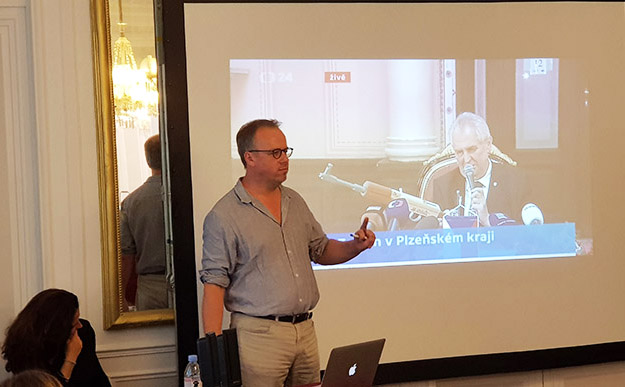
First up in RSF’s catalogue of crimes and threats against the global media was Czech President Miloš Zeman’s macabre press conference stunt late last year.

However, Zeman’s sick joke angered the media when he brandished a dummy Kalashnikov AK47 with the words “for journalists” carved into the wood stock at the October press conference in Prague and with a bottle of alcohol attached instead of an ammunition clip.

RSF’s Christophe Deloire talks of the Czech President’s anti-journalists gun “joke”.
Image: David Robie/PMC
Zeman has never been cosy with journalists but this gun stunt and a recent threat about “liquidating” journalists (another joke?) rank him alongside US President Donald Trump and the Philippines leader, Rodrigo Duterte, for their alleged hate speech against the media.

Monday, July 9, 2018

This week in history - the Rainbow Warrior bombing as told to ABC's Nightlife


Journalist, media educator and author David Robie ... Rainbow Warrior bombing reflections
after 33 years. Image: PMC
Pacific Media Watch Newsdesk
PACIFIC environmental and political journalist David Robie has recalled the bombing of the original Greenpeace flagship Rainbow Warrior 33 years ago in an interview with host Sarah Macdonald on the ABC’s Nightlife “This Week in History” programme.

Dr Robie, now professor of journalism and director of the Pacific Media Centre at Auckland University of Technology, wrote the 1986 book Eyes Of Fire: Last Voyage of the Rainbow Warrior that has been published in four countries and five editions.

LISTEN: Terrorism in Auckland in 1985

Wednesday, June 20, 2018

Former military chief warns PNG soldiers could be ‘outgunned’ in Mendi strife

Deadly MAG 58 Model 60-20 machine guns mounted on a cabin-top truck in the Southern Highlands.
Image: PNGAttitude
From Asia Pacific Report
A FORMER Papua New Guinea military commander has warned that he is “concerned, if not frightened” that the PNG Defence Force may be deploying police and soldiers in the troubled Southern Highlands province facing a deadly weapon.

Ex-Brigadier-General Jerry Singirok , a former commander of the PNGDF who arrested mercenaries deployed by the Sir Julius Chan government for the Bougainville war in the so-called Sandline crisis in 1997, has made his views known in independent media.

In an item published by PNG Attitude and EMTV journalist Scott Waide’s blog, Singirok described Prime Minister Peter O’Neill’s government response to last week’s Mendi riots as a “premature state of emergency” and a “cheap, reckless and knee-jerk option”.

His comments have come at a time when the nation has been shocked by the display of high powered assault weapons by protesters since last week’s Mendi rioting.

It is clear that the government’s guns amnesty last year did little to encourage people to surrender their weapons, reports Loop PNG.

Wednesday, May 2, 2018

'Free media' week killings - but don't forget crimes against Papuans


"Save Papuan Journalists" - a theme poster from last year's May 3 World Press Freedom Day event in Jakarta, Indonesia.
West Papuan media freedom issues tend to be "lost" in the standard press freedom reports on Indonesia.
Image: David Robie/Pacific Media Centre
By David Robie

MONDAY – just three days before today’s World Press Freedom Day – was the deadliest day for news media in Afghanistan in 17 years. The killing of nine journalists and media workers among 26 people who died in dual suicide bomb attacks in Kabul was the worst day for the press since the fall of the Taliban.

Five other journalists were wounded and a 10th journalist was shot and killed in a separate attack outside the capital.

Among the dead was Agence France-Presse chief photographer Shah Marai who left behind an extraordinary legacy of images.

READ MORE: Hatred of journalism threatens democracies

It was the also the most horrendous day for global media since the Ampatuan massacre on the southern Philippines island of Mindanao on 23 November 2009. A shocking 32 journalists were murdered that day, most of the total death toll of 58 in an ambush on a pre-election cavalcade.

To date nobody has been successfully brought to justice. The scores of private militia “owned” by the Ampatuan family alleged to have carried out the killings have got away with their vile crime almost scot-free.

Monday, April 23, 2018

The Ben Bohane photo that Facebook censored on an article about Indonesia

The original version of this photo, of West Papuan nambas (traditional penis gourds), which was published
in the weekend edition of the family newspaper Vanuatu Daily Post and then by Asia Pacific Report,
was deemed to have breached Facebook's "community standards". The photo was by award-winning
photojournalist Ben Bohane, who lives in Vanuatu.
BEN BOHANE: CHINA? NO, LET'S FACE THE ELEPHANT IN THE PACIFIC ROOM

BRIEFING: By Ben Bohane in Port Vila

China … China … China …

All the talk is of increasing Chinese influence in our region. But this is to wilfully see past the elephant in the room.

Contrary to most commentary, the biggest destabilising player in Melanesia over the past five years is not China but Indonesia, which through its “look east” policy has deliberately paralysed the Melanesian Spearhead Group (MSG) while financing local MPs and political parties across the Pacific to try and stop snowballing regional support for West Papuan independence.

Indonesia already has Peter O’Neill onside in PNG, and Voreqe Bainimarama in Fiji, and is busy trying to neutralise Vanuatu, the Solomons and FLNKS (Kanak Socialist National Liberation Front) leaders in New Caledonia, who are resisting Indonesian influence.

READ MORE: The Vanuatu Daily Post and the photo censored by Facebook

The reason Vanuatu and other Melanesian nations may be turning to China is because they are more worried about Indonesia, which has directly threatened Vanuatu over its strong diplomatic support for the West Papuans.

Chinese 'baseless rumour', Nauru 'justice' for refugees and Fiji diabetes


David Robie talks on 95bFM about current Pacific issues


Reuben McLaren of 95bFM talks to Professor David Robie, director of the Pacific Media Centre at Auckland University of Technology, on the centre's Southern Cross radio programme.

David speaks about various upheavals around the Pacific, including the alleged Chinese military "base plans" for Vanuatu, Nauru abolishing its Appeal Court in Australia, and a huge diabetes health bill blowout in Fiji.

Saturday, March 17, 2018

Flashback to the 1968 My Lai massacre: 'Something dark and bloody'


RT's special report on the My Lai massacre and the cover-up of this atrocity.


THE MELBOURNE Sunday Observer -- the original newspaper of that name which campaigned against Australian involvement as a US surrogate in the Vietnam War -- published photographs of the My Lai massacre in December 1969. It was prosecuted for "obscenity" for reporting the atrocity but the charge was later dropped.

Image: David Robie from Al Jazeera
Michael Cannon was editor and David Robie chief subeditor at the time (and later the editor). The photographs were published by arrangement with Life Magazine and were later shown to Federal MPs in an attempt to change Australian government support for the war.

The photographs were published during a period when newspapers in Australia rarely published pictures of bodies, and certainly not as victims of "atrocities" by "our side". This website has a small selection of the photographs published by the Observer.

The Sunday Observer was the springboard for the launching of Nation Review in 1970:

Sunday, March 11, 2018

Harsh response lessons abound in wake of PNG’s ‘invisible’ quake

Timu village from the top showing the site where 11 people were buried by landslips during the earthquake on
26 February 2018. Four of the bodies have been recovered, seven are still buried, including five children.
Image: Sylvester Gawi/Graun Blong Mi- My Land
By David Robie

Tomorrow Papua New Guinea is marking two weeks since the devastating 7.6 magnitude earthquake that devastated parts of Hela, Southern Highlands and Western Highlands provinces on February 26. Officials still have little idea of the full scale of the death and damage, because of the remote rugged terrain involved in what has been described by the BBC as the “invisible quake” – at least to the outside world. However, more than 100 people have died with landslides engulfing entire villages.

Some Papua New Guinean journalists have been doing an admirable job reporting the disaster to international media as well as their own people in difficult and risky circumstances – journalists such as EMTV’s deputy editor Scott Waide and NBC’s Sylvester Gawi. When communications were difficult through mainstream media connections, they have used their personal blogs. Here is the latest blog from Gawi republished from Asia Pacific Report:

BRIEFING: By Sylvester Gawi in Tari, Papua New Guinea


Papua New Guinea’s Highlands earthquake disaster has brought to light some of the many things that need to be considered in assisting those affected by disaster and restoring vital infrastructures and communication links between relief agencies and the people.

The response to the 7.5 magnitude earthquake on February 26 took almost a week for the National Disaster Centre to find out statistics of people who were affected, casualties, homes and food gardens destroyed and how to deliver relief supplies to those affected.

Tuesday, February 27, 2018

Where were the Pacific activists and independent media at climate summit?

Papua New Guinea’s Northern Province Governor Gary Juffa …he asked what about the climate
change activists and West Papuan advocates? Where were they? Image: David Robie/PMC

By David Robie at Te Papa

A recent Andy Marlette cartoon published by the Statesman Journal in Salem, Oregon, depicted a bathtub-looking Noah’s Ark with a couple of stony-faced elephants on board with a sodden sign declaring “Climate change is a hoax”.

The other animals on board floating to safety were muttering among themselves: “The elephants won’t admit that these 100-year events are happening once a month …”

At the other end of the globe in Wellington this week for the second Pacific Ocean Climate Conference at Te Papa Tongarewa Museum, I encountered a fatalistic message from a Tongan taxi driver counting down the hours before the tail-end of Tropical Cyclone Gita struck the New Zealand capital after wreaking a trail of devastation in Samoa, Tonga and Fiji.

He had it all worked out: “We don’t need climate conferences,” he said. “Just trust in God and we’ll survive.”

However, a key takeaway message from the three-day conference was just how urgent action is needed by global policymakers, especially for the frontline states in the Pacific – Kiribati, Marshall Islands and Tuvalu, where none of the sprawling atolls that make up those countries are higher than 2m above sea level.

Friday, February 2, 2018

Coups, globalisation and tough questions for Fiji's future

The General's Goose - three decades of Fiji "coup culture". And what now with the second
post-coup election due this year?
REVIEW: By David Robie of Café Pacific
Historian Dr Robbie Robertson ... challenges "misconceptions"
about the Bainimarama government and previous coups, and asks
fundamental questions about Fiji's future.


When Commodore (now rear admiral retired and an elected prime minister) Voreqe Bainimarama staged Fiji’s fourth “coup to end all coups” on 5 December 2006, it was widely misunderstood, misinterpreted and misrepresented by a legion of politicians, foreign affairs officials, journalists and even some historians.

A chorus of voices continually argued for the restoration of “democracy” – not only the flawed version of democracy that had persisted in various forms since independence from colonial Britain in 1970, but specifically the arguably illegal and unconstitutional government of merchant banker Laisenia Qarase that had been installed on the coattails of the third (attempted) coup in 2000.

Yet in spite of superficial appearances, Bainimarama’s 2006 coup contrasted sharply with its predecessors.

Bainimarama attempted to dodge the mistakes made by Sitiveni Rabuka after he carried out both of Fiji’s first two coups in 1987 while retaining the structures of power.

Instead, notes New Zealand historian Robbie Robertson who lived in Fiji for many years, Bainimarama “began to transform elements of Fiji: Taukei deference to tradition, the provision of golden eggs to sustain the old [chiefly] elite, the power enjoyed by the media and judiciary, rural neglect and infrastructural inertia” (p. 314). But that wasn’t all.

Friday, January 26, 2018

UN critics join global outrage over Duterte’s Rappler ‘free press’ attack


Rappler’s CEO and executive editor Maria Ressa says that the Philippine government spends a lot of effort to turn journalism into a crime which shouldn’t be the case. Video: Rappler


By David Robie from Asia Pacific Report

Three United Nations special rapporteurs have added their voice to the global protests this week over the President Rodrigo Durterte government bureaucracy’s attack on the independent online news website Rappler and a free press in the Philippines.

Rappler has been the latest media target for the administration’s wrath over a tenacious public interest watchdog that has been relentless in its coverage of the republic’s so-called “war on drugs” and state disinformation.

Some media freedom advocates claim that the Philippines is facing its worst free expression and security crisis since the Marcos dictatorship, with The New York Times denouncing the “ruthlessness” and “viciousness” of Duterte’s disdain for democracy.

The death toll in the extrajudicial spate of killings range between 3993 (official) and more than 12,000 since Duterte took office on June 30, 2016, according to Human Rights Watch.

Saturday, December 30, 2017

One Palestinian family’s devastating story of Israeli military cruelty

Israel arrests 16-year-old Palestinian girl Ahed Tamimi in a night raid in the occupied West Bank. Video: Al Jazeera

COMMENT: By Sister Barbara Cameron

When I read last week of the detention of a young Palestinian teenage girl, 16-year-old Ahed Tamimi, dragged from her bed in the middle of the night by Israeli soldiers, for me it wasn’t just another Palestinian teenage protester.

I was devastated. This is the beautiful young woman I’d met as a happy, innocent 10-year-old, in whose house I’d slept, with whose family I’d sat at table, to whose grandmother I had listened as she shared the pain of the terrible things her own children had suffered at the hands of the Israeli military, her daughter shot in a military court room, her son detained innumerable times.

I was gutted thinking of this family having to deal with yet another trauma, fearing what might happen to their 16-year-old daughter in military detention.

READ MORE: Why is the West praising Malala but ignoring Ahed?

Ahed with her mother Nariman ... a family suffering
again from the cruelty and injustice of the Israeli
occupation. Image: Al Jazeera
Not only that but her 15-year-old brother, Mohammed, is now lying in an induced coma as the result of the injury caused by being shot in the face by a rubber bullet. For me it was heartbreaking news.

In 2011, as a NZ Catholic nun, a Mission Sister, I had volunteered with the International Women’s Peace Service group in Palestine on the West Bank, a group that supports the Palestinians in any nonviolent resistance to the occupation of their land by Israel, and reports on human rights abuses.

Monday, December 18, 2017

Film industry sources criticise TVNZ ‘devaluing’ of Māori programmes

New Māori and Pacific television programming commissioning move for TVNZ leaves many
in industry "shocked and questioning". Image: TEARA
 By Kendall Hutt of Pacific Media Watch

Independent filmmakers fear a slow erosion of Māori and Pacific content at Television New Zealand has begun.

Their fears have emerged after the role of commissioner for Māori and Pacific programmes was removed from a full-time commissioning role in recent restructuring by TVNZ.

The move has left some within the film and television industry shocked and questioning whether it is ignorance or arrogance.

“Given that we are an increasing demographic, this seems like a mad racist move,” said Joanna Paul (Ngai te Rangi), an independent television producer who was one of the pioneers of the Māori Television Service.

“That TVNZ considers this a part-time job is arrogant and ignorant enough, but given there is more Māori and Pacific programming on air than ever before beggars belief,” Paul said.

Friday, November 24, 2017

Tiny Timbulsloko fights back in face of Indonesia’s ‘ecological disaster’


Drone views of the village of Timbulsloko showing the scale of coastal erosion and sinking flatlands in an area that once used to be rice fields on the edge of the Central Java city of Semarang. Mangroves are being rapidly re-established. Drone footage source: CoREM (UNDIP). Video compilation: Scott Creighton (AUT), David Robie’s Café Pacific

ANALYSIS: By David Robie in Semarang, Indonesia

A vast coastal area of the Indonesian city of Semarang, billed nine months ago by a national newspaper as “on the brink of ecological disaster”, is fighting back with a valiant survival strategy.

Thanks to a Dutch mangrove restoration programme and flexible bamboo-and-timber “eco” seawalls, some 70,000 people at risk in the city of nearly two million have some slim hope for the future.

An area that was mostly rice fields and villages on the edge of the old city barely two decades ago has now become “aquatic” zones as flooding high tides encroach on homes.

Onetime farmers have been forced to become fishermen.

Villagers living in Bedono, Sriwulan, Surodadi and Timbulsloko in Demak regency and urban communities in low-lying parts of the city are most at risk.

Saturday, October 21, 2017

Indonesian academic exchange an opportunity for unique collaboration

Universitas Gadjah Mada's Centre for Southeast Asian Social Studies (CESASS)
meets AUT's Pacific Media Centre with a Sky Tower backdrop. Photo: PMC
From AUT University

Pacific Media Centre director Professor David Robie will next week join academics from around the world in a global professorial exchange with Indonesia's Universitas Gadjah Mada. In return, six academics from the progressive Yogyakarta university have visited Auckland University of Technology for the first communication and publication research collaboration of its kind in New Zealand.

The academics from Yogyakarta, led by Gadjah Mada University's Centre for Southeast Asian Social Studies (CESASS) director Dr Hermin Indah Wahyuni, arrived in Auckland earlier this month for a two-week visit featuring workshops, seminars and joint research projects related to climate change.

They will also be collaborating with their newly published research journal IKAT, the PMC's 23-year-old Pacific Journalism Review and AUT Library's Tuwhera research platform on a major project involving ecological communication and Asia-Pacific maritime disasters.

Dr Robie is one of six academics invited by CESASS as part of the Indonesian government's World Class Professor (WCP) programme to strengthen international publication and research studies.

Saturday, July 15, 2017

PNG activist blogger Martyn Namorong protests online in defiance of gag order

PNG blogger Martyn Namorong ... gagged but not silenced. Image: MN Twitter
By Mong Palatino of Global Voices

A Papua New Guinea court has issued a gag order against Martyn Namorong, a prominent political blogger and activist accused of defaming Patilias Gamato, the country’s Electoral Commissioner.

Gamato this week sued Namorong after Namorong compared him to a "fruit" (tomato) on social media, as reported by Pacific Media Watch. When Namorong learned about the court order, he posted this image on Twitter before adding the above blue gag selfie image:


He added that he also needed a lawyer.

Sunday, July 2, 2017

Gary Juffa: Why these PNG elections are taking us towards dictatorship

Oro Governor Gary Juffa speaking at a PNG campaign gathering ... explaining the qualities to look for in
national leadership. Image: JuffaFB
By Gary Juffa, Oro Governor and an opposition MP writing for Asia Pacific Report.

I SUSPECT that these Papua New Guinea elections have been so deliberately set to fail, leaving much room for fraud and confusion, and distracting from what is really going on – the establishment of a dictatorship.

Already Prime Minister Peter O’Neill has his own special police unit that flies around Papua New Guinea escorting him in his private airlines, he has a special army unit of 40 exclusively for his callout, he controls the media and Public Service, and, it seems, the Police and Defence commands — and perhaps the judiciary -- the signs and red flags are blinking bright red now…

Yet many people do not see it. We are inching closer towards dictatorship and the ensuing bloodshed and violence that must come from the hostility towards it. But, like lemmings and sheep, we are led to that reality with little resistance at all. Is this the Papua New Guinea we all believed in once upon a time?

Last Wednesday in Oro province, provided a demonstration of how much the PNG government is not for PNG.

Tuesday, June 27, 2017

'Voice of the voiceless' - Al Jazeera's response over Saudi-led blog gag pressure

The Doha headquarters of the global news network. Photo: Al Jazeera
An important media freedom statement: An open letter from Al Jazeera
Republished on Café Pacific from the Doha-based global news network

OVER two decades ago, Al Jazeera Arabic was launched with a simple mission: to provide reliable information to viewers across the Arab world. Ten years later, in 2006, Al Jazeera English began broadcasting with the same mission - to provide people around the world with accurate, balanced and impartial information.

When Al Jazeera Arabic went on air in 1996, it was unique in the Arab world. Most media in the region at the time were state-controlled and often unchallenged mouthpieces for the different rulers and governments in the region. Al Jazeera was different, a truly independent voice, with a mission to hear and report the human stories that were otherwise ignored; to cover events with balance and integrity; and to hold power to account.

Al Jazeera Arabic quickly gained a huge and loyal audience across the region. The information we provided became a lifeline to millions of people who wanted to know what was really going on around them.

Saturday, June 24, 2017

Rights groups condemn ‘cowardly censorship’ bid over Al Jazeera


Flashback to the US-led coalition invasion of Iraq in 2003 -- how the rolling 24 hour news station Al Jazeera played a key role in the  battle for hearts and minds and has made many political enemies. "We are surrounded by despots," says fiesty presenter Faisal Al-Qaseem. Video: Journeyman Pictures

Pacific Media Watch/Asia Pacific Report


PRESS freedom and human rights advocates, journalists and social media users have condemned a demand by Saudi Arabia and other Arab countries to shut Al Jazeera television network and other media outlets in Qatar.

The Arab states reportedly issued a 13-point list on Friday, demanding the closure of all news outlets that it funds, directly and indirectly, including Arabi21, Rassd, Al Araby Al Jadeed, Mekameleen and Middle East Eye.

“We are really worried about the implication and consequences of such requirements if they will ever be implemented,” said Alexandra El Khazen, head of Middle East and North Africa desk at Reporters Without Borders, a non-profit organisation promoting press freedom.

Speaking to Al Jazeera from Paris, Khazen said: “We are against any kind of censorship and measures that could threaten the diversity in the Arab media landscape and pluralism, for instance.

“The Arabic media landscape should make room and accept the broadest range of viewpoints instead of adopting repressive measures against alternative viewpoints that are found to be critical of some governments.”

Saturday, June 10, 2017

Celebrating 30 years of Nuclear-Free Aotearoa -- the Pacific connection

Auckland mayor Phil Goff admiring a photograph by John Miller taken of the politician when he was a student activist campaigning for a nuclear-free New Zealand. Goff spoke at the "Celebrating 30 Years of Nuclear-Free Aotearoa/New Zealand" at the Depot Artspace in Devonport today. Image" David Robie
Reflections from David Robie

CONGRATULATIONS everybody for that tremendous achievement three decades ago. And thank you to WILPF Aotearoa and Ruth Coombes for inviting me. It was literally a David and Goliath struggle to make New Zealand nuclear-free against United States and global pressure – not just David Lange, prime minister at the time, although he was vital too.

The real “David” was the ordinary people of New Zealand who exerted extraordinary pressure on the government to deliver. The barrages of letters from citizens, constant lobbying by peace campaigners, local councils – such as right here in Devonport -- declaring themselves nuclear-free, the door-knocking petitioners – and, of course, the spectacular protests.

However, in my few minutes I would like to talk about the Pacific context, as this was my background. While the New Zealand campaign and success was tremendously inspirational for the Pacific, it should not be forgotten that some small Pacific countries and communities were actually ahead of the game.

Some examples:

Thursday, May 11, 2017

An Indonesian oasis of progressive creativity emerges in culture city


Dr Max Lane, pictured here with Faiza Mardzoeki, talks about his project to establish a community and activist library for the student city of Yogyakarta in Indonesia. Video: Café Pacific

By David Robie in Yogyakarta

A VISION for a progressive activists, writers and researchers retreat in the lush outskirts of Indonesia’s most cultural city, Yogyakarta, is close to becoming reality.

Unfinished Nation ... one of Dr Max Lane's
many books.
The Indonesian Community and Activists Library (ICAL) is already an impressive “shell” in the front garden of Australian author and socio-political analyst, intellectual and consultant Max Lane, arguably the most knowledgeable English-language writer on Indonesian affairs.

Dr Lane, who has been writing and commenting about cultural and political developments in Indonesia, Philippines, Timor-Leste and his homeland since the 1970s, is delighted that completing the centre is so close.

“We have almost completed this building, the library, which will have a reading room, an office, and also some accommodation for those who would like to stay for a few days, or even longer to use the library,” he says, gesturing towards the empty rooms at the complex in the rice-producing and tourist village of Ngepas.

“The library will have about 4000 to 5000 books in the field of social sciences, humanities, history, feminism and so on.”

Sunday, May 7, 2017

Rave hospitality, but Indonesia fails West Papua with media freedom hypocrisy


Al Jazeera's coverage by Step Vaessen of the Papuan protest at WPFD2017 in Jakarta.

By David Robie in Jakarta 


INDONESIAN hospitality was given a rave notice this week for hosting World Press Freedom Day 2017, but it was also given a huge black mark for its “gagging” of free discussion over West Papua violations. 

Four days before the WPFD event got under way, prominent Papuan journalist Victor Mambor had warned in the New Internationalist that Indonesian double standards had imposed a silence over West Papua.

Even a Papuan protest outside the Jakarta Conference Centre venue was kept at the margins, ensuring most of the 1300 journalists, media academics and communication policy makers from 90 countries were unaware of the shocking press and human rights violations that continue almost daily in the Melanesian provinces of Papua and West Papua (collectively known as West Papua).

Al Jazeera broadcast the most comprehensive television report from its Jakarta bureau on media freedom and West Papua with both Titro.id website and The Jakarta Post also carrying reports.

But for the rest, mostly silence.

>>> Popular Café Pacific Posts