Journalist, author and media academic David Robie has launched an
independent news and current affairs website to complement his
long-established Asia Pacific Report.
While Asia Pacific Report will continue to cover regional affairs, the new website — dubbed Café Pacific,
the same name as his blog which is being absorbed into the new venture —
will focus on more in-depth reports and make available on open access a
range of books and articles previously hidden behind paywalls.
Café Pacific will be operated on a Creative Commons licence basis as is APR.
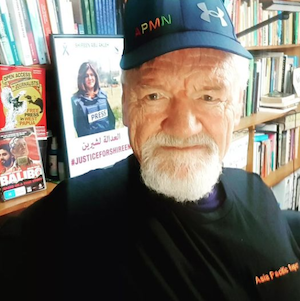
Dr David Robie . . . editor and publisher of Café Pacific. IMAGE: APR
Dr Robie, formerly founding director of AUT’s Pacific Media Centre and a professor of Pacific journalism, described the website project as “innovative”.
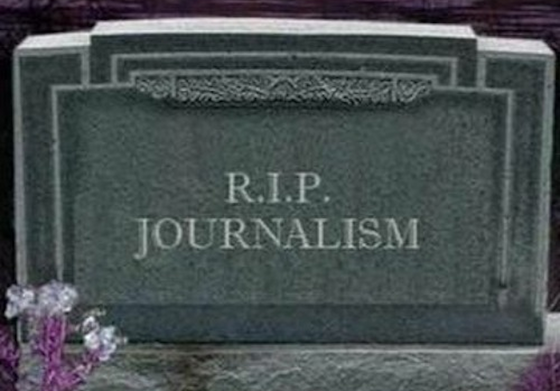
R.I.P. Journalism . . . with "thanks" to ChatGPT. IMAGE: CP
A SNIPPET shared about the ChatGPT debate from one of the gurus of investigative journalism, Sheila Coronel,
at New York’s Columbia School of Journalism. She reports on social
media about a recent assignment brief given by a student to ChatGPT:
“Write an obituary for journalism.”
The less than 500-word result churned out by the chatbot was too close for comfort.
“It is with heavy heart that we must announce the passing of
journalism, a once-vital industry that served as a cornerstone for
democracy and truth-seeking around the world.
“Born in the early days of print media, journalism grew and
evolved alongside society, providing a critical lens through which we
could understand the events and people shaping our world. From the rise
of the penny press in the 19th century to the advent of television news
in the mid-20th century, journalism adapted to new technologies and
mediums, but always remained committed to its fundamental purpose:
informing the public and holding those in power accountable.
NZ
pilot Philip Mehrtens with some of his West Papuan rebel captors . . .
hopes for his release as with the hostages in neighbouring Papua New
Guinea. IMAGE: TPNPB video screenshot APR
TWO countries. A common border. Two hostage crises. But the responses
of both Asia-Pacific nations have been like chalk and cheese.
On February 7, a militant cell of the West Papua National Liberation
Army (TPNPB), the armed wing of the Free Papua Organisation (OPM) — a
fragmented organisation that been fighting for freedom for their
Melanesian homeland from Indonesian rule for more than half a century —
seized a Susi Air plane at the remote highlands airstrip of Paro,
torched it and kidnapped the New Zealand pilot.
It was a desperate ploy by the rebels to attract attention to their
struggle, ignored by the world, especially by their South Pacific near
neighbours Australia and New Zealand.
Many critics deplore the hypocrisy of the region
which reacts with concern over the Russian invasion and war against
Ukraine a year ago at the weekend and also a perceived threat from
China, while closing a blind eye to the plight of the West Papuans – the
only actual war happening in the Pacific.
Papuan independence rebels are playing a desperate game of cat and
mouse with Indonesian authorities over their hostage taking last week
with a New Zealand pilot caught in the middle.
Christchurch-raised Philip Mehrtens, 37, a pilot for the national
feeder airline Susi Air owned by a former cabinet minister and with
Jakarta government supply contracts, was seized by rebels last Tuesday,
February 7, shortly after he had touched down at the remote Paro
airstrip near Nduga in the Papuan highlands.
Five Indigenous Papuans on board the aircraft were set free and the plane was set on fire.
After initial reports saying the authorities were trying to pinpoint
the actual place where the rebels are in hiding and that a rescue
operation is under way, the West Papua National Liberation Army (TPNPB)
played a trump card today by releasing “proof of life” video footage and photos.
“Papua Merdeka!,” said Mehrtens in one of the obviously coached video
messages. “The Papuan military have taken me captive in the fight for
Papuan independence,” he added hesitantly while surrounded by a group of
armed rebels.
When Papuan journalist Victor Mambor visited New Zealand almost nine
years ago, he impressed student journalists from the Pacific Media
Centre and community activists with his refreshing candour and courage.
As the founder of the Jubi news media group, he remained defiant that he would tell the truth no matter what the risk while facing an oppressive and vindictive regime.
“Journalists need to break down the wall and learn freely about our struggle,” he said in a message to New Zealand media via an interview with Pacific Media Watch.
Now the 49-year-old journalist and editor finds that the risks are
growing exponentially as his media network has expanded — with an
English language website and Jubi TV becoming add-ons — and the exposure of his networks have also widened.
He writes for the Jakarta Post, Benar News and contributes to international news services. Two years ago he was also co-producer of an award-winning Al Jazeera 101 East documentary about the plunder of West Papuan forests for oil palm plantations.
Fiji journalist Lice Movono talks to Café Pacific publisher David Robie while preparing interviews for her media freedom podcast for Radio Australia's Pacific Beat. IMAGE: Screenshot Café Pacific
RADIO Australia’s Pacific Beat
reports on how Fiji has fared under the draconian Media Act that
has restricted media freedom over the past decade and moves to change
the law.
There are hopes that state-endorsed media censorship will stop in
Fiji following last month’s change in government to the People’s
Alliance-led coalition.
Reported by Fiji correspondent Lice Movono, the podcast outlines former Fiji Times editor-in-chief Netani Rika’s experiences of repression under the former FijiFirst government.
AOTEAROA New Zealand has been shaken to the
core by the sudden resignation of one of its most iconic and revered
prime ministers amid a fierce controversy over misogyny and death
threats stirred by the global coronavirus pandemic.
Jacinda Ardern, the world’s youngest female prime minister at
37 when she was elected in 2017 on a stardust wave of “Jacinda-mania”,
stepped aside on January 19 after emotional scenes at her last official
function wrapped in a traditional Māori feathered cloak at the historic
Ratana church.
It is now less than a fortnight after her resignation caught the nation
by surprise and has thrown this year’s general election due on October
14 wide open.
Ardern told New Zealanders that after five and a half years as
leader of the left-of-centre Labour Party and with the biggest mandate
in modern times, she “no longer had enough in the tank to do the job
justice”.
Her party had been trailing in opinion polls in the face of a
revived conservative National Party led by former airline executive
Christopher Luxon and the right-wing ACT party, but she was still the
most preferred prime minister in spite of her eroding popularity.
Police gather evidence near the site of a bomb explosion that took place
outside the house of Jubi editor Victor Mambor, in Jayapura, Papua,
Indonesia, on 23 January 2023. IMAGE: AJI for BenarNews
By DANDY KOSWARAPUTRA and PIZARO GOZALI IDRUS Pacific Media Watch
A VETERAN journalist known for covering rights abuses in Indonesia’s
militarised Papua region says a bomb exploded outside his home yesterday
and a journalists group has called it an act of “intimidation”
threatening press freedom.
No one was injured in the blast near his home in the provincial
capital Jayapura, said Victor Mambor, editor of Papua’s leading news
website Jubi, who visited New Zealand in 2014.
Police said they were investigating the explosion and that no one had yet claimed responsibility.
Popular original 1987 coup leader Sitiveni Rabuka . . . back as prime minister in Fiji but with promises of a more democratic and transparent era. Image: FIJIVILLAGE
The Pacific year started with a ferocious eruption and global tsunami in Tonga, but by the year’s end several political upheavals had also shaken the region with a vengeance.
A razor’s edge election in Fiji blew away a long entrenched authoritarian regime with a breath of fresh air for the Pacific, two bitterly fought polls in Papua New Guinea and Vanuatu left their mark, and growing geopolitical rivalry with the US and Australia contesting China’s security encroachment in the Solomon Islands continues to spark convulsions for years to come.
It was ironical that the two major political players in Fiji were both former coup leaders and ex-military chiefs – the 1987 double culprit Sitiveni Rabuka, a retired major-general who is credited with introducing the “coup culture” to Fiji, and Voreqe Bainimarama, a former rear admiral who staged the “coup to end all coups” in 2006.
And pundits had been predicting that the 74-year-old Rabuka, a former prime minister in the 1990s, and his People’s Alliance-led coalition would win. However, after a week-long stand-off and uncertainty, Rabuka’s three-party coalition emerged victorious and Rabuka was elected PM by a single vote majority.
West Papua's funeral procession for Filep Karma . . . banned
Morning Star flags in defiance for the man who strove for “justice,
democracy, peace and non-violent resistance" against Indonesian rule. IMAGE: Twitter screenshot APR
A TRAGIC day of mourning. Thousands thronged the West Papuan funeral cortège today and tonight as the banned Morning Star led the way in defiance of the Indonesian military.
There haven’t been so many Papuan flags flying under the noses of the security forces since the 2019 Papuan Uprising.
Filep Jacob Semuel Karma,
63, the “father” of the Papuan nation, was believed to be the one
leader who could pull together the splintered factions seeking
self-determination and independence.
It is still shocking a day after his lifeless body in a wetsuit was found on a Jayapura beach.
Police and Filep Karma’s family say they had no reason to believe that his death resulted from foul play, report Jubi editor Victor Mambor in Jayapura and Nazarudin Latif from Jakarta for Benar News.
“I followed the post-mortem process and it was determined that my
father died from drowning while diving,” Karma’s daughter, Andrefina
Karma, told reporters.
But many human rights advocates and researchers aren’t so convinced.
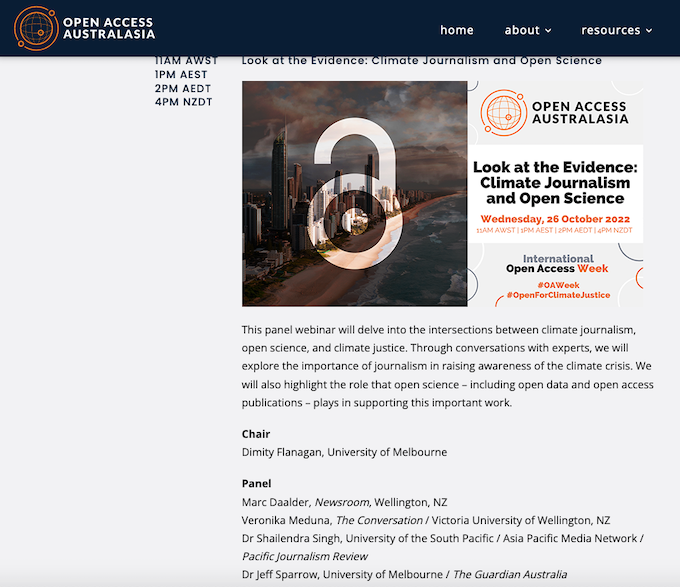
Open Access Australasia deputy chair Dimity Flanagan . . . moderating
the "look at the evidence" webinar on the media and climate crisis. IMAGE: Open Access screen shot APR
A Fiji-based academic challenged the Pacific region’s media and
policymakers today over climate crisis coverage, asking whether the
discriminatory style of reporting was a case of climate injustice.
Associate Professor Shailendra Singh,
head of the journalism programme at the University of the South
Pacific, said climate press conferences and meetings were too focused on
providing coverage of “privileged elite viewpoints”.
“Elites have their say, but communities facing the brunt of climate change have their voices muted,” he told the Look at the Evidence: Climate Journalism and Open Science
webinar panel exploring the role of journalism in raising climate
awareness in the week-long Open Access Australasia virtual conference.
Dr Singh, who is also on the editorial board of Pacific Journalism Review and was speaking for the recently formed Asia Pacific Media Network (APMN), threw open several questions to the participants about what appeared to be “discriminatory reporting”.
“Is slanted media coverage marginalising grassroots voices? Is this a form of climate injustice?” he asked.
“Are news media unknowingly perpetuating climate injustice?”
He
cited many of the hurdles impacting on the ability of Pacific news
media to cover the climate crisis effectively, such as lack of resources
in small media organisations and lack of reporting expertise.
‘Jack-of-all-trades’
“We are unable to have specialist climate reporters as in some other
countries; our journalists tend to be a jack-of-all-trades, and master
of none,” he said.
He did not mean this in a “disparaging manner”, saying “it’s just our reality” given limited resources.
Key Pacific media handicaps included:
• The smallness of Pacific media systems;
• Limited revenue and small profit margins;
• A high attrition rate among journalists (mostly due to uncompetitive salaries);
• Pacific journalists “don’t have the luxury” of specialising in one area; and
• No media economies of scale.
“Our journalists don’t build sufficient knowledge in any one topic
for consistent or in-depth reporting,” he said. “And this is more deeply
felt in areas such as climate reporting.”
He cited pioneering research on Pacific climate reporting by Samoan climate change journalist Lagipoiva Dr Cherelle Jackson, saying such Pacific media research was “scarce”.
‘Staying afloat in Paradise’
A research fellow with the Reuters Institute and Oxford University, Dr
Jackson carried out research on how media in her homeland and six other
Pacific countries were covering climate change. The 2010 report was
titled Staying Afloat in Paradise: Reporting Climate Change in the Pacific.
Pacific journalists and editors “have a responsibility to inform
readers on how climatic changes can affect them, she argued. But this
did not translate into the pages of their newspapers.
“Climate change is simply not as high a priority for Pacific
newsrooms as issues such as health, education and politics which all
take precedence over even general environment reporting,” Dr Jackson
wrote.
“For a region mainly classified by the United Nations as ‘least
developed’ and ‘developing’ countries, it is apparent that there are
more pressing issues than climate change.
“But the fact that the islands of the Pacific are already at the
bottom end of the scale in regards to wealth and infrastructure, and the
fact that climate change is also threatening the mere existence of some
islands, should make it a big story. But it isn’t.”
She has continued her advocacy work on climate change as climate
editor of the Associated Press and completing a doctorate on the topic.
Newsroom’s
Marc Daalder . . . “we need this [open access] to happen for climate
reporting”. IMAGE: Open Access Week 2022 screenshot APRThe Open Access Australasia media panel today also included Newsroom’sMarc Daalder, The Conversation’s New Zealand science editor Veronica Meduna, and Guardian
columnist Dr Jeff Sparrow of the University of Melbourne. It was
chaired by Open Access Australasia deputy chair Dimity Flanagan.
Critical of paywalls
Daalder spoke about how open access to scientific papers was vitally
important for journalists who needed to read complete papers, not just
abstracts. He was critical of the paywalls on many scientific research
papers.
Open access enabled journalists to do their job better and this was
clearly shown during the covid-19 pandemic — “and we need this to happen
for climate reporting”.
Meduna said it took far too long for research, such as on climate
change, to filter through into public debate. Open access helped to
reduce that gap.
She also said the success of The Conversation model showed
that there was a growing demand for scientists communicating directly
with the public with the help of journalists.
Dr Sparrow called for a social movement for meaningful action on the
climate crisis and more scientific literacy was needed to enable this.
Highly critical of the “dysfunctional” academic publishing industry,
he said open access would contribute to “radically accessible” science
for the public.
Media educator and Asia Pacific Report editor Professor David Robie tells of the resilience and courage of Pacific journalists faced with many challenges. IMAGE: MediAsia Iafor/La Trobe screenshot
New Zealand journalist and academic David Robie has covered the Asia-Pacific region for international media for more than four decades.
An advocate for media freedom in the Pacific region, he is the author
of several books on South Pacific media and politics, including an account of the French bombing of the Greenpeace flagship Rainbow Warrior in Auckland Harbour in 1985 — which took place while he was on the last voyage.
In 1994 he founded the journal Pacific Journalism Review examining media issues and communication in the South Pacific, Asia-Pacific, Australia and New Zealand.
He is also convenor of the Pacific Media Watch media freedom
collective, which collaborates with Reporters Without Borders in Paris,
France.
Until he retired at Auckland University of Technology in 2020 as that
university’s first professor in journalism and founder of the Pacific Media Centre, Dr Robie organised many student projects in the South Pacific such as the Bearing Witness climate action programme.
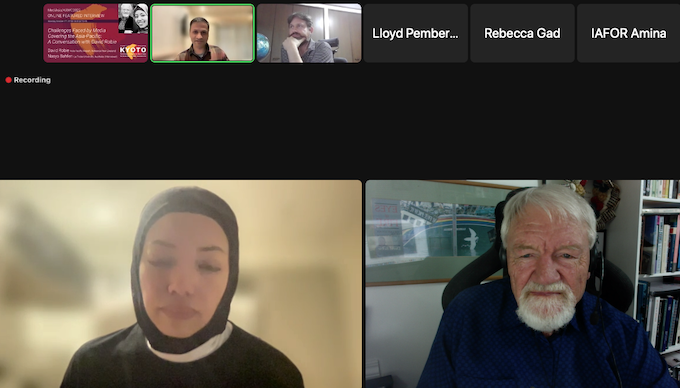
Watch the conversation between Dr Nasya Nahfen and Asia Pacific Report editor Professor David Robie. VIDEO: MediAsia Iafor/Café Pacific Media
In this interview conducted by Mediasia organising committee member Dr Nasya Bahfen of La Trobe University for this week’s 13th International Asian Conference on Media, Communication and Film
that ended today in Kyoto, Japan, Professor Robie discusses a surge of
disinformation and the challenges it posed for journalists in the region
as they covered the covid-19 pandemic alongside a parallel “infodemic”
of fake news and hoaxes.
The MediAsia “conversation” on Asia-Pacific issues in Kyoto, Japan. IMAGE: Iafor screenshot APRHe also explores the global climate emergency and the disproportionate impact it is having on the Asia-Pacific.
Paying a tribute to the dedication and courage of Pacific
journalists, he says with a chuckle: “All Pacific journalists are
climate journalists — they live with it every day.”
Challenges
facing the Asia-Pacific media . . . La Trobe University’s Dr Nasya
Bahfen and Asia Pacific Report’s Dr David Robie in conversation. IMAGE:
Iafor screenshot APR
Anjum Rahman, project lead of the Inclusive Aotearoa Collective Tāhono .
. . “If our democracy fails, all those other things fail as well.” IMAGE: David Robie/Asia Pacific Report
A human rights advocate has appealed for people in Aotearoa New
Zealand to take personal responsibility in the fight against
disinformation and to upskill their critical thinking skills.
Anjum Rahman, project lead of the Inclusive Aotearoa Collective Tāhono,
said this meant taking responsibility for verifying the accuracy and
source of information before passing it on and not fuelling hate and
misunderstanding.
“Our democracy is very fragile,” she warned while delivering the annual David Wakim Memorial Lecture 2022 with the theme “Protecting Democracy in an Online World” at Parnell’s Jubilee Hall.
She said communities were facing challenging and rapidly changing
times with climate change, conflicts, inflation and the ongoing
pandemic.
“If our democracy fails, all those other things fail as well,” she said.
“And for those of us who are more vulnerable it is a matter of life and death.
“Who most stand to lose their freedom if democracy fails? Who will be on the frontline to be exterminated?”
Rahman is co-chair of the Christchurch Call Advisory Network and a
member of the Independent Advisory Committee of the Global Internet
Forum for Countering Terrorism.
Argued strongly for diversity
As an advocate, she has argued strongly for many years in support of
diversity and inclusion and in 2019 was made a member of the New Zealand
Order of Merit.
On the third anniversary of the 15 March 2019 mosque massacre, she wrote in a column for The Spinoff that “we don’t need any more empty platitudes of sorrow . . . we need firm action and strong resolve. Across the board.”
The David Wakim Memorial Lecture 2022. Video: Billy Hania
The recommendations of the Royal Commission of Inquiry were more critical now than ever, and absolutely urgent, she wrote.
“In a world that feels chaotic, with war, rising prices, anger and
hate expressed in protests across the world, our hearts seek a certainty
that isn’t there.
“We need more urgency, and in many areas. I’m still disappointed with the Counter-Terrorism legislation passed last year, granting greater powers without evidence of any benefit. Hate speech legislation has been delayed, and we await a full review and overhaul of the national security system.”
A founding member of the Islamic Women’s Council of New Zealand,
Rahman gave a wide-ranging address tonight on the online challenges for
democracy, and answered a host of questions from the audience of about
100.
“I’m really worried about trolls,” said one. “They affect government,
they influence voters, they have an impact on all sorts of decision
making – what can be done about it?”
Rahman replied that it was very difficult question – “I wish there was a simple answer.”
The audience at the Pax Christi-hosted David Wakim Memorial Lecture 2022 at Parnell’s Jubilee Hall. IMAGE: David Robie/APR
Removing troll incentives
She said there needed to be more education and greater awareness of the
activities of trolls and the sort of social media platforms they
operated on.
One problem was that the more attention paid trolls got, it often meant the more money they were getting.
A challenge was to remove the incentive being given to them.
Award-winning cartoonist Malcolm Evans asked Rahman what her response
was to the global situation “right now” with the invasion of Ukraine
where people were “under intense pressure to vilify the Russians . . .
treating them as ‘evil’.”
He added that “we live in a time that is probably the most dangerous
that I have experienced in my lifetime … we are facing an Armageddon and
I blame the media for that.
“It’s a disgrace.”
This led to a discussion by Pax Christi Aotearoa’s Janfrie Wakim about how Evans lost his job as a cartoonist on The New Zealand Herald in 2003 for “naming Israeli apartheid” over the repression of Palestinians to the loud applause of the audience.
‘Quality journalism’ paywalls
In a discussion about media, Rahman said she was disturbed by the
failures of the media business model that meant increasingly “quality
journalism” was being placed behind paywalls while the public that could
not afford paywalls were being served “poor quality” information.
Introducing Anjum Rahman, Pax Christi’s Susan Healy said how
“especially delighted the Wakim whanau were” that she had agreed to give
the lecture.
David Wakim
was the inaugural president of Pax Christi Aotearoa, an independent
section of Pax Christi International, a Catholic organisation founded in
France at the end of World War Two committed to working “to transform a
world shaken by violence, terrorism, deepening inequalities, and global
insecurity”.
Growing up in a Sydney Catholic family, Wakim was an advocate of
interfaith dialogue. His travels in Muslim countries strengthened his
links with the three faiths of Abraham – Judaism, Christianity and
Islam.
He helped establish the Council of Christians and Muslims in Auckland, but was especially committed to Palestinian rights.
Wakim died in 2005 and the annual lecture honours his and Pax
Christi’s mahi for Tiriti o Waitangi, interfaith dialogue, peace
education, human rights and restorative justice.
Anjum
Rahman addressing the Pax Christi-hosted David Wakim Memorial Lecture
2022. IMAGE: Billy Hania video screenshot/APR
A new Asia Pacific nonprofit group has taken up the role of publishing the independent Pacific Journalism Review and other research and publication ventures.
The launch of the Asia Pacific Media Network | Te Koakoa Inc. (APMN)
has ensured the viability of the New Zealand-based 28-year-old journal
that was founded at the University of Papua New Guinea in 1994.
Chair Dr Heather Devere says the members of the network — mostly in
Australia, Fiji and New Zealand — aim to “show support and work for the
benefit of First Nations and other communities in Aotearoa and the
Asia-Pacific region”.
But, adds Dr Devere, an author and retired director of research
practice at the National Centre for Peace and Conflict Studies (NCPACS):
“The first and most urgent aim is to enable the continued publication
of the nonprofit media research journal Pacific Journalism Review”.
A Gabriela poster honouring martyred women during the Marcos martial law
years in the Philippines on display at the AUT film screening. IMAGE:
David Robie/APR
Seven weeks ago the Philippines truth-telling martial law film Katips
was basking in the limelight in the country’s national FAMAS academy
movie awards, winning best picture and a total of six other awards.
Last week it began a four month “world tour” of 10 countries starting
in the Middle East followed by Aotearoa New Zealand on Sunday – hosted
simultaneously at AUT South campus and in Wellington and Christchurch.
The screening of Vincent Tañada’s harrowing – especially the graphic
torture scenes – yet also joyful and poignant musical drama touched a
raw nerve among many in the audience who shared tears and their
experiences of living in fear, or in hiding, during the hate-filled
Marcos dictatorship.
The martial law denunciations, arbitrary arrests, desaparecidos (“disappeared”),
brutal tortures and murders by state assassins in the 1970s made the
McCarthy era red-baiting witchhunts in the US seem like Sunday School
picnics.
The Sunday Graphic's 1953 Royal Tour Picture Album ... "The tour seems
to have been a strange affair, a tour of places rarely visited by
royalty alongside some more important, but equally far-flung outposts of
the Commonwealth. It was rather like Iron Maiden playing in Christchurch
or Caracas." IMAGE: PJR screenshot
As global tributes pour in for Queen Elizabeth II, who has died at 96 after an extraordinary reign of 70 years, my colleague PHILIP CASS, editor of Pacific Journalism Review, reflects on the late Queen’s first — of many — royal tours of the Pacific and what it reveals about colonial attitudes of the time.
One of the joys of travelling the world and collecting books is the
historical oddities that turn up in the most unexpected places.
I have a splendid copy of the complete works of Shakespeare dating to
the Second World War, completely re-set, so the frontispiece notes, due
to the original plates having been “destroyed by enemy action”. One
wonders at the perfidy of the Luftwaffe in trying to blow up the Bard.
I have a copy of Grove’s encyclopaedia of music from the 1930s which
notes with disdain that attempts to make jazz respectable by using an
orchestra have failed—and this written several years after Gershwin’s Rhapsody in Blue.
The same volume also contains a section on the influence of Jews in
classical music, noting such important ‘Hebrew’ composers as Mahler.
Both these volumes came from a secondhand bookseller near the bus
station in Suva: relics, I suppose, of a long departed British colonial
administrator.
Each of these volumes is a window into the past and into attitudes and ideas that have long vanished.
In the year of the Platinum Jubilee of the late Queen Elizabeth
II—who died yesterday aged 96 after a 70-year reign—it was therefore
timely to find a copy of the Royal Tour Picture Album, a lavishly illustrated record of her 1953 tour of the Commonwealth in my local Salvation Army shop.
The 1953 tour seems to have been a strange affair, a tour of places
rarely visited by royalty alongside some more important, but equally
far-flung outposts of the Commonwealth. It was rather like Iron Maiden
playing in Christchurch or Caracas.
Frontline investigative articles on Aotearoa New Zealand’s 23-day
Parliament protester siege, social media disinformation and Asia-Pacific
media changes and adaptations are featured in the latest Pacific Journalism Review.
The assault on “truth telling” reportage is led by The Disinformation Project,
which warns that “conspiratorial thought continues to impact on the
lives and actions of our communities”, and alt-right video researcher
Byron C Clark.
Several articles focus on the Philippines general election with the
return of the Marcos dynasty following the elevation of the late
dictator’s son Ferdinand “Bongbong” Marcos Jr and the crackdown on
independent media, including Nobel Peace Prize co-laureate Maria Ressa’s
Rappler.
Columbia Journalism School’s Centre for Investigative Journalism
director Sheila Coronel writes of her experiences under the Marcos
dictatorship: “Marcos is a hungry ghost. He torments our dreams, lays
claim to our memories, and feeds our hopes.”
But with Marcos Jr’s landslide victory in May, she warns: “You will
be in La-La Land, a country without memory, without justice, without
accountability. Only the endless loop of one family, the soundtrack
provided by Imelda.”
Bodies of civilians being evacuated after an attack by an armed group at
Nogolaid Village, Kenyam District, Nduga Regency, Papua, last Saturday. IMAGE: Jubi
A LIVELY 43sec video clip surfaced during last week’s Pacific Islands
Forum in the Fiji capital of Suva — the first live leaders’ forum in
three years since Tuvalu, due to the covid pandemic.
Posted on Twitter by Guardian Australia’s Pacific Project
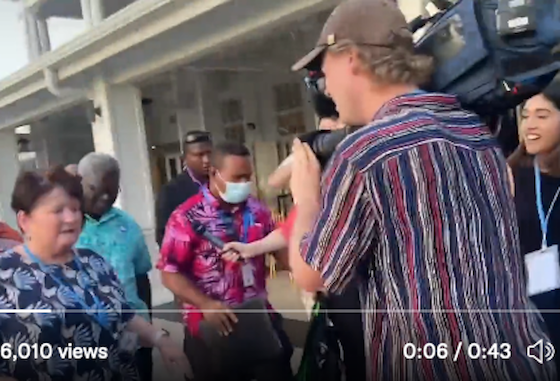
editor Kate Lyons it showed the doorstopping of Solomon Islands Prime
Minister Manasseh Sogavare by a melee of mainly Australian journalists.
A
doorstop on security and China greets Solomon Islands Prime Minister
Manasseh Sogavare (in blue shirt) at the Pacific islands Forum in Suva
last week. IMAGE: Twitter screenshot @MsKateLyons
But Lyons made a comment directed more at questioning journalists themselves about their newsgathering style:
“Australian media attempt to get a response from PM Sogavare, who has
refused to answer questions from international media since the signing of the China security deal, on his way to a bilateral with PM Albanese. He stayed smilingly silent.”
Filipinos in the Wellington meeting make their pledge simultaneously
with the Auckland group for “history, truth and democracy” in the
Philippines. IMAGE: Del Abcede/APR
MIGRANTS and overseas Filipinos in Aotearoa New Zealand have called
on the governments of both Australia and New Zealand to halt all
military and security aid to the Philippines in protest over last
month’s “fraudulent” general election.
At simultaneous meetings in Auckland and Wellington, a new broad
coalition of social justice and community campaigners endorsed a
statement pledging: “Never forget, never again martial law!”
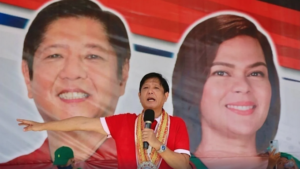
“Bongbong” Marcos Jr, the son of the late dictator Ferdinand Marcos
Sr, was elected President in a landslide ballot on May 9 and will take
office at the end of this month.
Philippine
President-elect Bongbong Marcos Jr wooing voters at a campaign rally in
Borongan, Eastern Samar. Image: Rappler/Bongbong FB
His father ruled the Philippines with draconian leadership —
including 14 years of martial law — between 1965 and 1986 until he was
ousted by a People Power uprising.
Timor-Leste, the youngest independent nation and the most fledgling
press in the Asia-Pacific, has finally shown how it’s done — with a big
lesson for Pacific island neighbours.
Tackle the Chinese media gatekeepers and creeping authoritarianism threatening journalism in the region at the top.
In Dili on the final day of Chinese Foreign Minister Wang Yi’s grand
Pacific tour to score more than 50 agreements and deals — although
falling short of winning its Pacific region-wide security pact for the
moment — newly elected (for the second time) President José Ramos-Horta
won a major concession.
Under pressure from the democrat Ramos-Horta, a longstanding friend
of a free media, Wang’s entourage caved in and allowed more questions
like a real media conference.












%20Upcoming%20edition%20560wide.png)