Showing posts with label pacific journalism review. Show all posts

Saturday, September 24, 2022

New Asia Pacific nonprofit takes up role of PJR publishing for research

Members of the recently formed APMN at a recent general meeting at the
Whānau Community Hub in Auckland's Mt Roskill. IMAGE: APMN

Asia Pacific Report
newsdesk

A new Asia Pacific nonprofit group has taken up the role of publishing the independent Pacific Journalism Review and other research and publication ventures.

The launch of the Asia Pacific Media Network | Te Koakoa Inc. (APMN) has ensured the viability of the New Zealand-based 28-year-old journal that was founded at the University of Papua New Guinea in 1994.

The journal has a focus on Asia Pacific, Australian and New Zealand media research but also publishes widely on global issues.

Chair Dr Heather Devere says the members of the network — mostly in Australia, Fiji and New Zealand — aim to “show support and work for the benefit of First Nations and other communities in Aotearoa and the Asia-Pacific region”.

But, adds Dr Devere, an author and retired director of research practice at the National Centre for Peace and Conflict Studies (NCPACS): “The first and most urgent aim is to enable the continued publication of the nonprofit media research journal Pacific Journalism Review”.

Friday, September 9, 2022

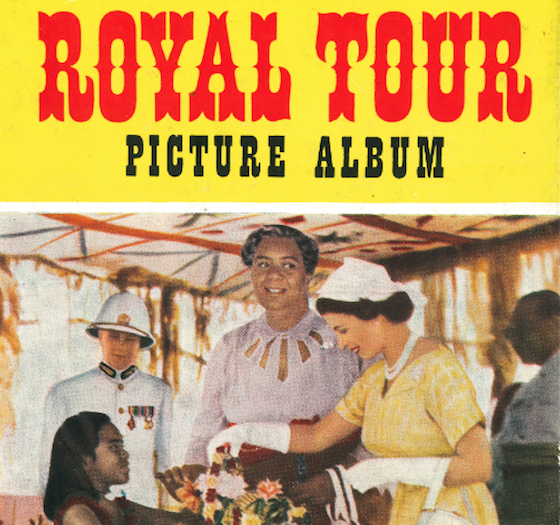
Late Queen Elizabeth’s 1953 Pacific royal tour teaches us much about how we saw the world

The Sunday Graphic's 1953 Royal Tour Picture Album ... "The tour seems to have been
a strange affair, a tour of places rarely visited by royalty alongside some more important,
but equally far-flung outposts of the Commonwealth. It was rather like
Iron Maiden playing in Christchurch or Caracas." IMAGE: PJR screenshot

As global tributes pour in for Queen Elizabeth II, who has died at 96 after an extraordinary reign of 70 years, my colleague PHILIP CASS, editor of Pacific Journalism Review, reflects on the late Queen’s first — of many — royal tours of the Pacific and what it reveals about colonial attitudes of the time.

One of the joys of travelling the world and collecting books is the historical oddities that turn up in the most unexpected places.

I have a splendid copy of the complete works of Shakespeare dating to the Second World War, completely re-set, so the frontispiece notes, due to the original plates having been “destroyed by enemy action”. One wonders at the perfidy of the Luftwaffe in trying to blow up the Bard.

I have a copy of Grove’s encyclopaedia of music from the 1930s which notes with disdain that attempts to make jazz respectable by using an orchestra have failed—and this written several years after Gershwin’s Rhapsody in Blue. The same volume also contains a section on the influence of Jews in classical music, noting such important ‘Hebrew’ composers as Mahler.

Both these volumes came from a secondhand bookseller near the bus station in Suva: relics, I suppose, of a long departed British colonial administrator.

Each of these volumes is a window into the past and into attitudes and ideas that have long vanished.

In the year of the Platinum Jubilee of the late Queen Elizabeth II—who died yesterday aged 96 after a 70-year reign—it was therefore timely to find a copy of the Royal Tour Picture Album, a lavishly illustrated record of her 1953 tour of the Commonwealth in my local Salvation Army shop.

The 1953 tour seems to have been a strange affair, a tour of places rarely visited by royalty alongside some more important, but equally far-flung outposts of the Commonwealth. It was rather like Iron Maiden playing in Christchurch or Caracas.

Friday, July 29, 2022

NZ’s Parliament siege, ‘disinformation war’, kava and media change featured in latest PJR

Pacific Journalism Review ... exposing the assault on "truth telling" and a
kava photoessay. IMAGE: Todd Henry/PJR

By PACIFIC MEDIA WATCH

Frontline investigative articles on Aotearoa New Zealand’s 23-day Parliament protester siege, social media disinformation and Asia-Pacific media changes and adaptations are featured in the latest Pacific Journalism Review.

The assault on “truth telling” reportage is led by The Disinformation Project, which warns that “conspiratorial thought continues to impact on the lives and actions of our communities”, and alt-right video researcher Byron C Clark.

Several articles focus on the Philippines general election with the return of the Marcos dynasty following the elevation of the late dictator’s son Ferdinand “Bongbong” Marcos Jr and the crackdown on independent media, including Nobel Peace Prize co-laureate Maria Ressa’s Rappler.

Columbia Journalism School’s Centre for Investigative Journalism director Sheila Coronel writes of her experiences under the Marcos dictatorship: “Marcos is a hungry ghost. He torments our dreams, lays claim to our memories, and feeds our hopes.”

But with Marcos Jr’s landslide victory in May, she warns: “You will be in La-La Land, a country without memory, without justice, without accountability. Only the endless loop of one family, the soundtrack provided by Imelda.”

Tuesday, October 5, 2021

Behind the scenes investigation of Bougainville struggle for independence tops Pacific Journalism Review

Pacific Journalism Review investigation poses questions about the “silence” in Australia
over the controversial Bougainville documentary Ophir that has won several
international film awards in other countries. IMAGE: Ophir still

Pacific Journalism Review

A FRONTLINE investigative journalism article on the politics behind the decade-long Bougainville war leading up to the overwhelming vote for independence is among articles in the latest Pacific Journalism Review.

The report, by investigative journalist and former academic Professor Wendy Bacon and Nicole Gooch, poses questions about the “silence” in Australia over the controversial Bougainville documentary Ophir that has won several international film awards in other countries.

Published this week, the journal also features a ground-breaking research special report by academics Shailendra Singh and Folker Hanusch on the current state of journalism across the Pacific – the first such region-wide study in almost three decades.

Griffith University’s journalism coordinator Kasun Ubayasiri has produced a stunning photo essay, “Manus to Meanjin”, critiquing Australian “imperialist” policies and the plight of refugees in the Pacific.

Monday, August 17, 2020

Facebook censorship on West Papua – then deafening silence

Facebook censorship on West Papua ... a "cruel irony". Image: RSF/PMC

By David Robie

THE SILENCE from Facebook is deafening and disturbing.

At first, when I lodged my protests earlier this month to Facebook over the immediate removal of a West Papua news item from the International Federation of Journalists shared with three social media outlets, including West Papua Media Alerts and The Pacific Newsroom, I thought it was rogue algorithms gone haywire.

The “breach of community standards” warning I also received on my FB page was unacceptable, but surely a mistake?

However, with subsequent protests by the Paris-based Reporters Without Borders (RSF) media freedom watchdog and the Sydney office of the Asia-Pacific branch of the International Federation of Journalists (IFJ), the world’s largest journalist organisation with more than 600,000 members in 187 countries, falling on deaf ears, I started wondering about the political implications of this censorship.

READ MORE: Melanesia: Facebook algorithms censor article about press freedom in West Papua

We had all complained separately to the FB director of policy for Australia and New Zealand, Mia Garlick, and were ignored.

Friday, February 2, 2018

Coups, globalisation and tough questions for Fiji's future

The General's Goose - three decades of Fiji "coup culture". And what now with the second
post-coup election due this year?
REVIEW: By David Robie of Café Pacific
Historian Dr Robbie Robertson ... challenges "misconceptions"
about the Bainimarama government and previous coups, and asks
fundamental questions about Fiji's future.


When Commodore (now rear admiral retired and an elected prime minister) Voreqe Bainimarama staged Fiji’s fourth “coup to end all coups” on 5 December 2006, it was widely misunderstood, misinterpreted and misrepresented by a legion of politicians, foreign affairs officials, journalists and even some historians.

A chorus of voices continually argued for the restoration of “democracy” – not only the flawed version of democracy that had persisted in various forms since independence from colonial Britain in 1970, but specifically the arguably illegal and unconstitutional government of merchant banker Laisenia Qarase that had been installed on the coattails of the third (attempted) coup in 2000.

Yet in spite of superficial appearances, Bainimarama’s 2006 coup contrasted sharply with its predecessors.

Bainimarama attempted to dodge the mistakes made by Sitiveni Rabuka after he carried out both of Fiji’s first two coups in 1987 while retaining the structures of power.

Instead, notes New Zealand historian Robbie Robertson who lived in Fiji for many years, Bainimarama “began to transform elements of Fiji: Taukei deference to tradition, the provision of golden eggs to sustain the old [chiefly] elite, the power enjoyed by the media and judiciary, rural neglect and infrastructural inertia” (p. 314). But that wasn’t all.

Tuesday, February 28, 2017

Worlds of Journalism global research project produces NZ findings

The latest Pacific Journalism Review ... publishing for 22 years. Image: Hans Tommy/AUT
From Asia Pacific Report

NEW ZEALAND journalists are working longer hours, and feeling more pressure, both ethically and resource-wise, than they were only two years ago, a new research survey has found.

A survey of New Zealand professional journalists, published today in Pacific Journalism Review, also shows for the first time that women journalists are paid less than men, despite making up the bulk of the workforce.

The survey shows female journalists, despite predominating in the profession, are significantly disadvantaged in terms of promotion and income.

The average before tax income of all journalists was $69,400 (in 2015 dollars) but the median after-tax salary of women was 26 percent lower than that of men of equivalent rank and experience.

READ MORE: Pacific Journalism Review on the new Tuwhera platform

Thursday, October 15, 2015

From 'reality' TV to the reality of documentary making - the new civic impulse

Tame Iti featured on the cover of the latest Pacific Journalism Review. Image: Jos Wheeler/The Price of Peace
THE RISE of popular factual television has threatened the key claim on “reality” of documentary practice but there is hope on the horizon in the post-documentary era, says Pacific Journalism Review in the latest edition published this week.

The October edition examines the state of documentary practice in the Asia-Pacific region and also profiles the work of many contemporary filmmakers.

“Documentary programmes on broadcast television have been progressively replaced by lavish series, formulaic docu-soaps or reality TV,” writes edition co-editor Professor Barry King in his editorial.

He adds that a “troubling implication is that post-documentary forms threaten the legitimacy and credibility of the documentary tradition as a whole.”

King notes that one symptom of this “tangible appetite can be found in the rise of citizen journalism, which, however evaluated, still answers to civic impulse”. The surveillance of authorities also boosted this eyewitness function.

Thursday, December 18, 2014

Video insights into Asia-Pacific political journalism


ASYLUM SEEKERS in the Pacific, media freedom issues, post-elections Fiji, climate change, the climate of impunity in the Philippines and investigative documentaries in Timor-Leste, Australia and New Zealand were among the wide-ranging topics featured at a three-day political journalism in the Asia-Pacific conference last month.

The conference marked 20 years of publishing the research journal Pacific Journalism Review.

This video features the conference opening, video premiere Sasya Wreksono's min-doco The Life of Pacific Journalism Review, the Ampatuan massacre in the Philippines, and media freedom issues in the Pacific and Fiji. Speakers include: Walter Fraser (AUT's Head of Pacific Advancement), Sasya Wreksono (NZ/Indonesia), Del Abcede (Philippines), Barbara Dreaver (NZ/Pacific), Ricardo Morris (Fiji).

Thursday, May 23, 2013

New models of funding needed, say NZ investigative journalists

Pacific Media Centre's David Robie ... “We need to educate the universities."
Photo: Jamie Small/Te Waha Nui
INVESTIGATIVE journalists are calling for new models of funding to fill a gap in the industry where the private sector has failed.  

By Jamie Small of Te Waha Nui

Nicky Hager, author of The Hollow Men and Other People’s Wars, says there is not enough support for investigative journalists in countries like New Zealand.

“I hope that one day there will be a return to serious public funding for investigative journalism,” he says.

Hager says most investigative journalists do not have much industry training or support. They are often citizens who begin investigating a crime or wrongdoing and do not realise they have become a journalist.

Professor David Robie, director of AUT University’s Pacific Media Centre, believes he has an answer.

“As the mainstream media reduces its reporting skills, universities should be picking up the slack,” he says.

Tuesday, June 10, 2008

New lease of life for Pacific Media Watch

Just 11 years or so after it was founded, Pacific Media Watch has discovered a new lease of life at its new home at AUT University. Always with an eye to journalist freedom in the region - and sometimes a persistent thorn in the side of self-interested media fat cats - the voluntary media monitoring service has been relaunched as a "future proofed" dynamic digital resource. Launching the database along with the latest edition of the research journal Pacific Journalism Review, Office of Pasifika Advancement director Pauline Winter described the new media resource as invaluable for media and journalism schools. The new Pacific Media Centre took over development of the PMW service last year and has established the database as the first project on DSpace, a digital archive set up by the university's Creative Industries Research Institute (CIRI). The revamped service combines more than 5000 news reports on Pacific media freedom, ethics, education and training issues - updated daily - with a major archive of media research reports and documents, and audio and video clips. But the new database is just at the first stage of its new development. Many new improvements will come in the months ahead.
The original PMW news monitoring service was established in 1996 as a journalism partnership between the University of Technology, Sydney, and the University of Papua New Guinea. The University of the South Pacific journalism school has also been a key contributor in recent years.
PMW campaigned in support of Tongan publisher Kalafi Moala, fellow journalist Filokalafi 'Akau'ola and pro-democracy MP 'Akilisi Pohiva who were wrongfully jailed that year for contempt of Parliament.
At the launch, I paid tribute to the researchers and students involved in the centre. But I would especially like to single out Sydney television journalist Peter Cronau for his sustained work on PMW over many years - including setting up the original PMW website and Kiribati journalist Tabs Korauaba who helped work on developing files for the digital archive last year.

Friday, May 30, 2008

Clark critical of 'personality driven' NZ media

New Zealand Prime Minister Helen Clark has highlighted a number of faults in the national media while discussing the need for a lively press "with responsibility" in the latest Pacific Journalism Review. Among several points she raises are:

  • Too many youthful journalists with energy but a limited grasp of history, geography, sociology and economics - leaving "a large gap in general knowledge".
  • The lack of resources given by the media to covering international stories of "importance to New Zealand".
  • The need for mainstream media to have a better understanding of cultural diversity.
  • Journalists shouldn't confuse healthy scrutiny with cynicism because that undermines the political process.
  • Personality driven media with journalists making themselves the centre of the story.
  • The role of blogs and the tendency for journalists to make "rushed judgments".

This edition's special section of research papers from the Journalism Education Association of NZ conference at Massey University last December has been edited by my Wellington colleague Dr Grant Hannis. The journal has only just gone out to subscribers but already there has been plenty of positive feedback. Other contributors include Fortune journalist and author Bethany McLean, who exposed Enron over its gigantic scam, and Dom Post editor Tim Pankhurst over how his paper is facing the challenges of digital media. Hannis himself contributes a revealing research paper about freelance journalists. Other articles in the AUT Pacific Media Centre- published journal highlight the Maori Party and the media, bogans in West Auckland and West Papuan coverage plus a state-of-media-health report by Bill Rosenberg. And a host of good reviews are also included.

Friday, January 11, 2008

News media ownership in NZ - updates

An update from Bill Rosenberg about his media ownership in New Zealand monitoring file (cartoon by Malcolm Evans from a previous PJR cover):
A revised version of my paper "News media ownership in New Zealand" is now available, which includes updates to the 15 October 2007 version, including some suggestions from readers (many thanks). The changes are outlined below.
It is available either by clicking the above link or going to the
CAFCA web site. I am unlikely to release another update for at least 2-3 months. If you do not wish to be notified of future updates, please reply to this message and I will remove you from my list (with no offence taken!).
The changes from the 15 October version:

For those needing the URL, it is as follows. As I release updates, I
will simply replace the document under the same name as the latest
version -
mediaown.pdf - so links do not need to be updated.

Comments are, as always, welcome.
Bill Rosenberg

Bill Rosenberg's evolving media ownership file at CAFCA

Friday, October 19, 2007

NZ's Pacific minister praises AUT over Pasifika boost

Opening AUT University's new Pacific Media Centre officially last week, NZ Associate Minister for Pacific Island Affairs Luamanuvao Winnie Laban was full of praise for the university's diversity media initiatives. She says AUT has "stepped up to the plate" to take the lead in the sector. She acknowledged the efforts being made in media research and curriculum development and challenged other j-schools, media and universities to follow a similar path. AUT has:

Says Laban: "This centre demonstrates commitment to our cultural diversity, but also to critical thinking and the pursuit of excellence." Pictured: Luamanuvao and PMC director David Robie at the unveiling of the PMC plaque. Photo: Alan Koon.

Tuesday, October 16, 2007

Fiji regime rapped over blogger flak

While regime chief Commodore Voreqe Bainimarama and the vexed Fiji question irritates a couple of pale southern neighbours at the Pacific Islands Forum in Tonga this week, Pacific Journalism Review has published an insightful inquiry into the post-coup blogging issue. And the regime has landed itself on hot coals. Sophie Foster, a onetime editor of the now defunct Pacific Islands Monthly and a former senior editorial hand at The Fiji Times, reckons the military is partly responsible for the number of political blogs that have expanded the media landscape in Fiji since the fourth coup last December. She says blogs have flourished because of the military squeeze on dissenting opinion. Sophie is now a postgraduate student in Pacific media studies at the University of the South Pacific in Suva and she is clearly making good use of her research time.
In her PJR paper, Sophie says that while some blog content was racist, defamatory, provocative and irresponsible, the argument for a free, responsible press has also been also strengthened as an option worth maintaining in any society. This edition of PJR has been produced jointly by the USP journalism programme and AUT University's Pacific Media Centre. PJR cover cartoon by top Kiwi cartoonist Malcolm Evans.
Incidentally, in the latest Reporters Sans Frontieres world press freedom index, bloggers are reported to be threatened as much as in international media.

Monday, October 8, 2007

New NZ survey exposes disgruntled journos

A survey of more than 500 New Zealand journalists has revealed marked unhappiness about levels of pay, resourcing and training, reports the Pacific Media Centre. The “Big Journalism 2007” survey found that, while many individual journalists are very satisfied with aspects of their jobs, overall most want improvements in (respectively) pay, support, mentoring and staffing levels.They want more opportunity for discussion and input into ethical and professional issues such as sensationalism, more guidance on how to cope with commercial and advertising pressures, and more time and resources to pursue investigations. The survey, titled "Under-paid, under-trained, under-resourced, unsure about the future - but still idealistic", published in the latest Pacific Journalism Review, is the first to ask NZ journalists what they think about a variety of topics such as quality of news coverage and their ethics and standards.
The survey revealed a generally ethical stance among journalists, with most agreeing that NZ journalists do not omit or distort relevant facts, and that stories are based on journalistic rather than political or commercial values. Asked to rate the quality of NZ news coverage, journalists rated sports coverage the highest, while foreign coverage got the lowest rating, at slightly below average.
The survey was conducted jointly by Massey University lecturers James Hollings, Alan Samson and Dr Elspeth Tilley, and Waikato University associate professor Geoff Lealand. It builds on Dr Lealand's previous surveys of NZ journalists.
The old and the new journos, according to cartoonist Malcolm Evans.

>>> Popular Café Pacific Posts