A new Asia Pacific nonprofit group has taken up the role of publishing the independent Pacific Journalism Review and other research and publication ventures.
The launch of the Asia Pacific Media Network | Te Koakoa Inc. (APMN)
has ensured the viability of the New Zealand-based 28-year-old journal
that was founded at the University of Papua New Guinea in 1994.
Chair Dr Heather Devere says the members of the network — mostly in
Australia, Fiji and New Zealand — aim to “show support and work for the
benefit of First Nations and other communities in Aotearoa and the
Asia-Pacific region”.
But, adds Dr Devere, an author and retired director of research
practice at the National Centre for Peace and Conflict Studies (NCPACS):
“The first and most urgent aim is to enable the continued publication
of the nonprofit media research journal Pacific Journalism Review”.
A Gabriela poster honouring martyred women during the Marcos martial law
years in the Philippines on display at the AUT film screening. IMAGE:
David Robie/APR
Seven weeks ago the Philippines truth-telling martial law film Katips
was basking in the limelight in the country’s national FAMAS academy
movie awards, winning best picture and a total of six other awards.
Last week it began a four month “world tour” of 10 countries starting
in the Middle East followed by Aotearoa New Zealand on Sunday – hosted
simultaneously at AUT South campus and in Wellington and Christchurch.
The screening of Vincent Tañada’s harrowing – especially the graphic
torture scenes – yet also joyful and poignant musical drama touched a
raw nerve among many in the audience who shared tears and their
experiences of living in fear, or in hiding, during the hate-filled
Marcos dictatorship.
The martial law denunciations, arbitrary arrests, desaparecidos (“disappeared”),
brutal tortures and murders by state assassins in the 1970s made the
McCarthy era red-baiting witchhunts in the US seem like Sunday School
picnics.
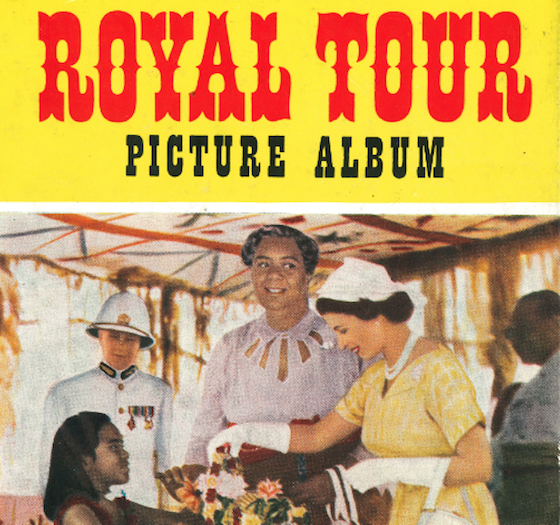
The Sunday Graphic's 1953 Royal Tour Picture Album ... "The tour seems
to have been a strange affair, a tour of places rarely visited by
royalty alongside some more important, but equally far-flung outposts of
the Commonwealth. It was rather like Iron Maiden playing in Christchurch
or Caracas." IMAGE: PJR screenshot
As global tributes pour in for Queen Elizabeth II, who has died at 96 after an extraordinary reign of 70 years, my colleague PHILIP CASS, editor of Pacific Journalism Review, reflects on the late Queen’s first — of many — royal tours of the Pacific and what it reveals about colonial attitudes of the time.
One of the joys of travelling the world and collecting books is the
historical oddities that turn up in the most unexpected places.
I have a splendid copy of the complete works of Shakespeare dating to
the Second World War, completely re-set, so the frontispiece notes, due
to the original plates having been “destroyed by enemy action”. One
wonders at the perfidy of the Luftwaffe in trying to blow up the Bard.
I have a copy of Grove’s encyclopaedia of music from the 1930s which
notes with disdain that attempts to make jazz respectable by using an
orchestra have failed—and this written several years after Gershwin’s Rhapsody in Blue.
The same volume also contains a section on the influence of Jews in
classical music, noting such important ‘Hebrew’ composers as Mahler.
Both these volumes came from a secondhand bookseller near the bus
station in Suva: relics, I suppose, of a long departed British colonial
administrator.
Each of these volumes is a window into the past and into attitudes and ideas that have long vanished.
In the year of the Platinum Jubilee of the late Queen Elizabeth
II—who died yesterday aged 96 after a 70-year reign—it was therefore
timely to find a copy of the Royal Tour Picture Album, a lavishly illustrated record of her 1953 tour of the Commonwealth in my local Salvation Army shop.
The 1953 tour seems to have been a strange affair, a tour of places
rarely visited by royalty alongside some more important, but equally
far-flung outposts of the Commonwealth. It was rather like Iron Maiden
playing in Christchurch or Caracas.
Frontline investigative articles on Aotearoa New Zealand’s 23-day
Parliament protester siege, social media disinformation and Asia-Pacific
media changes and adaptations are featured in the latest Pacific Journalism Review.
The assault on “truth telling” reportage is led by The Disinformation Project,
which warns that “conspiratorial thought continues to impact on the
lives and actions of our communities”, and alt-right video researcher
Byron C Clark.
Several articles focus on the Philippines general election with the
return of the Marcos dynasty following the elevation of the late
dictator’s son Ferdinand “Bongbong” Marcos Jr and the crackdown on
independent media, including Nobel Peace Prize co-laureate Maria Ressa’s
Rappler.
Columbia Journalism School’s Centre for Investigative Journalism
director Sheila Coronel writes of her experiences under the Marcos
dictatorship: “Marcos is a hungry ghost. He torments our dreams, lays
claim to our memories, and feeds our hopes.”
But with Marcos Jr’s landslide victory in May, she warns: “You will
be in La-La Land, a country without memory, without justice, without
accountability. Only the endless loop of one family, the soundtrack
provided by Imelda.”
Bodies of civilians being evacuated after an attack by an armed group at
Nogolaid Village, Kenyam District, Nduga Regency, Papua, last Saturday. IMAGE: Jubi
A LIVELY 43sec video clip surfaced during last week’s Pacific Islands
Forum in the Fiji capital of Suva — the first live leaders’ forum in
three years since Tuvalu, due to the covid pandemic.
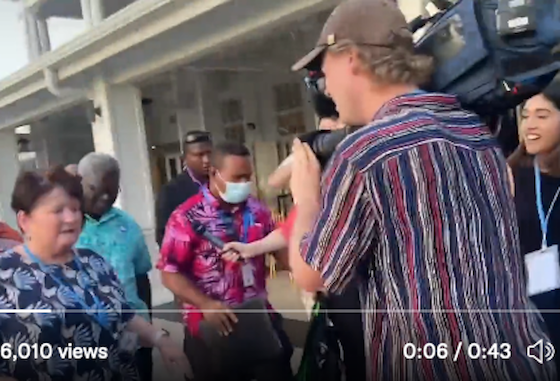
Posted on Twitter by Guardian Australia’s Pacific Project
editor Kate Lyons it showed the doorstopping of Solomon Islands Prime
Minister Manasseh Sogavare by a melee of mainly Australian journalists.
A
doorstop on security and China greets Solomon Islands Prime Minister
Manasseh Sogavare (in blue shirt) at the Pacific islands Forum in Suva
last week. IMAGE: Twitter screenshot @MsKateLyons
But Lyons made a comment directed more at questioning journalists themselves about their newsgathering style:
“Australian media attempt to get a response from PM Sogavare, who has
refused to answer questions from international media since the signing of the China security deal, on his way to a bilateral with PM Albanese. He stayed smilingly silent.”
Filipinos in the Wellington meeting make their pledge simultaneously
with the Auckland group for “history, truth and democracy” in the
Philippines. IMAGE: Del Abcede/APR
MIGRANTS and overseas Filipinos in Aotearoa New Zealand have called
on the governments of both Australia and New Zealand to halt all
military and security aid to the Philippines in protest over last
month’s “fraudulent” general election.
At simultaneous meetings in Auckland and Wellington, a new broad
coalition of social justice and community campaigners endorsed a
statement pledging: “Never forget, never again martial law!”
“Bongbong” Marcos Jr, the son of the late dictator Ferdinand Marcos
Sr, was elected President in a landslide ballot on May 9 and will take
office at the end of this month.
Philippine
President-elect Bongbong Marcos Jr wooing voters at a campaign rally in
Borongan, Eastern Samar. Image: Rappler/Bongbong FB
His father ruled the Philippines with draconian leadership —
including 14 years of martial law — between 1965 and 1986 until he was
ousted by a People Power uprising.
Timor-Leste, the youngest independent nation and the most fledgling
press in the Asia-Pacific, has finally shown how it’s done — with a big
lesson for Pacific island neighbours.
Tackle the Chinese media gatekeepers and creeping authoritarianism threatening journalism in the region at the top.
In Dili on the final day of Chinese Foreign Minister Wang Yi’s grand
Pacific tour to score more than 50 agreements and deals — although
falling short of winning its Pacific region-wide security pact for the
moment — newly elected (for the second time) President José Ramos-Horta
won a major concession.
Under pressure from the democrat Ramos-Horta, a longstanding friend
of a free media, Wang’s entourage caved in and allowed more questions
like a real media conference.
Sadly, the Philippines has sold its soul. Thirty six years ago a
People Power revolution ousted the dictator Ferdinand Marcos after two
decades of harsh authoritarian rule.
Yesterday, in spite of a rousing and inspiring Pink Power would-be
revolution, the dictator’s only son and namesake “Bongbong” Marcos Jr
seems headed to be elected 17th president of the Philippines.
And protests have broken out after the provisional tallies that give Marcos a “lead of millions” with more than 97 percent of the vote counted. Official results could still take some days.
Papuan
student advocate Laurens Ikinia ... “We are so grateful to all Kiwis
across the country for their generous support." IMAGE: Del Abcede/Asia
Pacific Report
IT IS unconscionable. A bewildering and grossly unfair crisis for 34
young Papuan students – 25 male and 9 female – the hope for the future
of the West Papua region, the Melanesian half of Papua New Guinea island
ruled by Indonesia.
They were part of a cohort of 93 Papuan students studying in Aotearoa New Zealand
on local provincial autonomy government scholarships, preparing for
their careers, and learning or improving their English along the way.
They were also making Pacific friendships and contacts.
They were fast becoming a “bridge” to New Zealand. Ambassadors for their people.
And then it all changed. Suddenly through no fault of their own, 41
of them were told out of the blue their scholarships were being
cancelled and they had to return home.
Their funds were cut with no warning. Many of them had accommodation
bills to pay, university fees to cover and other student survival debts.
Time is running out for a group of West Papuan students in New
Zealand whose scholarships were cut — out of the blue — by the
Indonesian government
The sudden removal of government funding for the Papuan students has
left many of them in financial dire straits on visas that are running
out.
Forty two students learned of the termination of their scholarships
at the beginning of this year. With deadlines approaching they have
appealed to both the Indonesian government and MPs in New Zealand to see
if they can fix their dashed hopes of a completed education.
Green Party MPs Ricardo Menendez March, Golriz Ghahraman and Teanau
Tuiono penned a letter to Minister of Foreign Affairs Nanaia Mahuta
requesting government to support for the students before they are
deported.
They are calling for a scholarship fund to support the impacted
students, a residency pathway for West Papuan students whose welfare has
been affected, and an assurance that the students will have access to
safe housing in affordable accommodation.
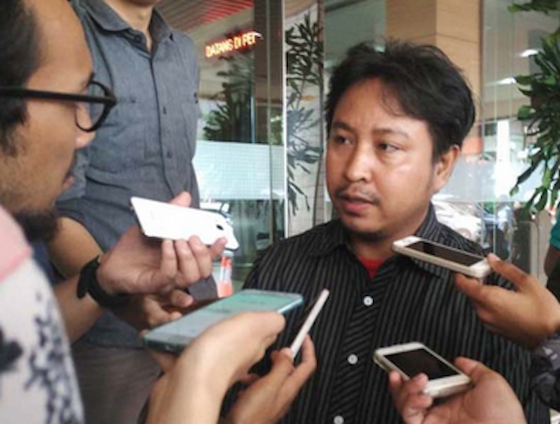
AJI general chairperson Sasmito Madrim speaking to journalists ...
disinformation hacking attack on Madrim's personal WhatsApp, Instagram
and Facebook accounts. IMAGE: Populis
By Vitorio Mantalean in Jakarta
THE INDONESIAN Independent Journalist Alliance (AJI) has condemned
the hacking and disinformation attacks against the group’s general
chairperson Sasmito Madrim as a serious threat to media freedom.
In a written release, the AJI stated that the incident was a “serious threat to press freedom and the freedom of expression”.
“This practice is a form of attack against activists and the AJI as
an organisation which has struggled for freedom of expression and press
freedom,” the group stated.
“The hacking and disinformation attack against AJI chairperson
Sasmito Madrim is an attempt to terrorise activists who struggle for
freedom of expression and democracy”, the group said.
The AJI stated that the hacking attack began on February 23 and
targeted Madrim’s personal WhatsApp, Instagram and Facebook accounts as
well as his personal mobile phone number.
RADIO 531pi's Ma'a Brian Sagala talks to the retired founding director of the Pacific Media Centre, Professor David Robie, and Tahitian researcher and advocate Ena Manuireva on the Pacific DaysWith Brian show about uncertainties over the centre's future a year ago.
Since then the centre has remained in limbo -- if it even still exists after all the pledges by the AUT University administration to continue its pioneering cultural diversity media work into the future.
And in spite of the talented staff who worked hard to keep the centre going in spite of management obstacles.
COMMENTARY:EMTV’s deputy news editor Jack Lapauve Jr in Port Moresby writes in defence of the newsroom’s decision to walk out in protest over the suspension of head of news and current affairs Sincha Dimara on February 7.
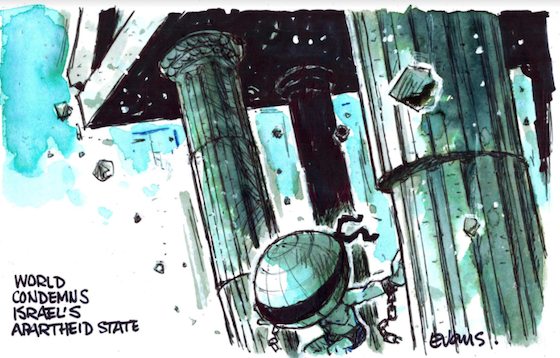
Titled“Israel’s Apartheid against Palestinians”, the 211-page report concludes that the occupation state has imposed a “cruel system of domination” and is committing “crimes against humanity.”
“Our report reveals the true extent of Israel’s apartheid regime. Whether they live in Gaza, East Jerusalem and the rest of the West Bank, or Israel itself, Palestinians are treated as an inferior racial group and systematically deprived of their rights.
"We found that Israel’s cruel policies of segregation, dispossession and exclusion across all territories under its control clearly amount to apartheid. The international community has an obligation to act,”
said Agnès Callamard, Amnesty International’s secretary-general.
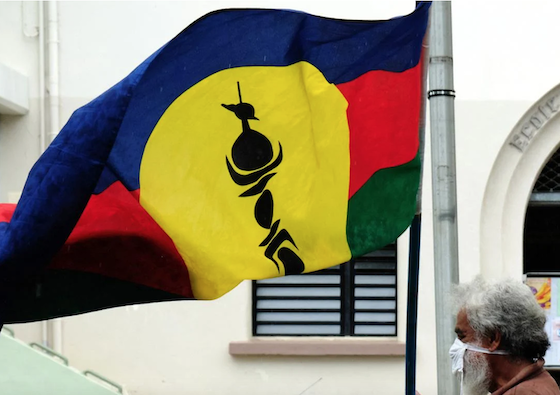
Independence and self-determination in the Pacific ... contrasting
referendum experiences between Bougainville, Kanaky New Caledonia and
West Papua. IMAGE: Screenshot of the Kanak flag in Middle East Eye
THE PACIFIC year has closed with growing tensions over sovereignty and self-determination issues and growing stress over the ravages of covid-19 pandemic in a region that was largely virus-free in 2020.
Just two days before the year 2021 wrapped up, Bougainville President Ishmael Toroama took the extraordinary statement of denying any involvement by the people or government of the autonomous region of Papua New Guinea being involved in any “secret plot” to overthrow the Manasseh Sogavare government in Solomon Islands.
Insisting that Bougainville is “neutral” in the conflict in neighbouring Solomon Islands where riots last month were fuelled by anti-Chinese hostilities, Toroama blamed one of PNG’s two daily newspapers for stirring the controversy.
“Contrary to the sensationalised report in the Post-Courier (Thursday, December 30, 2021) we do not have a vested interest in the conflict and Bougainville has nothing to gain from overthrowing a democratically elected leader of a foreign nation,” Toroama said.
The frontpage report in the Post-Courier appeared to be a beat-up just at the time Australia was announcing a wind down of the peacekeeping role in the Solomon Islands.
The referendum is likely to be seen as a failure,
a capture of the vote by settlers without the meaningful participation
of the Indigenous Kanak people. Pacific nations are unlikely to accept
this disenfranchising of Indigenous self-determination.
In the final results on Sunday night,
96.49 per cent said “non” to independence and just 3.51 per cent “oui”.
This was a dramatic reversal of the narrow defeats in the two previous
plebiscites in 2018 and 2020.
However,
the negative vote in this final round was based on 43.9 per cent
turnout, in contrast to record 80 per cent-plus turnouts in the two
earlier votes. This casts the legitimacy of the vote in doubt, and is likely to inflame tensions.
AFTER three decades of frustratingly slow progress but with a measure
of quiet optimism over the decolonisation process unfolding under the
Noumea Accord, Kanaky New Caledonia is again poised on the edge of a
precipice.
Two out of three pledged referendums from 2018 produced higher than
expected – and growing — votes for independence. But then the delta
variant of the global covid-19 pandemic hit New Caledonia with a
vengeance.
Like much of the rest of the Pacific, New Caledonia with a population
of 270,000 was largely spared during the first wave of covid
infections. However, in September a delta outbreak infected 12,343 people with 280 deaths – almost 70 percent of them indigenous Kanaks.
With the majority of the Kanak population in traditional mourning –
declared for 12 months by the customary Senate, the pro-independence
Kanak and Socialist National Liberation Front (FLNKS) and its allies
pleaded for the referendum due this Sunday, December 12, to be deferred
until next year after the French presidential elections.
FROM Auckland Tāmaki Makaurau in Aotearoa New Zealand to Paris,
France, and from Wellington Te Whanganui-a-Tara to Jayapura and far
beyond, thousands of people across the world today raised the Morning Star flag — banned by Indonesian authorities — in simple acts of defiance and solidarity with West Papuans.
They honoured the raising of the flag for the first time 60 years ago
on 1 December 1961 as a powerful symbol of the long West Papua struggle
for independence.
One of the first flag-raising events today was in Wellington where Peace Movement Aotearoa and Youngsolwara Pōneke launched a virtual ceremony online with most participants displaying the banned flag.
Four months ago Papua New Guinean journalists had been warning about increasing tensions over misinformation about
COVID vaccines and a lack of clear communication from health
authorities. IMAGE: Screenshot Guardian Pacific Project
IN RESPONSE to the escalating COVID-19 coronavirus pandemic in mid-February 2020 came a warning by the World Health Organisation (WHO) Secretary-General, Dr Tedros Adhanom, who declared that “we’re not just fighting an epidemic; we’re fighting an infodemic”. He added that fake news “spreads faster and more easily than this virus” .
The following month, in March 2020, UN Secretary-General António Guterres identified the “new enemy” as a “growing surge of disinformation”.
However, the term “disinfodemic” – which I much prefer – was adopted by the authors of a policy brief for UNESCO to describe the “falsehoods fuelling the pandemic”.
This disinfodemic has been rapidly leading to upheavals in many countries – including in Australia and Aotearoa New Zealand in the weeks with protests, civil disobedience and attacks on health officials, medical staff and frontline workers.
Such assaults and violent confrontations have taken particular nasty turns in some of our neighbouring microstates of the South Pacific – notably Fiji and Papua New Guinea, the largest countries and biggest economies in the region.
Filmmaker and journalist Max Stahl, 66, has died almost 30
years after capturing images of the Indonesian massacre at Santa Cruz cemetery
in the Timor-Leste capital Dili, which helped accelerate the country’s
struggle for independence.
By coincidence, he died on the same day in 1991 as Sebastião Gomes,
the young man who was buried in Santa Cruz and whose death led to the
protest that ended in the Santa Cruz Massacre.
More than 2000 people went to Santa Cruz to pay tribute to Gomes, who
was killed by Indonesian-backed militia in the Motael neighbourhood.
Filmmaker Max Stahl speaking to the 20th anniversary of Pacific Journalism Review in Auckland in 2014. Image: Del Abcede/APR
The atrocity by the Indonesian military was secretly filmed by Max
Stahl and footage smuggled out of the country. International attention
on East Timor dramatically changed as a result.
At the graveyard, the Indonesian military opened fire on the crowd,
killing 74 people at the scene. Over the next few days, more than 120
young people died in hospital from their wounds or as a result of the
crackdown by occupying forces.
Most bodies were never recovered.
Born on 6 December 1954 in the United Kingdom, journalist and
documentary maker Christopher Wenner, better known as Max Stahl, began
his ties to the country in 1991 when he managed to enter East Timor for
the first time.
He became a Timorese citizen in 2019.
Hiding among the graves
On November 12, hiding among the graves of Santa Cruz cemetery, he
filmed the massacre — one of many during the Indonesian occupation of
the country. Images were circulated around the world’s media and this
changed history.
Decorated with the Order of Timor-Leste, the highest award given to
foreign citizens in the country, the Rory Peck Prize for filmmakers, and
several other rewards, Max Stahl leaves as a legacy the main archives
of images from the last years of the Indonesian occupation of the
country.
The archive was adopted by UNESCO for the World Memory Register and
has been used for teaching and research on Timor’s history under the
framework of cooperation between the University of Coimbra, the National
University of East Timor and CAMSTL.
The original 1991 Dili massacre footage by Max Stahl. Video: Journeyman Pictures
Stahl studied literature at the University of Oxford and he was a
fluent speaker of several languages, including the two official
languages of East Timor — Portuguese and Tetum.
He began his career writing for theatre and children’s television
shows. However, he found his calling as a war correspondent when he
lived with his family. At the time his father was ambassador to El
Salvador where Stahl reported on the civil war between 1979 and 1992.
Stahl covered other conflicts such as those of Georgia, former
Yugoslavia and East Timor (from 30 August 1991), where he arrived as a
“tourist” at the invitation of resistance groups.
“The king is dead. With great sadness, I write to inform you that Max passed away this morning.”
— Max Stahl’s wife Dr Ingrid Brucens
Historic resistance leaders
Throughout his long ties to East Timor, where he lived until he had to
travel recently to Australia for medical treatment, he interviewed
historic resistance leaders such as Nino Konis Santa, David Alex and
others.
Santa Cruz and the 12 November 1991 massacre made the name Max Stahl
known internationally with his images exposing the barbarism of the
Indonesian occupation.
In Portugal, the images made a special impact — both through the
brutality of the violence portrayed and because the survivors gathered
in the small chapel of Santa Cruz, praying in Portuguese while listening
to the bullets being fired by the Indonesian military and police.
The 1999 referendum prompted Max Stahl to return to East Timor when
he covered the violence before the referendum and after the announcement
of independence victory. He also accompanied families on the flight to
the mountains.
News of Max Stahl’s death on Wednesday at a Brisbane hospital quickly
became the most commented subject on social media in East Timor,
prompting condolences from several personalities during the struggle for
independence.
In statements to Lusa news agency, former President José Ramos-Horta
described Max Stahl’s death as a “great loss” to Timor-Leste and the
world. He said it would cause “deep consternation and pain” to the
Timorese people.
“Someone like Max, with a big heart, with a great dedication and love
for East Timor … [has been] taken to another world,” he told Lusa.
Dr Ingrid Brucens, Max Stahl’s wife, and who was with him and the children in Brisbane, announced his death to friends.
“The king is dead. With great sadness, I write to inform you that Max
passed away this morning,” she wrote in messages to friends.
Antonio Sampaio is the Lusa correspondent in Dili.


%20Upcoming%20edition%20560wide.png)