Sunday, April 13, 2014

Border ‘butchers’, absentee poll reps and West Papua’s growing strife

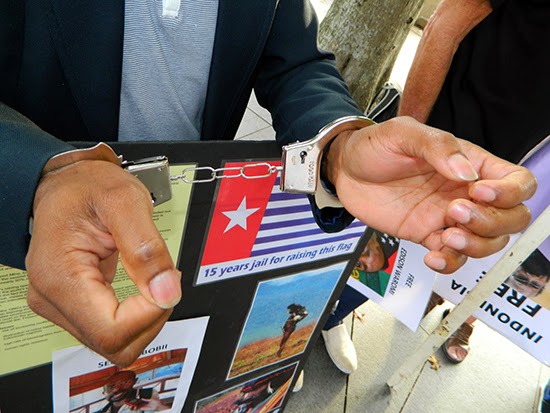
A West Papuan in handcuffs at a recent “Free West Papuans” rally in Auckland. Photo: Del Abcede/PMC
THE INDONESIAN parliamentary elections this week were disappointing on a number of fronts, especially for presidential frontrunner Jakarta Governor Joko “Jokowi” Widodo. His Democratic Party of Struggle (PDI-P) which gained just 19 percent of the vote, was far less than the expected 25 percent. But the presidential vote is not until July.

What about West Papua? What was the fate of representation for the two Melanesian provinces bordering Papua New Guinea this week? Who among the Jakarta hopefuls really have the future of the Papuan region at heart?

Bobby Anderson, one of the rare journalists filing from West Papua, wrote in New Mandala:
In Papua, where state sovereignty and legitimacy is deeply contested, representation matters. So in this national election, who purports to represent Papua?

Candidate residence is one way of sizing up the candidates and the results are telling. Sixty three out of 114 candidates running for the DPR (National House of Representatives) seats in Papua province live within the greater Jakarta area.

Thursday, April 3, 2014

MIDA’s chair finds Fiji TV guilty of ‘hate speech’ and blasts bloggers


Audio podcast of today's media conference with MIDA chairperson Ashwin Raj on YouTube from the Pacific Media Centre.

SO THERE we have it. Fiji’s Media Industry Development Authority chairperson Ashwin Raj is going to stamp out all hate and race speech in his country with the stroke of a decree-backed pen.

A momentous mind shift is going to happen just like that. The media “chilling” climate will ensure this unfolds. He thinks ...

Raj is “quite perturbed by the level of public discourse” in Fiji as the country moves toward the return-to-democracy general election on September 17.

“Masquerading itself as an exercise in freedom of expression, political discourse has, in fact, descended to unabashed racial vilification and in some instances its content is tantamount to injurious or hate speech,” he railed at a MIDA media conference in Suva today.

“What is even more disconcerting is the complicity of select Fijian journalists and media, either wittingly or those that remain oblivious to the laws of Fiji despite several awareness workshops on the Crimes Decree, the Media Industry Development Decree and the Constitution.”

Friday, March 28, 2014

Corruption, illegal tuna fisheries and a ‘lifestyle tsunami’ trouble Pacific business editors


Sean Dorney's presentation ABC report on illegal tuna fishing in the Pacific on 28 October 2013.

HOW IRONIC. For two days this week, veteran Pacific affairs correspondent Sean Dorney from Australia Network was contributing hugely to an inaugural regional business media summit organised by the Asian Development Bank.

His final contribution to the seminar was a rundown on “tunanomics” and how illegal fishing was, for him, the biggest economic story confronting the Pacific.

He punctuated this presentation with an ABC video report from last October which exposed how lack of cooperation by at least six Pacific countries was undermining the Forum Fisheries Agency’s surveillance efforts.
Anthony Bergin, the Deputy Director of the Australian Security Policy Institute, estimates that about US$1.7 billion is lost through illegal and unregulated fishing activity in the Pacific. He’s proposing that the Australian patrol boat programme should not only be a Defence Department commitment but that Australian aid should also contribute to the programme now being developed to replace those 22 patrol boats that Australia has donated to Pacific countries but which are coming to the end of their work life.
No sooner than his fine contribution and the ADB seminar was over, Dorney found himself in the gun again with Fiji media "control freaks" - Dorney's description - who seem determined to use the controversial 2010 Media Industry Development Decree to gag anything deemed to be “un-Fijian”.

Wednesday, March 19, 2014

Parliament soft-pedals over East Timor’s harsh draft media law

East Timorese media ... fears draft media law could lead to censorship.
Photo: Diariu Timor Pos
JOSÉ BELO, Timor-Leste’s celebrated champion of investigative journalism and advocate for a free media, recently vowed he was prepared to go to jail rather than allow his fledgling independent nation muzzle the press.

Belo, 42, publisher of the small yet probing Tempo Semanal online and print weekly, says he won’t give up in the current struggle over the fate of the media.

He has been campaigning against a draconian draft media law over the past few months.

“It’s about the future of our country,” he told Fairfax Media’s Lindsay Murdoch.

But the news about a draft law that is feared could lead to censorship is not getting any better. Since Café Pacific broke this story in early February, the Timorese non-government organisation La’o Hamutuk has been monitoring developments closely – and making quality submissions.

Sunday, March 16, 2014

Lies, media integrity and the new digital environment


Review by David Robie

Stop Press: The Last Days of Newspapers, by Rachel Buchanan (Melbourne: Scribe, 2013)
The New Front Page: New Media and The Rise of the Audience, by Tim Dunlop (Melbourne: Scribe, 2013)

WHEN Rachel Buchanan penned a commissioned article entitled “From the classroom to the scrap heap” for The Age last September, she railed against Australian journalism schools, in particular, over an alleged “lie” and “little integrity” of journalism education.

“Between 2002 and 2012, enrolments in journalism degrees almost doubled,” she noted about what was troubling her across the Tasman. “We now have the bizarre situation where there are more people studying journalism than there are working journalists.”

She concluded that journalism schools were creating false career hopes; Australia didn’t need any more journalists, but needed nurses and doctors, engineers and actuaries and so on.

“Poets, screenwriters, novelists, scribblers – we writers all need a day job now. You can’t eat integrity.”

Friday, March 14, 2014

Australia ‘shockingly close’ to oil companies in discredited Timor treaty


AUSTRALIAN government negotiators were “shockingly close” to the oil companies in a controversial maritime treaty signed with the emerging nation of Timor-Leste in 2006, it is claimed in a new documentary about the recent spy drama that has stirred allegations of industrial espionage by Canberra.

The ABC Four Corners investigation, “Drawing The Line”, by Marian Wilkinson and Peter Cronau, will be broadcast on Monday night.

It provides fresh insights into Australian national security in the Asia-Pacific region in the post-Cold War environment.

“Do governments too freely use espionage for economic advantage? And is it in the national interest?” asks the investigation.

Earlier this month, a ruling by the International Court of Justice banning Australia from using documents seized during a controversial intelligence raid on the Canberra home of Timor-Leste’s Australian-based lawyer was hailed as a David-versus-Goliath victory by Australia’s neighbour.

Friday, March 7, 2014

Libération newspaper now fighting for its own ‘liberation’

Not a "brand" ... 40 years of Libération on display in a gallery near les Halles, Paris,
last October. Photo: David Robie

By DAVID ROBIE
JEAN-PAUL SARTRE would have turned in his grave over the fate of his cherished daily newspaper.

Founded by Sartre and Serge July more than four decades ago in the aftermath of the 1968 student riots in Paris, the left-leaning Libération has fallen on hard times.

But the company’s new shareholders came up with a plan to rescue it that has been greeted with derision by staff.

Founded on a non-conformist editorial policy that shunned commercialisation, the paper’s headquarters would be turned into a multimedia cultural centre, with a bar, restaurant, a TV studio and a social network “hub”.

This new proposal followed failed negotiations to put the Libération’s online edition behind a paywall.

Wednesday, March 5, 2014

Vanuatu PM’s speech spotlights Indonesian Papuan atrocities and Pacific ‘blind eye

Vanuatu Prime Minister Moana Carcasses Kalosil (left) with Papuan journalist
Victor Mambor in Noumea. Photo: Tabloid Jubi
By DAVID ROBIE

SHAME on New Zealand politicians. With the courageous exception of the Green Party’s Catherine Delahunty, most of the rest offer a shameful silence over Indonesia’s human rights violations in West Papua.

The Melanesian brothers and sisters of the colonised region, forcibly invaded by Indonesian paratroopers in 1962 and annexed under the fraudulent United Nations “Act of Free Choice” in 1969, have suffered under Indonesian atrocities and brutal rule ever since.

But it took the Prime Minister of Vanuatu,  Moana Carcasses Kalosil, to take the podium at the United Nations Human Rights Council and condemn Jakarta for its past and ongoing crimes in West Papua, before the world took notice.

This not only shames New Zealand, it also exposes most Pacific leaders for their lack of spine over Papuan human rights.

When Vanuatu became independent from the British and French joint colonial condominium, better known as “pandemonium”, in 1980, founding Prime Minister Father Walter Lini was a champion for West Papuan independence.

Monday, March 3, 2014

Struggle for editorial independence at Noumea daily as Kanaks await promised referendum

Protesters supporting editorial independence for Les Nouvelles Calédoniennes say:
"Yes to information - No to propaganda!" Photo: NC Journalists Facebook
FEARS last year that drove journalists working for New Caledonia's only daily newspaper to go on strike have been borne out. At the time, journalists were worried about what would happen when Les Nouvelles Calédoniennes faced resale last April with a loss of journalistic independence.

According to Economist and Pacific Scoop reports, they wanted any new owners to sign an agreement guaranteeing their freedom.

The paper was being bought by New Caledonian business interests with reportedly close links to the territory's pro-French, anti-independence political forces. 

This followed the sale of the paper in December 2012 by its owners, Groupe Hersant Media, to a group including French businessman Bernard Taipe, which snapped up several newspapers across France and its overseas territories.

Since last May 17, when the assets were finally transferred to New Caledonian ownership,  Les Nouvelles Calédoniennes has been controlled by three local business interests.

Friday, February 28, 2014

A 'Pacific brand' of journalism? A forthcoming media book tells how

ADVOCATES, campaigners,  journalists and researchers gathered at New Zealand's AUT University today to honour past campaigns for the Nuclear-Free and Independent Pacific Movement (NFIP) and to strategise for the future.

Panel presentations ranged from the US Castle Bravo nuclear test on Bikini Atoll in 1954 - today, March 1, was the 60th anniversary - to the Rongelap Atoll evacuation by Greenpeace in May 1985, the protests against French nuclear testing, the ICAN campaign to abolish all nuclear weapons, the "forgotten struggle" in West Papua, and to the future self-determination vote in Kanaky.

Delegates were also told about a new book being published next month about NFIP issues and journalism - Don't Spoil My Beautiful Face: Media, Mayhem and Human Rights in the Pacific by Pacific Media Centre director and Café Pacific publisher David Robie.

What commentators say:

David Robie has been committed to developing quality journalism in the Pacific, and especially in developing a “Pacific brand” of journalism.
Kalafi Moala, Pasifika Media Association (PASIMA)

Tuesday, February 25, 2014

Fighting for East Timor's right to free expression and information for everybody, not just journalists

La'o Hamutuk ... submissions for free speech and the right to information
for everybody in Timor-Leste. Photo: David Robie
EARLIER this month Café Pacific published two commentaries on the draconian proposed media law for Timor-Leste and why journalists are up in arms about it. They were republished on Pacific Scoop.

But it isn't only journalists who are concerned, non-government organisations that often carry out independent investigations on issues that local media don't have the resources to tackle are also upset.

It is the narrow definition of "journalists" and freedom of information for the public at stake. One of the provisions essentially gags freelance and independent journalists, and also foreign correspondents are blocked as the draft currently stands.

The International Federation of Journalists has issued a statement criticising the draft law and Reporters Sans Frontières is believed to be sending a letter to the Timorese legislators reviewing the draft law.

On February 19, Committee A of Timor-Leste's Parliament invited La'o Hamutuk and the HAK Association to present and discuss our views.

Sunday, February 23, 2014

‘Scapegoat Season’ at USP fails to hide achievements


By DAVID ROBIE

SO it’s Scapegoat Season again at the University of the South Pacific journalism programme. Barely more than a year has elapsed since the last incumbent was dumped as head.

Dr Ian Weber ... out the USP
"revolving door". 
Photo: Jay Folio blog
And now Australia-based Dr Ian Weber, a colleague of his predecessor, has shot out the “revolving door”, as Fijileaks put it. He apparently resigned the same week as the journalism classes were supposed to start for the year.

His litany of complaints about the USP establishment is much the same as many coordinators have expressed in the past, in private if not always publicly – “favouritism, lack of consultation and unethical pressure” plus general lack of support.

So what’s new? Well, this time Dr Weber has launched into an extraordinary and unfounded personal attack on his distant colleague, a local Fiji Islander who is well on the way to becoming the first Pacific Islands media educator at the regional university with a doctorate in journalism.

And Shailendra Singh, a former editor of the Fiji news magazine The Review who has put in far more of the hard yards for the benefit of Fiji and Pacific journalism over the past decade than any expatriate fly-by-nighter, is not even on the Laucala campus in Fiji.

Tuesday, February 18, 2014

'Protect our reporters' - radio interview on The Wire


REPORTERS all over the planet die to tell stories. From the Philippines where journalists were massacred in Maguindanao on the southern island of Mindanao in 2009, to Mexico where journalists families are targeted with threats of torture.

The Pacific is a far cry from these situations yet only one Pacific country made it to the top 10 in press freedom for 2014 - New Zealand at ninth.

This is not a one off occasion. In 2013, the situation occurred where New Zealand was also the only Pacific country in the top 10. 

Australia was 28th in the 2014 index.

The highest placed Pacific Islands country was Samoa, ranked 40th, closely followed by Papua New Guinea at 44.

Saturday, February 15, 2014

Fiji in from the cold - and courted for the asylum seekers ‘Pacific Solution’


THE AUSTRALIAN yesterday featured an “historic come-in-from-the-cold” meeting in Suva between Foreign Minister Julie Bishop with Fiji military-backed regime chief Voreqe Bainimarama in a report by Asia-Pacific affairs editor Rowan Callick.

She revealed to Bainimarama that the past 56 requests for exemptions under the relaxed travel sanctions policy had been granted (except for one on a technicality), with Callick summing up the “warm” meeting like this:
In the Coalition’s most decisive step away from the foreign policy position of the Rudd-Gillard years, it is restoring links with Fiji across the whole of government, including, crucially, defence ties.

Ms Bishop’s meeting with Commodore Bainimarama went for an hour, running overtime.
According to Callick’s report, Fiji’s Foreign Minister, Ratu Inoke Kubuobola, has been "to Australia often, and the government’s second most powerful figure, the Attorney-General, Aiyaz Sayed-Khaiyum, was allowed to travel to Australia over Christmas". Callick wrote:

Thursday, February 13, 2014

Harassment of The Guardian causes UK drop in press freedom index rankings

The Guardian offices ... harassed over intelligence leaks.
Photo: Bethany Clarke/Greenslade Blog
From the Greenslade Blog and Reporters Without Borders

THE UNITED KINGDOM has slipped three places down the World Press Freedom Index rankings this year - to 33rd.

According to the global media watchdog Reporters Without Borders (RSF) in its report this week, this was due to the country "distinguishing itself by its harassment of The Guardian" following its publication of the NSA and GCHQ leaks by the whistleblower Edward Snowden.

That incident, and the White House administration's reaction to the Snowden affair and the jailing of Chelsea Manning over the Wikileaks revelations, also resulted in the United States falling by 13 places to 46th in the list.

RSF remarks: "The hunt for leaks and whistleblowers serves as a warning to those thinking of satisfying a public interest need for information about the imperial prerogatives assumed by the world's leading power."

Major declines in media freedom were recorded in Central African Republic and Guatemala but RSF also pointed to marked improvements in Ecuador, Bolivia and South Africa among the total of 180 countries.

Tuesday, February 11, 2014

East Timor journalists form press union as concerns mount over draft media law

Timorese journalists check out their stories in two of the daily newspapers while
waiting for a media conference in Dili. Photo: David Robie
By DAVID ROBIE

TIMOR-LESTE Press Club has this week transformed itself into the fledgling Timor-Leste Press Union and now seeks to become affiliated to the Brussels-based International Federation of Journalists.

It is also seeking collaboration with the National University of Timor-Leste (UNTL) to establish a training programme for journalists in the industry.

These are just two of the current moves by journalists in response to mounting concern over a proposed media law that some fear may curb a free press in the country.

While journalists are worried about the legislation, some are reluctant to openly condemn it. Timor-Leste ranked 77th in the latest 2014 Reporters Without Borders World Press Freedom Index report.

Timor-Leste Press Union president Jose Belo, the country’s best known investigative journalist and publisher of the independent Tempo Semanal, has confirmed the new status of his journalists advocacy group and says he is concerned over “government control” of media.

Exposing the Invisible - digital technology for social justice

Unseen War ... one of the trilogy of Exposing the Invisible films.

By DAVID ROBIE

IN A remarkable “before we are launched” event organised by the fledgling Sydney Democracy Network in one of Australia’s oldest lecture theatres, a digital technology collective has demonstrated dramatic and progressive examples of the global “information war”.

The Berlin-based Tactical Technology Collective co-founders, Stephanie Hanley and Marek Tuszynski, treated a packed theatre at Sydney University to a smorgasbord of video and technology at the forefront of ground-breaking social justice information collaborations.

The video Unseen War was an inspiring and provocative investigation into the use of drones for illegal targeting killings in Pakistan’s Tribal Areas bordering Afghanistan – far from the glare of media publicity.

An estimated 2500-3500 civilians have been killed in this “unseen war” through drone attacks on urban areas.

Twelve journalists have also been killed in the past decade, many as a result of investigating these targeted killings.

Friday, February 7, 2014

Timor-Leste's media law ‘secrecy’ lifted, but draconian content revealed

East Timorese journalists at work ... no more freelancers
under the draft media law? Photo: David Robie
By DAVID ROBIE

THE PROPOSED Timor-Leste media law is a draconian mixed bag. And it is ironical that such a document with lofty claims of protecting the freedom of the press should be shrouded in secrecy for the past six months.

After being approved by the Council of Ministers last August 6, it has languished in the “don’t touch” basket since then, apart from a critical airing at a conference on the state of the media last October.

And then suddenly, with few copies of the document being in circulation previously, a hurried “consultation" was held with journalist representatives this week. A journalists' submission is expected by Parliamentary Committee A by Monday.

But other people with a stake in the future of media regulation – such as academics, bloggers, book publishers, non-government organisations, political commentators and media users themselves – haven’t yet had a chance to give any input.

While the document contains an interesting attempt to define “duties” of journalists in an evolving new democracy such as Timor-Leste and professes to support freedom of information and the right to be informed, in reality many clauses seek to effectively gag the press and debate.

Thursday, February 6, 2014

'Pak' Prabowo seeks to 'clear' his name over Timor atrocities allegations in media jousting

Beatriz looks for her husband among the bodies after the 1983 Kraras massacre, as portrayed in
Beatriz's War, East Timor's first feature film.

By DAVID ROBIE

INDONESIAN presidential hopeful ‘Pak” Prabowo, the retired Kopassus general notorious for his alleged human rights violations in Timor-Leste, has finally broken his silence and made a statement to the Jakarta Post denouncing a recent article about his past as “scurrilous allegations”.

Yet his odious record speaks for itself.

He claims in an open letter that allegations about his actions three decades ago, notably the massacre in August 1983 in Kraras - now known as the “village of widows",  were "based on unproven allegations, innuendos and third-hand reports".

What was he forced to reply to? Journalist Aboeprijadi Santoso, a contributor  to The Jakarta Post writing from the safety of Amsterdam, had written an article entitled: “Whatever happened in Kraras, Timor-Leste, ‘Pak’ Prabowo?”
Timor-Leste soldiers and young citizens paying homage
to the Kraras  massacre victims in 2013.
Photo: David Robie

He was referring to the massacre that has been immortalised in Beatriz's War, the harrowing new film about the Timorese struggle for independence from Indonesia, especially telling the story from a woman's perspective.

Heroine Beatriz (a composite character created from real life people) was a survivor from the Kraras massacre. Prabowo is depicted as being responsible for many human rights atrocities in the film.

Santoso recently described Prabowo as one of the “most interesting – and most controversial” presidential hopefuls in the Indonesian elections due in July because he has reinvented himself as an anti-corruption campaigner. 

Sunday, February 2, 2014

Timor-Leste’s Max Stahl – documenting the audiovisual and development ‘war’

Filmmaker and digital historian Max Stahl with an image from his 1991 Santa Cruz
massacre footage in Timor-Leste. Photo: David Robie
By David Robie

A YEAR after Indonesian troops killed more than 270 peaceful demonstrators at the cemetery of Santa Cruz in the Timor-Leste capital of Dili in 1991, news footage secretly shot by a cameraman surfaced in a powerful new film.

The Yorkshire Television documentary, In Cold Blood: The Massacre of East Timor, screened in six countries and later broadcast in other nations, helped change the course of history.

Until then, countries such as Australia and New Zealand – in spite of a New Zealander being killed in the massacre – had been content to close a blind eye to the illegal Indonesian invasion in 1975 and the atrocities committed for a quarter century.

The cameraman, Max Stahl, who risked his own life to film the massacre and bury the footage cassette in a freshly dug grave before he was arrested, knew this evidence of the massacre would be devastating.

In a documentary made a decade later by Yorkshire Television’s Peter Gordon, Bloodshot: The Dreams and Nightmares of East Timor, that interviewed key players –including Stahl himself - in the transition to restored independence in 2002, Timorese leaders reveal just how critical this footage was in telling their story of repression to the world.

>>> Popular Café Pacific Posts