Thursday, September 12, 2013

Indigenous leaders from Australia, West Papua meet in secret at sea

Photo: West Papua Freedom Flotilla

From the West Papua Freedom Flotilla

EVADING the Indonesian navy, two tiny boats met near the Australia-Indonesia border to ceremonially reconnect the indigenous peoples of Australia and West Papua.

The ceremony was the pinnacle of a 5000km journey beginning in Lake Eyre, in which sacred water and ashes were carried and presented to West Papuan leaders.

While the Freedom Flotilla’s flagship, The Pog, sailed towards West Papua, the world watched its progress via a live satellite tracker onboard the vessel, providing a much needed distraction for the clandestine ceremony to take place in an undisclosed location off the south coast of Papua.

The cultural exchange of Indigenous elders was held in secret, due to threats made by Indonesian government ministers and military officials who had stated that the navy and air-force would “take measures” against the peaceful protest, and had not ruled out the use of lethal force.

Soon to be Australian Foreign Minister Julie Bishop had also stated that Indonesia may do “whatever it wishes” to stop the peaceful protest.

Wednesday, September 11, 2013

Say fromage! AFP 'self-censorship row' highlights thin-skinned politicians

A visitor takes a picture of the artwork entitled "Travesty" depicting Valdimir Putin
and Dmitry Medvedev at an exhibition in St Petersburg, 15 August 2013. Photo: IOC/R
By Milana Knezevic of Index on Censorship/IFEX

FRENCH news agency AFP has been caught up in a self-censorship row after attempting to retract a photo of President Francois Hollande flashing a gormless smile. The whole debacle has gone viral, forcing AFP to make a statement denying they had caved to government pressure.

Rather, they cited internal editorial guidelines "not to transmit images that gratuitously ridicule people". However, politicians are not strangers to banning (or trying to ban!) images that make them look a bit silly.

You'd think that Vladimir Putin, used to being in the public eye, captured in completely random and non-staged situations like this, wouldn't mind being the inspiration for some fine art.

That turned out not to be the case when a St Petersburg gallery exhibited a painting of Putin and PM Dmitry Medvedev - the former sporting a fetching pink negligee, the latter a black lace push-up bra.

Russian police raided the gallery and removed the picture in question, as well as three others depicting Russian political leaders. The reason given was that the images 'violate existing legislation'.

Tuesday, September 10, 2013

Damning indictment of nuclear testing in the Pacific


Nuclear Exodus - Rongelap Islanders on board the Rainbow Warrior. Photo/video: David Robie

Flashback to 1987: NUCLEAR EXODUS: THE RONGELAP EVACUATION

The legacy from US nuclear testing in the Marshall Islands has provided a media backdrop to last week's 44th Pacific Islands Forum in Majuro. Here is a short documentary made by David Robie and his Aroha Productions team and broadcast by Television New Zealand.

The item was published in the New Zealand Listener as a documentary preview on 2 May 1987 before the film was screened on TVNZ's Tagata Pasifika:

By Pamela Stirling, editor of the NZ Listener

The Rongelap Islanders of Micronesia have been described as the first victims of World War Three.

Many of them remember March 1, 1954, as the day it "snowed" on their atoll, as deadly fallout dusted down from a 15 megaton thermonuclear test, codenamed Bravo, held on Bikini Atoll.

Since then Rongelap people have suffered leukaemia deaths, cancers, thyroid tumours, miscarriages, deformed children and births described as "jellyfish" babies.

A noted American researcher has predicted that everyone who was aged under 10 when the contamination occurred will die of cancer.

This award-winning, 12-minute film tells the story of their contamination, and of their evacuation three decades later by the peace ship Rainbow Warrior to Mejato Island, 150 km away. Scripted and co-produced by Pacific affairs writer David Robie, Nuclear Exodus is a damning indictment of the nuclear machine.

Monday, September 9, 2013

French rugby success gives hope to the marginalised


Mourad Boudjellal  ... the 'rugby emperor' of Toulon, champion of European rugby
and of the French marginalised. Photo: sarugbymag.com

By COLIN RANDALL of The Nation

On the morning after the French rugby club Toulon won Europe's Heineken cup final in May, the club's owner, Mourad Boudjellal, depicted the victory as a source of pride for people, like him, of immigrant

Aiming his remarks at Marine Le Pen, the leader of the far right, anti-immigrant Front National, Boudjellal, the son of an Algerian father and Armenian mother, said: "Let's hope Marine takes note.

"When access to culture and knowledge is given to the children of immigrants and they are trusted, they get to do a few things for their country and city," he told the French television channel BFMTV.

"When you do not hold them back, they can do good things."

As François Hollande launches his initiative to alleviate unemployment, poverty, poor housing and crime in the shabby suburbs where much of the immigrant community lives, he arguably needs such role models to show success in life, from modest beginnings, is possible.

Tuesday, September 3, 2013

Fossil fuel industry 'needs to back down - not the Pacific' on climate change


Pacific Media Watch contributing editor Daniel Drageset interviews Marshall Islands Journal editor
Giff Johnson in Majuro.

By Michael Sergel of Pacific Scoop and the AUT journalism programe

CLIMATE CHANGE is top of the agenda in Majuro as the Pacific Islands Forum meets for the 44th time.

The Marshall Islands is calling for strong committed action on preventing and responding to climate change, as it welcomes delegates from 16 member states (minus suspended Fiji) to the renewable village that will play host to the next four days of talks.

Marshall Islands Forum Minister Phillip Muller said the Majuro Declaration was about “tangible action” rather than a “you-go-first” approach to climate policy.

“In the Pacific, we cannot afford to wait. We want the Forum to set the stage for a new, bolder approach,” he wrote in a Washington Post op-ed in June.

“We call on not just governments but also intergovernmental organisations, the private sector and civil society to sign on to our declaration with their own measurable commitments aimed at averting a climate catastrophe.”

Tuesday, August 27, 2013

PNG money laundering - 59 charged over corruption, alleges Today Tonight


By James Thomas of Today Tonight


Billions of dollars in foreign aid going to PNG are being siphoned off by corrupt politicians and officials - and into Aussie companies.

The Australian property market, casinos, and the banks are playing host to millions of dollars in foreign aid allegedly being siphoned off by corrupt Papua New Guinea politicians and officials.

The money trail ends up in Australian companies, caught up in the multi-million dollar corruption ring.

Sam Koim, head of PNG's Anti-Corruption Task Force, is on a mission to lift the lid on billions of dollars of dirty money leaving PNG to be laundered in Australia.

About 59 people have already been charged with corruption offences in PNG, and it is alleged much of their illegally obtained money is spent in Cairns.

Koim says Australia contributes about $500 million to the PNG budget, and 40 percent of that budget is lost to corruption annually.

Friday, August 23, 2013

West Papua activists will 'rot in jails' if Freedom Flotilla not helped

Aboriginal elder Kevin Buzzacott in silhouette with the West Papuans' Morning Star
- banned by Indonesian authorities - and Aboriginal flags on
the West Papua Freedom Flotilla.
CAMPAIGNERS on board the West Papua Freedom Flotilla will ‘rot in jail’ if the Australian government doesn't help them if they get into trouble, says Aboriginal elder Kevin Buzzacott.

The objective is “to free our brothers and sisters up there with all the bad stuff that’s happening”, Buzzacott says in an exclusive audio interview on YouTube with the Pacific Media Centre's Daniel Drageset, reporting for Pacific Media Watch and Pacific Scoop.

The flotilla has gathered a range of pro-independence campaigners on the journey going from Lake Eyre in northern South Australia, via New South Wales and the Queensland coast, across the Torres Strait to Daru in Papua New Guinea and finally Merauke in West Papua, where the flotilla is scheduled to arrive early next month.

Australian Foreign Minister Bob Carr says Australian authorities have informed the Freedom Flotilla that local laws and penalties will apply in Papua New Guinea and Indonesia.

“We’ve given them this warning. Therefore, should they end up in prison as a result of breaching the law of Indonesia or Papua New Guinea we’ve got no obligation to give them consular support,” Carr said, according to news.com.au.

Wednesday, August 14, 2013

Sneak preview on Solomon Islands documentary in progress - help needed


By Tarcisius Tara Kabutaulaka


THIS is a sneak preview of a documentary about the Solomon Islands conflict that Larry Thomas from Fiji and I have been working on for years.

We started filming in early 2003, prior to the deployment of the Regional Assistance Mission to Solomon Islands (RAMSI). We went back and did more filming after the RAMSI intervention.

We are now in the editing stage and looking for funds to complete the film. If you have ideas on where and how to access funds to complete this important film, please let me know.

This film will contribute a lot to the history of the Solomon Islands conflicts and the aspirations of Solomon Islanders.

In filming, we travelled to Malaita, Western Solomons and around Guadalcanal.

Friday, August 9, 2013

'Cry Freedom: Mandela's Legacy' - new Peter Cronau investigation on ABC

Cry Freedom: Mandela's Legacy. Photos by Louie Eroglu/ACS
Four Corners TV report by Matt Carney and Peter Cronau

NELSON MANDELA promised a South Africa based on freedom and equality. But as the country's former leader lies in hospital critically ill, the nation he fought to create is slowly disintegrating.

Violence is commonplace, unemployment is out of control and the ruling ANC government is accused of rampant corruption.

Next on Four Corners reporter Matthew Carney goes to South Africa to try and understand the forces that threaten to pull the "rainbow nation" apart. What he finds after nearly 20 years of ANC in government is a tiny black elite have enriched themselves at the expense of a poor black majority.

For the poor not much has changed... 18 million people live on less than $2 a day.

The Marikana mine massacre illuminates the massive contradictions and difficulties confronting the country.

On 16 August last year, 3000 miners gathered to protest substandard wages. The police opened fire killing 34 people and wounding another 78.

Thursday, August 8, 2013

Café Pacific now on YouTube

A NEW VIDEO channel has been opened by Café Pacific on YouTube with a variety of Pasifika media, human rights and environmental resources. Find it here.

Media academic seeks stronger journalism empowerment over climate change


The Hungry Tide, one of the documentaries featured in Professor David Robie’s Suva paper on Pacific journalism’s own challenges of adaptation to environmental changes. Trailer: Ronin Films

By Sherita Sharma in Suva

A former USP academic says global environmental challenges – especially in the Pacific region – give the opportunity for deliberative journalism to help Pacific communities become empowered.

At a symposium organised during the recent 12th Pacific Science Inter-Congress, Professor David Robie, based at the Auckland University of Technology and a former head of USP Journalism, talked about a variety of issues stemming from the challenge of environmental reporting in the Pacific.

In his presentation, Deliberative journalism, environmental risk and media credibility, Dr Robie explored traditional media values and Pacific journalism’s own challenges of adaptation to environmental changes.

Deliberative journalism is issues-based reporting, and looking at daily news as issues and not merely events.  In the Pacific context, reporting on environmental issues such as climate change have become more prevalent, with countries such as Kiribati and Tuvalu bearing the brunt of these global challenges.

Dr Robie was speaking at a parallel social sciences symposium entitled “Oceans and Islands: ‘Failed states’ and the environment in the Pacific”.

Sunday, August 4, 2013

Behind The Shroud - Ahmed Zaoui case exposé finally on TV


By Selwyn Manning

BEHIND THE SHROUD:
Tonight for the first time on New Zealand television the public will be told why and how the Security Intelligence Service (SIS) got the Ahmed Zaoui case so wrong. What can we learn from those mistakes?

Should the SIS, GCSB and our intelligence aparatus undergo significant reform? This documentary explains what the government refused to reveal.

FaceTV Sky channel 83 @ 8pm.

Behind The Shroud reveals for the first time secret testimonies of witnesses who appeared before the Inspector-General of Intelligence and Security’s secret hearings into the Ahmed Zaoui case.

This testimony is highly relevant today as we all debate how we as New Zealanders can all take a role in resisting gross abuses against our civil liberties and the excessive use of the state’s intelligence agency powers.

Friday, August 2, 2013

Australia complicit in PNG's Bougainville blight


Pacific conflict: Associate Professor Tarcisius Kabutaulaka, of the University of Hawai'i, and others speak about conflict and transition. How can conflict-affected countries break cycles of violence, low trust or weak institutions? A Praxis panel seminar series.

OPINION by Ellena Savage of Eureka Street

THE PNG Solution is in breach of international law. It doesn't serve the best interest of the asylum seekers it will affect.

And Australia's Department of Immigration and Citizenship is taking grossly insufficient responsibility for the safety and security of its detainees on Manus Island.

But the PNG Solution is just another in a long line of "border control" solutions which are in breach of legality and morality. There is nothing new about it.

Much has been made of PNG's poverty and gender-based violence, but even more disturbing is its military and police human rights record.

Evidence of abuses in the form of a military blockade, massacres, rape and torture during the Bougainville Crisis, the civil war that spanned the 1990s, are well-documented.

Wednesday, July 31, 2013

Powerful documentary on NZ military in Afghanistan poses tough questions


AWARD-WINNING filmmakers Annie Goldson (Brother Number One, An Island Calling), and Kay Ellmers (Canvassing the Treaty, Polynesian Panthers) present the feature version of He Toki Huna: New Zealand in Afghanistan.

It will be screened - full-length - for the first time at the New Zealand International Film Festival on Sunday.

Originally airing in a broadcast version on Māori Television, the film has been extended adding substantial more content.

Following non-embedded journalist Jon Stephenson into Afghanistan, the documentary discusses the role and legacy New Zealand troops have played in that beautiful war-torn country.

Revelations have surfaced that Stephenson was spied upon by US agencies while he was working in Afghanistan, and that as an investigative journalist, he was called a "subversive" by New Zealand's own Defence Force gives the film a currency - even urgency - begging the question of what the role of the media is within our democracy.

Using a range of Kiwi and Afghan voices, He Toki Huna asks why New Zealand became involved in the war, why it stayed so long, and why the public have learned so little.

He Toki Huna challenges the rosy picture presented by most media reports, which have side-stepped the realities of combat and death in a conflict that has dragged on for 10 years.

Jake Bryant's footage captures the extraordinary landscapes of Afghanistan.

Monday, July 29, 2013

NZ Defence Force’s paranoia about journalism 'subversives'

Cartoon source: Bryce Edwards blog
By Gordon Campbell on Scoop

IF THE thousands of people who marched on the weekend against New Zealand's Government Communications Security Bill (GCSB Bill) wanted further justification for their concerns, the Defence Force has just provided it with bells on.

The mindset that treats journalists as being threats to security on a par with foreign hostiles, activist groups, criminal hackers and dishonest staff is an excellent illustration of why the surveillance powers bestowed by the Bill are so dangerous.

A Defence Force that treats the normal querying of the status quo by the Fourth Estate as being essentially treasonous in nature, has gone off the reservation, and is out of control.

Give it the power to do so, and such an organisation will readily use the surveillance powers in the GCSB Bill to substantiate its persecution complex.

It is already doing so. This isn’t just a theoretical danger, glimmering somewhere off in the future.

Sunday, July 28, 2013

French nuclear tests 'showered vast area of Polynesia with radioactivity'

The French Licorne thermonuclear test at Moruroa Atoll on 3 July 1970. Photo: CTBTO
Flashback to a story earlier this month: Declassified papers show extent of plutonium fall-out from South Pacific tests of 60s and 70s was kept hidden, reports French paper

By Angelique Chrisafis in Paris for The Guardian

FRENCH nuclear tests in the South Pacific in the 1960s and 1970s were far more toxic than has been previously acknowledged and hit a vast swath of Polynesia with radioactive fallout, according to newly declassified Ministry of Defence documents which have angered veterans and civilians' groups.

The papers, seen by the French paper Le Parisien, reportedly reveal that plutonium fallout hit the whole of French Polynesia, a much broader area than France had previously admitted. Tahiti, above, the most populated island, was exposed to 500 times the maximum accepted levels of radiation. The impact spread as far as the tourist island, Bora Bora.

Thousands of veterans, families and civilians still fighting for compensation over health issues have insisted France now reveals the full truth about the notorious tests whose impact was kept secret for decades.

From 1960 to 1996, France carried out 210 nuclear tests, 17 in the Algerian Sahara and 193 in French Polynesia in the South Pacific, symbolised by the images of a mushroom cloud over the Moruroa atoll.

Friday, July 26, 2013

NZ protesters condemn GCSB ‘spy bill’ and spooks centre with Pacific targets

A young mother with a ‘nothing to hide’ placard during the ‘spy bill’
protest in Auckland today. Image: Del Abcede/PMC
Thanks to the Pacific Media Centre's report on Pacific Scoop

THOUSANDS of protesters took to the streets in New Zealand today to demonstrate against a government communications agency accused of spying on Pacific nations, including Fiji, and proposed law giving it greater powers to spy on NZ citizens.

More than 1000 people protested in central Auckland outside the Town Hall, including internet millionaire Kim Dotcom who is a vocal opponent of NZ's Government Communications Security Bureau (GCSB).

Big crowds gathered in protest staged in 11 other cities and downs against Prime Minister John Key's proposed "spy bill", which would give extra powers to the GCSB.

The legislation is likely to be passed in Parliament after United Future's Peter Dunne confirmed earlier this week that he would back the controversial bill after changes that have been widely condemned as "window-dressing".

Once passed into law, the bill would extend the powers of the GCSB to allow it to provide information for the New Zealand Police, Defence Force and the Security Intelligence Service.

Tuesday, July 23, 2013

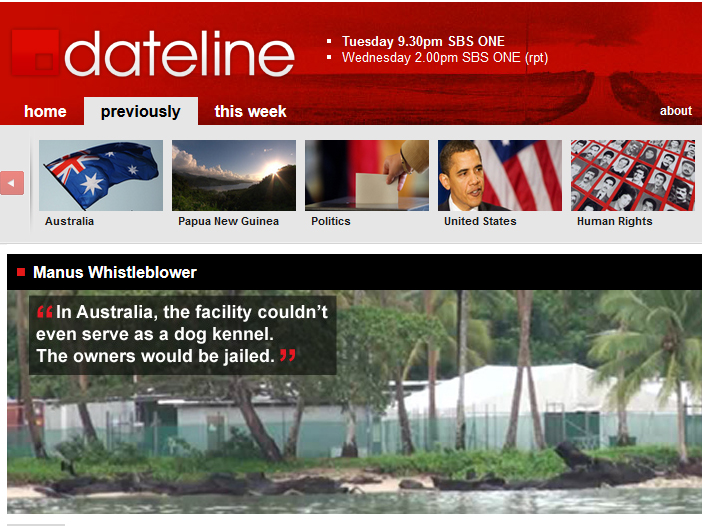
The horrors of PNG's Manus Island - by a whistleblower


TONIGHT'S SBS Dateline programme has an exclusive insight - Manus Whistleblower - into the horrors of life within Australia’s refugee centre at Manus Island in Papua New Guinea.

Reporter Mark Davis speaks to a detention centre whistleblower, who has explosive allegations of detainees being sexually abused and tortured by other asylum seekers.

With no facilities to segregate or remove the abusers, Mark hears of the desperation for those continually being abused while waiting months for their asylum applications to be processed … attempted suicides and self-harming are said to be an "almost daily" occurrence.

The allegations come as the Australian government announces all asylum seekers arriving by boat will be processed and resettled in Papua New Guinea, with the Manus centre to be expanded.

Dateline's whistleblower interview follows Mark’s disturbing story two months ago about life at Manus Island, when Australian officials at the detention centre went to great lengths to stop him filming.

Monday, July 22, 2013

A ‘dirty war’, NZ military cover-up and the vindication of a journalist


 Trailer for the Jeremy Scahill film Dirty Wars about the hidden truth over America's covert wars.

INDEPENDENT investigative journalist Jon Stephenson called it a “moral victory”. The Herald on Sunday described it as a “vindication” in an editorial.

And for many New Zealand journalists it was a humiliation of the military even before the defamation case was over.

Although the jury couldn’t make up its mind on whether it was defamation, the NZ Defence Force chief, Lieutenant-General Rhys Jones, had already conceded the factual issues, the smear webpage against Stephenson had been removed and the military had pledged to make public statement accepting the journalist’s version of events in his reports of New Zealand’s role in the “dirty war” in Afghanistan.

An independent journalist had taken on the might of the Defence Force with its battery of lawyers and legal resources – and won.

Jon Stephenson’s credibility was intact, the Defence Force’s credibility in tatters. But at what price?

Saturday, July 20, 2013

Is Australia's new Asia-Pacific asylum policy the harshest in its history?

Australian protesters rail against the new Rudd asylum-seekers policy outside the
Sydney Town Hall today. Photo: Peter Boyle/Socialist Action
FOLLOWING Australian Prime Minister Kevin Rudd's announcement, asylum seekers who arrive in Australian waters by boat will no longer have the chance to be settled in Australia.

Instead, asylum seekers arriving by boat will be held in an expanded facility at Papua New Guinea's Manus Island and those who are found to be genuine refugees will be settled in PNG under a surprise agreement with the Peter O'Neill government in Port Moresby.

Announcing the changes yesterday, Rudd admitted it was "a very hardline decision".

 Protests in Sydney greeted the new policy.

The Conversation spoke to three policy analysts for their response to Rudd's announcement:

ALISON GERARD, senior lecturer in justice studies at Charles Sturt University, Bathurst: Prime Minister Kevin Rudd's "Pacific Solution #3" is irreconcilable with our international refugee obligations. Like other proposals put forward by this government, it is likely to be robustly contested in court as a breach of basic human rights.

Rugby - sorry, football's - Le Choc match more than crunch charity winner

Toulon's Pierrick Gunther tackles Olympique Marseille's Mathieu Valbuena
in the hybrid football/rugby charity match. Photo: AFP
SURELY this could only happen in France. And with the balmy Mediterranean air massaging the brain. Olympique Marseille, one of France's top football teams, has defeated European rugby champions Toulon in a a hybrid rugby/football charity match by - yes, one point.

And then as a side-piece of entertainment, co-referee Eric Cantona showed why he is "still the king" by lobbing over a trick rugby penalty goal that scraped the crossbar.

The other co-referee was former France coach Marx Lievremontwho almost steered Les Bleus to a shock World Rugby Cup win over the host New Zealand All Blacks in 2011.

This mad entertainment at Toulon's Stade Felix Mayol last Thursday was billed "Le Choc".

Thanks to Chris Wright of Who Ate All the Pies website for the report:

Tuesday, July 16, 2013

Rainbow Warrior, state terrorism and 'paranoid' French politicians


 Total Recall interview with David Robie by programme host Sam Bloore.


Thanks to Pacific Media Watch:

PACIFIC MEDIA CENTRE director Professor David Robie has spoken out about the 1985 Rainbow Warrior state terror attack in a recent interview on the Newstalk ZB programme Total Recall.

July 10 marked the 28th anniversary of the French attack, which Professor Robie wrote about in his 1986 book Eyes of Fire and also Blood on their Banner on Pacific independence struggles in 1989.

"The whole attack was outrageous in the first instance. It's just inconceivable that an attack like that could have been launched against a major nation in the world, a peaceful nation," Dr Robie said.

"It's bad enough that they did that, but then the French government at the time also blackmailed New Zealand over trade."

Dr Robie was on the Rainbow Warrior voyage more more than two months as a journalist, but had left the ship three nights before it was bombed in Auckland's Waitemata Harbour.

Sunday, July 14, 2013

Pacific climate change, ‘failed states’ and media muddles

David Robie being interviewed by Litia Ava on Fiji National University's Radio FM88.6
on "open day". Also pictured are Jessica Gounder and Wati Talebula.
Photo: Varanisese Nasilasila (FNU)
WHAT is it with the Fiji media? Or at least with many of on-the-job reporters? Bylines on slightly rehashed press releases, regularly misquoted subjects and "direct quotes" from people when the reporter isn’t even present to hear them … the list goes on.

Café Pacific publisher David Robie has just experienced more of the same with his latest conference presentations at the University of the South Pacific. At USP for a “conference within a conference” with the theme “Islands and Nations: ‘Failed states’ and the environment" at the Pacific Science Inter-congress last week.

Last time it was The Fiji Times at fault. Now it is the Fiji Sun. Reporter Rinu Shyyam correctly reported the call for a new “media morality” (without explaining the context) but the rest of her story was a garbled parody of what Robie actually said.

And it seems the reporter wasn't actually at the presentation at all – she has simply rehashed a University of the South Pacific press release.

The problem is that reporter Shyyam has simply uplifted paraphrased comments from the media release and then reintroduced them into her story as direct quotes and made nonsense of the statements.

Thursday, July 11, 2013

Media moguls, new media and ethics

The Melia Purosani Hotel ... venue for the AMIC 2013 media conference,
Yogyakarta, Indonesia. Photo: David Robie
IRONICALLY, while the major annual Asia-Pacific media research conference was unfolding in the Indonesian city of Yogyakarta - with a final day focused on "new ethics for old media" - the national press was highlighting corporate control by media moguls.

Election  organisers and Indonesia's broadcast commission have embarked on imposing tougher rules as media tycoons signal their plans to enter the presidential elections next year.

At the four-day 22nd Asian Media Information and Communication (AMIC) conference at Yogyakarta, University of Queensland head of journalism Dr Rhonda Breit, herself a qualified lawyer, criticised the ethical "invisibility" of large sections of the media.

She called on media schools to broaden journalism education and refocus on the "morality" of media, not just journalism as a profession.

Media Asia editor Dr Cherian George also called for a broader view of ethics, beyond professional codes, encompassing the responsibility of all citizens to treat journalism as a public good.

Friday, June 21, 2013

Asia-Pacific faces 'alarming scenario' in latest global warming report


THE RISING possibility of a warmer world in the next two decades is magnifying the development challenges South-East Asia is already struggling with, and threatens to reverse hard-won development gains, says a new scientific report just released by the World Bank Group cited on Pacific Scoop.

Turn Down the Heat: Climate Extremes, Regional Impacts and the Case for Resilience was prepared for the World Bank by the Potsdam Institute for Climate Impact Research and Climate Analytics. It builds on a World Bank report released late last year, which concluded the world would warm by 4 degrees Celsius above pre-industrial levels by the end of this century without concerted action now.

This new report looks at the likely impacts of present day (0.8°C), 2°C and 4°C warming on agricultural production, water resources, coastal ecosystems and cities across Sub-Saharan Africa, South Asia and South-East Asia.

"South East Asia" includes the western Pacific (PNG and Timor-Leste) - Brunei, Cambodia, Indonesia, Laos, Malaysia, Myanmar, Papua New Guinea, the Philippines, Singapore, Thailand, Timor-Leste and Vietnam.

“This new report outlines an alarming scenario for the days and years ahead ¬ what we could face in our lifetime,” says World Bank Group president Jim Yong Kim.

Monday, June 17, 2013

Turkey's ‘woman in red’, global protest and the Pacific media


An interview with David Robie on the Pacific at the Protest and Media conference in London. Video report by Sumy Sadurni

'The woman in red'. Photo: Clip from vimeo.com video
THE SO-CALLED “woman in red” became a reluctant icon of a people’s revolt in Turkey this month.

Ceyola Sungur, an academic at Istanbul’s Technical University, was projected into instant global fame because of media images of her being blasted at point blank-range with pepper spray by security police. 

Dressed in a red summer dress, the unarmed and defenceless woman’s defiance in the face of state assaults on protesters demonstrating over plans to remove the city’s central Gezi Park adjoining Taksim Square to make way for mega property development has become an iconic symbol of resistance.

Violence against journalists has been mounting and Turkish police have arrested dozens in a series of nation-wide raids in the latest crackdown.

“There are a lot of people who were at the park and they were also tear-gassed,” the uncomfortable heroine told Turkey’s TV24. “There’s no difference between them and me.”

While the protests raged on amid concerns among many Turkish women that Prime Minister Recep Tayyip Erdogan plans a major roll back of women’s rights, Turkish issues were among the many being explored at an international “protest and media” conference in London, jointly organised by the University of Westminster’s Communication and Media Research Institute (CAMRI) and the British Journalism Review.

Friday, June 7, 2013

Greens senator lambasts Australian foreign minister over 'offensive' denial of West Papuan human rights

Senator Richard Di Natale questions Foreign Minister Bob Carr about allegations
of ongoing human rights abuses in West Papua.

AUSTRALIAN Greens Senator Dr Richard Di Natale has condemned the Australian Foreign Minister’s comments in Senate Estimates where he blamed the escalating tensions in West Papua on the international human rights movement.

“Senator Carr’s comments are a clear acknowledgement that human rights abuses, killings and incarceration of political prisoners in the province of West Papua are escalating but rather than show leadership he has blamed people like me who are campaigning for an end to the
violence,” said Senator Di Natale

“To imply that I am in some way responsible for the atrocities inflicted on the West Papuan people and to label my advocacy for the West Papuan people as the ‘Greens latest cause de jour’ and ‘a cruel deceit byself-indulgent people’ is both offensive and patronising.

“It is patronising to the people of West Papua, who are not taking their cues from me but are actively engaged in a local movement for self-determination. It also makes me wonder what Minister Carr thinks about the many Australians who campaigned for an end to violence in East Timor or for Nelson Mandela to be freed from prison.

“Filep Karma is currently serving a 15 year prison sentence simply for flying the West Papuan Morning Star flag but according to Minister Carr, any foreigner who flies a flag as a way of highlighting this injustice is ‘planting in the minds of people who actually live in the place, the notion that this campaign has some sort of international resonance’.

Wednesday, June 5, 2013

New Caledonian rugby star in French line-up against New Zealand

                               Benjamin Fall and other French rugby players speak out. 

NEW CALEDONIAN lock Sébastien Vahaamahina, 21, will play his fourth rugby test for France in the start of the the three-match series against the New Zealand All Blacks at Auckland's Eden Park on Saturday.

Sébastien Vahaamahina ... test debut.
The Perpignan player toured Argentina last year but this is his first run-on test.

Bordeaux-Bègles fly-half Camille Lopez - who almost singlehandedly demolished European champions Toulouse 41-0 in February will also make his test debut.

Coach Philippe Saint-André has also handed Perpignan wing Adrien Planté his first international start while on the other wing Maxime Médard returns to win his 33rd cap, almost four years to the day since scoring the winning try in Dunedin - the last time France beat the All Blacks in New Zealand.

Les Bleus will have a fresh faced half-back pairing as Racing Metro scrum-half Maxime Machenaud joins Lopez in the starting XV. Both are just 24.

Luc Ducalcon is at tighthead prop in the absence of stalwart Nicolas Mas, who is still recovering from injury.

Sunday, June 2, 2013

PIMA takes on challenge to revive Pasifika media advocacy

Logo design from PIMA's 10th anniversary conference.
By Michael Sergel (thanks to Pacific Media Watch)

SAMOAN Language Week celebrates the language and culture of the 1 in 20 New Zealanders who trace their ancestry to the islands of Samoa, at a time when there are more Samoan stories being told from Samoan perspectives than ever before.

But there are still many stories that go unreported, and the organisation set up to promote a Pacific presence in the New Zealand media faces an uncertain future.

The Pacific Islands Media Association (PIMA) was forced to reconsider its own viability at its annual general meeting in April, due to a lack of interest in committee positions and a low attendance from its 90 members.

Outgoing secretary Sandra Kailahi, one of the founders of PIMA, told the meeting that a new committee would have to step forward if the organisation was to continue to exist.

That interim committee has been formed, and chair Will 'Ilolahia has asked members to give PIMA “one more go” at being an effective Pacific representation in the media industry.

Tuesday, May 28, 2013

How media ownership in Fiji chokes the watchdog

Journalists in Suva interviewing Australian Foreign Minister Bob Carr
during his Forum Ministerial Contact Group meeting in Fiji.
Photo: Ministry of Information

By Professor WADAN NARSEY

SINCE 2009, the Fiji regime’s decrees, public stance and prosecutions of media owners, publishers and editors, have effectively prevented the media from being a “watchdog” on government. Some media organisations are now largely propaganda arms for the regime.

[Read the first part of this article at this link for my take on the current performance of the media.]

But it is unfortunate that some critics are targeting journalists, who are minor cogs in the media machine.

The reality is that journalists are totally under the control of editors and publishers, who in turn are ultimately controlled by the media owners.

The real weakness in Fiji’s media industry currently is that Fiji’s media owners are not “dedicated independent media companies”, but corporate entities with much wider business interests which are far more valuable to the media owners than their profits from their media assets.

Monday, May 27, 2013

Pearson speaks out on press freedom, social media and the citizen


FINALLY, we have the full video of Mark Pearson's inspiring UNESCO World Press Freedom day lecture available on YouTube.

This was the inaugural such lecture with the theme "Press freedom, social media and the citizen," delivered by Professor Pearson on May 3 at AUT University's impressive communications "heart" at the Sir Paul Reeves Building.

In his opening words, he said: "Firstly I wish to acknowledge the tangata whenua of Tamaki Makaurau and to thank UNESCO and my hosts here at AUT's Pacific Media Centre and the School of Communication Studies for your hospitality this week.

"The Pacific region can lay claim to several 'press freedom warriors' over recent decades. It would be a mistake to try to name such individuals in a forum like this because you inevitably leave someone off the list -- and they are usually sitting in the very room where you are giving your address!" 


And from then on, he spoke on a wide-ranging series of media freedom issues and touched on his new ethical approach to media in a bid to regain our public trust, which he has dubbed "mindful journalism".

Thursday, May 23, 2013

New models of funding needed, say NZ investigative journalists

Pacific Media Centre's David Robie ... “We need to educate the universities."
Photo: Jamie Small/Te Waha Nui
INVESTIGATIVE journalists are calling for new models of funding to fill a gap in the industry where the private sector has failed.  

By Jamie Small of Te Waha Nui

Nicky Hager, author of The Hollow Men and Other People’s Wars, says there is not enough support for investigative journalists in countries like New Zealand.

“I hope that one day there will be a return to serious public funding for investigative journalism,” he says.

Hager says most investigative journalists do not have much industry training or support. They are often citizens who begin investigating a crime or wrongdoing and do not realise they have become a journalist.

Professor David Robie, director of AUT University’s Pacific Media Centre, believes he has an answer.

“As the mainstream media reduces its reporting skills, universities should be picking up the slack,” he says.

Sunday, May 19, 2013

Honouring a pledge for Tahitian independence


Radio Australia video.

The United Nations General Assembly has restored French Polynesia to the UN list of territories to be decolonised at a meeting boycotted by France. The resolution, passed by consensus, was sponsored by Solomon Islands, Nauru and Tuvalu last February but not tabled until Friday. It calls on France to intensify its dialogue with French Polynesia to include a fair self-determination process. France withdrew its Pacific territories from the UN list in 1947 and earlier resisted the re-inscription bid by the French Polynesian government. France has immediately condemned the UN move, describing it as a glaring interference in its affairs and a total lack of respect for the choice made by Polynesian voters.


Backgrounder by Caroline Lafargue

IN 1977, when he founded the Tavini Huiraatira party, Oscar Temaru swore to win independence for French Polynesia.

Until the latest territorial elections earlier this month, he was French Polynesia's President. The territory also has its own ministers, its own territorial assembly and its local laws. This was made possible by a new status granted by Paris in February 2004.

Tuesday, May 14, 2013

'Opportunistic, reactionary alliance' - an open letter on Fiji

A one-time outspoken Fiji trade unionist, academic, author and commentator, Scott MacWilliam, who believes in free speech declares in an open letter to the Australian Council of Trade Unions (ACTU) president Ged Kearney why he won't be supporting the "Destination Fiji" campaign.

Dear Ged,

UNFORTUNATELY, on this occasion the Australian Council of Trade Unions (ACTU) has the situation in Fiji wrong. As offensive as all democrats find a military regime, the party and trade union opposition to the Bainimarama government in Fiji does not have clean hands either.

The trade union officials who are, quite rightly, opposed to many of the restrictions imposed by the regime have been mostly supporters of a political party, the Fiji Labour Party, which is undemocratic, unrepresentative - except of a few cane farmers and long-term party hacks - and definitely not a desirable alternative to the present government. Indeed, the FLP is in the process of forming an electoral alliance with the most reactionary ethnic Fijian/itaukei party which includes all "the born to rule", anti-Indo-Fijian chiefs.  The alliance is purely opportunistic and represents a return to the past which produced the military regime in the first place.

Tuesday, May 7, 2013

Coups, conflicts and human rights - Pacific media challenges in the digital age


AT THE heart of a global crisis over news media credibility and trust has been Britain's so-called Hackgate scandal involving allegations of phone-hacking and corruption against the now defunct Rupert Murdoch tabloid newspaper News of the World.

Major inquiries on media ethics, professionalism and accountability have been examining the press in Australia, Britain and NZ over the past two years.

The Murdoch media empire has stretched into the South Pacific with the sale of one major title being forced by political pressure.

The role of news media in global South nations and the declining credibility of some sectors of the developed world's Fourth Estate also pose challenges for the future of democracy.

Truth, censorship, ethics and corporate integrity are increasingly critical issues in the digital age for a region faced with coups, conflicts and human rights violations, such as in West Papua.

Sunday, May 5, 2013

Media academic warns over digital surveillance, calls for new robust ethical model


Audio report by AUT student journalist Michael Sergel for the Pacific Media Centre.


By Anna Majavu


A LEADING journalism academic has voiced concern at the high levels of digital surveillance facing journalists today and has urged journalists to adopt a new ethical model of reporting for social good.

Dr Mark Pearson, professor of journalism and social media at Griffith University and the Australian correspondent for Reporters Without Borders, spoke at New Zealand's inaugural UNESCO World Press Freedom Day 2013 lecture marking May 3, organised and hosted by AUT’s Pacific Media Centre and School of Communication Studies.

The lack of press freedom in the Asia-Pacific region was well documented with media in Malaysia, Singapore, Brunei and Fiji needing government licences to operate, and journalists in Malaysia facing 53-year-old “internal security” laws under which they could be detained for long periods for “prejudicing national security”, Dr Pearson said.

But Professor Pearson said his concerns were not limited to these cases, and that his major worry was the “ever-increasing government regulation of media and social media everywhere”, including the anti-terror laws introduced all over the world since 9/11, modelled on the US Patriot Act.

These laws “typically give intelligence agencies unprecedented powers to monitor the communications of all citizens. There is also an inordinate level of surveillance, logging and tracking technologies in use in the private sector – often held in computer clouds or multinational corporate servers in jurisdictions subject to search and seizure powers of foreign governments”, said Dr Pearson.

Thursday, May 2, 2013

Media freedom and social media - Pacific trends on Press Freedom Day


A LEADING Australian journalism law professor and freedom of the press advocate will give New Zealand’s inaugural UNESCO World Press Freedom Day lecture at AUT University today.

Dr Mark Pearson, professor of journalism and social media at Griffith University near Brisbane, will be speaking on the theme “Press freedom, social media and the citizen”, at the university on May 3, observed globally as media freedom day.

The public address is being hosted by AUT’s Pacific Media Centre and supported by the New Zealand National Commission for UNESCO and the School of Communication Studies.

UNESCO, the UN agency with a mandate for freedom of expression through its Communications and Information Programme, takes a lead role in promoting this freedom as a human right through its celebration each year of World Press Freedom Day.

This year’s international theme is: “Safe to speak: Securing freedom of expression in all media”.

Tuesday, April 23, 2013

Media ignores major 'young leaders' Pacific politics forum

New Zealand Labour MPs Louisa Wall and Kris Fa'afoi, a former journalist, speaking about the Marriage Amendment Bill and Pacific culture in Parliament. The bill, designed to amend the 1955 Marriage Act to enable gay couples to marry, decisively passed its third reading. The MPs also spoke at this week's Pacific Parliament and Politics Forum in Wellington. Video: Tagata Pasifika/NZ Parliament

Thanks to Pacific Media Watch:

By Michael Sergel and Finian Scott, two AUT University student journalists on the Asia-Pacific Journalism course reporting for the Pacific Media Centre and Pacific Scoop

GOVERNMENT and opposition MPs and NGO representatives from 18 countries made a significant commitment to gender equality and sustainable development last weekend, but the forum received limited coverage from New Zealand and international media.

Barred West Papuan leader Benny Wenda with
PMC journalist Henry Yamo.
Image: Del Abcede/PMC
More than 70 delegates from across the Pacific were in Wellington for the Pacific Parliamentary and Political Leaders Forum, including New Zealand’s Deputy Prime Minister Bill English and other National, Labour, Green and independent MPs.

Delegates agreed on the need for greater action around gender equality, climate change and healthcare - but overwhelmingly rejected a push from the World Bank to free up trade conditions and deregulate economies.

NZAid invested $330,000 in the forum - the first of its kind in New Zealand history - but media coverage was scarce.

Monday, April 22, 2013

'Safety first for journos', says PINA boss in heated exchange over Fiji media

Michael Sergel's live blog from the Pacific politics forum ... insightful news reports
from him and fellow AUT student journalist Finian Scott have featured on Pacific Scoop.
Discussions on media freedom at the just-ended Pacific Parliamentary and Political Leaders Forum in Wellington have highlighted deep divisions in Fiji media, reports Radio NZ International. Pacific Scoop and Pacific Media Centre Online have comprehensively reported the forum with a team of student journalists who have been running a live blog (see below).

By Johnny Blades of Radio NZ International

FIJI'S GOVERNMENT insists it supports media freedom but has cautioned that it won’t tolerate what it calls misreporting or media coverage which fuels racial division.

But in its 2013 global report, Reporters without Borders says that Fiji journalists still operate under a media decree which imposes the threat of heavy fines or imprisonment as in the case of a recently convicted editor of the Fiji Times.

However Tura Lewai of the Young People’s Concerned Network told delegates at the Wellington forum that media in Fiji is gagged by the point of a gun.

Friday, April 19, 2013

'Secrecy for sale' offshore bank leaks draw global responses


By Emily Menkes, Michael Hudson and Kimberley Porteous of the ICIJ


The International Consortium of Investigative Journalism (ICIJ) investigative series on offshore secrecy – which draws from a cache of 2.5 million leaked secret records – has ignited reactions around the globe, including the Pacific.

Since the initial release of stories by the ICIJ and its media partners across the world, public officials have issued statements, governments have launched investigations, and politicians and journalists have been debating the implications of the records and the reporting.

Among reactions and responses:
  • Bayartsogt Sangajav: resigned his post after offshore account revelation: Bayartsogt Sangajav, deputy speaker of the Mongolian Parliament, has reportedly resigned from his post following ICIJ's revelations about his undeclared offshore company and bank account. In a parliamentary session he was asked to explain his actions. Several MPs called for further disciplinary action, including expelling him from Parliament entirely.
  • Santosh Kumar Agarwal (Kedia), a member of the board of directors for the Antwerp World Diamond Centre, has resigned from the organisation after his offshore dealings were revealed: “In the interest of the integrity of the Antwerp World Diamond Centre as [an] organisation and the industry as a whole, Kedia has taken the initiative to withdraw from the AWDC's board of directors, awaiting the outcome of a potential investigation,” said a statement released by the company.

Enterprising student journalists scoop the Pacific politics forum

Tiaré le Goff of New Caledonia speaking to a motion on climate change
in the Pacific Forum today. Image: Kennedy Graham/PMC #Pacleaders
ONCE again a major Pacific event on New Zealand shores has received scant media attention. Gender equality, climate change and freedom of expression and media issues all scored points on the first full day of the Pacific Parliamentary and Political Leaders Forum in Wellington this week.

Samoan Justice Minister Fiame Naomi Mata’afa says achieving gender equality is essential to the achievement of successful social, economic, and political development in countries. Yet there was just a sprinkling of Pacific women from the region actually among the 70 delegates to hear her message.

Ironically, it took a live blog from two AUT University student journalists to provide the only real coverage. Six of the only seven stories to register online in a Google news search 24 hours after the start of the forum were filed by them, or via their blog piggybacked on Pacific Scoop and Pacific Media Centre Online.

Awesome Michael Sergel and Finian Scott! They organising their reporting stint this week, assigning themselves to Wellington from their Auckland campus with none of the resources sported by bigger media organisations, not much more than their mobile phones.

#pacleaders


Sunday, April 14, 2013

Rebuilding the foundations of independent public interest journalism


Scoop editor and general manager Alastair Thompson (left)
and Pacific Media Centre’s director Professor David Robie
at the Scoop Foundation launch. Image: Del Abcede/PMC
An address by Scoop editor and general manager Alastair Thompson for the launch of the Scoop Foundation project and Pacific Scoop Internship at AUT's Pacific Media Centre.

By Alastair Thompson

In a push to offer new support and momentum for public interest journalism, New Zealand's leading independent news provider, Scoop Media, is lending its weight to two initiatives being announced for the first time.

The first initiative, the Scoop Foundation Project, brings Scoop.co.nz together with a group of New Zealand’s leading practitioners of public interest journalism to create a charitable trust to fund investigative journalistic work.

This coincides with the launch by Scoop of a $5000 Pacific Scoop internship being awarded in conjunction with AUT University’s Pacific Media Centre (PMC). The first recipient, Danish radio journalist Daniel Drageset, was named at the School of Communication Studies Awards event held at the newly opened Sir Paul Reeves Building at AUT last week.

The name for Scoop's "Scoop Foundation Project" plays on the associated ideas of "foundation" and "construction". It is clear that we now need to build a new journalism.

The one that we have has been struggling for some time, and a key component of it - print - is now on life support.

And to build a new journalism we need to start by (re)constructing some foundations. And that is what the Scoop Foundation project will do.

The first important thing to understand about the Scoop Foundation Project is that it is a completely separate entity from Scoop Media Limited, publisher of the Scoop.co.nz.

Tuesday, April 9, 2013

‘Free-riding defence’ Kiwis slammed by rightist Danish MP over cultural heritage

A graphic from the Danish tabloid BT featuring Marie Krarup. The headline reads:
"'Doubts cast on Māori-Marie's penis story", referring to the MP's
comments about carvings in a visit to the Navy's marae. Source: PMW
THE RIGHTWING Danish MP who stirred an upheaval Down Under with her attack on taha Māori – traditional rituals and protocols that are basic to everyday life in Aotearoa/New Zealand – barely seems to have any understanding of the country she visited last month.

But underneath all the defensive bleatings from the PC brigade this week in response to Marie Krarup’s misguided criticisms of a “grotesque” powhiri with “half-naked” men poking out their tongues published in the tabloid BT, her arguably more damaging condemnation of New Zealand’s "humanitarian" military seems to have largely gone unnoticed by mainstream media.

Only Pacific Media Watch’s Daniel Drageset, a Norwegian radio journalist who is a postgraduate student at AUT University and who has a fluent command of Danish, seems to have got the point. He took the trouble to translate Krarup’s original commentary on her blog and his story Danish MP apologises after calling Maori powhiri ‘grotesque’, mocking ‘free-ride’ defence was run in full on Pacific Media Centre Online and Pacific Scoop.

Clearly Krarup had no idea that she was being given a great honour with a cultural welcome that has a history going back centuries. And several "embarrassed" Danes have written to PMC and Pacific Scoop criticising Krarup over her views.

Although Krarup might seem a minor political player, being the defence spokesperson for the third-ranked party Danish People’s Party ( a mere 12.3 percent of the votes in the 2011 election), which has extremist views against migrants (especially Muslim), she was in fact a member of the six-strong Danish Committee on Defence visiting parliamentary group.

Saturday, April 6, 2013

Dutch journalist releases second Bali undercover extortion video in scam exposé

One of the  Bali police bribery segments in the 'Fraudsters Abroad' programme.


By Made Arya Kencana in Denpasar

INDONESIAN authorities have been dealt another embarrassing blow when a second video shot by Dutch stunt journalist Kees Van der Spek hit YouTube this week.

Van der Spek, a journalist for the Dutch TV station SBS6, secretly recorded a customs officer at Bali's Ngurah Rai Airport demanding a $200 bribe. The video was posted days after another undercover shoot showing extortion by Bali police made headlines in Indonesia.

Both segments are part of a new Dutch show titled Oplichters in het Buitenland ("Fraudsters Abroad"). In the 42-minute show, Van der Spek and his crew travel the world, breaking the law to expose scams and extortion attempts by local authorities.

In the latest video, the undercover journalist's team is held up by customs officials at Ngurah Rai Airport. The crew was attempting to arrive in Indonesia without necessary filming permits from the Indonesian Embassy.

>>> Popular Café Pacific Posts