Wednesday, July 30, 2014

Cross-party support in NZ Parliament for 'media freedom' in West Papua

GREEN PARTY MP Catherine Delahunty stunned New Zealand's Parliament today with an untabled motion supporting media freedom in West Papua. Her motion won unanimous cross-party support.

Open access has been a long-standing demand by journalists and civil society advocates.

The recent presidential vote has offered a chance for major changes in the Jakarta-ruled two provinces of Papua and West Papua, collectively known as the region of West Papua.

Delahunty's motion: 
I move that this House call upon the new President of Indonesia to commit to genuine media freedom in West Papua including the right of local and international journalists to report on the political situation there without risk of imprisonment or harassment by the Indonesian state.

Thursday, July 24, 2014

Walkley review: The complex notion of news in the Pacific

Brent Edwards in The Walkley Magazine looks at journalist and academic David Robie’s scrutiny of the Pacific region’s governance and journalism. Cartoon by David Pope.

DAVID ROBIE has spent 35 years working as a journalist and journalism academic in the Asia- Pacific region. In Don’t Spoil My Beautiful Face: Media, mayhem and human rights in the Pacific, Robie summarises his reportage on many of the significant events that have marked his years working in the Pacific. It is part autobiography, part history and part journalism treatise.

As well as providing his perceptive analysis of human rights and democracy, or lack of, in the Pacific, Robie also spends time commenting on journalistic practices, particularly as they relate to reporting on our immediate neighbourhood. For someone like me, who is not an expert on the Pacific, the book is a valuable reference to the significant issues that continue to bedevil the region.

Robie’s book is broad in its compass. It covers the Kanaky struggle for self-determination in New Caledonia, the rise of the Flosse dynasty in Tahiti, coups in Fiji, Chinese influence in Tonga, the struggle in Bougainville, the fight for independence in Timor Leste, the ongoing struggle in West Papua and the bombing of the Rainbow Warrior in Auckland in New Zealand. His stories range as far away as covering indigenous struggles in Canada to the violence in the Philippines. And always he is concerned with human rights in the Pacific.

Robie includes articles he has written over the past 30 years or so, updated by his contemporary analysis of what is happening now. Take New Caledonia for instance. That chapter includes an article Robie wrote for the New Zealand Listener in 1984 titled “Blood on their banner”.

He writes that his reporting on New Caledonia led to a protracted and acrimonious dispute with Fiji’s Islands Business publisher Robert Keith-Reid, when the magazine accused him in 1989 of alleged “leftist” support of Kanak activists. It is just one example of the pressure that has been exerted on Robie and other journalists over their coverage of independence movements in the region.

But it is Robie’s comments on the practice of journalism that should excite the most debate. He makes no bones about his distaste of the tendency of regimes and other vested interests in the region trying to suppress press freedoms, often by intimidation and threats.

His views on journalism in the region have not just been shaped by his experience as a journalist. He has also been the head of journalism at both the universities of Papua New Guinea and the South Pacific and he is now journalism professor and director of the AUT University’s Pacific Media Centre in Auckland.

He praises those journalists throughout the region who struggle to do their job in the face of intimidation, legal restraints and poor pay. But he is less effusive about the role of Western journalism in covering the Pacific. He questions whether the Western notion of news is appropriate to covering the many complex issues in the region. And, before some journalists protest too loudly, this is not a cry for the media to go soft. But Robie does raise some interesting questions about the role of journalism and whether its approach could be altered.

Robie puts forward the case for journalists practising what he calls critical deliberative journalism in the region. He argues that Pacific journalists now have a greater task than ever in encouraging democratisation of the region and informed insights into development, social justice and peace issues facing related island states. In other words, he says journalists should be part of the solution, not part of the problem.

Robie says this does not mean allowing politicians’ slogans, such as “cultural sensitivity”, to be used as a smokescreen for the abuse of power and violations of human rights. Instead, he says the approach he advocates will put greater pressure on journalists to expose the truth and report on alternatives and solutions.

Robie sums it up this way: “Critical deliberative journalism also means a tougher scrutiny of the region’s institutions and dynamics of governance. Answers are needed for the questions: Why, how and what now?”

Those questions do not just apply to the island states. Here in Australia and New Zealand we, too, might consider a different approach to the way we practise journalism.

Wednesday, July 23, 2014

A Kanaky tale of mining skulduggery and environmental courage


AN EXTRAORDINARY story of mining skulduggery and a courageous struggle by indigenous Kanak environmental campaigners has been captured in a poignant new documentary, Cap Bocage – described by the filmmaker as a tale of “when a mountain fell into the sea”.

The culprit in this case is Ballande, one of the oldest nickel mining companies in New Caledonia with a record of three decades laying waste a coastal environment in north-east Grande Terre.

The documentary, made by director Jim Marbook, filmmaker and also a television and screen production lecturer in AUT University’s School of Communication Studies, is an astute piece of cinematography.

Made over a period of seven years, it patiently peels away all the complexities and subtleties of the environmental struggle against a hard-nosed mining company that employs most of the people in the remote Kanak community.

It also tells the story of articulate and charismatic campaigner Florent Eurisouké – who visited Auckland for the global premiere at this week’s New Zealand International Film Festival – and his environmental organisation Mèè Rhaari take on Ballande through boycotts and finally the lawcourts.

Monday, June 30, 2014

USP’s attempted gag over media freedom issues stirs international protests

USP protagonists (from left): Acting journalism coordinator and journalism fellow Pat Craddock,
deputy vice-chancellor Dr Esther Williams and journalism lecturer and author
Dr Matt Thompson. Montage: Fijileaks
Café Pacific is on holiday with the publisher looking for “summer” somewhere in western Ireland. But this blog couldn’t stay on hold any longer with all the current shenanigans going on at Fiji’s University of the South Pacific. 

Beleaguered journalism academics Pat Craddock, the acting regional media programme leader who is a New Zealand broadcaster and has long experience at USP and is widely respected on campus, and Australian author, educator and journalist Dr Matt Thompson, have stirred a hornet’s nest in administration circles over the past week because of their frank and defiant talking about media and freedom of speech issues in Fiji. 

The controversy has stirred condemnation by Amnesty International and sparked a column by Roy Greenslade in The Guardian. In the latest statement by Craddock, published by Fijileaks, he has refused to be “silenced” by the university: 

Friday, June 13, 2014

Pacific media 'too cosy' with political power, says author


From Pacific Media Watch


The Pacific Media Centre's director, Professor David Robie, has called for more emphasis on critical development journalism in the Asia-Pacific region.

Speaking on ABC's Media Report, Dr Robie said there was a tendency globally - and not just in the Pacific -  for journalism to be a "bit too cosy with political power".

"Agendas are often set in the media based around press galleries and what's seen as priorities by governments, whereas critical development journalism is really a proclamation - if you like - for ordinary people getting their values and their needs investigated and getting some sort of result from policy changes," Dr Robie told presenter Richard Aedy.

Discussing the state of media freedom in the Pacific, Dr Robie said West Papua was the most neglected region in the Pacific in terms of media coverage, mainly because there was "virtually no ready access into West Papua by journalists".

To report from West Papua without being sanctioned by the Indonesian government was risky for journalists, and even more so for their contacts and sources, added the author of the recently published Don't Spoil My Beautiful Face: Media, Mayhem and Human Rights in the Pacific.

Tuesday, June 10, 2014

Bad news from East Timor as media faces petro fund 'guided democracy' gag

Timorese students protest over Australian spying in its efforts to manipulate Timor-Leste's oil industry
... free speech at risk under the new media law. Photo: Global Voices
By Tempo Semanal editor/publisher José Antonio Belo

SADLY, I have bad news to report from East Timor. It is not yet clear how long my colleagues and I will be able to freely report the news. But readers should know, things are not what they seem in the glowing press releases from Government Palace in Dili.

The government, through its members in the national Parliament, is taking steps to limit basic freedoms held by Timorese citizens.

East Timor is now a vibrant and peaceful young democracy, but a few weeks ago it took a significant step backwards towards the days of the Suharto regime, when Indonesia occupied East Timor for 24 years between 1975 and 1999.

On May 6, the national Parliament of East Timor passed a law to regulate the media and freedom of expression in East Timor. The law has yet to be promulgated by the President of the Republic, Taur Matan Ruak, although it was sent to him to pass last week.

The law is not only undemocratic but is also in violation of the constitution. The constitution gives rights to the media and citizens for freedom of expression in articles 40 and 41, but the new law seeks to limit, restrict and in some cases terminate those rights.

Sunday, June 1, 2014

Timor-Leste raises bar in media suppression with new law

Graphic from the latest edition of Index on Censorship with a profile on the new law.
Image: Shutterstock/Index on Censorship
JOURNALISTS and civil society critical of the flawed Fiji mediascape in the lead-up to the first post-coup general election in September should also be up in arms over the attempts to muzzle the press in Timor-Leste.

A new law passed by the National Assembly in Dili early last month raises the Asia-Pacific bar in suppression tactics against probing media.

The law, not yet endorsed by the president, severely limits who can qualify to be “journalists” and could potentially curb overseas investigative journalists and foreign correspondents from reporting from the country as they would need advance state permission.

It also sidelines independent freelancers and researchers working for non-government organisations in quasi media roles.

In a fledgling country where the media has limited resources, media officers and other researchers working for NGOs have been providing robust reporting and analysis of the country’s development progress – especially over the oil producing industry.

Monday, May 26, 2014

Bouquets for the Fiji media from a ‘new wave’ politician

Professor Biman Prasad ... sound credentials - for democracy and a free media.
Photo: Republika Magazine
FIJI ‘new wave” political hopeful Biman Prasad, a University of the South Pacific academic and economist with some sound democratic credentials, had positive messages for the beleaguered media last weekend.

In a speech to a working group of the rejuvenated National Federation Party, he handed out a few bouquets to the Fiji scribes.

Professor Prasad was at pains to acknowledge the handicaps that journalists faced in Fiji under the Media Industry Development Decree (MIDA), saying that while this remained in force, the 2014 general election in September “cannot be free and fair – period”.

And unlike many other politicians, he actually knows what he is talking about with the country’s media. In 2008, he was co-editor of a Fijian Studies academic journal with the theme “Media and democracy” in Fiji. And this followed a rare Pacific media textbook textbook Media and Development: Issues and Challenges in the Pacific Islands. In both collaborations his partner was then USP head of journalism Shailendra Singh.

So his commitment to media freedom is sincere and well-argued. But after eight years under this military backed regime, it is hard to think back to the days when Fiji actually had a feisty, truly independent media, arguably the best in the region.

Thursday, May 15, 2014

RSF ‘information hero’ fights new media law in Timor-Leste

Gagged José Belo at a Media Law Seminar in Dili hosted by the Secretary for Communication.
Image: Jornal Independente
Bob Howarth files a special report from Dili for Café Pacific

IT WAS a stunt that arguably, in any democratic country on any given day, would have led the media headlines and stopped anyone that cared about their rights to speak freely in their tracks.

But as the man who was this year included in Reporters Without Borders 100 “information heroes” list for his contribution to journalism world-wide, José Belo, sat quietly on the head table at yesterday’s Secretary of State-led media capacity workshop in Dili with a bandana fixed across his mouth, the noise was sadly minimal.

For almost an hour Belo sat, his mouth forced shut as a sign of the gag the veteran journalist believes will soon be forced on Timor-Leste’s fragile media under a new law.

As the nation’s first new media law now sits waiting presidential approval, Belo warned that, in its current form, its restrictions on who can and can’t operate as a journalist, government control of the regulating press council body and worrying stipulations on information access would signal the death of Timorese journalists’ spirit.

Sobering times, but is it too little too late to save freedom of expression and plurality of voices in a country that so many times has proudly paraded its own long fight for freedom?

David Robie on ‘critical development journalism’

Media in Jayapura pictured in a photograph from Don't Spoil My Beautiful Face featured during a course
in "Safe Witness Journalism". Photo: West Papua Media
Media with Gavin Ellis – Radio New Zealand National

REVIEW: WHAT makes the book Don’t Spoil My Beautiful Face: Media, Mayhem and Human Rights in the Pacific really interesting is that it’s not just the reprinting of David Robie’s very good investigative pieces of reporting, but he weaves into it his autobiographical story and that gives context to his various pieces that he has gathered together.

A wide range of stories from the Kanak uprising of the 1980s, the Fiji coups, Moruroa - really the whole breadth of events in the Pacific over the last 30 or 40 years ...  And it’s deep journalism …

It gets rights inside the issues and shows the trust that was placed in David Robie by people who really wanted their stories told. So it is well contextualised and I think it is a real contribution to Pacific journalism by collecting it all together.

The final part of the book is about his role as a journalism educator, and also his perceptions of the way that journalism in the Pacific has developed. He has a very interesting model that he calls critical development journalism. It is a little bit like investigative journalism.

Tuesday, May 13, 2014

Caveman Chabal, 'monument to marketing', bows out


Last year's infamous Caveman 'ko' against Marc Giroud moment for his Lyon club as captured on YouTube.

Special correspondent in Paris


SELF-STYLED caveman Sebastien Chabal retired from rugby on Sunday, the French forward bowing out with critics split over his rugby-playing abilities but no-one in doubt over his role as a "monument to marketing".
The 36-year-old Chabal won 62 caps for France as a powerhouse lock and back row forward, winning two Grand Slams, and his last act of a 16-year career came when he turned out a final time for Lyon, his current club which he has helped seal promotion from the ProD2 to the Top 14.

Lyon beat La Rochelle 27-26 on Sunday, Chabal coming on as a substitute to rapturous applause.

Chabal was one of the best-known and best-paid rugby players in the world, his dark beard and locks catapulting him into the public eye, with a couple of notable performances on the pitch in 2007.

"I adore rugby but I'm very conscious of the efforts needed to perform at the highest level," Chabal had said when announcing he would retire earlier in the week.

Friday, May 2, 2014

Sedition, e-libel become the new Pacific media front line

Participants in today's University of the South Pacific media freedom forum chaired by
Stanley Simpson (centre), founding editor of Wansolwara. Image: USP Livestreaming
Criminal cyber defamation, journalist killings with impunity and legal gags are growing threats to Asia-Pacific press freedoms, writes educator David Robie on World Media Freedom Day.

ONE OF Fiji’s best investigative journalists and media trainers ended up as a spin doctor and henchman for wannabe dictator George Speight. Like his mentor, he is now languishing in jail for life for treason.

Some newshounds in Papua New Guinea have pursued political careers thanks to their media training, but most have failed to make the cut in national politics.

A leading publisher in Tonga was forced to put his newspaper on the line in a dramatic attempt to overturn a constitutional gag on the media. He won—probably hastening the pro-democracy trend in the royal fiefdom’s 2010 general election.

The editor of the government-owned newspaper in Samoa runs a relentless and bitter “holier than thou” democracy campaign against the “gutless” media in Fiji that he regards as too soft on the military-backed regime. Yet the editor-in-chief of the rival independent newspaper accuses him of being a state propagandist in a nation that has been ruled by one party for three decades.

In West Papua, Indonesia still imposes a ban on foreign journalists in two Melanesian provinces where human rights violations are carried out with virtual impunity. Journalists in the Philippines are also assassinated with impunity.

Saturday, April 26, 2014

Dangerous trend in copycat cybercrime laws in the Pacific [video]

             Video by Pacific Media Watch editor Anna Majavu.

COPYCAT cybercrime laws designed to curb freedom of expression on social media and independent blog news sites are becoming a major threat to the Asia-Pacific region.

Café Pacific today publishes a video from the book launch of David Robie's new book Don't Spoil My Beautiful Face: Media, Mayhem and Human Rights in the Pacific, which raises these issues.

Speakers at the event included the AUT Dean of Creative Technologies, Professor Desna Jury; Wiremu Tipuna, Takawaenga Māori at AUT (Ngati Kahungunu); Dr Steven Ratuva, president of the Pacific Islands Political Studies Association (PIPSA); publisher Tony Murrow of Little Island Press; and Pacific Islands Media Association (PIMA) chair Sandra Kailahi.

TV New Zealand's Pacific correspondent, Barbara Dreaver, sent a "launch" message which was read out by Kailahi.

Thursday, April 24, 2014

A measured media brand of Pacific thoughtfulness, courage and balance

David Robie with TVNZ Tagata Pasifika reporter John Pulu at the book launch. Image: Del Abcede/PMC

BARBARA DREAVER, on assignment for Television New Zealand somewhere in the Pacific, sent this book launching message for David Robie's Don’t Spoil My Beautiful Face last night. It was read out by Sandra Kailahi, chair of the Pacific Islands Media Association (PIMA), who launched the book:
Don’t Spoil My Beautiful Face takes its readers on a journey through a sometimes unfamiliar Pacific…and it’s a road you can’t help thinking you should be travelling on.

TVNZ's Barbara Dreaver ... book launch message
for David Robie's Don't Spoil My Beautiful Face.
Photo: PMC
West Papua, Bougainville, Fiji – it’s every journalist’s conscience. If it’s not, then it should be.

The stories explored in
Don’t Spoil My Beautiful Face are vitally important and delightfully varied.

From the Hagahai tribesman whose blood cells have been patented by the United States to the struggles of Tonga’s media over the years with the public’s right to know under threat.

David Robie has been at the forefront of Pacific journalism for decades bringing his brand of measured thoughtfulness, courage and balance.

His account of reporting in the Philippines on the “Forgotten Victims of a Silent War 1991” is chilling. Equally so “Terror in Timor” and the self-censorship of mainstream media reporting on it.

And lest we think that was in the past, look no further than West Papua - a brutal modern day example of a story that may as well be virtually non-existent.

David Robie’s book reads like the man – there’s no fancy bells and whistles. It’s a stripped back and honest look at a region facing many challenges.

Don’t Spoil My Beautiful Face is not only a valuable tool for budding journalists, it’s essential reading for anyone who cares about the Pacific.

I am privileged to know David Robie. He is a great colleague but also a mentor who has been unfailingly supportive to me working in this region I love. I was very proud to be asked to launch this book –  but it was a risky move given I am often out of the country.

Sadly, that has proven to be the case here.

But I will conclude by saying this: David Robie, a leading advocate for media freedom and quality journalism, has yet again proven he is a brilliant author.
More stories
Radio New Zealand International interview

Monday, April 14, 2014

Fighting PNG corruption and social media gags with … outspoken blogs

Graphic: shutterstock.com
THE BLOGGING war is hotting up in Papua New Guinea – just when things are getting riskier with draconian proposals over cybercrime law on the horizon. The state target for Prime Minister Peter O’Neill’s government appears to be social media. Trample on any possible dissent.

O’Neill is seen as a proxy for Canberra’s strategic interests in the region. As PNGexposed claimed in one posting, the Australian government “has already assumed the role of regional sheriff and wants to sit astride a region of compliant states and micro-states”.
“This means other countries markets and resources should be open to foreign capital without barriers such as the muscular protection of landowner rights, or strong environmental laws. Australia is targeting its aid spending to ensure Bougainville fits this model.

“Whatever the future for Bougainville, Australia wants to ensure the island is a subservient neighbor providing a supporting role to Australia’s own economic and political interests. Australia is therefore targeting its aid spending to ensure that outcome, placing consultants in key political and financial roles and neglecting health and other people-centered sectors.”
According to figures released by the Australian Department of Foreign Affairs and Trade (see table here) show that more than 90 percent of $2.9 million a year spent on the salaries or commissions of consultants working for Australia on Bougainville is directed at ensuring Australian political structures, policy priorities, economic models, and security interests dominate in the new Bougainville government and bureaucracy.

Sunday, April 13, 2014

Border ‘butchers’, absentee poll reps and West Papua’s growing strife

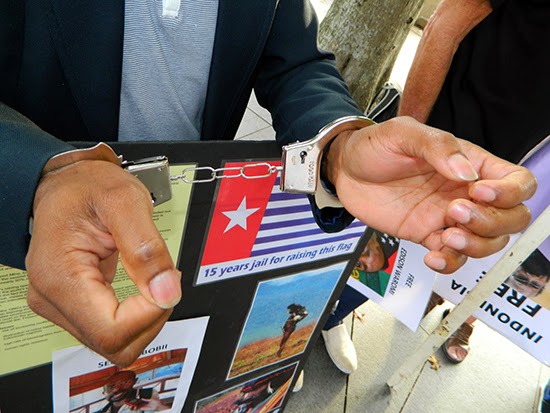
A West Papuan in handcuffs at a recent “Free West Papuans” rally in Auckland. Photo: Del Abcede/PMC
THE INDONESIAN parliamentary elections this week were disappointing on a number of fronts, especially for presidential frontrunner Jakarta Governor Joko “Jokowi” Widodo. His Democratic Party of Struggle (PDI-P) which gained just 19 percent of the vote, was far less than the expected 25 percent. But the presidential vote is not until July.

What about West Papua? What was the fate of representation for the two Melanesian provinces bordering Papua New Guinea this week? Who among the Jakarta hopefuls really have the future of the Papuan region at heart?

Bobby Anderson, one of the rare journalists filing from West Papua, wrote in New Mandala:
In Papua, where state sovereignty and legitimacy is deeply contested, representation matters. So in this national election, who purports to represent Papua?

Candidate residence is one way of sizing up the candidates and the results are telling. Sixty three out of 114 candidates running for the DPR (National House of Representatives) seats in Papua province live within the greater Jakarta area.

Thursday, April 3, 2014

MIDA’s chair finds Fiji TV guilty of ‘hate speech’ and blasts bloggers


Audio podcast of today's media conference with MIDA chairperson Ashwin Raj on YouTube from the Pacific Media Centre.

SO THERE we have it. Fiji’s Media Industry Development Authority chairperson Ashwin Raj is going to stamp out all hate and race speech in his country with the stroke of a decree-backed pen.

A momentous mind shift is going to happen just like that. The media “chilling” climate will ensure this unfolds. He thinks ...

Raj is “quite perturbed by the level of public discourse” in Fiji as the country moves toward the return-to-democracy general election on September 17.

“Masquerading itself as an exercise in freedom of expression, political discourse has, in fact, descended to unabashed racial vilification and in some instances its content is tantamount to injurious or hate speech,” he railed at a MIDA media conference in Suva today.

“What is even more disconcerting is the complicity of select Fijian journalists and media, either wittingly or those that remain oblivious to the laws of Fiji despite several awareness workshops on the Crimes Decree, the Media Industry Development Decree and the Constitution.”

Friday, March 28, 2014

Corruption, illegal tuna fisheries and a ‘lifestyle tsunami’ trouble Pacific business editors


Sean Dorney's presentation ABC report on illegal tuna fishing in the Pacific on 28 October 2013.

HOW IRONIC. For two days this week, veteran Pacific affairs correspondent Sean Dorney from Australia Network was contributing hugely to an inaugural regional business media summit organised by the Asian Development Bank.

His final contribution to the seminar was a rundown on “tunanomics” and how illegal fishing was, for him, the biggest economic story confronting the Pacific.

He punctuated this presentation with an ABC video report from last October which exposed how lack of cooperation by at least six Pacific countries was undermining the Forum Fisheries Agency’s surveillance efforts.
Anthony Bergin, the Deputy Director of the Australian Security Policy Institute, estimates that about US$1.7 billion is lost through illegal and unregulated fishing activity in the Pacific. He’s proposing that the Australian patrol boat programme should not only be a Defence Department commitment but that Australian aid should also contribute to the programme now being developed to replace those 22 patrol boats that Australia has donated to Pacific countries but which are coming to the end of their work life.
No sooner than his fine contribution and the ADB seminar was over, Dorney found himself in the gun again with Fiji media "control freaks" - Dorney's description - who seem determined to use the controversial 2010 Media Industry Development Decree to gag anything deemed to be “un-Fijian”.

Wednesday, March 19, 2014

Parliament soft-pedals over East Timor’s harsh draft media law

East Timorese media ... fears draft media law could lead to censorship.
Photo: Diariu Timor Pos
JOSÉ BELO, Timor-Leste’s celebrated champion of investigative journalism and advocate for a free media, recently vowed he was prepared to go to jail rather than allow his fledgling independent nation muzzle the press.

Belo, 42, publisher of the small yet probing Tempo Semanal online and print weekly, says he won’t give up in the current struggle over the fate of the media.

He has been campaigning against a draconian draft media law over the past few months.

“It’s about the future of our country,” he told Fairfax Media’s Lindsay Murdoch.

But the news about a draft law that is feared could lead to censorship is not getting any better. Since Café Pacific broke this story in early February, the Timorese non-government organisation La’o Hamutuk has been monitoring developments closely – and making quality submissions.

Sunday, March 16, 2014

Lies, media integrity and the new digital environment


Review by David Robie

Stop Press: The Last Days of Newspapers, by Rachel Buchanan (Melbourne: Scribe, 2013)
The New Front Page: New Media and The Rise of the Audience, by Tim Dunlop (Melbourne: Scribe, 2013)

WHEN Rachel Buchanan penned a commissioned article entitled “From the classroom to the scrap heap” for The Age last September, she railed against Australian journalism schools, in particular, over an alleged “lie” and “little integrity” of journalism education.

“Between 2002 and 2012, enrolments in journalism degrees almost doubled,” she noted about what was troubling her across the Tasman. “We now have the bizarre situation where there are more people studying journalism than there are working journalists.”

She concluded that journalism schools were creating false career hopes; Australia didn’t need any more journalists, but needed nurses and doctors, engineers and actuaries and so on.

“Poets, screenwriters, novelists, scribblers – we writers all need a day job now. You can’t eat integrity.”

>>> Popular Café Pacific Posts