Friday, July 30, 2010

Fijilive left off 'legal' media list, news editor quizzed

FIJI police have picked up the news editor of the Fiji web news pioneering agency Fijilive, Richard Naidu, for questioning – and then released him.

State-owned Fiji Broadcasting Corporation News reported that he was questioned over a story that was published by the online news agency on Thursday.

Criminal Investigations Department (CID) director Adi Sen was quoted as saying the police questioned Naidu overnight and released him at about 11am Saturday.

Naidu was reportedly questioned over a story alleging the suspension of the Police Commissioner Commodore Esala Teleni, a story the police say was incorrect.

The questioning happened on the same day that the regime announced the news organisations that have been registered under the new Media Decree – minus Fijilive. Related, or did Fijilive simply fail to meet the deadline?

Fijilive was offline all weekend but resumed publication again on Monday, August 2, without explanation. The regime denied any responsibility for the Fijilive "whiteout".

The media groups named by Attorney-General Aiyaz Sayed-Khaiyum, as reported by the FBC News, include:

Active Media, ALSA Ltd as Mai Life Magazine, Bula Namaste, Communications Fiji Ltd, Fiji Broadcasting Corporation, Fiji Sun, Fiji Times, Fiji TV, Half Times Publications, Islands Business, Mai TV and Sporting Pulse.

The membership of the new Media Industry Development Authority, also announced by Sayed-Khaiyum, is intriguing. It includes several strong civil society advocates for a more “responsible” news media and several literary figures.

One thing they can be counted on is to be committed to working towards a higher quality media for Fiji.

It also includes the manager of a Suva-based regional news organisation widely accused of failing to defend Pacific media freedoms by staying in Fiji and "kowtowing" to the regime.

Highly respected author and academic Professor Subramani is now the chairman of authority, replacing Satendra Nandan who withdrew over health issues.

Pacific Islands News Association (PINA) manager Matai Akauola is also a member of the authority, as well as the Solicitor General Christopher Pryde.

The other three members are: Aselika Uluilakeba, representing the interests of the children; Peni Moore representing women’s interests; and Jimaima Schultz, representing consumer interests.

Pictured: Fijilive's Richard Naidu. Photo: FBC

Sunday, July 25, 2010

Wanted: Fiji Times censored footage

CAFÉ PACIFIC has received this appeal for censored Fiji Times footage from Vanja Alispahic, a researcher for a forthcoming documentary about the censorship of journalists worldwide. Killing The Messenger: The Deadly Cost of News is a feature length film taking a hard look at the price of news in the world. Any takers?:

We pay every week with the life of a reporter, a cameraman and a support worker and the world barely notices. The abuses of civil liberties and denial of human rights for journalists varies dramatically from country to country. Everyone in the world is impacted each time a reporter is imprisoned or a blogger is censored.

We are beginning principal filming and we are hoping that you can aid us in tracking down ima
ges and/or footage of the Fiji Times on the instances that the newspaper was forced to replace its articles with blank spaces as in the image attached. Printed or high quality digital copies, if available, would help us immensely.

As countries restrict news, they restrict information that is important to all. This film aims to address the dangers faced by journalists today and why these dangers exist, as well as raise public consciousness about the deadly cost of news in today's society.


We hope you can aid us in the completion of this film. We will be honored to give you due credit in our film for your participation.


If you need more information regarding the documentary please let me know. You can also visit our website for more information on all of our documentary projects.

Thursday, July 22, 2010

'Radio Free Fiji' - radio plan or pipedream?

MEDIA reports in the past few days have featured the idea of a pirate radio to breach Fiji's news media blackout. Usaia Waqatairewa of the Australian-based Fiji Democracy and Freedom Movement has floated the idea of broadcasting "uncensored" news and music programmes to Fijian radio listeners from the safety of a 'pirate radio' ship anchored in international waters near Fiji.

According to the Radio Heritage Foundation - which maintains an extensive database of Pacific radio broadcasters believes - this is the first proposed "pirate radio" station in the South Pacific since landbased Radio Tanafo and Radio Vemerama hit the headlines from Vanuatu several decades ago.

Ironically, this news has just come when Voreqe Bainimarama has been claiming a huge "egg on their face" PR coup over Australia and New Zealand with his "engagement with the Pacific" summit in Natadola - featured in the exclusive print and video reports by Fiji-born investigative journalist Graham Davis in The Australian.

Interviewed on Radio Australia's Pacific Beat programme and also reported in The Australian newspaper this week, Waqatairewa says that starting such a new radio station would help Fijians obtain a different perspective on events in Fiji where a recent media decree has tightened restrictions on media ownership and cemented ongoing censorship of news reporting and the broadcast of some banned pop songs.

Recent reports have discussions underway with the owners of a Dutch radio ship that could be repositioned to the South Pacific to broadcast on AM and FM to the scattered islands of Fiji.

Floating signal
Waqatairewa says: "Sure, the dictatorship might try to jam us, but we would certainly move frequencies. The ship need only be a floating transmitter because we could send the signal from Australia on a live stream over the net. It would not be difficult to do."

A review of Fiji news websites, including Radio Fiji, Communications Fiji, Fiji Times, Fiji Sun, Fiji Daily Post and www.fijilive.com reveals no reference to the remarks by Waqatairewa.

However, the personal Facebook page for Commodore Bainimarama, the Fijian government leader is more revealing on the subject.

Not only is the pirate radio proposal mentioned, there is even a direct link to Radio Australia's Pacific Beat interview with Waqatairewa.

A revealing comment is also attributed to Commodore Bainimarama himself - "our favourite former resident Usaia Waqatairewa wants to set up a pirate radio station in international waters around Fiji and play banned pop music".

The Facebook page includes a range of responses from readers such as "Just another project that will go bust"......."We've got more than enough radio stations here in Fiji"....."Sounds like a brilliant idea but wrong time, wrong situation"......."What a waste of money. Any investors must be mad"....and chillingly, "I wonder how his kin folks are feeling for they could be classified as persons of interest to our security personnel".

Media contact
Waqatairewa is the former deputy director of the Fiji Human Rights Commission and now resides in Sydney where he is president of the Fiji Democracy and Freedom Movement.

He claims his organisation has been in contact with News Limited which is owned by Rupert Murdoch, the global media billionaire and which also owns the Fiji Times newspaper which is now for sale to comply with a recent media ownership decree.

Pro-democracy blog Fijitoday has a recent headline "When Will Murdoch Bring His Big Guns to Bear" and observes "It's not just the media he owns. It's billions of dollars he has at his disposal and the human resources he can muster and deploy to make things happen."

Fijian radio listeners will know in the weeks and months ahead whether Murdoch will use some of those dollars and human resources to bankroll the floating pirate radio station that Waqatairewa's organisation is suggesting.

In the meantime, the Fiji government has since announced a new decree requiring the registration of every telephone in the country within the next 30 days or owners face fines of up to F$10,000 or six months in jail.

Many Fijians now use mobile phones for cheap local calls, phone banking, and, of course, listening to the many popular local FM radio stations currently on the air.

If a "Radio Free Fiji" does float onto the Fijian airwaves, there may be many listeners nervous about tuning in with their mobile phone FM receivers if the state has their photo ID, date-of-birth, home address and name on a central database.

For now, Fijians wanting to know about the pirate radio plans can reportedly still listen to Radio Australia news on state-run Radio Fiji, have access to local FM relays of the BBC in Suva and Nadi, can tune to many Australian and New Zealand AM signals at nighttime, and, of course, read Commodore Bainimarama's Facebook page. - Radio Heritage Foundation

Wednesday, July 14, 2010

Indonesia's Jawa Pos – a remarkable success story

THE PUBLISHER of all three major newspapers in West Papua is barely known in this part of the Pacific. Yet the Jawa Pos group is the largest media chain in Indonesia with 140 titles and 20 television stations under the “grand pen” umbrella.

Some brand Dahlan Iskan as a sort of Indonesian Rupert Murdoch entrepreneurial character, a former journalist who took control of the Jawa Pos in the eastern Javanese city of Surabaya in 1982 and within five years had transformed the ailing daily – then selling a mere 6000 copies – into a thriving major newspaper with a circulation of more than 300,000.

Since then, the newspaper’s daily sales have rocketed to more than 500,000 – more than double the circulation of the New Zealand Herald, for example.

As well as an expanding multimedia empire – it is totally dominant in the country’s second largest city and also challenging Kompas in the capital of Jakarta – Iskan has also developed the Jawa Pos network, established an independent newsprint mill and power plants and erected skyscrapers in Surabaya, Jakarta, Makassar and other Indonesian cities.

The three dailies in West Papua owned by the Jawa Pos group are the Cenderawasih Post in Jayapura, Radar Sorong and Radar Timika, published in the town near the controversial Freeport McMoRan copper and gold mine.

Self-taught
A self-taught publisher and journalist – he never graduated from a journalism or communication studies school, Iskan kicked off his media career at the age of 24 in 1975. His first newspaper job was with a small local paper in Samarinda, East Kalimantan.

The following year, he joined Tempo news magazine and his career took off. Appointed as head of bureau by Tempo in Surabaya, East Java, he was later named by the magazine publisher PT Grafiti Pers as head of the Jawa Pos when Tempo took over the newspaper.

What is the secret of Iskan's success? Many Western newspaper editors with plunging circulations would love to know this.

Café Pacific put this to the current Jawa Pos editor in a recent chat in the newspaper’s vast and impressive convergent newsroom. Leak Kustiya says Iskan has an astute knack of keeping his finger on the youth pulse in all the cities and towns where he publishes and broadcasts.

“The Jawa Pos group is constantly introducing fresh ideas and isn’t afraid to appoint young guns to key jobs. Most chief editors are under 40,” he says. Leak Kustiya is himself an example of the innovative approach to publishing. He is a former influential political cartoonist, possibly the first cartoonist to become an editor of a major daily in the Asia-Pacific region.

Jawa Pos was the first newspaper in Indonesia – perhaps globally – to launch a special interest section for youth every day. DeTeksi was founded in 2000 and has grown enormously in the past decade.

The average age of the DetEksi editorial team is 20 + - and many of the reporters, photographers and designers are students. Jawa Pos also has a special daily section for “new families” – newly weds or couples with children aged under 10 (Nouvelle) and Life Begins at 50 caters for the growing older age group.

The paper’s slogan is “Selalu ada yang baru” – We always have something new.

Another key string to the Jawa Pos bow is being part of the community and the newspaper launched the Development Basketball League (DBL), Indonesia’s biggest student competition; built a stadium next door to the Surabaya newspaper office; and promoted environment and social campaigns.

Instead of looking to Australia and New Zealand for media inspiration with tired models, Pacific media should be looking to the achievements of its Asia-Pacific neighbours such as at the Jawa Pos. Inspiring indeed.

Pictures: Top to bottom: DetEksi to the rescue for Surabaya's youth market; entrepreneurial Indonesian publisher Dahlan Iskan; and Jawa Pos editor Leak Kustiya with Airlangga communications graduate Nur Dheny (Photo: David Robie).

Jawa Pos website

Tuesday, July 13, 2010

Fiji media decree also clouds Daily Post

THE FOCUS on Fiji media and press freedom invariably centres on The Fiji Times and its "valiant fight" for Fourth Estate independence in the face of an "oppressive regime". While the courage of the Murdoch-owned Fiji Times journalists certainly needs to be acknowledged, the vested interests of a group of Anzac journalists and media need to be seen for what they are. More attention needs to be given to the other Fiji news media and varying perspectives they offer on the reality of post-coup Fiji today - and a closer look is needed at their constrasting strategies for "media freedom" ... and survival. Take the struggling Fiji Daily Post for example:

Reluctant newspaper publisher may have to fold as ownership decree bites

By JOEL GIBSON of The Sydney Morning Herald

ALAN HICKLING is the other Australian owner of a Fiji newspaper. But unlike his competitor, Rupert Murdoch, the little-known Hickling is no media scion.

Six years ago, the Melbourne businessman became the majority owner of the Fiji Daily Post ''by accident'' after visiting the country to train aged-care nurses for a church group.

The father-in-law of his friend, Dr Robert Wolfgramm, a Monash University academic born in Fiji, wanted to take over the business.

When the previous owners agreed to part with the paper for ''a token gesture,'' Hickling agreed to back them. Doing due diligence after the sale, they were ''gobsmacked'' to find a $1 million injection of government funds had been embezzled.

''It was never my intention to make money,'' Hickling, who now owns 80 percent of the newspaper, said.

''Robert is a personal friend and I said I would help him get it on track and sort the legal case out. I was going to distribute my shares to all members of staff. It would be their paper and if they wanted my help I would stay on the board.''

Today, their lawsuit is stalled in Fiji's unstable court system and the paper's operations are suspended due to the military regime's Media Industry Development Decree, which this week required all Fiji media to be 90 per cent locally owned within three months.

''It's disappointing that the regime has taken this approach because we were quite supportive of the Fijian people and we are about creating jobs there,'' Hickling said.

The Daily Post is 19 per cent-owned by the Fiji government.

Murdoch's newspaper, The Fiji Times, also faces closure or an uncertain financial future.

If both were to fold, they would leave only the locally-owned Fiji Sun - the organ generally considered to be closest to the military regime [New Zealand-born journalist Peter Lomas is publisher].

Sharon Smith-Johns, a former Fairfax sales executive and now Fiji's Permanent Secretary for Information, said this week that reaction to the decree had been ''sensationalised''. She denied it was designed to gag critical media.

''I think you have to be in Fiji to understand some of the damage that can be caused in the media here and the sensational headlines, the very biased reporting,'' she said. ''[But] … I'd say 90 percent of stories are reported in the paper every day.''

Smith-Johns left Fairfax and started an online women's magazine, SheSaid.com.au, in 1999, but sold her share after six months to be with her Fijian boyfriend, Billy.

She has risen to be the military government's chief spin doctor and will have to enforce the new laws.

''She was always bloody driven … I can't imagine her wearing a sarong and drinking mai tais for the rest of her life,'' her former business partner, Monique Talbot, said.

Fiji Media Industry Development Decree 2010

Tuesday, May 25, 2010

Hostile world media debate draws packed house

A REAL irony in these cynical times about the global “journalism crisis” and the inability of many journalists and ginger groups to seriously tackle the shackling of the media by corporate conglomerates, that AUT University experienced a packed house this week to debate safety for war correspondents. Some 200 people turned up to see the film Balibo and discuss media safety.
It may have been a mere sprinkling of journalists themselves, but the audience was made up of a horde of aspiring journalists, civil society advocates concerned about the state of the Fourth Estate and media educators and social scientists whose job is to be reflective about the media. All were treated to an inspiring evening of debate and insight into the state of the profession and the challenges of an increasingly hostile world for journalists.

Keynote speaker Tony Maniaty, author of Shooting Balibo: Blood and Memory in East Timor, spoke of the growing trend to what he calls the “outsourcing of danger” – a growing reliance on freelancers and independents to do the dangerous work. Reflecting on the East Timor experience, he also notes how easy it is nowadays for younger reporters today to sidestep the years of grind and experience taken to become a war reporter in the past.
Today, my students can - and some do - circumvent all that rigmarole by walking around the corner, buying a laptop and HD camera and a cheap air ticket to Kabul, and two days later be filming – alone, unsupported - on the frontline. And in this increasingly prevalent scenario are two more challenges facing us. One, we need to inject compulsory safety training modules into our media courses; and two, we need to address more carefully the vexed issue of freelancers, and what I call ‘the outsourcing of danger’. If networks are not prepared to send staff reporters into hot zones, do they have any right to send others there – for far lower pay, without training or insurance or training, without safety gear?
Maniaty, an ABC television reporter in 1975 and now senior lecturer in international journalism at the University of Technology, Sydney, was a survivor back then. After reporting on the Indonesian incursions at the border town of Balibo in October that year, he withdrew before the impending invasion. On his retreat, he warned Channel 7 reporter Greg Shackleton and two of his four colleagues from two networks that pressed on to Balibo – and to their deaths. They were murdered at the hands of notorious Indonesian Kopassus commandos intent on stopping the truth about the invasion "softening up" getting to the global media.

The complicity of Australian governments in the cover-up of their murders and the long silence of New Zealand governments about this episode is shameful. Another journalist, Australian Roger East, went to Dili to set up the East Timor News Agency (ETNA) and investigate the killings of the Balibo Five. He in turn was murdered, executed by Indonesian troops in cold blood on Dili’s wharf the day after the December 7 invasion and his body dumped into the sea.

Seminar host Dr David Robie, director of the Pacific Media Centre, spoke of the questions confronting journalists:
Are we making progress in issues of the duty of care by the news media organisations for their journalists assigned to war zones and to cover dangerous events? How well do journalists know and understand International Humanitarian Law and their rights and responsibilities? With other countries adopting a news media safety code, including Australia, should New Zealand be doing the same?

The deaths of two journalists, both of them foreigners – a Japanese and an Italian – in the civil disturbances in Thailand, are a reminder of the huge dangers f
acing media workers when reporting in a conflict zone.
Chris Cramer, New York-based global multimedia editor of Reuters News, who had been keynote speaker at the Reporting Wars conferences a year ago in Sydney and Wellington, sent an impassioned message to the seminar and noted how committed his own organisation was to safety of journalists and news workers (see video). It is something of a role model. Cramer is also currently president and a founding member of the International News Safety Institute.

Independent New Zealand journalist Jon Stephenson opened the panel debate by suggesting that since last year’s Reporting Wars conferences there had been no real progress made towards addressing journalist safety in New Zealand.
I regret to say this, but our profession has become something of a bad joke. Despite the slogans on the billboards around Auckland it is most definitely not ‘all about the story’… it’s all about the bottom line.
Other speakers on the panel, chaired by PMC advisory board member Dr Camille Nakhid, were TV3’s Mike McRoberts, just back from covering the crushing of the “red shirts” populist insurrection in Bangkok, TVNZ’s Sunday presenter Cameron Bennett, and Kelisiana Thynne, who gave a legal perspective, adding previous Reporting Wars seminars had been more successful than other panellists suggested, having raised considerable awareness of the role international humanitarian law can play in journalism.

Jean-Luc Metzker, head of the Regional Delegation of the International Commission of the Red Cross based in Suva, launched the latest edition of Pacific Journalism Review which is themed on the issue of war reporting and published a number of papers from last year’s conferences and additional research about the safety of journalists.

The response to the seminar and film screening was phenomenal. The largest previous response on a media topic at AUT was when 150 came to hear The Independent's Middle East correspondent Robert Fisk in 2008.

It shows this issue of war reporting and safety for journalists amid the growing complexities of today's world, where you can have urban war across the street in some countries and media workers are constantly at risk, is a crucial challenge for the profession. New Zealand media managements haven't been treating the issues seriously enough - and this is at their peril.

Pictured: Top: TVNZ's Cameron Bennett. Lower Top: Tony Maniaty. Middle: Pacific Journalism Review. Lower middle: Kelisiana Thynne of the International Committee of the Red Cross and panel chair Dr Camille Nakhid of the Pacific Media Centre advisory board. Above: TV3's Mike McRoberts, independent journalist Jon Stephenson and PMC director Dr David Robie. Photos: Del Abcede/PMC

The film screening and seminar were jointly hosted by the International Committee of the Red Cross, New Zealand Red Cross, AUT University and AUT’s Pacific Media Centre.


Saturday, May 15, 2010

Ben Bohane's retrospective on Pacific war reporting

BEN BOHANE is travelling from Vanuatu to Brisbane tomorrow for an exhibition launch of his photo collective with a retrospective of his best war reportage over the years. He is without peer in South Pacific photojournalism, but his remarkable career actually began with a five-year stint in South-East Asia covering warfare in Afghanistan, Burma, Cambodia.

According to his profile on Degree South:
[Bohane] got the first interview with opium warlord General Khun Sa in 1991 and in 1992 he was reportedly the first foreign traveller to go overland from Kabul to Moscow in 80 years.

In 1994, Ben returned to Australia and began covering the much under-reported Pacific region.

He has spent the past 12 years specialising in “Conflict and Kastom” throughout Melanesia and black Australia. While covering every major conflict in the South Pacific – Bougainville, East Timor, Fiji, New Caledonia, West Papua, Papua New Guinea, Maluku, Solomon Islands, Vanuatu and West Papua - he traveled and lived with a variety of tribal and rebel groups and was thereby able to secure the first pictures of BRA (Bougainville Revolutionary Army) leader Francis Ona in Bougainville and the only interview and pictures of Guadalcanal warlord Harold Keke before he surrendered to Australian troops.

He has perhaps the largest contemporary photo archive of the South Pacific in the world. His photographs are collected by the New York Metropolitan Museum of Modern Art and the Australian War Memorial.
Pacific Journalism Review published a photoessay by Ben Bohane in September 2006 (v12 n2) to mark his "Black Islands: Spirit and war in Melanesia" exhibition in Sydney's Australian Centre for Photography. His work has also appeared in Geo, Time, Newsweek, The Guardian, Rolling Stone and other publications. He also regularly makes documentaries for the ABC and SBS in Australia and other networks.

Bohane has just returned from an assignment for SBS Dateline reporting on the controversial huge Exxon LNG project in the Southern Highlands. Militant landowners claim this will turn into "another Bougainville", where a 10-year civil war was fought over the massive environmental and social destruction wrought by the Panguna copper mine.

Photo: Ben Bohane


Friday, May 14, 2010

Audio flashback to Rabuka's first Fiji coup

AN EXCERPT from a documentary about the original Fiji coup led by Lieutenant-Colonel Sitiveni Rabuka on 14 May 1987. It was made by University of the South Pacific journalism students a decade later. In 1997, Patrick Craddock, a former Radio New Zealand producer, was
working at USP in Suva with François Turmel, a former
BBC journalist who established the the Fiji-based regional journalism training programme with French support. As part of an exercise in documentary making, the students collected audio interviews with people who had
experienced the 1987 coup in Suva.

Interviewees included Sam Thompson, news editor of FM96 radio who broke the story about the coup; a radio journalist at Radio Fiji; Dr Tupeni Baba, a politician in the Fiji Labour Party-led coalition government of Dr Timoci Bavadra; the police chief appointed by Rabuka, students, staff of USP and people attending an NGO workshop.

At the time, none of the participants wanted to be identified by name with this documentary and no names were included in the production details. The documentary was seen as an exercise for USP journalism students and was never broadcast. Most audio interviews were done on location. The programme is now a small part of the history of the period.

Producer: Patrick Craddock, USP Media Centre.

Picture: Sitiveni Rabuka on 14 May 1987. Photo: Fiji Times

Wednesday, May 12, 2010

Fiji coups: 'Out of the barrel of a gun'

Flashback to the original Sitiveni Rabuka coup – 14 May 1987:

“OUR chiefs,” said Taniela Veitata, now an Opposition MP, “are really the guardians of the peace in Fiji.” A day after he and his Taukei colleagues had been plotting the next stage in the plan to depose Prime Minister Timoci Bavadra, Veitata was laying down the law in Parliament about racism.

“Peace is quite distinct, Mr Speaker, from the political philosophy of Mao Zedong where he said that political power comes out of the barrel of a gun. In Fiji, there is no gun. But our chiefs are there; we respect them …”

Seven minutes later, at the stroke of ten o’clock, ten soldiers wearing gasmasks burst into the chamber.

“Sit down everybody, sit down,” barked the squad leader, a captain disguised by a balaclava and brandishing a 9mm pistol. “This is a takeover. Ladies and gentlemen, this is a military takeover. We apologise for any inconvenience caused. You are requested to stay cool, stay down and listen to what we are going to tell you.”

Lieutenant-Colonel Sitiveni Ligamamada Rabuka, dressed in a suit and a sulu stood up in the public gallery. He strode towards the Speaker – his uncle, Militoni Leweniqila.

“Please stay calm, ladies and gentlemen,” Rabuka said. “Mr Prime Minister, please lead your team down the right,” the colonel said. “Policemen, keep the passage clear. Stay down, remain calm. Mr Prime Minister, sir, will you lead your team now.”

Outside in the corridor, Ratu Finau Mara, son of the former Prime Minister [Ratu Sir Kamisese Mara], stood making sure the passage was clear. A back-up team of about 12 soldiers in full combat gear and armed with M16 assault rifles waited there. Moments earlier, Finau Mara had been making room in the passage for the soldiers to enter Parliament.

Shocked, Bavadra, his cabinet ministers and MPs were led outside at gunpoint to two waiting military trucks and ordered to get in.

Education Minister Dr Tupeni Baba, noticing uncertainty on the face of a soldier near him, made a gesture of resistance. “We’re not going on the trucks,” he said.

Dou raici koyo, sa lako yani oqori,” snapped the captain. “Watch out for that one heading your way.”

Rabuka grabbed a loaded M16 from a nearby soldier and cocked it at Baba’s head. Baba, the most outspoken of any of the indigenous Fijian ministers, moved but still protested defiantly.

[Excerpt from David Robie’s Blood on their Banner: Nationalist Struggles in the South Pacific (Zed Books, London, 1989), pp. 218-219.]

Flashback to the George Speight attempted coup – 19 May 2000

At precisely 10.50am, [Deputy Prime Minister Dr Tupeni Baba] was stopped in mid-sentence as three men, two holding guns and one walking calmly towards the Speaker's chair, entered among screams.

That is when our complaints about being stuck in Parliament just about stopped - guns? We looked at each other, realised our good fortune and started counting the gunmen.

[Speaker Dr Apenisa] Kurisaqila was demanding to know: "What is this? What is this?'

In a more composed manner with his books in hand, Dr Kurisaqila said: "This is an illegal takeover!'

Within seconds all seven doors were shut by gunmen and [a group of Fiji Institute of Technology students in the public gallery] were told to leave.

In the press gallery, we were told to stop recording things, stop writing and just remain seated; the door to our room was locked from outside.

In the meantime, George Speight was telling Dr Kurisaqila to sit down. He turned to Opposition members and told them to leave the chambers. All left except Opposition Leader Ratu Inoke Kubuabola, Sam Speight (George's father), Jim Ah Koy and Ofa Duncan.

Speight's repeated request for the lot to leave was backed with a gunshot at this point; Dr Kurisaqila and these Opposition members refused to budge…

[Excerpt from Matelita Ragogo's article "The day of the parliamentary gunmen". She was one of three journalists reporting in the parliamentary press gallery on the morning when Speight’s gunmen walked in. From the University of the South Pacific journalism students’ coup archive.]

And Fiji, 14 May 2010… what of the so-called "coup culture" set in motion by Rabuka? The man who led the country's first two coups last month publicly apologised for his actions and has been on a personal journey of seeking forgiveness from its victims. He told the Fiji Sun:
“On this personal journey I am trying to go to all the victims of 1987 to apologise for what I did,” he said. He began in 1997 with Queen Elizabeth II when he was then Prime Minister. After carrying out the coup, Rabuka severed
ties with the British monarchy and declared Fiji a Republic.

“I also tried to return my OBE (Order of the British Empire) medal but Queen Elizabeth told me to keep it because I earned it before I carried out my 1987 actions,” he said.


Rabuka has also apologised to the family of Dr Bavadra; Defence Minister Ratu Epeli Ganilau, son of the former Governor-General and the Fiji's first President Ratu Sir Penaia Ganilau; and to former junior officers.

But in the end, too little too late. Rabuka unleashed a damaging culture that has devastated Fiji for more than two decades, crippling the economy and political and social institutions. A legacy of ruin.

Pictures: Top: A Rabuka coup soldier in 1987. Photo: Matthew McKee (from Robie's Blood on their Banner). Above: A Speight gunman in 2000. Photo: Joe Yaya/USP coup archive).

Sunday, May 9, 2010

The unapproved Fiji military dictionary (Part 2)

COUP: A Fiji custom first started in 1987 where the celebrants promise a better future. It is held about every five years

Example: The banker said to the coup leader please take this F$200 million and say nothing about it, as the bank does not want it back.

Weapons of Mass Destruction: Guns paid for by the taxpayers of Australia and New Zealand and given to the coup leaders who say prayers and promise to protect babies, old people and the poor.

Example: We say prayers so that they will leave us alone to enjoy our poverty and ill-health in our own hovels.

China: A generous donor who is yet to show us their weapon of mass destruction.

Example: We are communists, and one day you will share all your wealth with us.

Fiji Sevens:
Formerly the personal property of Waisale Serevi; a game that provides supporters temporary amnesia when they contemplate Fiji’s future.

Example: I used my weekly pay to go to the match and Traps Bar afterwards. I then went home and beat my wife. I was angry because she asked for money when she knew I had already spent it.

Newspaper publisher: One who is damned to live somewhere else after publishing the news (see Dante’s Inferno for more examples).

Example: He was sent back to Australia although he wanted to live in Suva.

People’s Charter: The eleven pillars or commandments given to Commodore Voreqe Bainimarama with the help of the Catholic Church.

Example: Moses broke the tablets given to him by God ... The modern way is to shoot holes through them and win the heart and minds of the population.
Attorney-General: A person who has the ability to wear all the colours of the rainbow and use all the letters of the alphabet in any one day and smile and smile and smile.

Example: I do not talk out of the side of my mouth, because that would be too obvious to anyone who was looking and listening to me. My totem is a tsunami, and I invite all my critics to come to the beach and see it when it arrives.

Contributed by Patrick Craddock. Cartoon: Malcolm Evans and Pacific Journalism Review.

Fiji military dictionary (Part 1)

Friday, May 7, 2010

PNG ombudsman the toast of media freedom

By David Robie in Brisbane

Five months ago, he was the target of would-be assassins. Now he is the magnet for politicians wanting to rein in the powers of his state corruption watchdog.

But Chronox Manek is one of the most popular public figures in Papua New Guinea and thousands of ordinary citizens flocked to a peaceful protest this week against a controversial draft law aimed at curbing his powers.

And he charmed his way to the hearts of freedom of speech and free media advocates gathered in Brisbane for the annual two-day UNESCO World Press Freedom Day conference marking May 3.

Manek, Papua New Guinea’s Ombudsman, is the scourge of the coalition government led by founding “father” Prime Minister Sir Michael Somare – and a problem for Opposition politicians as well.

However, many journalists and public activists see him as a courageous and determined campaigner against corruption by public figures.

More than 7500 citizens took part in Tuesday’s Port Moresby protest against legal amendments – the so-called Maladina Bill, named after the sponsoring MP Moses Maladina – they claim will undermine the Ombudsman Commission.

Corruption epidemic
After marching on Parliament House in Waigani, the demonstrators delivered a petition of 20,000 signatures demanding a halt to the legislation curbing the commission’s powers.
The petition follows several weeks of public protest and condemnation over what critics describe as serious erosion of governance in this country where corruption is an epidemic.

Maladina’s Parliamentary Committee into the Ombudsman Commission tabled amendments impacting on both the commission and the so-called Leadership Code governing conduct by politicians and top civil servants.

One of the critical changes block the commission’s current powers to freeze public funds suspected of being used for corrupt or improper purposes.

The bill also imposes a four-year time limit on investigations, effectively blocking the ability of the commission to probe historical corruption cases.

Another provision means that politicians and civil service heads that breach the Leadership Code will no longer be able to be tried in criminal courts.

The bill has passed two readings with unanimous parliamentary support in spite of the public criticism. However, although the last vote was 83 to nil in favour of the draft law, the Opposition now says that it had been misinformed over the provisions and is now opposed.

Prime Minister Somare, Treasurer Patrick Pruaitch and several prominent government figures are currently being investigated by the Ombudsman Commission.

'Speading misinformation'
Somare has accused the Ombudsman Commission of “spreading misinformation” about the bill, but the final reading has been delayed until July.

Transparency International recently ranked PNG as the 151st most corrupt out of 182 nations.

In Brisbane, Manek spoke in two freedom of information panels in the conference hosted by the University of Queensland.

While saying the free expression and free press provisions in Article 19 of the Universal Human Rights Declaration were enshrined in the country’s constitution and that the courts enforced these rights, he added there was a major problem.

“This is about the availability of records – it is very low priority for government business,” Manek said.

“It is all very well being entitled to the information, but in many cases the government is unable to supply it because of the poor state of official records.”

At the time of independence in 1975 and for several years later, the importance of records and information management had been in good health.

'Fell off the rails'
“But somewhere along the way it fell off the rails,” Manek said.

He said it was the duty of the government to provide basic information to its citizens and to build trust.

The role of the media was important too.

“The government uses the National Broadcasting Corporation with talkback and radio and television to get policies across to the public. That’s a good start,” he said.

“But with media freedom goes great responsibility for the news media.
“Freedom of the press is not a privilege, but a responsibility.”

The media could do more to get information before the public and “we need more investigative journalism”.

He challenged the upholders of the nation’s information policy to recruit “honest” people to rebuild the open culture.

Last December, Manek was left for dead after several gunmen opened fire on him outside his home, gangland style.

They blocked his car as he waited for his driveway gate to open and fired through the windscreen of his Nissan Patrol.

He was hit in the shoulder but he told The National newspaper after the attack that a point-blank shot aimed at his chest glanced off the vehicle door.

Photo of Chronox Manek by David Robie

Thursday, May 6, 2010

An open letter to the commodore

Bula Frank,

I AM sure you prefer being called by your first name, rather than being than being called coup leader. I know you see yourself as a saviour – but may I say that you seem to be a slow saviour. You move … snail slow towards democracy, vinaka. From 2006 to 2014 is tomorrow and then Election Day – a special day, which I hope will be long, prosperous and full of fair play to the people.

Your media decree is a genuine way to boost the economy. Over the next four years you will be able to make a considerable amount of money from media organisations by collecting F$100,000 from journalists when they refuse to disclose their sources about their news story with the person who said in a mild manner… that your policies
Encourage people to think carefully and restrain themselves from voicing their negative views of the army.
To pay your fines, senior journalists will be able to mortgage their homes, take their children away from school, postpone paying the doctor, ignore their donations to the church and cut back on the food budget.

But… Frank… I see you have been thoughtful of the needs of journalists and left a loophole. Non-payment of the $100,000 fine will allow any journalist to go to jail and be clothed and fed at state expense. Good thinking.

I am sure your self-appointed judges will ensure married journalists with children will get a priority to go to jail before young single reporters. Perhaps, you can lock up the junior journalists at the army barracks. Your men know to do that.

The numerous $500,000 cheques collected from the media organisations will mount up and you will soon have enough money to legally buy The Fiji Times. With a little bit of luck (or military strategy) by 2014 you will own all the media in Fiji except perhaps the internet.

Internet story
It will be sad for you to miss out on owning the internet. It is among your harshest critics and I know that sometimes the information is wrong and often offensive. But, then how else do the people of Fiji, and the rest of the world finds out about Fiji in all its black, white, grey and khaki colours?

A short story for you about the internet. During 2000 when George Speight had his coup, the big Fiji media of radio, TV and the newspapers were uncertain about how to deal with him. The limited information they could glean was crucial for the public to hear and crucial too for the outside world. Getting information out to the rest of the world was difficult.

At the time I was working at the Media Centre of the University of the South Pacific. We managed to record news reports from radio and TV. That information along with on-the-spot reporting by student journalists was forwarded several times a day through the internet to media organisations in New Zealand, Australia, the US and Britain. This process continued for many days even after the overseas journalists arrived. Some of those students now hold key media positions in Fiji.

I no longer teach journalism to students in Suva, but if I was, I would still be helping them understand, learn and practise the Fiji Code of Ethics. It’s a sound code. I would want them to be fearless and to ask questions on the many facets of the problems and needs of society.

Young journalism students could ask… why do you need so many years in power to develop a new Constitution?

I would encourage them to think on questions about how you are dealing with the growing number of poor people in Fiji. Various blogsites tell me the poor are now half the population. Why are there more poor people now than in 2006 – you and your soldiers have been in charge of the country for a long time?

I would get students thinking too, on why we need so many military men in key administrative posts. Hopefully, they are all working towards putting themselves out of work and replacing their jobs posts with civilians. Are they?

About elections
Student journalists may ask you questions on democratic practice? In New Zealand, there are elections every three years. When the voters dislike the government, they tell it to go … and the government goes. Helen Clark went, John Key will go too.

Citizens in Britain are in the middle of a cliffhanger election to decide who they will want to lead the country for the next few years. The citizens’ decision this week does not bode well for the present government, but then democracy is difficult.

I hope you agree with me? If not, what will happen after 2014 when a decision by a civilian elected government angers you or perhaps a junior officer who has modelled himself on your behaviour?

To close off the tutorial and leave students thinking, it would be useful for them to reflect on this recent statement on democracy.
Pacific Beat Story from Radio Australia March 2, 2010
Fiji's military backed regime has announced that any politician, who has played a role in the country's politics, since 1987, will be banned from contesting the promised elections in 2014. The announcement has been made by interim Prime Minister Commodore Frank Bainimarama ...
A reply would be appreciated. Please post it on your favorite blog site

Vinaka
Patrick Craddock
Aotearoa

Tuesday, May 4, 2010

Fiji censorship by 'legal camouflage'


ON World Press Freedom Day's eve in Brisbane, the Australian journalists union - Media, Arts and Entertainment Alliance (MEAA) - threw a party for Aussie hacks and the UNESCO flacks attending the two-day conference at the University of Queensland. A "South Pacific soirée" to be exact. Guest speaker Sean Dorney had to compete with a cacophony of riverside fireworks to be heard. The latest "press freedom" edition of the Walkley Magazine was launched there too. Along with a 13-page report card on the state of media freedom in Australia, the following article on Fiji was also published:

No colonel of truth in Fiji

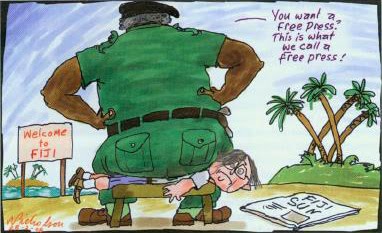
For a year, journalists in Fiji have had to live with censors posted in the newsroom. Now a new media decree threatens huge fines and and five years in prison for reports against the national interest. It's a dangerous precedent for the entire Pacific region, says David Robie. Cartoon by Peter Nicholson.

When an Indo-Fijian academic and former trade unionist turned up on Fiji’s shores from Hawaii by invitation to conduct a media industry “review” in June 2007, few took him seriously. Whatever Dr James Anthony’s expertise in other fields, news media was certainly not one of his strengths. Also, it had been decades since he had lived in Fiji and he seemed out of touch.

And then there was a niggling question about the legitimacy of his mission. He had been commissioned by then Fiji Human Rights Commission director Dr Shaista Shameem – no friend of Fiji news organisations – to study media freedom and the future of the industry in the Pacific country.

“Negative reactions of the media industry to human rights scrutiny in the public interest are not unique to Fiji,” Shameem said. “Other human rights commissions have faced similar obstacles – such as the South African Human Rights Commission.”

Anthony immediately clashed with local news media companies and the self-regulatory Fiji Media Council and they refused to cooperate with him. He persevered in an atmosphere of hostility and produced a 161-page report branded by his opponents as “racist” – for a sweeping claim that the industry was dominated by eight white expatriates – and “riddled with inaccuracy”.

Ironically titled “Freedom and independence of the media in Fiji”, the report was discredited and appeared to have sunk into oblivion. Yet now Anthony has come back into focus. His recommendations were adopted as the basis of a draconian draft decree widely regarded as a sinister threat to the future of a free press in Fiji and across the South Pacific.

Attorney-General Aiyaz Sayed-Khaiyum claimed the Media Industry Development Decree 2010 “takes the already established rules of professionalism, of media behaviour – or how they should behave – and gives it teeth”.

Decree 'teeth'
The “teeth” includes rolling Anthony’s primary proposals for a Singapore-inspired Media Development Authority and an “independent” Media Tribunal into this proposed law along with a radical curb on foreign ownership, wide powers of search and seizure and harsh penalties for media groups and journalists breaching the decree.

The authority and tribunal would be empowered to fine news organisations up to F$500,000 and to fine individual journalists and editors up to F$100,000 – or imprison them for up to five years – for violations of vaguely defined codes such as publishing or broadcasting content that is “against public order”, “against national interest” or “creates communal discord”.

Foreign ownership is retrospectively restricted to a 10 percent stake in any media organisation and directorships must only go to Fiji citizens who have been residing in the country for five of the past seven years, and nine of the past 12 months.

Many critics see this as a vindictive section aimed at crippling the Fiji Times, the country’s largest and most influential newspaper and owned by a Murdoch subsidiary, News Limited.
The regime wants to put the newspaper, founded at Levuka in 1869, out of business, or at least effectively seize control and muzzle its independent stance – seen by the military-backed government as “anti-Fiji”.

Two Australian publishers of the Fiji Times have been deported on trumped up grounds since military commander Voreqe Bainimarama staged the country’s fourth coup in December 2006. The High Court also imposed a hefty F$100,000 fine against the Fiji Times in early 2009 for publishing an online letter criticising the court for upholding the legality of the 2006 coup.

While international responses have focused on the serious impact for the Fiji Times group, the terms of the decree will also hit the country’s two other dailies – the struggling Fiji Daily Post (it hasn't been publishing lately), which has 51 per cent Australian ownership, and the Fiji Sun, which has taken a distinctly “pro-Fiji” (that is, pro-regime) stance but also has some expatriate directors.

John Hartigan, chief executive of the Fiji Times' parent company News Limited, warned the decree raised “important commercial issues” for the newspaper. “We have made representations to the Fiji authority to find a way to resolve these issues and are awaiting the outcome,” he said.

Mixed responses
The draft decree follows 12 months of “sulu censors” - so-called because of the traditional Fijian kilt-like garment some officials wear - keeping tabs on newsrooms after the 1997 constitution was abrogated by the regime in April last year and martial law declared.

Responses to the proposed law have been mixed within Fiji, but other media groups have strongly condemned it. Paris-based Reporters Without Borders criticised the regime for tightening its grip on media, noting that Fiji had fallen 73 places in its annual freedom rankings. Fiji is now placed 152nd out of 175 countries.

The Pacific Media Centre branded the draft decree as “draconian and punitive” and the Pacific Freedom Forum said it would “deal a death-blow to freedoms of speech”. The International Federation of Journalists criticised the regime for investing authorities with the power to define the meaning of “fair, balanced and quality” journalism.

Most Fiji journalists were reluctant to speak out publicly with their jobs potentially on the line. But many contributed postings to some of the 72 post-coup blogs about Fiji or shared insights with their Pacific colleagues on cyberspace networks.

Dangerous precedent
Other Pacific journalists see the draft law as a dangerous precedent for the region, one that could be emulated by unscrupulous politicians in other countries as a strategy to control the media.

Already the Suva-based Pacific Islands News Association (PINA) and its regional news cooperative Pacnews are facing a dilemma – to stay and risk being compromised, or to leave but have less lobbying influence on the regime. Vice-president John Woods, editor of the Cook Islands News, has called on the organisation to relocate out of Fiji, describing PINA as “dysfunctional” and “kowtowing” to the regime.

One Suva old hand who had been a star reporter at the time of the first two coups in 1987 admitted there were some good aspects to the decree, such as encouraging training and enforcing the codes of ethics: “But it simply continues the censorship – although now in a camouflaged form.”

Dr David Robie is an associate professor in AUT University’s School of Communication Studies, director of the Pacific Media Centre in New Zealand and editor of Pacific Scoop. He was formerly head of journalism at the University of the South Pacific in Fiji. His media blog is Café Pacific.

Wednesday, April 28, 2010

Fiji regime stands firm over draft media decree

By Shailendra Singh in Suva

Fiji’s draft media decree continues to be criticised from within and outside the country, but the government is showing no signs of backing down or softening any of its provisions.

Attorney-General Aiyaz Sayed-Khaiyum has described international coverage of the draft decree as unbalanced and bordering on the hysterical. He told Radio Fiji recently: "(Again), I would suggest very strongly that most of these sorts of comments are not objective but
actually political in nature."

"I would also attribute some of this hysteria to some local media organisations that are probably whipping up this frenzy and trying to portray an image of Fiji that is far from the truth," he added.

Breach of content regulation or disclosure provisions of the proposed law could lead to a maximum fine of $F500,000 (about US$258,000 ) for the media company concerned, and a maximum fine of F$100,000 (about US$52,000) or a maximum jail term of five years, or both, for publishers, editors and reporters.

Critics of the government say that it has no one to blame but itself for any negative perceptions about Fiji or the draft decree.

After all, it was only last year that then President Ratu Josefa Iloilo abrogated the country’s charter, formed an interim government that is to remain in power until 2014, and then reappointed as prime minister Commodore Voreqe Bainimarama, who has ruled Fiji since staging a coup in 2006.

Freedom of expression and of the press have also been under heavy strain under the Public Emergency Regulations (PER) that, said the Suva-based Citizens’ Constitutional Forum, would only be replaced in name by the proposed Media Industry Development Decree 2010.

Censorship continues
According to the forum’s executive director, Rev Akuila Yabaki, the draft decree only "allows strict media censorship to continue in Fiji".

"PER and censorship must be lifted so that citizens of Fiji can enjoy the right to receive and impart information and diverse opinions," Yabaki said.

The Brussels-based International Federation of Journalists (IFJ), for its part, said that the draft decree invests all power of interpretation over the meaning of fair, balanced and quality
journalism to officers and authorities appointed by the Bainimarama regime.

"This decree is clearly focused on the regime retaining control and entrenching its highly oppressive restrictions, not only on the media but (also) on members of the public who might wish to express dissenting views," the IFJ said in a statement.

At the same time, IFJ general secretary Aidan White said it "strictly limits the ability of Fiji’s media to regain its role as a critical watchdog on the accountability of power-holders, and must be substantially rewritten or withdrawn".

Among other things, the draft decree calls for the formation of a Media Development Authority whose powers would include compelling media outfits to disclose the documentation they performed for their stories. The body would also be exempt from legal proceedings unless it can be shown that it acted in bad faith or without care.

Offences outlined in the decree meanwhile include publishing or broadcasting material that is against public interest or order, offends good taste or decency, or creates communal discord.

Wide-ranging powers
The draft decree’s miscellaneous provisions also hand the minister concerned wide-ranging powers to stop broadcast or publication in an emergency. Precisely what constitutes an "emergency," however, is not defined.

The same minister gets to appoint, as well as dismiss, the director of the Media Development Authority.

According to Prime Minister Bainimarama, the proposed decree will set a better relationship with the media.

But the draft law was already clouded in controversy even before it was tabled on April 7, withmedia organisations and interested parties complaining that they were not given enough time to scrutinise the 49-page document.

Those who registered for the consultations were asked to collect copies of the draft at 8 a.m. or 90 minutes before the consultations began at the Holiday Inn Hotel in Suva.

They were also not allowed to make copies of the document, which they all had to return afterward.

The international media monitor Reporters Without Borders, however, apparently read enough to issue a statement on April 8 that said the draft decree is an "authoritarian imposition by a regime with no democratic legitimacy".

Grip tightened
"Nowhere is press freedom mentioned in this proposed decree, which appears to be designed to enable the military government to tighten its grip on the media – control of media ownership, control of content, and control of the dissemination of news within the country," the organisation said.

The draft decree is reportedly modeled after Singapore’s media laws – which has not exactly provided any comfort to the local and international media.

In the 2009 Reporters Without Borders press freedom index, Singapore was ranked 133rd out of 175 countries.

Then again, it still bested Fiji, which fell 73 places from its position the previous year and landed on the 152nd spot in the index.

It remains to be seen whether the draft decree would improve or worsen that ranking.

What looks certain, however, is the draft becoming law. Although Attorney-General Khaiyum has not given any timeframe or date for its promulgation, he has said that it would be implemented in due course.

Shailendra Singh is head of journalism at the University of the South Pacific. This article was originally published with the Inter Press Service. Cartoon: Malcolm Evans, Pacific Journalism Review.

Thursday, April 22, 2010

Fiji Times 'buy out' - who are the jackals?

THE jackals are circling around the great Fiji Times carve-up, but no serious contenders have so far emerged. The Australian news group, wholly owned by News Limited, a subsidiary of Rupert Murdoch's US-based News Corp, is still hoping for a reprieve. Although the military-backed regime is insistent that the newspaper must be ready to divest 90 percent of its shareholding to local Fiji interests when the draft media decree becomes law, Attorney-General Aiyaz Sayed-Khaiyum says there is no need for the country's largest and most influential newspaper to "close down".

Sections of the draft Fiji Media Industry Development Decree 2010 relating to media ownership include:
s36(1): In every media organisation -

(a) in the case of a company, all the directors and in the case of any other legal entity, partnership, joint venture and of an individual, any person or persons holding analogous powers shall respectively be citizens of Fiji permanently residing in Fiji;


(b) up to 10 perce
nt of the beneficial ownership of any share or shares in a company or any interest in the nature of ownership, partial or total, of any other person holding any interest in a media organisation may be owned by foreign persons, but at least 90 percent of the beneficial ownership of any shares or shares in a company or any interest in the nature of ownership, partial or total, of any person holding any interest in a media organisation must be owned by citizens of Fiji permanently residing in Fiji, whether any such interests subsist at the present time or are sought with a view to future ownership.
A key Fiji entrepreneur, Mahendra Patel, has scoffed at rumours linking him to a buy-out of the Fiji Times:
A prominent businessman has denied rumours that his company is interested in leading a buyout of Fiji Times shares. Mahendra Patel, of Motibhai & Co Limited, laughed off rumours that the company was interested in the newspaper.

Speaking from his Nadi office yesterday, Mr Patel said the rumours were news to them.


“We did not even know that Fiji Times was on sale,” he said when queried about the rumours.


“We are not interested and there have been no negotiations whatsoever.”


Australian newspaper company News Limited owns the Fiji Times.


However, under the draft of the Media Industry Development Decree, 90 per cent of such ownership must be held by local interests.
Meanwhile, the Fiji Sun, which editorially takes an opposing view to the Fiji Times and is seen as being more pragmatic and accommodating to the regime, has condemned the Samoan prime minister, Tuilaepa Sailele Malielegaoi, over an "erratic" attack on regime leader Voreqe Bainimarama.
A message should be sent to Tuilaepa not to waste his time commenting on issues about Fiji...

Tuilaepa talks about democracy. Yet he ruthlessly presides over the closest thing in the Pacific Islands to a one-party state.

It takes a brave person in Samoa to take on Tuilaepa’s party machine.
Tuilaepa talks about media freedom.

Yet he shamelessly presides over some of the most draconian media laws in the Pacific Islands.

They constantly threaten freedom of expression in Samoa.


In fact, Tuilaepa still has much to learn, especially about leadership in the region.


Tuilaepa would do well to learn from prime ministers like Papua New Guinea’s Sir Michael Somare, Vanuatu’s Edward Natapei and the Solomon Islands’ Dr Derek Sikua ...

Sunday, April 18, 2010

Whale Oil highlights NZ hypocrisy over Fiji

WHILE the New Zealand Herald has published an editorial declaring the "emasculating" media and amnesty decrees in Fiji mean that NZ must "stand firm", Fiji-born blogger Whale Oil has reminded the country about government hypocrisy over press freedom and human rights. His blog points out while NZ "waves the finger" at the military-backed Fiji regime in the Pacific, it quite happily engages in treaties with other authoritarian countries and those that have a repressive track record in media freedoms and human rights. When New Zealand has much to gain from trade, it remains curiously silent and pragmatic. Whale Oil writes:
There has been a great deal of angst over Com­modore Bainimarama’s draft Media Indus­try Devel­op­ment Decree 2010 which fea­tures harsh penal­ties for jour­nal­ists and news organ­i­sa­tions which breach vaguely worded con­tent reg­u­la­tions. Being a free­dom of speech kind a guy, I can see too why this isn’t a good thing. How­ever, Fiji isn’t New Zealand and each coun­try has its own solu­tions to par­tic­u­lar issues of the time.

It is extremely hyp­o­crit­i­cal of us to wave the fin­ger at Fiji over press free­doms while at the same time hav­ing free trade agree­ments with other, far more author­i­tar­ian regimes. Cur­rently we have:


New Zealand-Hong Kong, China Closer Eco­nomic Part­ner­ship (NZ-HK CEP was signed on 29 March 2010 but not yet entered into force)

New Zealand-Malaysia Free Trade Agree­ment (MNZFTA was signed on 26 Octo­ber 2009 but not yet entered into force)

ASEAN-Australia-New Zealand Free Trade Agree­ment (AANZFTA) – 2010
New Zealand-China Free Trade Agree­ment (NZ-China FTA) – 2008 Trans-Pacific Strate­gic Eco­nomic Part­ner­ship (TransPac) – 2005
New Zealand-Thailand Closer Eco­nomic Part­ner­ship (NZTCEP) – 2005

New Zealand-Singapore Closer Eco­nomic Part­ner­ship (NZSCEP) – 2001
Australia-New Zealand Closer Eco­nomic Rela­tion­ship (CER) – 1983

Of those, only Aus­tralia has true free­dom of the press. The Asean Nations (Indone­sia, Malaysia, the Philip­pines, Sin­ga­pore and Thai­land, Brunei, Burma, Cam­bo­dia, Laos, and Viet­nam) with the sole excep­tion of the Philip­pines, and even that is mar­ginal, re true demo­c­ra­tic coun­tries, the rest, includ­ing Sin­ga­pore, Malaysia and Thai­land are author­i­tar­ian.

If you don’t think Thai­land is, then try and write some­thing in the press against the King of Thai­land and see where that gets you. There are no free­doms that we take for granted in Hong Kong and China yet we have deemed it desir­able to have a FTA and also to not com­ment on their inter­nal politics.


So why is Fiji dif­fer­ent. is it because gov­ern­ment was formed at the point of a gun? Yes? Then what about China? Their gov­ern­ment was formed at the point of a gun when the Com­mu­nists over­threw the legit­i­mate Kuom­intang gov­ern­ment in 1949.


At the moment we are also busily nego­ti­at­ing anti free­dom treaties like the Anti-Counterfeiting Trade Agree­ment (ACTA), a law and treaty at the behest of big busi­ness, but I don’t notice Keith Locke or Labour rail­ing against that. We are also nego­ti­at­ing an FTA with coun­tries from the Gulf States, (Bahrain, Saudi Ara­bia, the sul­tanate of Oman, Kuwait, Qatar, and the United Arab Emi­rates.). Autoc­ra­cies the lot of them with­out exception.


And so I come to Fiji again. For some rea­son New Zealand has a fix­a­tion, mostly for the neg­a­tive for Fiji. As I have demon­strated we want and have FTA’s with coun­tries with far worse polit­i­cal sit­u­a­tions, far worse human right records, and yet we impose sanc­tions upon Fiji and travel bans. The lat­est out­cry has been over press free­doms yet in our own coun­try of New Zealand we have gov­ern­ment organ­i­sa­tions cur­tail­ing free­doms with a self imposed censorship.


These are media organ­i­sa­tions that con­tinue to spread rumour, innu­endo and straight out lies about the sit­u­a­tion in Fiji and Radio New Zealand, in par­tic­u­lar, has taken a line of shut­ting down any dis­sent­ing voice from the polit­i­cal group think about how “we” are sup­posed to think about Fiji.
The other half of Whale Oil's column picks up on Café Pacific's recent posting about Radio NZ's Nights programme host Bryan Crump "dumping" one of the better informed Fiji analysts, Crosbie Walsh, formerly director of development studies at the University of the South Pacific. A case of silencing one of the dissenting voices that don't fit the politically correct view of Fiji?

>>> Popular Café Pacific Posts