Showing posts with label apartheid. Show all posts

Wednesday, February 2, 2022

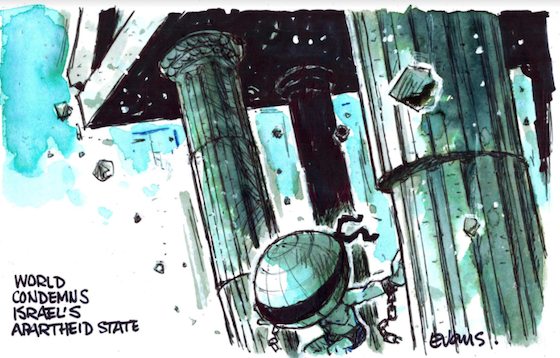
PSNA welcomes declaration of Israel as an apartheid state


Cartoon by Malcolm Evans, originally published in The Daily Blog.
Republished with permission.

By JOHN MINTO

PALESTINE Solidarity Network Aotearoa welcomes Amnesty International’s ground-breaking declaration of Israel as an apartheid state.

Titled “Israel’s Apartheid against Palestinians”, the 211-page report concludes that the occupation state has imposed a “cruel system of domination” and is committing “crimes against humanity.”

“Our report reveals the true extent of Israel’s apartheid regime. Whether they live in Gaza, East Jerusalem and the rest of the West Bank, or Israel itself, Palestinians are treated as an inferior racial group and systematically deprived of their rights. 

"We found that Israel’s cruel policies of segregation, dispossession and exclusion across all territories under its control clearly amount to apartheid. The international community has an obligation to act,” said Agnès Callamard, Amnesty International’s secretary-general.

Wednesday, July 28, 2021

1981 Springbok tour protests retrospective – and now Palestine is the new struggle


1981 Springbok tour protest leaders Ripeka Evans (left) and John Minto speak
to the protesters 40 years on at the restrospective exhibition at the Hamilton Museum -
Te Whare Taonga o Waikato. IMAGE: David Robie/APR

 By DAVID ROBIE

AFTER his release from prison in South Africa and he became inaugural president of the majority rule government with the abolition of apartheid, Nelson Mandela declared in a speech in 1997: “We know too well that our freedom is incomplete without the freedom of the Palestinians.”

Founding Halt All Racist Tours (HART) leader John Minto invoked these words again several times in Hamilton on Sunday as veterans and supporters of the 1981 Springbok Rugby Tour anti-apartheid protests gathered to mark the 40th anniversary of the historic events.

Starting at the “1981” tour retrospective exhibition at the Hamilton Museum – Te Whare Taonga o Waikato, the protesters gathered for a luncheon at Anglican Action and then staged a ceremonial march to FMG Stadium – known back then as Rugby Park – where they had famously breached the perimeter fence and invaded the pitch.

The exhibition features photographs by Geoffrey Short, Kees Sprengers and John Mercer of that day on 25 July 1981 when about 2000 protesters halted the second match of the tour.

Friday, December 6, 2013

Mandela, Indonesia and the liberation of Timor-Leste

Australian and English cricket fans observe a minute's silence for the passing of a global
icon of freedom and justice. Photo: Gurtong Trust
Nelson Mandela, who became one of the world's most beloved statesmen and a colossus of the 20th century when he emerged from 27 years in prison to negotiate an end to white minority rule in South Africa, has died. He was 95. His death closed the final chapter in South Africa's struggle to cast off apartheid, leaving the world with indelible memories of a man of astonishing grace and good humor. - Al Jazeera

In July this year, on the occasion of hs birthday, journalist ABOEPRIJADI SANTOSO wrote this tribute to Mandela’s role in Timor-Leste independence. 

WHEN he turned 95 years old, the late South African president Nelson Rolihlahla Mandela may have reflected on his struggle and his contribution with great satisfaction more than anyone else could. Popularly known as Madiba, he became an icon of freedom, reconciliation and hope the world over.

Much less known is his legacy to help liberate the people of Timor-Leste.

In 1955 Mandela lauded the historic Asia-Africa Conference held in Bandung. Two leading members of the African National Congress (ANC) - including his close ally Walter Sisulu - were there to represent their country.

Indonesia continued its support for the movement and provided the platform for the Asian struggle against apartheid, which Mandela respected.

Mandela, fond of batik shirts, loves Indonesia and visited four times: 1990, 1994, 1997 and 2002. The first time he came he visited the site of Bandung conference and said he was inspired by the Asia-Africa Conference and Sukarno's role.

Saturday, January 10, 2009

Time to target Israel's bloody occupation, says Klein

AFTER the impressive weekend protests in New Zealand - and globally - against the Israeli genocide in Gaza, The Nation has published a thought-provoking article by Naomi Klein on the "boycott, divest and sanctions" campaign that worked so well in bringing down apartheid. She argues:
It's time. Long past time. The best strategy to end the increasingly bloody occupation is for Israel to become the target of the kind of global movement that put an end to apartheid in South Africa.
In July 2005, a huge coalition of Palestinian groups laid out plans to do just that. They called on "people of conscience all over the world to impose broad boycotts and implement divestment initiatives against Israel similar to those applied to South Africa in the apartheid era." The campaign Boycott, Divestment and Sanctions - BDS
for short - was born.
Every day that Israel pounds Gaza brings more converts to the BDS cause, and talk of ceasefires is doing little to slow the momentum. Support is even emerging among Israeli Jews. In the midst of the assault roughly 500 Israelis, dozens of them well-known artists and scholars, sent a letter to foreign ambassadors stationed in Israel. It calls for "the adoption of immediate restrictive measures and sanctions" and draws a clear parallel with the anti-apartheid struggle. "The boycott on South Africa was effective, but Israel is handled with kid gloves.... This international backing must stop."

Pictured: Palestinian women and their large national flag carried at Saturday's Auckland city protest. Note Israel-apartheid links in posters. Photo: David Robie

>>> Popular Café Pacific Posts