A Gabriela poster honouring martyred women during the Marcos martial law
years in the Philippines on display at the AUT film screening. IMAGE:
David Robie/APR
Seven weeks ago the Philippines truth-telling martial law film Katips
was basking in the limelight in the country’s national FAMAS academy
movie awards, winning best picture and a total of six other awards.
Last week it began a four month “world tour” of 10 countries starting
in the Middle East followed by Aotearoa New Zealand on Sunday – hosted
simultaneously at AUT South campus and in Wellington and Christchurch.
The screening of Vincent Tañada’s harrowing – especially the graphic
torture scenes – yet also joyful and poignant musical drama touched a
raw nerve among many in the audience who shared tears and their
experiences of living in fear, or in hiding, during the hate-filled
Marcos dictatorship.
The martial law denunciations, arbitrary arrests, desaparecidos (“disappeared”),
brutal tortures and murders by state assassins in the 1970s made the
McCarthy era red-baiting witchhunts in the US seem like Sunday School
picnics.
Filipinos in the Wellington meeting make their pledge simultaneously
with the Auckland group for “history, truth and democracy” in the
Philippines. IMAGE: Del Abcede/APR
MIGRANTS and overseas Filipinos in Aotearoa New Zealand have called
on the governments of both Australia and New Zealand to halt all
military and security aid to the Philippines in protest over last
month’s “fraudulent” general election.
At simultaneous meetings in Auckland and Wellington, a new broad
coalition of social justice and community campaigners endorsed a
statement pledging: “Never forget, never again martial law!”
“Bongbong” Marcos Jr, the son of the late dictator Ferdinand Marcos
Sr, was elected President in a landslide ballot on May 9 and will take
office at the end of this month.
Philippine
President-elect Bongbong Marcos Jr wooing voters at a campaign rally in
Borongan, Eastern Samar. Image: Rappler/Bongbong FB
His father ruled the Philippines with draconian leadership —
including 14 years of martial law — between 1965 and 1986 until he was
ousted by a People Power uprising.
Sadly, the Philippines has sold its soul. Thirty six years ago a
People Power revolution ousted the dictator Ferdinand Marcos after two
decades of harsh authoritarian rule.
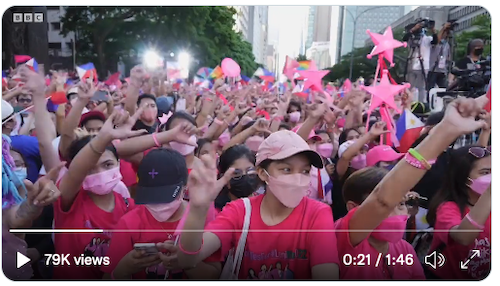
Yesterday, in spite of a rousing and inspiring Pink Power would-be
revolution, the dictator’s only son and namesake “Bongbong” Marcos Jr
seems headed to be elected 17th president of the Philippines.
And protests have broken out after the provisional tallies that give Marcos a “lead of millions” with more than 97 percent of the vote counted. Official results could still take some days.
Pacific
Journalism Review investigation poses questions about the “silence” in
Australia over the controversial Bougainville documentary Ophir that has
won several international film awards in other countries. IMAGE: Ophir
still
A FRONTLINE investigative journalism article on the politics behind
the decade-long Bougainville war leading up to the overwhelming vote for
independence is among articles in the latest Pacific Journalism Review.
The report, by investigative journalist and former academic Professor Wendy Bacon and Nicole Gooch, poses questions about the “silence” in Australia over the controversial Bougainville documentary Ophir that has won several international film awards in other countries.
Published this week,
the journal also features a ground-breaking research special report by
academics Shailendra Singh and Folker Hanusch on the current state of
journalism across the Pacific – the first such region-wide study in
almost three decades.
Griffith University’s journalism coordinator Kasun Ubayasiri has
produced a stunning photo essay, “Manus to Meanjin”, critiquing
Australian “imperialist” policies and the plight of refugees in the
Pacific.
A RATHER beautiful Guåhan legend is rather poignant in these stressed pandemic times. It is one about survival and cooperation.
In ancient times, goes the story, a giant fish was eating great
chunks out of this western Pacific island. The men used muscle and might
with spears and slings to try to catch it.
This didn’t work. So, the women from many villages got together while
washing their hair in a river. They wove their locks into a super
strong net, caught the fish and saved the island.
President
Rodrigo Duterte with the press ... his powers to ban Rappler for two
years challenged
in court. Image: Freeze frame/David Robie
By David Robie in Manila Rappler, the innovative online publisher that has been at
the media freedom frontline in the Philippines for the past three years,
has challenged President Rodrigo Duterte by taking the executive to the
Supreme Court.
The news website has called on the court to rule on whether President Duterte – or the state executive branch – has the power to control the media.
It has asked the court to lift a nearly two-year coverage ban against Rappler for covering events involving President Duterte wherever he is in the Philippines or abroad.
The Rappler video feed on the Ampatuan convictions last month.
For decades, the feared Ampatuan clan held sway in the
impoverished province of Maguindanao in Mindanao in the southern
Philippines. Through a ruthless private army and a reported “propensity
for beheadings”, the clan cultivated a culture of impunity. Now,
however, reports David Robie, a courageous judge has challenged the horror by jailing the masterminds of the 2009 Ampatuan massacre for life. SPECIAL REPORT:By David Robie in Manila
The families of the 58 victims – 32 of them journalists or media
workers – had waited for 10 years for justice in the Philippines.
After so long, what is another couple of hours?
The Ampatuan massacre in Maguindanao
on 22 November 2009 was the world’s worst single attack on journalists
and the worst elections-related violence in a country notorious for
electoral mayhem.
Reporters Without Borders secretary-general Christophe Deloire talks about the global threat against journalists. Video:Café Pacific By David Robie in Paris
WHEN Reporters Without Borders chief Christophe Deloire introduced the Paris-based global media watchdog’s Asia-Pacific press freedom
defenders to his overview last week, it was grim listening.
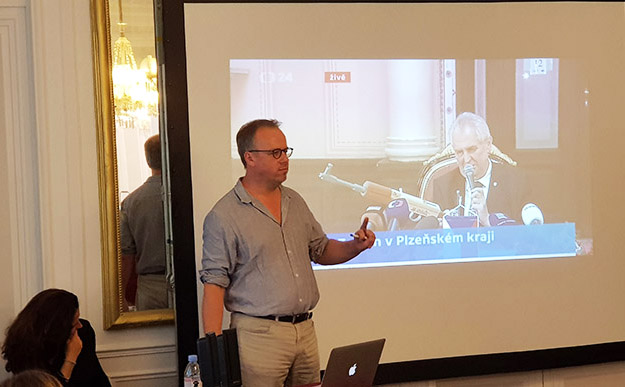
First up in RSF’s catalogue of crimes and threats against the global media was Czech President Miloš Zeman’s macabre press conference stunt late last year.
However, Zeman’s sick joke angered the media when he brandished a dummy Kalashnikov AK47 with the words “for journalists” carved into the
wood stock at the October press conference in Prague and with a bottle of alcohol attached instead of an ammunition clip.
RSF’s Christophe Deloire talks of the Czech President’s anti-journalists gun “joke”.
Image: David Robie/PMC
Zeman has never been cosy with journalists but this gun stunt and a recent threat about “liquidating” journalists (another joke?)
rank him alongside US President Donald Trump and the Philippines
leader, Rodrigo Duterte, for their alleged hate speech against the
media.
Rappler’s CEO and executive editor Maria Ressa says that the Philippine government spends a lot of effort to turn journalism into a crime which shouldn’t be the case. Video: Rappler
Three United Nations special rapporteurs have added their voice to the global protests this week over the President Rodrigo Durterte government bureaucracy’s attack on the independent online news website Rappler and a free press in the Philippines.
Rappler has been the latest media target for the administration’s wrath over a tenacious public interest watchdog that has been relentless in its coverage of the republic’s so-called “war on drugs” and state disinformation.
Some media freedom advocates claim that the Philippines is facing its worst free expression and security crisis since the Marcos dictatorship, with The New York Times denouncing the “ruthlessness” and “viciousness” of Duterte’s disdain for democracy.
The death toll in the extrajudicial spate of killings range between 3993 (official) and more than 12,000 since Duterte took office on June 30, 2016, according to Human Rights Watch.
MOUNTING calls for the Philippines president to be investigated over the allegations of human rights violations deepened over the weekend with revelations by a confessed hit man that at least 1000 extrajudicial killings had been ordered when the president was mayor of the southern city of Davao.
Fresh reports featuring the allegations were included in a cover story in the latest Time magazine, the Singapore Sunday Times and a new inquiry by the Philippine Center for Investigative Journalism into the so-called “Davao Death Squad”.
It is only 80 days since President Rodrigo Duterte was sworn into office, and the PCIJ reports that he now “commands an armed contingent that is a hundred times bigger than it was in Davao, and his ‘enemy’ a thousand times more numerous”.
More than 3000 people have reportedly been killed so far in the so-called Project Tokhang – or “Double barrel” - war on drugs. The president has also called for a six-month extension on his policy, claiming that the drugs business is largely "operated by people in government".
Time magazine branded its report the “killing season” in the Philippines with a subheading of “Inside President Rodrigo Duterte’s war on drugs”.
A grim reminder of the Maguindanao, or Ampatuan, massacre on 23 November 2009. Photo: DanRogayan
A TOP Filipino investigative journalist will be speaking about the “worst attack” on journalists in history and her country’s culture of impunity in a keynote address at a media education conference at AUT University next week.
Ces Oreña-Drilon, an anchor for the ABS-CBN flagship current affairs programme Bandila, has been investigating the 2009 Maguindanao massacre when 32 journalists were among the 58 people killed in the atrocity carried out by private militia recruited by a local warlord.
She has been reporting on the controversial legal and political contest around the massacre with nobody yet having been successfully prosecuted out of almost 200 people charged over the killings.
An update on Ces Oreña-Drilon and the Maguindanao massacre investigation. Her justice corruption allegations have led to a National Bureau of Investigation inquiry. Video: GMA News
PACIFIC JOURNALISM REVIEW, the only politics and media research journal in New Zealand and the Pacific, will host an international conference late next month marking its 20th anniversary of publication.
With the overall theme of “Political journalism in the Asia-Pacific”, many editors, investigative journalists, documentary makers, human rights advocates, media freedom activists and journalism educators and researchers will be converging on Auckland for the event at AUT University on November 27-29.
One of the keynote speakers at PJR2014, television journalist Ces Oreña-Drilon of ABS-CBN and an anchor for the celebrated current affairs programme Bandila, will give an address on the killings of journalists with impunity in the Philippines.
She has been investigating the 2009 massacre of 34 journalists by private militia while they were accompanying a candidate’s entourage to register for elections and she has a grim story to tell in her “Losing the landmark Maguindanao massacre case” presentation about the legal and political fallout from the tragedy.
She is attending the conference with the support of the Asia New Zealand Foundation.
Participants in today's University of the South Pacific media freedom forum chaired by
Stanley Simpson (centre), founding editor of Wansolwara. Image: USP Livestreaming
Criminal cyber defamation, journalist killings with impunity and legal gags are growing threats to Asia-Pacific press freedoms, writes educator David Robie on World Media Freedom Day.
ONE OF Fiji’s best investigative journalists and media trainers ended up as a spin doctor and henchman for wannabe dictator George Speight. Like his mentor, he is now languishing in jail for life for treason.
Some newshounds in Papua New Guinea have pursued political careers thanks to their media training, but most have failed to make the cut in national politics.
A leading publisher in Tonga was forced to put his newspaper on the line in a dramatic attempt to overturn a constitutional gag on the media. He won—probably hastening the pro-democracy trend in the royal fiefdom’s 2010 general election.
The editor of the government-owned newspaper in Samoa runs a relentless and bitter “holier than thou” democracy campaign against the “gutless” media in Fiji that he regards as too soft on the military-backed regime. Yet the editor-in-chief of the rival independent newspaper accuses him of being a state propagandist in a nation that has been ruled by one party for three decades.
In West Papua, Indonesia still imposes a ban on foreign journalists in two Melanesian provinces where human rights violations are carried out with virtual impunity. Journalists in the Philippines are also assassinated with impunity.
COPYCAT cybercrime laws designed to curb freedom of expression on social media and independent blog news sites are becoming a major threat to the Asia-Pacific region.
Café Pacific today publishes a video from the book launch of David Robie's new book Don't Spoil My Beautiful Face: Media, Mayhem and Human Rights in the Pacific, which raises these issues.
Speakers at the event included the AUT Dean of Creative Technologies, Professor Desna Jury; Wiremu Tipuna, Takawaenga Māori at AUT (Ngati Kahungunu); Dr Steven Ratuva, president of the Pacific Islands Political Studies Association (PIPSA); publisher Tony Murrow of Little Island Press; and Pacific Islands Media Association (PIMA) chair Sandra Kailahi.
TV New Zealand's Pacific correspondent, Barbara Dreaver, sent a "launch" message which was read out by Kailahi.
I NEED to tell you: Typhoon Haiyan was worse than any of us could ever have imagined. The Philippines receives 20+ typhoons every year - floods, landslides and partly-blown off roofs are par for the course.
Believe me when I say we have never before seen the likes of Yolanda /Haiyan.
I need to tell you: Everyday, I read the news and reports from the field, thinking we've reached the bottom of suffering and despair, only to find new depths.
Just when I think my heart can't break any further from the stories of loss and tragedy, something new turns up to break it all over again.
I need to tell you about the bodies decomposing on tree branches, under piles of rubble from collapsed houses, in churches, on the sides of roads, wrapped in blankets or straw mats.
I need to tell you that the news cameras cannot show their faces - features frozen in fear as they died.
I need to tell you about the storm surge - the 6-metre wall of water that rose out of the sea, rushed several kilometres inland and crashed over every building and house by the coastline.
You need to understand that our nation is made up of 7107 islands; nearly everything is by the coastline.
ACTIVISTS holding a key international conference in the Philippines this month opposing greater planned United States military presence in Asia, have accused the US of being responsible for rapes, killings and environmental destruction that go unpunished.
Dyan Ruiz, a co-producer of a Real News programme about the conference, has warned of the impact of a new wave of US militarisation in Asia.
The International Conference on the "US Pivot" to Asia-Pacific: US Militarism, Intervention and War was attended by nearly 60 delegates from 13 countries, including Australia, Japan, the Philippnes and South Korea.
Renato Reyes Jr, secretary general of Bayan, a Philippine progressive political organisation and a lead organiser of the conference, said: "It's high time that the people in Asia [should] be allowed to determine their own course and to chart own direction and their own foreign policy free from any dictates of the United States.
Producer Ruiz said: "Despite the support of their own respective governments, the delegates see US military intervention as a violation of their countries' sovereignty.
THE RISING possibility of a warmer world in the next two decades is magnifying the development challenges South-East Asia is already struggling with, and threatens to reverse hard-won development gains, says a new scientific report just released by the World Bank Group cited on Pacific Scoop.
Turn Down the Heat: Climate Extremes, Regional Impacts and the Case for Resilience was prepared for the World Bank by the Potsdam Institute for Climate Impact Research and Climate Analytics. It builds on a World Bank report released late last year, which concluded the world would warm by 4 degrees Celsius above pre-industrial levels by the end of this century without concerted action now.
This new report looks at the likely impacts of present day (0.8°C), 2°C and 4°C warming on agricultural production, water resources, coastal ecosystems and cities across Sub-Saharan Africa, South Asia and South-East Asia.
"South East Asia" includes the western Pacific (PNG and Timor-Leste) - Brunei, Cambodia, Indonesia, Laos, Malaysia, Myanmar, Papua New Guinea, the Philippines, Singapore, Thailand, Timor-Leste and Vietnam.
“This new report outlines an alarming scenario for the days and years ahead ¬ what we could face in our lifetime,” says World Bank Group president Jim Yong Kim.
Former New People's Army guerrilla Vanessa Delos Reyes talks to the author,
Cameron Walker, in hospital. Image: Cameron Walker/PMC
AT FIRST it was difficult to adapt to life as a guerrilla. Living in the mountains brings its own set of challenges. New recruits must get used to building temporary shelter, known as "postings". Now Vanessa Delos Reyes is grappling with life in support of detainees after a crippling spinal wound.
At the Southern Medical Centre of the Philippines in Davao City, I visited Vanessa Delos Reyes, a 27-year-old former guerrilla of the New People’s Army (NPA).
Vanessa is undergoing physical therapy to restore movement to her lower body after suffering a bullet wound to the spine while carrying an injured colleague to safety during an attack by the Armed Forces of the Philippines’ Scout Rangers in 2011.
She had been a member of the NPA, the armed wing of the Communist Party of the Philippines, since 2006.
Before arriving at the hospital, I had been told to expect to be searched by armed guards. Instead, I was greeted with warm smiles and handshakes by Vanessa’s parents and a Catholic nun who is in charge of the hospital ward.
THE PHILIPPINES government has admitted before the Supreme Court that liking, sharing libelous Facebook and Twitter posts can make one person criminally liable, prompting a judge to say that it creates a "chilling" effect.
“It is not an excuse that thousands of defamatory statements are on the internet. Then, we have to scrap the law,” Solicitor-General Francis Jardeleza said during a hearing last week about the controversial Cybercrime Prevention Act.
A restraining order of implementation of the 2012 law - dubbed "e-martial law" because of its repressive restrictions on freedom of speech - had been due to be lifted today.
“Defamation is defamation whether we communicate through megaphones, letters, person to person, tweets, Facebook or e-mail,” Jardeleza added.
Associate Justice Roberto Abad said that with the criminal liability that the new law creates, “it will make me now reluctant to express my view.”
The Anonymous view of the Filipino digital danger.
IN HIS recent AUT University inaugural professorial about global media truth, transparency and accountability, David Robie condemned the new so-called e-Martial Law in the Philippines, saying it was a warning for the Pacific.
“The most disturbing trend in the digital age is electronic martial law - a draft new law in the Philippines which criminalises e-libel in an extreme action to protect privacy,” he said.
“The Supreme Court has ruled to temporarily suspend this law. But what happens next? Will it be ruled unconstitutional or will the politicians prevail?
“This Cybercrime Prevention Act 2012 is like something out of the Tom Cruise futuristic movie Minority Report. An offender can be imprisoned for up to 12 years without parole and the law is clearly a violation of Article 19 of the International Covenant on Civil and Political Rights.
“And truth is not recognised as a defence.
“It would be disastrous if any Pacific country, such as Fiji, wanted to do a copycat law and gag cyberspace.”
Professor Robie highlighted the fact that in the Philippines at least 165 journalists have been murdered since 1986 – 32 of them in the Ampatuan massacre in Mindanao in 2009, the world’s worst single killing of journalists.
Three years later nobody has been convicted for these atrocities.
“The Philippines is a far more dangerous place for the media under democracy than it was under the Marcos dictatorship,” Professor Robie said. “There is a culture of impunity.”
In a joint statement by independent digital and online media, communications and journalism schools and media people in the Philippines, a strong attack has been made on the “cyberspace outrage”.
As outrage against the Cybercrime Prevention Act 2012 continues to snowball and create unprecedented unity and defiance among netizens, the Aquino administration has not backed down in its resolve to implement a clearly draconian measure designed to curtail our most basic civil liberties—the right to freedom of expression, of speech, and of the press.
As alternative media practitioners, filmmakers, bloggers, and artists who maximise the new media to bring to the public information, opinion and analysis, as well as works of art that serve to illuminate social conditions and present ideas for social change, we believe that the government’s repression of the medium is the message. With the Cybercrime Act, the government wants to ensure that no avenue for expression exists that is free from control by the rich and powerful elite.
The existing law on libel has long been used by powerful public figures mostly to harass and prosecute journalists for doing their job. Instead of decriminalising libel as urged by international human rights and media institutions, the government has even increased penalties. Worse, it now considers each and every citizen who uses Information and Communications Technology (ICT) as potential criminals.
With the rise of new media, ordinary citizens have been given the extraordinary power to reach large audiences, a power that has previously been the monopoly of the government and corporate media. The new media has been the recourse of citizens who see, report, and interpret social realities that traditional institutions ignore, hide or obliterate.
Citizens have long been marginalised from discourse on national issues through the agenda-setting powers of the government and corporate media. Through the new media, citizens have the opportunity to counter this marginalisation—to give voice to the poor and oppressed, to gain an audience without the need for huge capitalization, to criticise freely and creatively.
We believe that the Cybercrime Law is primarily a tool that exploits the rise of the new media and the use of ICT to suppress dissent and spy on citizens. The way the law is being defended by those who crafted it, and especially by the President who signed it, reveals that they enjoy, and will use to their own interest, the immense powers that the Cybercrime Law has given the government, such as the ability to take down websites, undertake surveillance, and seize electronic data.
Abuses that will surely arise from such powers will undermine any gains that this law claims to have against “cybercrimes.” For instance, online child pornography and sex trafficking should be addressed by the strict implementation and strengthening of existing laws to reflect the developments in ICT.
It is still debatable if hacking and cracking, spamming, online piracy, and cyberbullying are indeed crimes or if they can be covered under a single piece of legislation. What is clear is that these “cybercrimes” will not be addressed by a law makes expressing oneself online punishable by a jail term, or one that assumes that authorities can dip their hands into private electronic communication.
In other words, a law that throws us back to the dark ages won’t protect our women and children, nor our personal identities and safety. On the contrary, it makes every citizen using ICT vulnerable to abuse by the biggest band of criminals: a government that is corrupt, loathes criticism (as can be judged by President Aquino’s reaction to the online phenomenon ‘Noynoying’), and uses all of its resources to crush dissent.
Even the US government—the footsteps of which the government only follows—did not confer such broad powers unto itself when it attempted, but failed, to pass its Stop Online Piracy Act and Protect Intellectual Property Act.
However, the Cybercrime Law probably pleases the US government, as it strengthens their existing network of surveillance in the country, and boosts the counter-insurgency programme Oplan Bayanihan. The said law also pleases local and foreign big businesses that operate in utter secrecy in this country, further shielding them from public accountability and oversight while penalising those who use ICT to expose wrongdoing and abuses in the private and public sectors.
For e-martial law only reflects the de facto martial law already in place. Under Oplan Bayanihan, more than 100 citizens have been killed for their advocacies, forever silenced by bullets. More than 350 are imprisoned for their political beliefs. The Cybercrime Law makes it even easier to slap dissidents with trumped-up charges and send them to jail. After all, it now takes so little to be considered a cybercriminal.
Repression and lack of freedom is a daily reality for millions of Filipinos in the militarised countryside, violently demolished urban poor communities, and highly controlled workplaces and schools. Now it has become a daily reality as well for netizens who seek comfort in the freedom, however limited, of the new media.
As poverty, exploitation, and repression worsen, the duty to speak up and express ourselves through new media is more necessary than ever. As we begin to feel the grip of Aquino’s iron fist rule, it becomes more urgent to struggle to break free through actions both online and offline. E-martial law has been declared, and as those who fought the Marcos dictatorship taught us, the only way to end it is to start defying it.
Junk the Cybercrime Prevention Act of 2012! Don’t criminalise criticism! Defend our freedom of expression, speech and the press! Resist tyranny!
Independent digital media supporters: Pinoy Weekly Online/ PinoyMedia Center Bulatlat.com Davao Today Northern Dispatch Weekly Burgos Media Center Mayday Multimedia Tudla Productions Kodao Productions Southern Tagalog Exposure UPLB Zoomout