Showing posts with label mark davis. Show all posts
Tuesday, July 23, 2013
The horrors of PNG's Manus Island - by a whistleblower
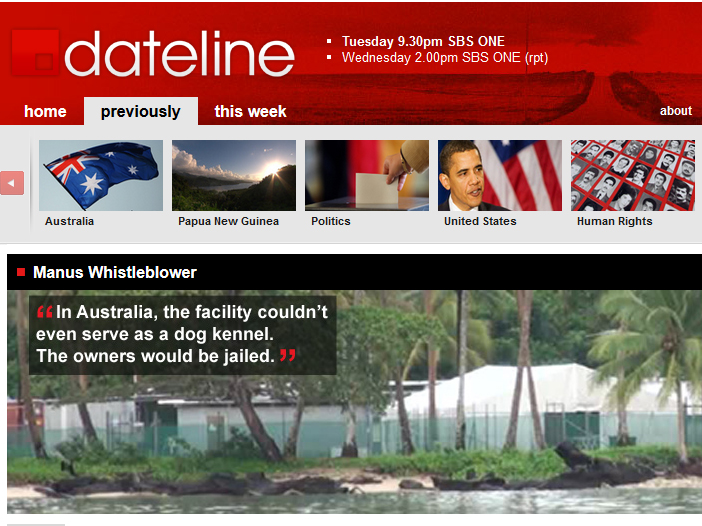
TONIGHT'S SBS Dateline programme has an exclusive insight - Manus Whistleblower - into the horrors of life within Australia’s refugee centre at Manus Island in Papua New Guinea.
Reporter Mark Davis speaks to a detention centre whistleblower, who has explosive allegations of detainees being sexually abused and tortured by other asylum seekers.
With no facilities to segregate or remove the abusers, Mark hears of the desperation for those continually being abused while waiting months for their asylum applications to be processed … attempted suicides and self-harming are said to be an "almost daily" occurrence.
The allegations come as the Australian government announces all asylum seekers arriving by boat will be processed and resettled in Papua New Guinea, with the Manus centre to be expanded.
Dateline's whistleblower interview follows Mark’s disturbing story two months ago about life at Manus Island, when Australian officials at the detention centre went to great lengths to stop him filming.
Friday, August 7, 2009
Media freedom and dealing with the Fiji regime's gag
THE EXPECTED fallout from PINA 2009 has been fast flowing since the two-yearly regional media circus. Many rifts were on show long before the conference began in Port Vila late last month - for example, the criticisms of PINA's recent lukewarm actions over regional media freedom and the founding of the successful upstart Pacific Freedom Forum by PINA dissidents; the hostility between the conference hosts, Media Asosiesen blong Vanuatu (MAV) and the country's main newspaper, Vanuatu Daily Post, and publisher Marc Neil-Jones; and the calls for PINA and Pacnews to be relocated outside of Fiji as a protest against the regime's media censorship. The election of MAV preside
nt Moses Stevens as PINA president only served to fuel the animosity. Stevens was elected ahead of talented Stanley Simpson of Fiji's Mai TV, an innovative graduate of the University of the South Pacific, to take the regional body forward for the next two years. He cited training for young journalists as a policy priority and also hinted at the possibility of Australian and NZ media groups being allowed to fully join PINA. Reflecting on the conference's results, Matangi Tonga editor Pesi Fonua wrote:What appeared to be a sincere intention by the former PINA board to turn its biannual convention into a Pacific Media Summit under the theme "Breaking Barriers - Access to Information'" did not live up to expectations.Café Pacific's correspondents report that the meeting became quite tense when it was realised that two military censors - both women - had been invited and were present. The mood was becoming ugly, with some people questioning why the censors were there - how dare PINA invite them?
Despite the great effort to attract as many participants as possible to attend the Vanuatu PINA inaugural summit, their contributions did not see the light of day, because most participants were not permitted to attend the AGM, and so some serious observations made by working journalists and media people were not translated into the decision-making process.
Cook Islands News editor John Woods (elected vice-president as the Cook Islands is hosting the next conference) was a particularly strong critic. He wanted the pair to be barred from the meeting. He said their presence would have a chilling effect on Fiji journalists and discourage them from speaking their minds. Woods described their presence there as "despicable". However, some journalists thought the whole issue rather over-dramatised and that it was important to get an insight into the thinking of the Fiji censors - one of them even a former journalist.
One leading regional journalism educator, Shalendra Singh, is head of journalism and media at the University of the South Pacific. He is a former news magazine editor and is committed to all sides of the story. He defended the women's right to speak as representatives of Fiji's Ministry of Information (a PINA member, although there was some doubt over whether the Minfo was actually paid up).
"Talk about shooting the messenger! The irony is staggering," Singh said later. He said the women should be allowed to speak. The conference should not do to the women what the regime administration in Fiji had done in gagging the media. Singh also mentioned that journalism was about balance and getting all sides of the story. It was an opportunity to put the regime representatives under the spotlight and question them. He said journalists should practise freedom of expression, not just preach it. Singh also described how Fiji was facing draconian censorship and there was a danger that people might become used to the status quo.
Some views changed then and other people present, such as Lisa Williams-Lahari, founding coordinator of the Pacific Freedom Forum, spoke in favour of the women speaking but only in a session about censorship under a military regime, not this one devoted to regional stories of media freedom under fire. She also strongly asked the censors during the Q and A whether they felt Minfo should withdraw as a PINA member without waiting for PINA expulsion. Another panellist, Fiji Times editor-in-chief Netani Rika, walked out in protest at the presence of the censors after his presentation. (He was awarded the region's media freedom prize).
Only one journalist - Dev Nadkarni, a former USP journalism coordinator - commenting on this contentious issue noted the fact that one of the regime's representatives, Lance Corporal Talei Tora, was in fact educated on the USP regional journalism programme and herself a former broadcaster. Tora was well-trained in rigorous journalism skills and freedom of speech. But now as a soldier - one of Fiji's pioneering women officer cadet recruits - she follows military orders. Her elder sister, Luisa Tora, is also an award-winning journalist and long a free speech advocate.
Corporal Tora raised issues of media bias in Fiji, of media paying journalists badly and exploiting them, and other shortcomings - but these issues were not discussed at all. Media in the Pacific does not like to discuss criticism that is leveled at it - as Café Pacific has noted often in the past. There is no critical self-scrutiny as there should be at such meetings - or as happens in many other countries that have challenging "media watch" style radio and television programmes, such as Media 7 in New Zealand. Pacific media too often just plays the victim.

Café Pacific understands that some mention of Pacific Media Centre director associate professor David Robie's past research on Fiji media at the time of the Speight coup was cited - the detailed findings were published in his 2004 USP book Mekim Nius: South Pacific media, politics and education. In Nadkarni's review of freedom of speech issues at the PINA convention, he wrote:
[Corporal Tora] said she was a civil servant and had a job to do and pointed to a number of cases of inaccurate reporting (for which several of the media outlets have since apologised).Freedom of speech cuts both ways. If media bleatings over the gagging of Fiji news organisations are to be taken seriously in global contexts, then a major effort needs to be taken by the region's journalists to be fully informed about the complexities of Fiji politics and to report with more insight and balance and to defend open dialogue. Ironically, two of the best reports to come out of Fiji in recent times have not been from Pacific media at all but by Australian-based investigative journalists Graham Davis and Mark Davis for their attempts to give the "other side of the story" of Bainimarama's claimed plan for genuine democracy shorn free of racism.
The questions flew thick and fast: Would she and her colleague be reporting the proceedings to their military bosses? Would the emergency regulations apply to Fiji journalists now they were in a different country? Would they be liable to action? Tora stood her ground and answered questions with confidence, although she used her comparatively junior rank to express inability to comment on the more sensitive matters.
Pictured: Fiji Times editor Netani Rika speaking at the PINA convention - he was awarded the PINA media freedom award for his defence of free speech in Fiji; Moses Stevens. Photos: Fiji Times; MAV.
- Media Asosiesen blong Vanuatu
- Media management at PIF - Sean Dorney
- PINA fails to stand up for media freedom - Pesi Fonua
- Fiji's isolation and PINA - Dev Nadkarni
- Fiji's Frank Bainimarama - Graham Davis
- Perfectly Frank - Mark Davis
- Mekim Nius: South Pacific media, politics and education - Amazon Books | USP, Fiji
- Pacific Media Watch
Wednesday, August 5, 2009
Taking a breather - and giving Fiji a break
BACK from a month's sojourn in remote corners of Bora Bora, Papenoo and Maui and far busier moments in Alcatraz, Sausalito and Santa Monica, Café Pacific's publisher David Robie is refreshed and back in the thick of things. It was a delight being immersed in the stacks of quality newspapers (albeit endangered) in San Francisco after the paucity of a good press in NZ. Among the many colleagues encountered in the travels were Tagata Pasifika's Adrian Stevanon and Tagaloatele Osone Okesene on the ground in Pape'ete. Café Pacific missed the special Balibo film screening of the long-awaited story of the murder of six journalists in East Timor in 1975 at the Auckland Film Festival (a couple of days after the Melbourne premiere), but it's a delight to see that it is getting such a positive reception.After a brief homecoming stopover in Fiji - thanks to Air Pacific - David was thrust back into the complex post-coup issues that cast a shadow over the Pacific. First the PINA media flop last week and now the Cairns "free trade" jackup prelude to the Pacific Islands Forum. Good to see the recent Mark Davis Dateline interview with Commodore Voreqe Bainimarama, which included some pithy insights into the "
one person, one vote" mantra to repel three decades of a racist and corrupt so-called democracy.It is also worth sharing this recent dispatch from NZ-based German journalist Ulli Weissbach. He doesn't run his own blog, so here's his personal perspective (abridged) directed to "friends and foes" alike following a three-week research trip:
Part of my job in Fiji was to prepare the ground for a German TV foreign affairs programme on Fiji. I had a chat with government spokesperson Lt Col Neumi Leweni, who assured me there would be absolutely no problem for the German TV crew entering Fiji and interviewing the "evil dictator".Pictures: Top: Newspapers in San Francisco; Middle: A Bora Bora pareo; a Tagata Pasifika crew in Pape'ete. Photos: David Robie
Experience 1: I actually saw him once, entering the lobby of the Holiday Inn hotel in Suva. No heavily armed bodyguards around him, just a guy in a plain suit. If a waitress at the bar hadn't pointed him out to me "Look, there's Frank", I wouldn't have noticed him. Now, dear friends and foes, do you think an evil dictator, who is hated by half of the country, would dare to walk into the public arena without bodyguards?
Experience 2: I talked to an Indian girl working at a Denarau Hotel and asked her how she feels under Frank's dictatorship. She said she actually feels better, because she can now safely walk the streets of Nadi at night. The crime rate has come down considerably since Frank took over, which is backed by official statistics as well.
Experience 3: I circumnavigated the whole of Viti Levu without seing one military checkpoint, except for Nadi airport. Dear colleague Barbara Dreaver, can you please stop peppering your Fiji reports with outdated checkpoint footage from TVNZ's archive?
Experience 4: Along the road I saw a lot of Methodist Church gatherings, where priests thundered through loudspeakers to their congregation. I can't prove it but it all sounded too familiar to me and reminded me of the time when I worked in Fiji at the end of the 1980s. Back then, a Reverend called Lasaro was the chief ideologist of the fundamentalist Methodist Church and incited indigenous Fijians to burn down Hindu temples and mosques. He's still the chief mullah of the Methodist Church and it makes perfect sense to me that Frank is trying to constrain him and his other mullahs. The Methodist Church was behind all the coups before Frank, it is a highly politicised organisation with close ties to the ultra-nationalistic and racist Taukei movement. I call them the Fiji Nazis.
Experience 5: The tourism industry is doing rather well, due to a lot of Australians and Kiwis ignoring their countries' negative travel advisories. But still they are hurting and hotels are cutting jobs, which proves, that sanctions only hurt the little people, not the government they are aimed at. Same with the sugar cane industry, where EU sanctions and the cutting of subsidies will hurt the little people - ie. Indo-Fijian farmers.
Experience 6: Yes, newspapers and other media are constrained and intimidated and no journalist can agree with that. Yet many of them are Australian-owned and follow their own agenda. NZ journalists who are banned from Fiji, like "Pacific commentator" Mike Field and TVNZ reporter Barbara Dreaver, have only themselves to blame. Mike Field has been found guilty of inaccurate comments about Fiji by the BSA (Broadcasting Standards Authority). And Barbara Dreaver filed a report about poverty in the goldmine town of Vatukoula, which was highly inaccurate...
If that's the quality of NZ journos reporting about Fiji, who can blame the Fiji government for wanting to keep them away?
Experience 7: During my Fiji trip, Commodore Bainimarama held a widely publicised speech to the nation about his Strategic Framework for Change, which outlined his envisaged roadmap to elections and democracy. It reflected many of the goals of his proposed People's Charter for building a better Fiji, which has been rubbished repeatedly by Mike Field and consorts as an "idealistic" document.
Idealistic - yes, it's in the nature of constitutions that they promise a better future for their people. But criticising it from a country that doesn't have a constitution and a fair non-racial electoral law is a bit rich. None of these commentators and journalists has bothered to properly inform New Zealanders about the constitutional process in Fiji. Read the People's Charter and make your own judgment. Some of it's principles would suit NZ as well - like equal voting rights for every citizen no matter what his ethnicity is.
Conclusion: We can judge Bainimarama in 2014, when his promised elections will be held. It took my own home country Germany four years to develop and agree to a truly democratic constitution after WW2. And guess who forced it to do so - the military government of the occupying forces (USA, GB and France)?
So please: GIVE FIJI A BREAK!
Fiji People's Charter
PINA summit fails to stand up for media freedom
Perfectly Frank interview [transcript]
Perfectly Frank [video 20m 09s]
Subscribe to:
Comments (Atom)
>>> Popular Café Pacific Posts
-
Photo: Del Abcede / PMC THE MOST astonishing unreported story in this week’s Pacific Island Forum in Auckland was a remarkable shift by the ...
-
New Zealand Labour MPs Louisa Wall and Kris Fa'afoi, a former journalist, speaking about the Marriage Amendment Bill and Pacific cul...
-
MELBOURNE-based Fiji academic and commentator Dr Mosese Waqa (caricature) had some kind words to say about the Pacific Scoop coverage of th...
-
AWARD-WINNING filmmakers Annie Goldson ( Brother Number One, An Island Calling ), and Kay Ellmers ( Canvassing the Treaty, Polynesian Panth...
-
The arrests of more than 1600 protesters in West Papua earlier this week are part of a broader systematic oppression of Papuans by the I...
-
Greenpeace activists create a solar symbol around a world-famous Paris landmark, the Arc de Triomphe. © Greenpeace OPINION: By Kum...
-
This picture taken on January 18, 2015 shows a giant half-broken pencil near the headquarters of French satirical newspaper Charlie ...
-
University of Papua New Guinea's Emily Matasororo ... in the bac k ground, images of heavily armed police shortly before they opene...
-
Rongelap islanders with their belongings approach the Rainbow Warrior in May 1985. Image: (c) David Robie SPECIAL REPORT: By David Rob...
-
Two Indonesian Air Force military policemen stomping on the head of a deaf Papuan teenager, Steven Yadohamang, in the Merauke region on 26...