NZ
pilot Philip Mehrtens with some of his West Papuan rebel captors . . .
hopes for his release as with the hostages in neighbouring Papua New
Guinea. IMAGE: TPNPB video screenshot APR
TWO countries. A common border. Two hostage crises. But the responses
of both Asia-Pacific nations have been like chalk and cheese.
On February 7, a militant cell of the West Papua National Liberation
Army (TPNPB), the armed wing of the Free Papua Organisation (OPM) — a
fragmented organisation that been fighting for freedom for their
Melanesian homeland from Indonesian rule for more than half a century —
seized a Susi Air plane at the remote highlands airstrip of Paro,
torched it and kidnapped the New Zealand pilot.
It was a desperate ploy by the rebels to attract attention to their
struggle, ignored by the world, especially by their South Pacific near
neighbours Australia and New Zealand.
Many critics deplore the hypocrisy of the region
which reacts with concern over the Russian invasion and war against
Ukraine a year ago at the weekend and also a perceived threat from
China, while closing a blind eye to the plight of the West Papuans – the
only actual war happening in the Pacific.
Papuan independence rebels are playing a desperate game of cat and
mouse with Indonesian authorities over their hostage taking last week
with a New Zealand pilot caught in the middle.
Christchurch-raised Philip Mehrtens, 37, a pilot for the national
feeder airline Susi Air owned by a former cabinet minister and with
Jakarta government supply contracts, was seized by rebels last Tuesday,
February 7, shortly after he had touched down at the remote Paro
airstrip near Nduga in the Papuan highlands.
Five Indigenous Papuans on board the aircraft were set free and the plane was set on fire.
After initial reports saying the authorities were trying to pinpoint
the actual place where the rebels are in hiding and that a rescue
operation is under way, the West Papua National Liberation Army (TPNPB)
played a trump card today by releasing “proof of life” video footage and photos.
“Papua Merdeka!,” said Mehrtens in one of the obviously coached video
messages. “The Papuan military have taken me captive in the fight for
Papuan independence,” he added hesitantly while surrounded by a group of
armed rebels.
When Papuan journalist Victor Mambor visited New Zealand almost nine
years ago, he impressed student journalists from the Pacific Media
Centre and community activists with his refreshing candour and courage.
As the founder of the Jubi news media group, he remained defiant that he would tell the truth no matter what the risk while facing an oppressive and vindictive regime.
“Journalists need to break down the wall and learn freely about our struggle,” he said in a message to New Zealand media via an interview with Pacific Media Watch.
Now the 49-year-old journalist and editor finds that the risks are
growing exponentially as his media network has expanded — with an
English language website and Jubi TV becoming add-ons — and the exposure of his networks have also widened.
He writes for the Jakarta Post, Benar News and contributes to international news services. Two years ago he was also co-producer of an award-winning Al Jazeera 101 East documentary about the plunder of West Papuan forests for oil palm plantations.
Police gather evidence near the site of a bomb explosion that took place
outside the house of Jubi editor Victor Mambor, in Jayapura, Papua,
Indonesia, on 23 January 2023. IMAGE: AJI for BenarNews
By DANDY KOSWARAPUTRA and PIZARO GOZALI IDRUS Pacific Media Watch
A VETERAN journalist known for covering rights abuses in Indonesia’s
militarised Papua region says a bomb exploded outside his home yesterday
and a journalists group has called it an act of “intimidation”
threatening press freedom.
No one was injured in the blast near his home in the provincial
capital Jayapura, said Victor Mambor, editor of Papua’s leading news
website Jubi, who visited New Zealand in 2014.
Police said they were investigating the explosion and that no one had yet claimed responsibility.
Anjum Rahman, project lead of the Inclusive Aotearoa Collective Tāhono .
. . “If our democracy fails, all those other things fail as well.” IMAGE: David Robie/Asia Pacific Report
A human rights advocate has appealed for people in Aotearoa New
Zealand to take personal responsibility in the fight against
disinformation and to upskill their critical thinking skills.
Anjum Rahman, project lead of the Inclusive Aotearoa Collective Tāhono,
said this meant taking responsibility for verifying the accuracy and
source of information before passing it on and not fuelling hate and
misunderstanding.
“Our democracy is very fragile,” she warned while delivering the annual David Wakim Memorial Lecture 2022 with the theme “Protecting Democracy in an Online World” at Parnell’s Jubilee Hall.
She said communities were facing challenging and rapidly changing
times with climate change, conflicts, inflation and the ongoing
pandemic.
“If our democracy fails, all those other things fail as well,” she said.
“And for those of us who are more vulnerable it is a matter of life and death.
“Who most stand to lose their freedom if democracy fails? Who will be on the frontline to be exterminated?”
Rahman is co-chair of the Christchurch Call Advisory Network and a
member of the Independent Advisory Committee of the Global Internet
Forum for Countering Terrorism.
Argued strongly for diversity
As an advocate, she has argued strongly for many years in support of
diversity and inclusion and in 2019 was made a member of the New Zealand
Order of Merit.
On the third anniversary of the 15 March 2019 mosque massacre, she wrote in a column for The Spinoff that “we don’t need any more empty platitudes of sorrow . . . we need firm action and strong resolve. Across the board.”
The David Wakim Memorial Lecture 2022. Video: Billy Hania
The recommendations of the Royal Commission of Inquiry were more critical now than ever, and absolutely urgent, she wrote.
“In a world that feels chaotic, with war, rising prices, anger and
hate expressed in protests across the world, our hearts seek a certainty
that isn’t there.
“We need more urgency, and in many areas. I’m still disappointed with the Counter-Terrorism legislation passed last year, granting greater powers without evidence of any benefit. Hate speech legislation has been delayed, and we await a full review and overhaul of the national security system.”
A founding member of the Islamic Women’s Council of New Zealand,
Rahman gave a wide-ranging address tonight on the online challenges for
democracy, and answered a host of questions from the audience of about
100.
“I’m really worried about trolls,” said one. “They affect government,
they influence voters, they have an impact on all sorts of decision
making – what can be done about it?”
Rahman replied that it was very difficult question – “I wish there was a simple answer.”
The audience at the Pax Christi-hosted David Wakim Memorial Lecture 2022 at Parnell’s Jubilee Hall. IMAGE: David Robie/APR
Removing troll incentives
She said there needed to be more education and greater awareness of the
activities of trolls and the sort of social media platforms they
operated on.
One problem was that the more attention paid trolls got, it often meant the more money they were getting.
A challenge was to remove the incentive being given to them.
Award-winning cartoonist Malcolm Evans asked Rahman what her response
was to the global situation “right now” with the invasion of Ukraine
where people were “under intense pressure to vilify the Russians . . .
treating them as ‘evil’.”
He added that “we live in a time that is probably the most dangerous
that I have experienced in my lifetime … we are facing an Armageddon and
I blame the media for that.
“It’s a disgrace.”
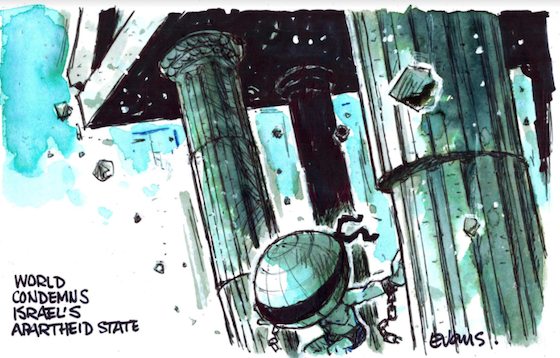
This led to a discussion by Pax Christi Aotearoa’s Janfrie Wakim about how Evans lost his job as a cartoonist on The New Zealand Herald in 2003 for “naming Israeli apartheid” over the repression of Palestinians to the loud applause of the audience.
‘Quality journalism’ paywalls
In a discussion about media, Rahman said she was disturbed by the
failures of the media business model that meant increasingly “quality
journalism” was being placed behind paywalls while the public that could
not afford paywalls were being served “poor quality” information.
Introducing Anjum Rahman, Pax Christi’s Susan Healy said how
“especially delighted the Wakim whanau were” that she had agreed to give
the lecture.
David Wakim
was the inaugural president of Pax Christi Aotearoa, an independent
section of Pax Christi International, a Catholic organisation founded in
France at the end of World War Two committed to working “to transform a
world shaken by violence, terrorism, deepening inequalities, and global
insecurity”.
Growing up in a Sydney Catholic family, Wakim was an advocate of
interfaith dialogue. His travels in Muslim countries strengthened his
links with the three faiths of Abraham – Judaism, Christianity and
Islam.
He helped establish the Council of Christians and Muslims in Auckland, but was especially committed to Palestinian rights.
Wakim died in 2005 and the annual lecture honours his and Pax
Christi’s mahi for Tiriti o Waitangi, interfaith dialogue, peace
education, human rights and restorative justice.
Anjum
Rahman addressing the Pax Christi-hosted David Wakim Memorial Lecture
2022. IMAGE: Billy Hania video screenshot/APR
Bodies of civilians being evacuated after an attack by an armed group at
Nogolaid Village, Kenyam District, Nduga Regency, Papua, last Saturday. IMAGE: Jubi
A LIVELY 43sec video clip surfaced during last week’s Pacific Islands
Forum in the Fiji capital of Suva — the first live leaders’ forum in
three years since Tuvalu, due to the covid pandemic.
Posted on Twitter by Guardian Australia’s Pacific Project
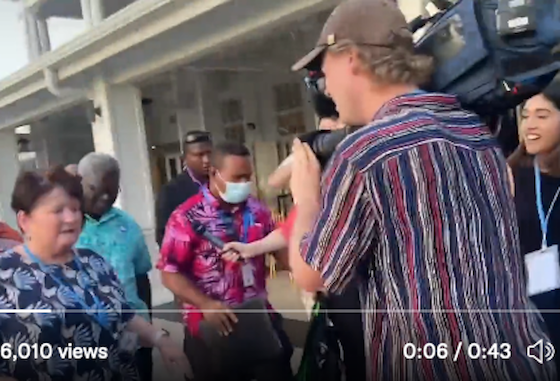
editor Kate Lyons it showed the doorstopping of Solomon Islands Prime
Minister Manasseh Sogavare by a melee of mainly Australian journalists.
A
doorstop on security and China greets Solomon Islands Prime Minister
Manasseh Sogavare (in blue shirt) at the Pacific islands Forum in Suva
last week. IMAGE: Twitter screenshot @MsKateLyons
But Lyons made a comment directed more at questioning journalists themselves about their newsgathering style:
“Australian media attempt to get a response from PM Sogavare, who has
refused to answer questions from international media since the signing of the China security deal, on his way to a bilateral with PM Albanese. He stayed smilingly silent.”
Sadly, the Philippines has sold its soul. Thirty six years ago a
People Power revolution ousted the dictator Ferdinand Marcos after two
decades of harsh authoritarian rule.
Yesterday, in spite of a rousing and inspiring Pink Power would-be
revolution, the dictator’s only son and namesake “Bongbong” Marcos Jr
seems headed to be elected 17th president of the Philippines.
And protests have broken out after the provisional tallies that give Marcos a “lead of millions” with more than 97 percent of the vote counted. Official results could still take some days.
Titled“Israel’s Apartheid against Palestinians”, the 211-page report concludes that the occupation state has imposed a “cruel system of domination” and is committing “crimes against humanity.”
“Our report reveals the true extent of Israel’s apartheid regime. Whether they live in Gaza, East Jerusalem and the rest of the West Bank, or Israel itself, Palestinians are treated as an inferior racial group and systematically deprived of their rights.
"We found that Israel’s cruel policies of segregation, dispossession and exclusion across all territories under its control clearly amount to apartheid. The international community has an obligation to act,”
said Agnès Callamard, Amnesty International’s secretary-general.
FROM Auckland Tāmaki Makaurau in Aotearoa New Zealand to Paris,
France, and from Wellington Te Whanganui-a-Tara to Jayapura and far
beyond, thousands of people across the world today raised the Morning Star flag — banned by Indonesian authorities — in simple acts of defiance and solidarity with West Papuans.
They honoured the raising of the flag for the first time 60 years ago
on 1 December 1961 as a powerful symbol of the long West Papua struggle
for independence.
One of the first flag-raising events today was in Wellington where Peace Movement Aotearoa and Youngsolwara Pōneke launched a virtual ceremony online with most participants displaying the banned flag.
Four months ago Papua New Guinean journalists had been warning about increasing tensions over misinformation about
COVID vaccines and a lack of clear communication from health
authorities. IMAGE: Screenshot Guardian Pacific Project
IN RESPONSE to the escalating COVID-19 coronavirus pandemic in mid-February 2020 came a warning by the World Health Organisation (WHO) Secretary-General, Dr Tedros Adhanom, who declared that “we’re not just fighting an epidemic; we’re fighting an infodemic”. He added that fake news “spreads faster and more easily than this virus” .
The following month, in March 2020, UN Secretary-General António Guterres identified the “new enemy” as a “growing surge of disinformation”.
However, the term “disinfodemic” – which I much prefer – was adopted by the authors of a policy brief for UNESCO to describe the “falsehoods fuelling the pandemic”.
This disinfodemic has been rapidly leading to upheavals in many countries – including in Australia and Aotearoa New Zealand in the weeks with protests, civil disobedience and attacks on health officials, medical staff and frontline workers.
Such assaults and violent confrontations have taken particular nasty turns in some of our neighbouring microstates of the South Pacific – notably Fiji and Papua New Guinea, the largest countries and biggest economies in the region.
Filmmaker and journalist Max Stahl, 66, has died almost 30
years after capturing images of the Indonesian massacre at Santa Cruz cemetery
in the Timor-Leste capital Dili, which helped accelerate the country’s
struggle for independence.
By coincidence, he died on the same day in 1991 as Sebastião Gomes,
the young man who was buried in Santa Cruz and whose death led to the
protest that ended in the Santa Cruz Massacre.
More than 2000 people went to Santa Cruz to pay tribute to Gomes, who
was killed by Indonesian-backed militia in the Motael neighbourhood.
Filmmaker Max Stahl speaking to the 20th anniversary of Pacific Journalism Review in Auckland in 2014. Image: Del Abcede/APR
The atrocity by the Indonesian military was secretly filmed by Max
Stahl and footage smuggled out of the country. International attention
on East Timor dramatically changed as a result.
At the graveyard, the Indonesian military opened fire on the crowd,
killing 74 people at the scene. Over the next few days, more than 120
young people died in hospital from their wounds or as a result of the
crackdown by occupying forces.
Most bodies were never recovered.
Born on 6 December 1954 in the United Kingdom, journalist and
documentary maker Christopher Wenner, better known as Max Stahl, began
his ties to the country in 1991 when he managed to enter East Timor for
the first time.
He became a Timorese citizen in 2019.
Hiding among the graves
On November 12, hiding among the graves of Santa Cruz cemetery, he
filmed the massacre — one of many during the Indonesian occupation of
the country. Images were circulated around the world’s media and this
changed history.
Decorated with the Order of Timor-Leste, the highest award given to
foreign citizens in the country, the Rory Peck Prize for filmmakers, and
several other rewards, Max Stahl leaves as a legacy the main archives
of images from the last years of the Indonesian occupation of the
country.
The archive was adopted by UNESCO for the World Memory Register and
has been used for teaching and research on Timor’s history under the
framework of cooperation between the University of Coimbra, the National
University of East Timor and CAMSTL.
The original 1991 Dili massacre footage by Max Stahl. Video: Journeyman Pictures
Stahl studied literature at the University of Oxford and he was a
fluent speaker of several languages, including the two official
languages of East Timor — Portuguese and Tetum.
He began his career writing for theatre and children’s television
shows. However, he found his calling as a war correspondent when he
lived with his family. At the time his father was ambassador to El
Salvador where Stahl reported on the civil war between 1979 and 1992.
Stahl covered other conflicts such as those of Georgia, former
Yugoslavia and East Timor (from 30 August 1991), where he arrived as a
“tourist” at the invitation of resistance groups.
“The king is dead. With great sadness, I write to inform you that Max passed away this morning.”
— Max Stahl’s wife Dr Ingrid Brucens
Historic resistance leaders
Throughout his long ties to East Timor, where he lived until he had to
travel recently to Australia for medical treatment, he interviewed
historic resistance leaders such as Nino Konis Santa, David Alex and
others.
Santa Cruz and the 12 November 1991 massacre made the name Max Stahl
known internationally with his images exposing the barbarism of the
Indonesian occupation.
In Portugal, the images made a special impact — both through the
brutality of the violence portrayed and because the survivors gathered
in the small chapel of Santa Cruz, praying in Portuguese while listening
to the bullets being fired by the Indonesian military and police.
The 1999 referendum prompted Max Stahl to return to East Timor when
he covered the violence before the referendum and after the announcement
of independence victory. He also accompanied families on the flight to
the mountains.
News of Max Stahl’s death on Wednesday at a Brisbane hospital quickly
became the most commented subject on social media in East Timor,
prompting condolences from several personalities during the struggle for
independence.
In statements to Lusa news agency, former President José Ramos-Horta
described Max Stahl’s death as a “great loss” to Timor-Leste and the
world. He said it would cause “deep consternation and pain” to the
Timorese people.
“Someone like Max, with a big heart, with a great dedication and love
for East Timor … [has been] taken to another world,” he told Lusa.
Dr Ingrid Brucens, Max Stahl’s wife, and who was with him and the children in Brisbane, announced his death to friends.
“The king is dead. With great sadness, I write to inform you that Max
passed away this morning,” she wrote in messages to friends.
Antonio Sampaio is the Lusa correspondent in Dili.
Pacific
Journalism Review investigation poses questions about the “silence” in
Australia over the controversial Bougainville documentary Ophir that has
won several international film awards in other countries. IMAGE: Ophir
still
A FRONTLINE investigative journalism article on the politics behind
the decade-long Bougainville war leading up to the overwhelming vote for
independence is among articles in the latest Pacific Journalism Review.
The report, by investigative journalist and former academic Professor Wendy Bacon and Nicole Gooch, poses questions about the “silence” in Australia over the controversial Bougainville documentary Ophir that has won several international film awards in other countries.
Published this week,
the journal also features a ground-breaking research special report by
academics Shailendra Singh and Folker Hanusch on the current state of
journalism across the Pacific – the first such region-wide study in
almost three decades.
Griffith University’s journalism coordinator Kasun Ubayasiri has
produced a stunning photo essay, “Manus to Meanjin”, critiquing
Australian “imperialist” policies and the plight of refugees in the
Pacific.
Censured or punished? Conflicting reports about the alleged punishment
of the two Indonesian Air Force military policemen who stomped on the
head of young Papuan Steven Yadohamang at Merauke last week. IMAGE: Yumi
Toktok Stret
IT IS open season again for Indonesian trolls targeting Asia Pacific Report and other media with fake news and disinformation dispatches in a crude attempt to gloss over human rights violations.
Just three months ago I wrote about this issue in my “Dear editor” article
exposing the disinformation campaign. There was silence for a while but
now the fake letters to the editor – and other media outlets — have
started again in earnest.
The latest four lengthy letters emailed to APR canvas the following topics — Jakarta’s controversial special autonomy status revised law for Papua, a brutal assault by Indonesian Air Force military policemen
on a deaf Papuan man, and a shooting incident allegedly committed by
pro-independence rebels – and they appear to have been written from a
stock template.
Two
Indonesian Air Force military policemen stomping on the head of a deaf
Papuan teenager, Steven Yadohamang, in the Merauke region on 26 July 2021. IMAGE: Screenshot
from video
By YAMIN KOGOYA
Shocking video footage showing a brutal and inhumane assault on a
deaf Papuan teenager named Steven Yadohamang has emerged from the Merauke region of
Papua and sparked outrage.
The video shows
an altercation between the 18-year-old and a food stall owner. Two
security men from the Air Force Military Police (Polisi Militer Angkatan
Udara, or POMAU) intervened in the argument.
One of the officers grabbed the young man and pulled him from the food
stall. The victim was slammed to the pavement and then stomped on by
the Air Force officers.
The two men, Serda Dimas and Prada Vian, trampled on Yadohamang’s head
and twisted his arms after knocking him to the ground. The young man was
seen screaming in pain, but the two men continued to step on his head
and body while the officers casually spoke on the phone.
Human rights defender Carmel Budiardjo ... many lives "touched - and
sometimes transformed - by her passionate and determined campaigning for
human rights, justice and democracy in Indonesia, East Timor, Aceh and
West Papua". IMAGE: TAPOL
BRITISH and Indonesian human rights defender Carmel Budiardjo,
founder of TAPOL watchdog and the movement’s driving force for many
decades, has died peacefully aged 96.
TAPOL said in an announcement that she had died on Saturday and would
be greatly missed by an extensive network of people whose lives had been
“touched — and sometimes transformed — by her passionate and determined
campaigning for human rights, justice and democracy in Indonesia, East
Timor, Aceh and West Papua”.
For many, she had been a great mentor as well as a beloved friend, TAPOL said.
WHEN Nanaia Mahuta was appointed Minister of Foreign Affairs, there
were hopes for a change in government thinking towards the struggles of
indigenous people. The minister said she hoped to bring her experience
and cultural identity as an indigenous woman to her role on
international issues.
Palestine, West Papua and Western Sahara are places where the
indigenous people are struggling for freedom and human rights and early
on there was hope New Zealand would join the 138 member states of the
United Nations that recognise Palestine.
However the hope has faded and Mahuta finally spoke on Tuesday,
via a tweet, saying she was “deeply concerned” about the deteriorating
situation in Jerusalem and Gaza. She called for a “rapid de-escalation”
from Israel and the Palestinians, for Israel to “cease demolitions and
evictions” and for “both sides to halt steps which undermine prospects
for a two-state solution”.
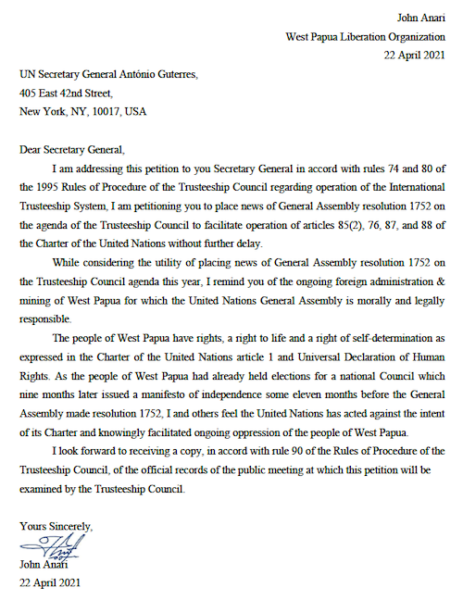
A WEST Papuan envoy who was gagged while addressing the United
Nations Permanent Forum on Indigenous Issues two years ago has been
blocked again while trying to speak out.
For six years, John Anari, leader of the West Papua Liberation
Organisation (WPLO) and an “ambassador” of the United Liberation
Movement for West Papua (ULMWP), has been appealing to the forum to push
for the Indonesian-ruled Melanesian region to be put on the UN
Trusteeship Council.
He was speaking for the two groups combined as the West Papua
Indigenous Organisation (WPIO), or Organisasi Pribumi Papua Barat, when
he attempted to give his address at the forum last Thursday.
The struggle of the Palestinians is integral to a larger struggle for
fundamental human rights that can be witnessed throughout the Middle
East. IMAGE: France 24
COVID-19 cases in Palestine, especially in Gaza, have reached record highs, largely due to the arrival of a greatly contagious coronavirus variant which was first identified in Britain.
Gaza has always been vulnerable to the deadly pandemic. Under a hermetic Israeli blockade since 2006, the densely populated Gaza Strip lacks basic services like clean water, electricity, or minimally-equipped hospitals. Therefore, long before covid-19 ravaged many parts of the world, Palestinians in Gaza were dying as a result of easily treatable diseases such as diarrhoea, salmonella and typhoid fever.
Needless to say, Gaza’s cancer patients have little fighting chance, as the besieged Strip is left without many life-saving medications. Many Palestinian cancer patients continue to cling to the hope that Israel’s military authorities will allow them access to the better equipped Palestinian West Bank hospitals.
Alas, quite often, death arrives before the long-awaited Israeli permit does.
The tragedy in Gaza - in fact in all of occupied Palestine - is long and painful. Still, it ought not to be classified as another sad occasion that invokes much despair but little action.
Papuan students demonstrating against extenson of the special autonomy
law for Papua and provincial expansion plans in front of the Ministry of
Home Affairs in central Jakarta on Monday. IMAGE: APR special
A West Papuan correspondent has compiled and translated this special article for Asia Pacific Report and Cafe Pacific drawn from Papuan news media.
THE INDIGENOUS people of West Papua have rejected the extension of special autonomy and the planned expansion of new provinces announced by the central government of Indonesia.
The rejection comes from grassroots communities across West Papua and
Papuan students who are studying in Indonesia and overseas.
Responding to the expansion of a new province, Mimika students
demonstrated in front of the Ministry of Home Affairs, Jl. Medan Merdeka
Utara, central Jakarta, this week.
Representing Mimika students throughout Indonesia and abroad, about
30 students who are currently studying in Jakarta, took part in the
protest on Monday.
A statement received by Asia Pacific Report said that the
Mimika regency students throughout Papua, Indonesia, and globally
rejected the division of the Central Papua province and return the
provincial division to the MRP and DPRP of Papua Province, and return
the customary institutions (LEMASA & LEMASKO) to the tribal and
Kamoro indigenous communities in Mimika regency.
As well as playing a role in critical moments of history as a journalist
in the region, Professor David Robie's students have also covered
landmark events that helped shape some Pacific nations. Image: AUT Pasifika
By Laurens Ikinia
A JOURNALIST who sailed on board the bombed environmental ship Rainbow Warrior,
was arrested at gunpoint in New Caledonia while investigating French
military garrisons in pro-independence Kanak villages, and reported on
social justice issues across the Pacific has stepped down as founding
director of the Pacific Media Centre.
Professor David Robie,
75, an author, academic, independent journalist and journalism
professor at Auckland University of Technology, retired last week after
more than 18 years at the institution.
He has been working as a journalist for more than 46 years and as an academic for more than 27 years.
As well as playing a role in critical moments of history as a
journalist in the region, his students have also covered landmark events
that helped shape some Pacific nations, especially in Melanesia – such
as the 1997 Sandline mercenary crisis in Papua New Guinea and the George Speight coup in Fiji in May 2000.
But a journalism or academic career were not always clearcut pathways
for Dr Robie. During his studies in high school, he was heavily
involved in outdoor pursuits and he became a Queen’s Scout.