Showing posts with label censorship. Show all posts

Monday, August 17, 2020

Facebook censorship on West Papua – then deafening silence

Facebook censorship on West Papua ... a "cruel irony". Image: RSF/PMC

By David Robie

THE SILENCE from Facebook is deafening and disturbing.

At first, when I lodged my protests earlier this month to Facebook over the immediate removal of a West Papua news item from the International Federation of Journalists shared with three social media outlets, including West Papua Media Alerts and The Pacific Newsroom, I thought it was rogue algorithms gone haywire.

The “breach of community standards” warning I also received on my FB page was unacceptable, but surely a mistake?

However, with subsequent protests by the Paris-based Reporters Without Borders (RSF) media freedom watchdog and the Sydney office of the Asia-Pacific branch of the International Federation of Journalists (IFJ), the world’s largest journalist organisation with more than 600,000 members in 187 countries, falling on deaf ears, I started wondering about the political implications of this censorship.

READ MORE: Melanesia: Facebook algorithms censor article about press freedom in West Papua

We had all complained separately to the FB director of policy for Australia and New Zealand, Mia Garlick, and were ignored.

Friday, April 24, 2020

Tough coronavirus controls threaten Pacific, global media freedom

Reporters Without Borders has just published its annual World Press Freedom Index ranking
countries over censorship. Video: Hannah Cleaver/DW

PACIFIC PANDEMIC DIARY:  By David Robie

Against a backdrop of many governments using tough controls under cover of fighting the covid-19 coronavirus pandemic to strengthen “creeping authoritarianism”, a global media freedom watchdog has signalled draconian virus reactions as a major threat.

From Papua New Guinea where media briefings have been curtailed with a lockdown of the national information and operations “nerve centre” at Morauta Haus, to Fiji where media personalities have been arrested, to the Philippines where state troll armies “weaponise” disinformation on social media, and to Indonesia where street artists have stepped in fill an information void, the signs are really worrying for defenders for media freedom.

The pandemic is “highlighting and amplifying the many crises”, already casting a shadow on press freedom, says the Paris-based Reporters Without Borders watchdog, which released its annual World Media Freedom Index this week.

READ MORE: The Reporters Without Borders 2020 World Press Freedom Index

While China and Iran have been singled out for strong criticism for suppressing details of the coronavirus outbreak early in the crisis, several countries traditionally strong on media freedom in the Asia-Pacific region have slipped down in the rankings – including Australia, New Zealand and Papua New Guinea.

Tuesday, July 2, 2019

Canadian cartoonist ‘dumped’ after viral Trump cartoon

The "problem" Michael de Adder cartoon ... too close to the truth?
By CAFE PACIFIC
CANADA'S “most read” cartoonist has been “let go” from all newspapers in New Brunswick, apparently over a Trump and migrants cartoon that went viral.

“I’m a proud New Brunswicker. I’ll miss drawing cartoons for my home province,” cartoonist Michael de Adder was quoted by The Daily Cartoonist as saying.

The above cartoon was the one that apparently caused the fuss.

“The highs and lows of cartooning. Today I was just let go from all newspapers in New Brunswick.”

Michael de Adder was born, raised, and educated in New Brunswick province and was a regular presence in its newspapers.

Thursday, April 11, 2019

WikiLeaks' Assange arrested to enable US extradition 'for journalism' - act now

Stakeout at the Ecuadorean Embassy and Julian Assange's arrest - at 11min 06sec.
He gives a "thumbs up" sign. Video: Ruptly


By Caitlin Johnstone of Medium

WIKILEAKS founder Julian Assange has been arrested and taken into custody by the London’s Metropolitan police, just as WikiLeaks warned days ago was about to happen.

Assange’s lawyer Jen Robinson reports that his arrest is related to an extradition request from the United States, which the British government has until now refused to admit exists.

“Just confirmed: #Assange has been arrested not just for breach of bail conditions but also in relation to a US extradition request,” tweeted Robinson.

“From #Assange: The US warrant was issued in December 2017 and is for conspiracy with Chelsea Manning in early 2010,” Robinson added.

Tuesday, January 22, 2019

Sacked head of Timor-Leste state broadcaster claims ‘political axe’

Ousted: Gil da Costa found out about his sacking through the news media. Image: RTTL
From Pacific Media Watch

The ousted president of Timor-Leste’s public television network says he has been sacked for political reasons.

Gil da Costa was removed this month from the post of chairperson of the board of directors of Timor-Leste Radio and Television (RTTL) following an audit undertaken by the government – and he had no knowledge of the result.

He has told the Portuguese news agency Lusa that his removal from office – which he first learned about on the news – was a political decision following the audit that was led by his successor.

“I heard from the news that I had been ousted. They did not even talk to me before or about any problem that existed,” Gil da Costa told Lusa yesterday.

Da Costa alleged that he was removed after the audit whose results he never knew without any prior information from the government and without having the opportunity to be heard or give any explanation.

Friday, July 13, 2018

Nauru, Fiji and Pacific Facebook gags criticised in Asia-Pacific media freedom summit


Reporters Without Borders secretary-general Christophe Deloire talks about the global threat against journalists.
Video:
Café Pacific

By David Robie in Paris
WHEN Reporters Without Borders chief Christophe Deloire introduced the Paris-based global media watchdog’s Asia-Pacific press freedom defenders to his overview last week, it was grim listening.

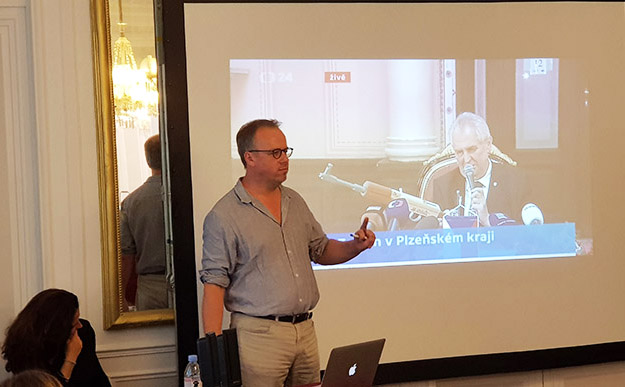
First up in RSF’s catalogue of crimes and threats against the global media was Czech President Miloš Zeman’s macabre press conference stunt late last year.

However, Zeman’s sick joke angered the media when he brandished a dummy Kalashnikov AK47 with the words “for journalists” carved into the wood stock at the October press conference in Prague and with a bottle of alcohol attached instead of an ammunition clip.

RSF’s Christophe Deloire talks of the Czech President’s anti-journalists gun “joke”.
Image: David Robie/PMC
Zeman has never been cosy with journalists but this gun stunt and a recent threat about “liquidating” journalists (another joke?) rank him alongside US President Donald Trump and the Philippines leader, Rodrigo Duterte, for their alleged hate speech against the media.

Monday, April 23, 2018

The Ben Bohane photo that Facebook censored on an article about Indonesia

The original version of this photo, of West Papuan nambas (traditional penis gourds), which was published
in the weekend edition of the family newspaper Vanuatu Daily Post and then by Asia Pacific Report,
was deemed to have breached Facebook's "community standards". The photo was by award-winning
photojournalist Ben Bohane, who lives in Vanuatu.
BEN BOHANE: CHINA? NO, LET'S FACE THE ELEPHANT IN THE PACIFIC ROOM

BRIEFING: By Ben Bohane in Port Vila

China … China … China …

All the talk is of increasing Chinese influence in our region. But this is to wilfully see past the elephant in the room.

Contrary to most commentary, the biggest destabilising player in Melanesia over the past five years is not China but Indonesia, which through its “look east” policy has deliberately paralysed the Melanesian Spearhead Group (MSG) while financing local MPs and political parties across the Pacific to try and stop snowballing regional support for West Papuan independence.

Indonesia already has Peter O’Neill onside in PNG, and Voreqe Bainimarama in Fiji, and is busy trying to neutralise Vanuatu, the Solomons and FLNKS (Kanak Socialist National Liberation Front) leaders in New Caledonia, who are resisting Indonesian influence.

READ MORE: The Vanuatu Daily Post and the photo censored by Facebook

The reason Vanuatu and other Melanesian nations may be turning to China is because they are more worried about Indonesia, which has directly threatened Vanuatu over its strong diplomatic support for the West Papuans.

Saturday, July 15, 2017

PNG activist blogger Martyn Namorong protests online in defiance of gag order

PNG blogger Martyn Namorong ... gagged but not silenced. Image: MN Twitter
By Mong Palatino of Global Voices

A Papua New Guinea court has issued a gag order against Martyn Namorong, a prominent political blogger and activist accused of defaming Patilias Gamato, the country’s Electoral Commissioner.

Gamato this week sued Namorong after Namorong compared him to a "fruit" (tomato) on social media, as reported by Pacific Media Watch. When Namorong learned about the court order, he posted this image on Twitter before adding the above blue gag selfie image:


He added that he also needed a lawyer.

Tuesday, June 27, 2017

'Voice of the voiceless' - Al Jazeera's response over Saudi-led blog gag pressure

The Doha headquarters of the global news network. Photo: Al Jazeera
An important media freedom statement: An open letter from Al Jazeera
Republished on Café Pacific from the Doha-based global news network

OVER two decades ago, Al Jazeera Arabic was launched with a simple mission: to provide reliable information to viewers across the Arab world. Ten years later, in 2006, Al Jazeera English began broadcasting with the same mission - to provide people around the world with accurate, balanced and impartial information.

When Al Jazeera Arabic went on air in 1996, it was unique in the Arab world. Most media in the region at the time were state-controlled and often unchallenged mouthpieces for the different rulers and governments in the region. Al Jazeera was different, a truly independent voice, with a mission to hear and report the human stories that were otherwise ignored; to cover events with balance and integrity; and to hold power to account.

Al Jazeera Arabic quickly gained a huge and loyal audience across the region. The information we provided became a lifeline to millions of people who wanted to know what was really going on around them.

Tuesday, January 13, 2015

‘Je suis Charlie’? Not I. Here’s why…


A profile on the role of satire in France a la Charlie Hebdo via Vox.

By Richard Fidler at Canada's Life on the Left


MILLIONS of people took to the streets in France and elsewhere in Europe and North America to protest the brutal murderous attacks by Islamist extremists on the French satirical weekly Charlie Hebdo and a Kosher supermarket in Paris.

At Charlie Hebdo, the death toll of 12 included the paper’s editor and some of its major cartoonists; a further 23 staff members were wounded. Several more were murdered at the Jewish grocery store.

The unifying slogan of these protests is “Je suis Charlie!” - I am Charlie, the implication being that the targeted publication — notorious in France for its ridicule of minority religious beliefs, especially Islam — had merely been exercising its right to “freedom of expression.”

That is the theme being propagated by the establishment media and politicians. Many on the left have chimed in. NDP [New Democrats] leader Thomas Mulcair in Canada says it was a “terrible attack against democracy and freedom of the press.” Québec Solidaire leader Amir Khadir, speaking for the party, said it was a “black day for free speech".

Free speech?

Sunday, January 11, 2015

Creating the cartoons that led to the Charlie Hebdo assassinations


Charlie Hebdo, Before the Massacre from The New York Times on Vimeo.

NINE years ago two Paris-based filmmakers, Jerôme Lambert and Philippe Picard, who have directed many documentaries for French public television, made a controversial documentary, Cabu: Politiquement Incorrect (Cabu: Politically Incorrect), about one of Charlie Hebdo's most famous cartoonists.

The documentary hasn't yet been released in English, but an almost six-minute section of it about the decision-making process around publication of a cartoon of the Prophet Muhammad has been edited as a short package and published online on Op-Docs at The New York Times.

Ultimately, the publication of this cartoon - and others – by the satirical magazine led this week to the tragic assassination by two jihadist gunmen of the cartoon creator, the editor and eight other people and two police officers protecting them in a savage raid on the publication’s office.

By the end of three days of blood-letting in Paris, including a double hostage siege, 17 innocent people had been killed plus three extremist gunmen - shot dead by French elite security forces. More than 3.7 million people and global leaders on Sunday marched in rallies across France - including the French Pacific territories - to pay tribute to those who lost their lives.

According to the NYT's website for Op-Docs, it is a "forum for short, opinionated documentaries, produced with creative latitude by independent filmmakers and artists". And there is an open invitation for submissions. Here is the introduction to the video - Charlie Hebdo, Before the Massacre:

Sunday, August 24, 2014

Timor-Leste’s Parliament handed ‘humiliating’ defeat over harsh media law

East Timorese journalists raise their hands to approve the Timor-Leste Journalist
Code of Ethics in October 2013. Photo: Tempo Semanal
PACIFIC SCOOP reported this week that East Timor’s Appeal Court had scrapped the country’s draconian new Media Law and sent it back to the National Parliament. The ruling was welcomed with open arms by journalists, foreign correspondents, civil society advocates and democrats.

Problem is that some legal interpretations doing the rounds seem to suggest this isn’t quite the full story. In fact, perhaps, some say, reports “jumped the gun” in suggesting that the court had ruled the law completely “unconstitutional”.

Tempo Semanal, the independent publication run by investigative journalist  José Belo, is probably closer to the mark by saying that parts of the law “violate” the Constitution of Timor-Leste. It is an embarrassing defeat for Prime Minister Xanana Gusmao who had backed the law.

This law is far harsher than the controversial Fiji Media Industry Development Decree imposed by the military-backed regime in Fiji in 2010, which casts a shadow over next month’s election, yet while New Zealand media has had a lot to say about the Fiji media law, it has largely ignored the legislation ushered in by a democracy in Dili.

This is what the Tetum-language Tempo Semanal report said in its stilted English - and the Timor-Leste Press Union, which has been fighting this law from the start, gave a big thumbs-up:

Thursday, August 7, 2014

Balibo's ghosts and Timor-Leste's controversial media law

A Timorese broadcast journalist working in Dili's Santa Cruz cemetery at a 2013 memorial event marking the
1991 massacre by Indonesian troops. Photo: David Robie
CAFÉ PACIFIC opened up public debate on the progress of Dili's widely condemned Media Law in February after a visit to Timor-Leste. Since then there has been a critical mass of coverage and analysis on this flawed piece of legislation. The latest commentary by Human Rights Watch's Phelim Kine is an indictment of Australian policy over Timor-Leste. He says the Australian government should "make it clear that media freedom is an indispensable component of a prosperous and stable society and demand that East Timor nurture a free media, not undermine it". Ditto for New Zealand policy. Read on:

Australia's stake in East Timor's media freedom is rooted in that country's hillside town of Balibo. It was there on October 16, 1975 that invading Indonesian military forces killed, execution-style, five journalists - Greg Shackleton, Tony Stewart, and New Zealander Gary Cunningham from Melbourne's Channel Seven and Brian Raymond Peters and Malcolm Rennie from Sydney's Channel Nine - to prevent them from reporting on the invasion.

Indonesian troops on December 8, 1975, killed Roger East, an Australian reporter drawn to East Timor to determine the fate of the Balibo Five.

Four decades later, East Timor's journalists and foreign correspondents are again under threat. A new media law that East Timor's Parliament passed on May 6 has the power to stifle the country's still-fragile media freedom. East Timor's Court of Appeal is reviewing the law's constitutionality in response to a July 14 request by president Taur Matan Ruak.

Monday, June 30, 2014

USP’s attempted gag over media freedom issues stirs international protests

USP protagonists (from left): Acting journalism coordinator and journalism fellow Pat Craddock,
deputy vice-chancellor Dr Esther Williams and journalism lecturer and author
Dr Matt Thompson. Montage: Fijileaks
Café Pacific is on holiday with the publisher looking for “summer” somewhere in western Ireland. But this blog couldn’t stay on hold any longer with all the current shenanigans going on at Fiji’s University of the South Pacific. 

Beleaguered journalism academics Pat Craddock, the acting regional media programme leader who is a New Zealand broadcaster and has long experience at USP and is widely respected on campus, and Australian author, educator and journalist Dr Matt Thompson, have stirred a hornet’s nest in administration circles over the past week because of their frank and defiant talking about media and freedom of speech issues in Fiji. 

The controversy has stirred condemnation by Amnesty International and sparked a column by Roy Greenslade in The Guardian. In the latest statement by Craddock, published by Fijileaks, he has refused to be “silenced” by the university: 

Tuesday, June 10, 2014

Bad news from East Timor as media faces petro fund 'guided democracy' gag

Timorese students protest over Australian spying in its efforts to manipulate Timor-Leste's oil industry
... free speech at risk under the new media law. Photo: Global Voices
By Tempo Semanal editor/publisher José Antonio Belo

SADLY, I have bad news to report from East Timor. It is not yet clear how long my colleagues and I will be able to freely report the news. But readers should know, things are not what they seem in the glowing press releases from Government Palace in Dili.

The government, through its members in the national Parliament, is taking steps to limit basic freedoms held by Timorese citizens.

East Timor is now a vibrant and peaceful young democracy, but a few weeks ago it took a significant step backwards towards the days of the Suharto regime, when Indonesia occupied East Timor for 24 years between 1975 and 1999.

On May 6, the national Parliament of East Timor passed a law to regulate the media and freedom of expression in East Timor. The law has yet to be promulgated by the President of the Republic, Taur Matan Ruak, although it was sent to him to pass last week.

The law is not only undemocratic but is also in violation of the constitution. The constitution gives rights to the media and citizens for freedom of expression in articles 40 and 41, but the new law seeks to limit, restrict and in some cases terminate those rights.

Sunday, June 1, 2014

Timor-Leste raises bar in media suppression with new law

Graphic from the latest edition of Index on Censorship with a profile on the new law.
Image: Shutterstock/Index on Censorship
JOURNALISTS and civil society critical of the flawed Fiji mediascape in the lead-up to the first post-coup general election in September should also be up in arms over the attempts to muzzle the press in Timor-Leste.

A new law passed by the National Assembly in Dili early last month raises the Asia-Pacific bar in suppression tactics against probing media.

The law, not yet endorsed by the president, severely limits who can qualify to be “journalists” and could potentially curb overseas investigative journalists and foreign correspondents from reporting from the country as they would need advance state permission.

It also sidelines independent freelancers and researchers working for non-government organisations in quasi media roles.

In a fledgling country where the media has limited resources, media officers and other researchers working for NGOs have been providing robust reporting and analysis of the country’s development progress – especially over the oil producing industry.

Thursday, May 15, 2014

RSF ‘information hero’ fights new media law in Timor-Leste

Gagged José Belo at a Media Law Seminar in Dili hosted by the Secretary for Communication.
Image: Jornal Independente
Bob Howarth files a special report from Dili for Café Pacific

IT WAS a stunt that arguably, in any democratic country on any given day, would have led the media headlines and stopped anyone that cared about their rights to speak freely in their tracks.

But as the man who was this year included in Reporters Without Borders 100 “information heroes” list for his contribution to journalism world-wide, José Belo, sat quietly on the head table at yesterday’s Secretary of State-led media capacity workshop in Dili with a bandana fixed across his mouth, the noise was sadly minimal.

For almost an hour Belo sat, his mouth forced shut as a sign of the gag the veteran journalist believes will soon be forced on Timor-Leste’s fragile media under a new law.

As the nation’s first new media law now sits waiting presidential approval, Belo warned that, in its current form, its restrictions on who can and can’t operate as a journalist, government control of the regulating press council body and worrying stipulations on information access would signal the death of Timorese journalists’ spirit.

Sobering times, but is it too little too late to save freedom of expression and plurality of voices in a country that so many times has proudly paraded its own long fight for freedom?

Monday, April 14, 2014

Fighting PNG corruption and social media gags with … outspoken blogs

Graphic: shutterstock.com
THE BLOGGING war is hotting up in Papua New Guinea – just when things are getting riskier with draconian proposals over cybercrime law on the horizon. The state target for Prime Minister Peter O’Neill’s government appears to be social media. Trample on any possible dissent.

O’Neill is seen as a proxy for Canberra’s strategic interests in the region. As PNGexposed claimed in one posting, the Australian government “has already assumed the role of regional sheriff and wants to sit astride a region of compliant states and micro-states”.
“This means other countries markets and resources should be open to foreign capital without barriers such as the muscular protection of landowner rights, or strong environmental laws. Australia is targeting its aid spending to ensure Bougainville fits this model.

“Whatever the future for Bougainville, Australia wants to ensure the island is a subservient neighbor providing a supporting role to Australia’s own economic and political interests. Australia is therefore targeting its aid spending to ensure that outcome, placing consultants in key political and financial roles and neglecting health and other people-centered sectors.”
According to figures released by the Australian Department of Foreign Affairs and Trade (see table here) show that more than 90 percent of $2.9 million a year spent on the salaries or commissions of consultants working for Australia on Bougainville is directed at ensuring Australian political structures, policy priorities, economic models, and security interests dominate in the new Bougainville government and bureaucracy.

Wednesday, March 19, 2014

Parliament soft-pedals over East Timor’s harsh draft media law

East Timorese media ... fears draft media law could lead to censorship.
Photo: Diariu Timor Pos
JOSÉ BELO, Timor-Leste’s celebrated champion of investigative journalism and advocate for a free media, recently vowed he was prepared to go to jail rather than allow his fledgling independent nation muzzle the press.

Belo, 42, publisher of the small yet probing Tempo Semanal online and print weekly, says he won’t give up in the current struggle over the fate of the media.

He has been campaigning against a draconian draft media law over the past few months.

“It’s about the future of our country,” he told Fairfax Media’s Lindsay Murdoch.

But the news about a draft law that is feared could lead to censorship is not getting any better. Since Café Pacific broke this story in early February, the Timorese non-government organisation La’o Hamutuk has been monitoring developments closely – and making quality submissions.

Wednesday, September 11, 2013

Say fromage! AFP 'self-censorship row' highlights thin-skinned politicians

A visitor takes a picture of the artwork entitled "Travesty" depicting Valdimir Putin
and Dmitry Medvedev at an exhibition in St Petersburg, 15 August 2013. Photo: IOC/R
By Milana Knezevic of Index on Censorship/IFEX

FRENCH news agency AFP has been caught up in a self-censorship row after attempting to retract a photo of President Francois Hollande flashing a gormless smile. The whole debacle has gone viral, forcing AFP to make a statement denying they had caved to government pressure.

Rather, they cited internal editorial guidelines "not to transmit images that gratuitously ridicule people". However, politicians are not strangers to banning (or trying to ban!) images that make them look a bit silly.

You'd think that Vladimir Putin, used to being in the public eye, captured in completely random and non-staged situations like this, wouldn't mind being the inspiration for some fine art.

That turned out not to be the case when a St Petersburg gallery exhibited a painting of Putin and PM Dmitry Medvedev - the former sporting a fetching pink negligee, the latter a black lace push-up bra.

Russian police raided the gallery and removed the picture in question, as well as three others depicting Russian political leaders. The reason given was that the images 'violate existing legislation'.

>>> Popular Café Pacific Posts