Showing posts with label media freedom. Show all posts

Saturday, February 4, 2023

Papuan journalist award-winner Victor Mambor targeted for his reports

Papuan editor and publisher Victor Mambor . . . “Journalists need to break
down the wall and learn freely about our struggle." IMAGE: Victor Mambor FB

By DAVID ROBIE

When Papuan journalist Victor Mambor visited New Zealand almost nine years ago, he impressed student journalists from the Pacific Media Centre and community activists with his refreshing candour and courage.

As the founder of the Jubi news media group, he remained defiant that he would tell the truth no matter what the risk while facing an oppressive and vindictive regime.

“Journalists need to break down the wall and learn freely about our struggle,” he said in a message to New Zealand media via an interview with Pacific Media Watch.

Now the 49-year-old journalist and editor finds that the risks are growing exponentially as his media network has expanded — with an English language website and Jubi TV becoming add-ons — and the exposure of his networks have also widened.

He writes for the Jakarta Post, Benar News and contributes to international news services. Two years ago he was also co-producer of an award-winning Al Jazeera 101 East documentary about the plunder of West Papuan forests for oil palm plantations.

But last week the timing was impeccable over his latest award, the Oktonianus Pogau Prize for courageous journalism. It came just eight days after a bomb blast had happened in the street outside his Jayapura home.

Tuesday, January 31, 2023

Fiji’s media veterans recount intimidation under FijiFirst government – eye on reforms

Fiji journalist Lice Movono talks to Café Pacific publisher David Robie while
preparing interviews for her media freedom podcast for Radio Australia's
Pacific Beat. IMAGE: Screenshot Café Pacific

Pacific Media Watch

RADIO Australia’s Pacific Beat reports on how Fiji has fared under the draconian Media Act that has restricted media freedom over the past decade and moves to change the law.

There are hopes that state-endorsed media censorship will stop in Fiji following last month’s change in government to the People’s Alliance-led coalition.

Reported by Fiji correspondent Lice Movono, the podcast outlines former Fiji Times editor-in-chief Netani Rika’s experiences of repression under the former FijiFirst government.

But a change in government has also been reflected by a change in attitude towards the media.

It comes as the Fijian Broadcasting Corporation board has terminated the contract of FBC’s chief executive Riyaz Sayed-Khaiyum amid reports that the CEO for the public broadcaster earned more money than the prime minister of the country.

Tuesday, January 24, 2023

‘Terror’ bomb explodes near Papua journalist Victor Mambor’s home

Police gather evidence near the site of a bomb explosion that took place outside the house
of Jubi editor Victor Mambor, in Jayapura, Papua, Indonesia, on 23 January 2023.
IMAGE: AJI for BenarNews

By DANDY KOSWARAPUTRA and PIZARO GOZALI IDRUS

Pacific Media Watch

A VETERAN journalist known for covering rights abuses in Indonesia’s militarised Papua region says a bomb exploded outside his home yesterday and a journalists group has called it an act of “intimidation” threatening press freedom.

No one was injured in the blast near his home in the provincial capital Jayapura, said Victor Mambor, editor of Papua’s leading news website Jubi, who visited New Zealand in 2014.

Police said they were investigating the explosion and that no one had yet claimed responsibility.

“Yes, someone threw a bomb,” Papua Police spokesperson Ignatius Benny told Benar News. “The motive and perpetrators are unknown.”

The Jayapura branch of the Alliance of Independent Journalists (AJI) condemned the explosion as a “terrorist bombing”.

In Sydney, the Australia West Papua Association (AWPA) and Pacific Media Watch in New Zealand protested over the incident and called for a full investigation.

Friday, July 29, 2022

NZ’s Parliament siege, ‘disinformation war’, kava and media change featured in latest PJR

Pacific Journalism Review ... exposing the assault on "truth telling" and a
kava photoessay. IMAGE: Todd Henry/PJR

By PACIFIC MEDIA WATCH

Frontline investigative articles on Aotearoa New Zealand’s 23-day Parliament protester siege, social media disinformation and Asia-Pacific media changes and adaptations are featured in the latest Pacific Journalism Review.

The assault on “truth telling” reportage is led by The Disinformation Project, which warns that “conspiratorial thought continues to impact on the lives and actions of our communities”, and alt-right video researcher Byron C Clark.

Several articles focus on the Philippines general election with the return of the Marcos dynasty following the elevation of the late dictator’s son Ferdinand “Bongbong” Marcos Jr and the crackdown on independent media, including Nobel Peace Prize co-laureate Maria Ressa’s Rappler.

Columbia Journalism School’s Centre for Investigative Journalism director Sheila Coronel writes of her experiences under the Marcos dictatorship: “Marcos is a hungry ghost. He torments our dreams, lays claim to our memories, and feeds our hopes.”

But with Marcos Jr’s landslide victory in May, she warns: “You will be in La-La Land, a country without memory, without justice, without accountability. Only the endless loop of one family, the soundtrack provided by Imelda.”

Monday, June 6, 2022

Ramos-Horta challenges Pacific’s biggest threat to media freedom – China’s gatekeepers

Showing how it's done ... a "more open" media conference in Dili
with China's Foreign Minister Wang Yi. IMAGE: TL Presidential Palace media
 

 By DAVID ROBIE

Timor-Leste, the youngest independent nation and the most fledgling press in the Asia-Pacific, has finally shown how it’s done — with a big lesson for Pacific island neighbours.

Tackle the Chinese media gatekeepers and creeping authoritarianism threatening journalism in the region at the top.

In Dili on the final day of Chinese Foreign Minister Wang Yi’s grand Pacific tour to score more than 50 agreements and deals — although falling short of winning its Pacific region-wide security pact for the moment — newly elected (for the second time) President José Ramos-Horta won a major concession.

Enough of this paranoid secrecy and contemptuous attitude towards the local – and international – media in democratic nations of the region.

Under pressure from the democrat Ramos-Horta, a longstanding friend of a free media, Wang’s entourage caved in and allowed more questions like a real media conference.

Tuesday, March 1, 2022

AJI slams hacking of group chief’s accounts as attack on press freedom

AJI general chairperson Sasmito Madrim speaking to journalists ... disinformation
hacking attack on Madrim's personal WhatsApp, Instagram and Facebook accounts.
IMAGE: Populis
 

By Vitorio Mantalean in Jakarta

THE INDONESIAN Independent Journalist Alliance (AJI) has condemned the hacking and disinformation attacks against the group’s general chairperson Sasmito Madrim as a serious threat to media freedom.

In a written release, the AJI stated that the incident was a “serious threat to press freedom and the freedom of expression”.

“This practice is a form of attack against activists and the AJI as an organisation which has struggled for freedom of expression and press freedom,” the group stated.

“The hacking and disinformation attack against AJI chairperson Sasmito Madrim is an attempt to terrorise activists who struggle for freedom of expression and democracy”, the group said.

The AJI stated that the hacking attack began on February 23 and targeted Madrim’s personal WhatsApp, Instagram and Facebook accounts as well as his personal mobile phone number.

Monday, February 21, 2022

Jack Lapauve: Why we walked out in protest over EMTV news independence


Jack Lapauve Jr.  IMAGE: FB

COMMENTARY: EMTV’s deputy news editor Jack Lapauve Jr in Port Moresby writes in defence of the newsroom’s decision to walk out in protest over the suspension of head of news and current affairs Sincha Dimara on February 7.

The EMTV News editorial decision to run the two stories [about the court cases involving Australian hotel businessman Jamie Pang] was based on two important points in our line of work:

Impartiality and Objectivity.

Impartiality cannot be achieved by the measure of words in a story, it is achieved by:

  • Avoiding bias towards one point of view
  • Avoiding omission of relevant facts
  • Avoiding misleading emphasis

All of which are stated in the EMTV News and Current Affairs Manual 2019 in section 17.5 under standard operations of the television code.

By running the stories, the team was accused of bias.

Saturday, June 19, 2021

How the 'voice of the voiceless' kaupapa became derailed at the Pacific Media Centre


Screenshot from the Pacific Media Centre video The PMC Project
by former student project editor Alistar Kata.

COMMENT: By DAVID ROBIE, founding director of the Pacific Media Centre

It really is bizarre. After 26 months of wrangling, stakeholders’ representations and appeals by the Pacific Media Centre participants to Auckland University of Technology management, in the end the innovative unit remains in limbo.

In fact, sadly it seems like a dead end.

In my 28 years as a media educator across four institutions in four countries I have never experienced as something as blatant, destructive and lacking in transparency as this.

Six weeks after I retired as founding director of the centre last December, the PMC office in AUT’s Sir Paul Reeves building was removed by packing up all the Pacific taonga, archives, books and files supporting student projects without consulting the stakeholders.

And then the award-winning staff running the centre on a de facto basis were apparently marginalised. 

As former Green Party MP Catherine Delahunty noted: “I am really shocked that a vibrant well developed centre is being treated like this - what is wrong with this institution?”

Sunday, June 6, 2021

West Papua, Palestine and other critical issues – why is NZ media glossing over them?


Indonesian police carry a body in the current crackdown against pro-independence Papuans
near Timika, Papua. IMAGE: seputarpapua.com

By DAVID ROBIE

International reporting has hardly been a strong feature of New Zealand journalism. No New Zealand print news organisation has serious international news departments or foreign correspondents with the calibre of such overseas media as The Sydney Morning Herald and The Age.

It has traditionally been that way for decades. And it became much worse after the demise in 2011 of the New Zealand Press Association news agency, which helped shape the identity of the country for 132 years and at least provided news media with foreign reporting with an Aotearoa perspective fig leaf.

It is not even much of an aspirational objective with none of the 66 Voyager Media Awards categories recognising international reportage, unlike the Walkley Awards in Australia that have just 34 categories but with a strong recognition of global stories (last year’s Gold Walkley winner Mark Willacy of ABC Four Corners reported “Killing Field” about Australian war crimes in Afghanistan).

Aspiring New Zealand international reporters head off abroad and gain postings with news agencies and broadcasters or work with media with a global mission such as Al Jazeera.

Friday, April 30, 2021

Branding armed Papuan resistance as ‘terrorists’ angers rights groups, sparks media warning


The Morning Star flag ... symbol of West Papuan independence and
freedom and "illegal" in Indonesia. IMAGE: CNN Indonesia

By DAVID ROBIE

Branding armed Papuan resistance groups as “terrorists” has sparked strong condemnation from human rights groups across Indonesia and in West Papua, some describing the move as desperation and the “worst ever” action by President Joko Widodo’s administration.

Many warn that this draconian militarist approach to the Papuan independence struggle will lead to further bloodshed and fail to achieve anything.

Many have called for negotiation to try to seek a way out of the spiralling violence over the past few months.

Ironically, with the annual World Press Freedom Day being observed on Monday many commentors also warn about the increased dangers for journalists covering the conflict.

Setara Institute for Peace and Democracy chairperson Hendardi (Indonesians often have a single name) has criticised the government’s move against “armed criminal groups” in Papua, or “KKB)”, as the Free Papua Movement (OPM) armed wing is described by military authorities.

Sunday, April 25, 2021

Gagged West Papuan envoy blocked again from raising self-determination issue at UN

West Papuan envoy John Anari
West Papuan envoy John Anari in New York ... "moral and legal obligation" for the UN
over West Papua. IMAGE: John Anari FB

By DAVID ROBIE

A WEST Papuan envoy who was gagged while addressing the United Nations Permanent Forum on Indigenous Issues two years ago has been blocked again while trying to speak out.

For six years, John Anari, leader of the West Papua Liberation Organisation (WPLO) and an “ambassador” of the United Liberation Movement for West Papua (ULMWP), has been appealing to the forum to push for the Indonesian-ruled Melanesian region to be put on the UN Trusteeship Council.

He was speaking for the two groups combined as the West Papua Indigenous Organisation (WPIO), or Organisasi Pribumi Papua Barat, when he attempted to give his address at the forum last Thursday.

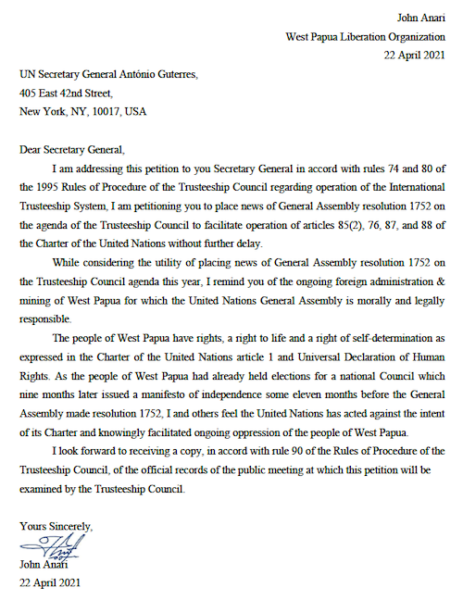
The West Papua letter to the UN Secretary-General
West Papuan envoy John Anari’s petitioning letter to the UN Secretary-General. IMAGE: APR screenshot

Wednesday, March 31, 2021

Future of AUT’s Pacific Media Centre under spotlight following director’s departure

AUT City Campus. Image: AUT

One of AUT’s Pacific research centres has been without a director since the end of last year and a lack of clarity around its future is causing division among staff and supporters. Teuila Fuatai reports for The Spinoff.  

SINCE 2007, AUT’s Pacific Media Centre has built a considerable portfolio and solid reputation for its research and reporting on issues throughout the Asia Pacific region, and as a training ground for Pasifika journalists and academics.

However, a month after veteran Pacific correspondent and researcher Professor David Robie retired as director late last year, the centre was packed up without any formal notification or explanation to the remaining AUT staff members associated with it.

The move prompted a social media outcry among supporters and regional journalists, who raised concerns about the centre’s closure and the lack of communication from the university.

Saturday, June 6, 2020

Toxic US politics, a brutal killing and the messengers become the target

CNN correspondent Omar Jimenez ... arrested in a First Amendment violation, then released
with a police apology. Image: Al Jazeera screenshot/David Robie
PACIFIC PANDEMIC DIARY: By David Robie
Three cartoonists had especially poignant takes on the tragic and toxic political aftermath of martyr George Floyd’s brutal killing under the knee of a white American policeman in Minneapolis last week.

The Boston Globe’s Christopher Weyant featured a split frame contrasting a red-capped “Make America Great Again” and a Covid Is A Hoax tee-short dangling his face mask while declaring: “You’re violating my freedom – I can’t breathe”.

On the other side of the frame is the accused policeman with his knee on Floyd’s neck as he gasps: “You’re violating my freedom … I … can’t breathe!”

READ MORE: US press freedom tracker records more than 300 incidents against journalists in the George Floyd protests

An unnamed Greek cartoonist shared by Elena Akrita showed the Statue of Liberty bearing the flame of freedom while extinguishing a life with a jackboot.

At the other end of the globe, in the South Pacific, New Zealand Herald’s Rod Emmerson depicted President Trump holding aloft a petrol can in his right hand instead of the Bible. In the background is the legend: In God We Trust: In Trump We Just Shake Our Heads.

Sunday, May 3, 2020

Jailing of Jakarta Six fuels virus fears over Papuan political prisoners

A past protest in London demanding the release of Papuan political prisoners. Image: Survival International
PACIFIC PANDEMIC DIARY: By David Robie, convenor of Pacific Media Watch

THE JAILING of the Jakarta Six – five Papuans and the first Indonesian to be convicted for a Papuan protest – in Indonesia last month has focused global attention on the plight of political prisoners in the face of a failing struggle against the coronavirus pandemic.

Already several analysts are warning that both Indonesia and Papua New Guinea are at risk of becoming coronavirus “failed states” and this will be of concern to Australia and New Zealand.

While Papua New Guinea has had only eight confirmed covid-19 cases so far – a spike is expected this month in spite of the state of emergency, Indonesia already has 10,843 cases with 831 deaths and the real toll is feared to be higher and climbing.

READ MORE: Tough coronavirus controls threaten Pacific, global media freedom


Coronavirus
ASIA PACIFIC REPORT CORONAVIRUS UPDATES

Friday, April 24, 2020

Tough coronavirus controls threaten Pacific, global media freedom

Reporters Without Borders has just published its annual World Press Freedom Index ranking
countries over censorship. Video: Hannah Cleaver/DW

PACIFIC PANDEMIC DIARY:  By David Robie

Against a backdrop of many governments using tough controls under cover of fighting the covid-19 coronavirus pandemic to strengthen “creeping authoritarianism”, a global media freedom watchdog has signalled draconian virus reactions as a major threat.

From Papua New Guinea where media briefings have been curtailed with a lockdown of the national information and operations “nerve centre” at Morauta Haus, to Fiji where media personalities have been arrested, to the Philippines where state troll armies “weaponise” disinformation on social media, and to Indonesia where street artists have stepped in fill an information void, the signs are really worrying for defenders for media freedom.

The pandemic is “highlighting and amplifying the many crises”, already casting a shadow on press freedom, says the Paris-based Reporters Without Borders watchdog, which released its annual World Media Freedom Index this week.

READ MORE: The Reporters Without Borders 2020 World Press Freedom Index

While China and Iran have been singled out for strong criticism for suppressing details of the coronavirus outbreak early in the crisis, several countries traditionally strong on media freedom in the Asia-Pacific region have slipped down in the rankings – including Australia, New Zealand and Papua New Guinea.

Sunday, February 2, 2020

Rappler challenges Duterte’s ‘media powers’ in democracy fight back

President Rodrigo Duterte with the press ... his powers to ban Rappler for two years challenged
in court. Image: Freeze frame/David Robie
By David Robie in Manila
Rappler
, the innovative online publisher that has been at the media freedom frontline in the Philippines for the past three years, has challenged President Rodrigo Duterte by taking the executive to the Supreme Court.

The news website has called on the court to rule on whether President Duterte – or the state executive branch – has the power to control the media.

It has asked the court to lift a nearly two-year coverage ban against Rappler for covering events involving President Duterte wherever he is in the Philippines or abroad.

READ MORE: The state of the Philippine media under Duterte – PCIJ
In a remarkable media freedom test case, Rappler has asked justices to clarify: Could the President pick and choose who is “legitimate media” and who is not?

It has also asked could Duterte restrict access to public events?

Thursday, January 16, 2020

'Monsters Inc' - Ampatuan massacre justice aftermath with more fear of warlords, corruption


                 The Rappler video feed on the Ampatuan convictions last month.

For decades, the feared Ampatuan clan held sway in the impoverished province of Maguindanao in Mindanao in the southern Philippines. Through a ruthless private army and a reported “propensity for beheadings”, the clan cultivated a culture of impunity. Now, however, reports David Robie, a courageous judge has challenged the horror by jailing the masterminds of the 2009 Ampatuan massacre for life.

SPECIAL REPORT: By David Robie in Manila

The families of the 58 victims – 32 of them journalists or media workers – had waited for 10 years for justice in the Philippines.

After so long, what is another couple of hours?

The Ampatuan massacre in Maguindanao on 22 November 2009 was the world’s worst single attack on journalists and the worst elections-related violence in a country notorious for electoral mayhem.

Sunday, August 25, 2019

West Papua’s road to 'independence', following the Timorese lead?


An Al Jazeera report on the protests and rioting in Papua this week in response to the racist attack in Surabaya. 

The groundswell of regional support continues to grow in the Pacific - and also globally - for West Papuan self-determination, writes DAVID ROBIE. The latest repression only adds to this momentum.

INDONESIA’s harsh policies towards West Papua ought to be scrapped. Whatever happened to the brief window of enlightenment ushered in by President Joko “Jokowi” Widodo in 2015 with promises of a more “open door” policy towards foreign journalists and human rights groups?

They were supposed to be seeing for themselves the reality on the ground. But apart from a trickle of carefully managed visits by selected journalists after the grand announcement – including two multimedia crews from RNZ Pacific and Māori Television in 2015 – no change really happened.

And the serious media freedom and human rights violations remain rampant.

Friday, July 12, 2019

'Pacific Media Watch - the Genesis', a new freedom, ethics and plurality doco


The new video produced by Blessen Tom and Sri Krishnamurthi for AUT's Pacific Media Centre.

By


“It’s a bit of a lighthouse” for vital regional news and information, says former contributing editor Alex Perrottet summing up the value of the Pacific Media Centre’s Pacific Media Watch freedom project for New Zealand and Pacific journalism.

The Radio New Zealand journalist is among seven international media people involved in the 23-year-old project featured in a new video released this week.

Pacific Media Watch – The Genesis is a 15-minute mini documentary telling the story of the project launched by two journalists at the University of Technology Sydney (UTS) and the University of Papua New Guinea (UPNG) in 1996 and adopted by Auckland University of Technology’s Pacific Media Centre in 2007.

READ MORE: The Pacific Media Watch freedom project

The video was released this week to coincide with the global media freedom conference in London this week.

Pacific Media Watch has become a challenging professional development opportunity for AUT postgraduate students seeking to develop specialist skills in Asia-Pacific journalism.

Thursday, June 6, 2019

ABC raid over Afghan Files atrocities allegations 'chilling' for freedom of press

The Afghan Files ... How the ABC reported a "Defence leak exposing deadly secrets of Australia’s
special forces" in 2017. Image: Screen shot of ABC/PMC
By Pacific Media Watch

AN Australian police raid on public broadcaster ABC this week risks having a chilling effect on freedom of the press, its editorial director says.

Police officers left the ABC’s Sydney headquarters more than eight hours after a raid began over allegations it had published classified material.

It related to a series of 2017 stories known as The Afghan Files about alleged misconduct by Australian troops in Afghanistan.

READ MORE: Why the raids on Australian media present a clear threat to democracy

ABC editorial director Craig McMurtrie told RNZ Morning Report the message the raids sent to sources and whistleblowers who wanted to reveal things in the public interest was concerning.

>>> Popular Café Pacific Posts