Showing posts with label climate activists. Show all posts

Saturday, October 22, 2022

Pacific lessons in climate crisis journalism and combating disinformation - David Robie

Media educator and Asia Pacific Report editor Professor David Robie tells of the resilience
and courage of Pacific journalists faced with many challenges.
IMAGE: MediAsia Iafor/La Trobe screenshot
By MEDIASIA IAFOR

New Zealand journalist and academic David Robie has covered the Asia-Pacific region for international media for more than four decades.

An advocate for media freedom in the Pacific region, he is the author of several books on South Pacific media and politics, including an account of the French bombing of the Greenpeace flagship Rainbow Warrior in Auckland Harbour in 1985 — which took place while he was on the last voyage.

In 1994 he founded the journal Pacific Journalism Review examining media issues and communication in the South Pacific, Asia-Pacific, Australia and New Zealand.

He is also convenor of the Pacific Media Watch media freedom collective, which collaborates with Reporters Without Borders in Paris, France.

Until he retired at Auckland University of Technology in 2020 as that university’s first professor in journalism and founder of the Pacific Media Centre, Dr Robie organised many student projects in the South Pacific such as the Bearing Witness climate action programme.

He currently edits Asia Pacific Report and is one of the founders of the new Aotearoa New Zealand-based NGO Asia Pacific Media Network.


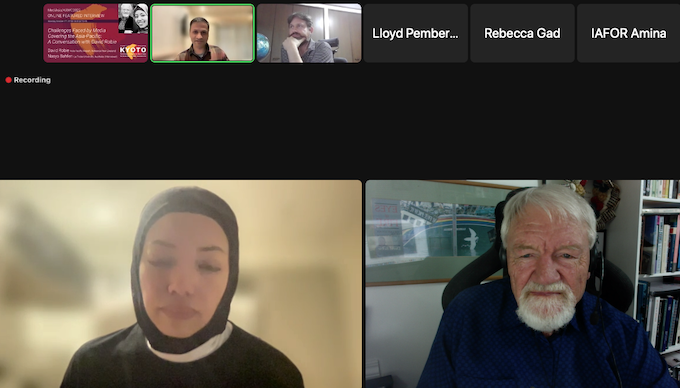
Watch the conversation between Dr Nasya Nahfen and Asia Pacific Report editor Professor David Robie. VIDEO: MediAsia Iafor/Café Pacific Media

In this interview conducted by Mediasia organising committee member Dr Nasya Bahfen of La Trobe University for this week’s 13th International Asian Conference on Media, Communication and Film that ended today in Kyoto, Japan, Professor Robie discusses a surge of disinformation and the challenges it posed for journalists in the region as they covered the covid-19 pandemic alongside a parallel “infodemic” of fake news and hoaxes.

The MediAsia “conversation” on Asia-Pacific issues in Kyoto, Japan.
IMAGE: Iafor screenshot APR
He also explores the global climate emergency and the disproportionate impact it is having on the Asia-Pacific.

Paying a tribute to the dedication and courage of Pacific journalists, he says with a chuckle: “All Pacific journalists are climate journalists — they live with it every day.”
Challenges facing the Asia-Pacific media
Challenges facing the Asia-Pacific media . . . La Trobe University’s Dr Nasya Bahfen
and Asia Pacific Report’s Dr David Robie in conversation.
IMAGE: Iafor screenshot APR

Friday, November 26, 2021

Journalism education ‘truth’ challenges in an age of growing hate, intolerance and disinformation


Four months ago Papua New Guinean journalists had been warning about increasing tensions over misinformation about COVID vaccines and a lack of clear communication from health authorities.
IMAGE: Screenshot Guardian Pacific Project

By DAVID ROBIE

IN RESPONSE to the escalating COVID-19 coronavirus pandemic in mid-February 2020 came a warning by the World Health Organisation (WHO) Secretary-General, Dr Tedros Adhanom, who declared that “we’re not just fighting an epidemic; we’re fighting an infodemic”. He added that fake news “spreads faster and more easily than this virus” .

The following month, in March 2020, UN Secretary-General António Guterres identified the “new enemy” as a “growing surge of disinformation”. However, the term “disinfodemic” – which I much prefer – was adopted by the authors of a policy brief for UNESCO to describe the “falsehoods fuelling the pandemic”.

This disinfodemic has been rapidly leading to upheavals in many countries – including in Australia and Aotearoa New Zealand in the weeks with protests, civil disobedience and attacks on health officials, medical staff and frontline workers.

Such assaults and violent confrontations have taken particular nasty turns in some of our neighbouring microstates of the South Pacific – notably Fiji and Papua New Guinea, the largest countries and biggest economies in the region.

Thursday, March 14, 2019

Mike Treen: Stand up to Islamophobia - time to tell Trump-like demagogues to get lost!


An eye witness on Strickland Street, Christchurch, saw one of the suspects being apprehended by New Zealand police after today's attack on two mosques. She said police deliberately rammed the car. Video: RNZ


By Mike Treen, national director of Unite Union

After a beautiful day in which thousands of young people across Aotearoa marched for a better future, a chill has descended across this country.

Far-right murderers have shot innocent Muslims in their holy mosques and livestreamed it on Facebook and 4Chan.

The true face of fascism is revealed once again. This is what happens when you believe the lies that they merely want “free speech” to advocate their genocidal ideology.

They hate people of different ethnicities so much that they are prepared to commit terrorist crimes.

Now more than ever, we must stand up in our millions as the true people of Aotearoa, and fight racism, fascism and Islamophobia in all forms.

Tuesday, February 27, 2018

Where were the Pacific activists and independent media at climate summit?

Papua New Guinea’s Northern Province Governor Gary Juffa …he asked what about the climate
change activists and West Papuan advocates? Where were they? Image: David Robie/PMC

By David Robie at Te Papa

A recent Andy Marlette cartoon published by the Statesman Journal in Salem, Oregon, depicted a bathtub-looking Noah’s Ark with a couple of stony-faced elephants on board with a sodden sign declaring “Climate change is a hoax”.

The other animals on board floating to safety were muttering among themselves: “The elephants won’t admit that these 100-year events are happening once a month …”

At the other end of the globe in Wellington this week for the second Pacific Ocean Climate Conference at Te Papa Tongarewa Museum, I encountered a fatalistic message from a Tongan taxi driver counting down the hours before the tail-end of Tropical Cyclone Gita struck the New Zealand capital after wreaking a trail of devastation in Samoa, Tonga and Fiji.

He had it all worked out: “We don’t need climate conferences,” he said. “Just trust in God and we’ll survive.”

However, a key takeaway message from the three-day conference was just how urgent action is needed by global policymakers, especially for the frontline states in the Pacific – Kiribati, Marshall Islands and Tuvalu, where none of the sprawling atolls that make up those countries are higher than 2m above sea level.

>>> Popular Café Pacific Posts