Showing posts with label education. Show all posts

Thursday, October 27, 2022

Fiji academic warns over media ‘climate injustice’ in open access webinar

Open Access Australasia deputy chair Dimity Flanagan . . . moderating
the "look at the evidence" webinar on the media and climate crisis.
IMAGE: Open Access screen shot APR

By DAVID ROBIE

A Fiji-based academic challenged the Pacific region’s media and policymakers today over climate crisis coverage, asking whether the discriminatory style of reporting was a case of climate injustice.

Associate Professor Shailendra Singh, head of the journalism programme at the University of the South Pacific, said climate press conferences and meetings were too focused on providing coverage of “privileged elite viewpoints”.

“Elites have their say, but communities facing the brunt of climate change have their voices muted,” he told the Look at the Evidence: Climate Journalism and Open Science webinar panel exploring the role of journalism in raising climate awareness in the week-long Open Access Australasia virtual conference.

Dr Singh, who is also on the editorial board of Pacific Journalism Review and was speaking for the recently formed Asia Pacific Media Network (APMN), threw open several questions to the participants about what appeared to be “discriminatory reporting”.

“Is slanted media coverage marginalising grassroots voices? Is this a form of climate injustice?” he asked.

“Are news media unknowingly perpetuating climate injustice?”

He cited many of the hurdles impacting on the ability of Pacific news media to cover the climate crisis effectively, such as lack of resources in small media organisations and lack of reporting expertise.

‘Jack-of-all-trades’
“We are unable to have specialist climate reporters as in some other countries; our journalists tend to be a jack-of-all-trades, and master of none,” he said.

He did not mean this in a “disparaging manner”, saying “it’s just our reality” given limited resources.

Key Pacific media handicaps included:

• The smallness of Pacific media systems;
• Limited revenue and small profit margins;
• A high attrition rate among journalists (mostly due to uncompetitive salaries);
• Pacific journalists “don’t have the luxury” of specialising in one area; and
• No media economies of scale.

“Our journalists don’t build sufficient knowledge in any one topic for consistent or in-depth reporting,” he said. “And this is more deeply felt in areas such as climate reporting.”

He cited pioneering research on Pacific climate reporting by Samoan climate change journalist Lagipoiva Dr Cherelle Jackson, saying such Pacific media research was “scarce”.

‘Staying afloat in Paradise’
A research fellow with the Reuters Institute and Oxford University, Dr Jackson carried out research on how media in her homeland and six other Pacific countries were covering climate change. The 2010 report was titled Staying Afloat in Paradise: Reporting Climate Change in the Pacific.

Pacific journalists and editors “have a responsibility to inform readers on how climatic changes can affect them, she argued. But this did not translate into the pages of their newspapers.

“Climate change is simply not as high a priority for Pacific newsrooms as issues such as health, education and politics which all take precedence over even general environment reporting,” Dr Jackson wrote.

“For a region mainly classified by the United Nations as ‘least developed’ and ‘developing’ countries, it is apparent that there are more pressing issues than climate change.

“But the fact that the islands of the Pacific are already at the bottom end of the scale in regards to wealth and infrastructure, and the fact that climate change is also threatening the mere existence of some islands, should make it a big story. But it isn’t.”

She has continued her advocacy work on climate change as climate editor of the Associated Press and completing a doctorate on the topic.

Newsroom's Marc Daalder
Newsroom’s Marc Daalder . . . “we need this [open access] to happen
for climate reporting”. IMAGE: Open Access Week 2022 screenshot APR
The Open Access Australasia media panel today also included Newsroom’s Marc Daalder, The Conversation’s New Zealand science editor Veronica Meduna, and Guardian columnist Dr Jeff Sparrow of the University of Melbourne. It was chaired by Open Access Australasia deputy chair Dimity Flanagan.

Critical of paywalls
Daalder spoke about how open access to scientific papers was vitally important for journalists who needed to read complete papers, not just abstracts. He was critical of the paywalls on many scientific research papers.

Open access enabled journalists to do their job better and this was clearly shown during the covid-19 pandemic — “and we need this to happen for climate reporting”.

Meduna said it took far too long for research, such as on climate change, to filter through into public debate. Open access helped to reduce that gap.

She also said the success of The Conversation model showed that there was a growing demand for scientists communicating directly with the public with the help of journalists.

Dr Sparrow called for a social movement for meaningful action on the climate crisis and more scientific literacy was needed to enable this.

Highly critical of the “dysfunctional” academic publishing industry, he said open access would contribute to “radically accessible” science for the public.

The panel was organised by Tuwhera digital and open access publishing team at Auckland University of Technology.

#OpenForClimateJustice
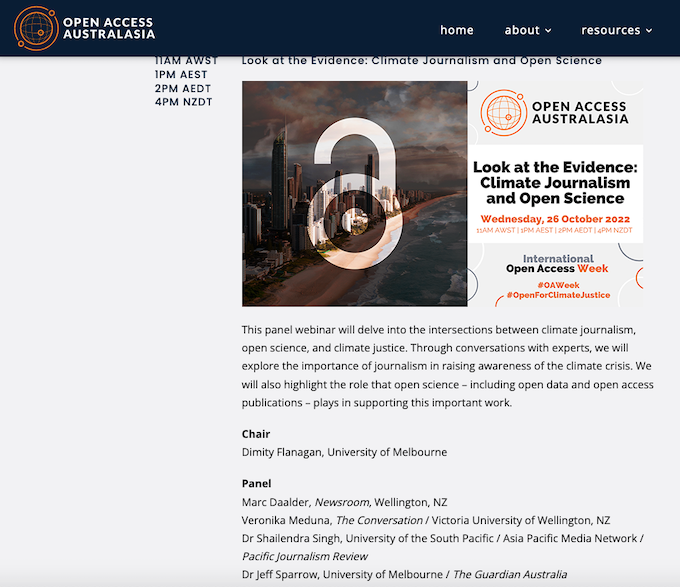
Open Access Week 2022
Open Access Week 2022 … the media climate webinar panel.
IMAGE: Open Access Week screenshot APR

Wednesday, April 13, 2022

Open letter to Minister Faafoi – an appeal to help 34 abandoned Papuan students

Papuan student advocate Laurens Ikinia ... “We are so grateful to all Kiwis across
the country for their generous support." IMAGE: Del Abcede/Asia Pacific Report

OPEN LETTER: By David Robie

Kia ora Immigration Minister Kris Faafoi

IT IS unconscionable. A bewildering and grossly unfair crisis for 34 young Papuan students – 25 male and 9 female – the hope for the future of the West Papua region, the Melanesian half of Papua New Guinea island ruled by Indonesia.

They were part of a cohort of 93 Papuan students studying in Aotearoa New Zealand on local provincial autonomy government scholarships, preparing for their careers, and learning or improving their English along the way. They were also making Pacific friendships and contacts.

They were fast becoming a “bridge” to New Zealand. Ambassadors for their people.

And then it all changed. Suddenly through no fault of their own, 41 of them were told out of the blue their scholarships were being cancelled and they had to return home.

Their funds were cut with no warning. Many of them had accommodation bills to pay, university fees to cover and other student survival debts.

Wednesday, March 30, 2022

Ukraine example cited in call to extend visas for abandoned Papuan students

Green Party MP Teanau Tuiono ... “As a Pacific nation we do have a responsibility to support West Papuans.” IMAGE: Tagata Pasifika screenshot APR

By MATTHEW SCOTT of Newsroom

Time is running out for a group of West Papuan students in New Zealand whose scholarships were cut — out of the blue — by the Indonesian government

The sudden removal of government funding for the Papuan students has left many of them in financial dire straits on visas that are running out.

Forty two students learned of the termination of their scholarships at the beginning of this year. With deadlines approaching they have appealed to both the Indonesian government and MPs in New Zealand to see if they can fix their dashed hopes of a completed education.

Green Party MPs Ricardo Menendez March, Golriz Ghahraman and Teanau Tuiono penned a letter to Minister of Foreign Affairs Nanaia Mahuta requesting government to support for the students before they are deported.

They are calling for a scholarship fund to support the impacted students, a residency pathway for West Papuan students whose welfare has been affected, and an assurance that the students will have access to safe housing in affordable accommodation.

Wednesday, March 31, 2021

Future of AUT’s Pacific Media Centre under spotlight following director’s departure

AUT City Campus. Image: AUT

One of AUT’s Pacific research centres has been without a director since the end of last year and a lack of clarity around its future is causing division among staff and supporters. Teuila Fuatai reports for The Spinoff.  

SINCE 2007, AUT’s Pacific Media Centre has built a considerable portfolio and solid reputation for its research and reporting on issues throughout the Asia Pacific region, and as a training ground for Pasifika journalists and academics.

However, a month after veteran Pacific correspondent and researcher Professor David Robie retired as director late last year, the centre was packed up without any formal notification or explanation to the remaining AUT staff members associated with it.

The move prompted a social media outcry among supporters and regional journalists, who raised concerns about the centre’s closure and the lack of communication from the university.

Tuesday, December 22, 2020

'Empowerment is really important. Journalism isn't just about writing a good story ... but empowering people with information in a democracy'

As well as playing a role in critical moments of history as a journalist in the region,
Professor David Robie's students have also covered landmark events
that helped shape some Pacific nations. Image: AUT Pasifika
By Laurens Ikinia

A JOURNALIST who sailed on board the bombed environmental ship Rainbow Warrior, was arrested at gunpoint in New Caledonia while investigating French military garrisons in pro-independence Kanak villages, and reported on social justice issues across the Pacific has stepped down as founding director of the Pacific Media Centre.

Professor David Robie, 75, an author, academic, independent journalist and journalism professor at Auckland University of Technology, retired last week after more than 18 years at the institution.

He has been working as a journalist for more than 46 years and as an academic for more than 27 years.

As well as playing a role in critical moments of history as a journalist in the region, his students have also covered landmark events that helped shape some Pacific nations, especially in Melanesia – such as the 1997 Sandline mercenary crisis in Papua New Guinea and the George Speight coup in Fiji in May 2000.

But a journalism or academic career were not always clearcut pathways for Dr Robie. During his studies in high school, he was heavily involved in outdoor pursuits and he became a Queen’s Scout.

Friday, January 27, 2017

What now for the Tongan Democrats looking ahead to 2018?

'Atenisi Institute's Dr Michael Horowitz with two Tongan newspapers -- Koe Kele'a and Talaki -- at the seminar
at Auckland University of Technology this week. Image: Del Abcede/PMC
By Kendall Hutt of the Pacific Media Centre

THE FUTURE of Tonga’s Democracy Coalition remains uncertain as next year’s election draws closer, a Nuku’alofa-based educator has concluded in a public seminar in Auckland last night.

Dr Michael Horowitz, dean of Tonga’s ‘Atenisi Institute, told the audience at his seminar entitled Can the Democracy Coalition retain power in Tonga? the fate of the party – and with it the election due late next year — was impossible to predict.

This is largely due to the fact no survey research is conducted, continuing Tonga’s “big surprise” election-day tradition, Dr Horowitz said.

Dr Horowitz, also a visiting research scholar with Auckland University of Technology’s Pacific Media Centre, said the Democracy Coalition may just hold on to power despite a bumpy term littered with controversy.

These controversies included a petition in 2015 for Prime Minister ‘Akilisi Pōhiva to surrender his education portfolio over the so-called “raw marks” policy controversy and the “cloudy issue” of state-owned Tongan Broadcasting Commission head of news Viola Ulakai’s suspension over alleged false representation, which prompted questions about Tonga’s media freedom status across the Pacific.

Monday, May 23, 2016

Standoff in PNG: Students take on Prime Minister Peter O'Neill


An NBC News report on May 17 - a useful backgrounder, but much has happened since.

Prime Minister Peter O'Neill's "I will not resign" reply to UPNG and Unitech student presidents over their "stand down" petition - May 23


By Bal Kama

Students at the University of Papua New Guinea are the latest in a long list of those in the firing line for denouncing the leadership of PNG’s seemingly impregnable Prime Minister Peter O’Neill.

The students have been on strike against the government since the end of last month. Students from the University of Technology and Divine Word University are also boycotting classes.

The UPNG students want O’Neill to resign from office and have demanded the police commissioner not suppress criminal investigations against the PM.

The students have threatened to withdraw en masse from their studies if the Prime Minister refuses to go. [Editor: He refused on Monday].

But what are their ultimate chances of success? Will O’Neill give in?

Friday, January 24, 2014

East Timor's shocking saga of the principal, the minister and a schoolgirl

The controversial image on a Timorese Facebook group.
By Alex Tilman of Di'ak Ka Lae? Timor-Leste Reconsidered

OPINION: THIS STORY will make you cringe! Last month photos of a middle-aged man (one of which is reproduced here) embracing what looked like a uniformed schoolgirl inside a car, lip-locked, surfaced on a popular Timorese Facebook group.

It was soon revealed that the middle-aged man is the principal of a Catholic high school in Dili, the Colegio de São Miguel in Rai Kotu (Comoro), and the alleged uniformed schoolgirl, one of his students.

Needless to say, the photo instantly stirred a controversy surrounding what most people see as a highly inappropriate and despicable relationship between teacher and student even though no other detail of the relationship exists.

Various individuals, including members of Parliament, called for criminal investigation and the principal's sacking. Most were appalled by the principal's behaviour, yet there were a persistent few who attempted to trivialise the significance of this photo.

The case is currently being heard in a court (see article below). But the nature of the controversy took on a new twist after journalists confronted Timor-Leste's Vice-Minister of Education in charge of secondary education, Virgilio Smith.

>>> Popular Café Pacific Posts