Showing posts with label investigative journalism. Show all posts

Saturday, March 25, 2023

The 'death' of journalism – may its memory be a blessing


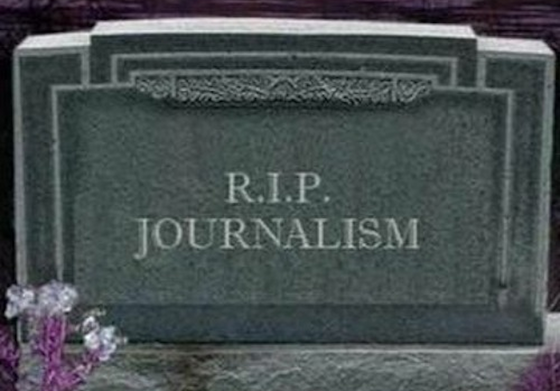
R.I.P. Journalism . . . with "thanks" to ChatGPT. IMAGE: CP

A SNIPPET shared about the ChatGPT debate from one of the gurus of investigative journalism, Sheila Coronel, at New York’s Columbia School of Journalism. She reports on social media about a recent assignment brief given by a student to ChatGPT: “Write an obituary for journalism.”

The less than 500-word result churned out by the chatbot was too close for comfort.

“It is with heavy heart that we must announce the passing of journalism, a once-vital industry that served as a cornerstone for democracy and truth-seeking around the world.

“Born in the early days of print media, journalism grew and evolved alongside society, providing a critical lens through which we could understand the events and people shaping our world. From the rise of the penny press in the 19th century to the advent of television news in the mid-20th century, journalism adapted to new technologies and mediums, but always remained committed to its fundamental purpose: informing the public and holding those in power accountable.

Monday, August 17, 2020

Facebook censorship on West Papua – then deafening silence

Facebook censorship on West Papua ... a "cruel irony". Image: RSF/PMC

By David Robie

THE SILENCE from Facebook is deafening and disturbing.

At first, when I lodged my protests earlier this month to Facebook over the immediate removal of a West Papua news item from the International Federation of Journalists shared with three social media outlets, including West Papua Media Alerts and The Pacific Newsroom, I thought it was rogue algorithms gone haywire.

The “breach of community standards” warning I also received on my FB page was unacceptable, but surely a mistake?

However, with subsequent protests by the Paris-based Reporters Without Borders (RSF) media freedom watchdog and the Sydney office of the Asia-Pacific branch of the International Federation of Journalists (IFJ), the world’s largest journalist organisation with more than 600,000 members in 187 countries, falling on deaf ears, I started wondering about the political implications of this censorship.

READ MORE: Melanesia: Facebook algorithms censor article about press freedom in West Papua

We had all complained separately to the FB director of policy for Australia and New Zealand, Mia Garlick, and were ignored.

Sunday, April 21, 2019

The Assange arrest - a warning from history for journalists

Julian Assange being dragged from the Ecuadorean Embassy in London ... an emblem of the times.
Image: John.Pilger.com

 By John Pilger in London

THE GLIMPSE of Julian Assange being dragged from the Ecuadorean Embassy in London is an emblem of the times. Might against right. Muscle against the law. Indecency against courage.

Six policemen manhandled a sick journalist, his eyes wincing against his first natural light in almost seven years.

That this outrage happened in the heart of London, in the land of Magna Carta, ought to shame and anger all who fear for "democratic" societies. Assange is a political refugee protected by international law, the recipient of asylum under a strict covenant to which Britain is a signatory. The United Nations made this clear in the legal ruling of its Working Party on Arbitrary Detention.

But to hell with that. Let the thugs go in. Directed by the quasi fascists in Trump's Washington, in league with Ecuador's Lenin Moreno, a Latin American Judas and liar seeking to disguise his rancid regime, the British elite abandoned its last imperial myth: that of fairness and justice.

Imagine Tony Blair dragged from his multi-million pound Georgian home in Connaught Square, London, in handcuffs, for onward dispatch to the dock in The Hague. By the standard of Nuremberg, Blair's "paramount crime" is the deaths of a million Iraqis. Assange's crime is journalism: holding the rapacious to account, exposing their lies and empowering people all over the world with truth.

Tuesday, August 26, 2014

La’o Hamutuk calls for inquiry into Timor GAP ‘mismanagement’ of oil resources

The Suai project on the South Coast ... "liberated" land but confused communities.
Photo: La'o Hamutuk
AN INDEPENDENT Timor-Leste development and social justice agency has called for an inquiry into the Timor GAP corporation established to manage the country’s energy resources for the benefit of its citizens, alleging “poor management” and “possible corruption”.

La’o Hamutuk, which has been monitoring state management of the oil and gas industry reserves and government spending, has sent an open letter to the Court of Appeal president Guilhermino da Silva and other agencies.

The state-owned company Timor Gás & Petróleo, E.P. was established in July 2011 and it began operations three months later - but has never filed an annual report for the past three years as required by law, according to La’o Hamutuk researchers.

“La’o Hamutuk has asked them about this many times, and Timor GAP said that problems with the internal audit of their GAP-MHS subsidiary prevented publication of these reports for more a year,” the development agency said in its open letter.

"We believe that Timor GAP, E.P. may have committed legal violations, maladministration, poor management, and possible corruption, as well as ignoring legal obligations for accountability and transparency."

The letter called for an “external audit” initiated by the "Camara de Contas [Tax and Audit Tribunal] or Parliament".

Thursday, July 24, 2014

Walkley review: The complex notion of news in the Pacific

Brent Edwards in The Walkley Magazine looks at journalist and academic David Robie’s scrutiny of the Pacific region’s governance and journalism. Cartoon by David Pope.

DAVID ROBIE has spent 35 years working as a journalist and journalism academic in the Asia- Pacific region. In Don’t Spoil My Beautiful Face: Media, mayhem and human rights in the Pacific, Robie summarises his reportage on many of the significant events that have marked his years working in the Pacific. It is part autobiography, part history and part journalism treatise.

As well as providing his perceptive analysis of human rights and democracy, or lack of, in the Pacific, Robie also spends time commenting on journalistic practices, particularly as they relate to reporting on our immediate neighbourhood. For someone like me, who is not an expert on the Pacific, the book is a valuable reference to the significant issues that continue to bedevil the region.

Robie’s book is broad in its compass. It covers the Kanaky struggle for self-determination in New Caledonia, the rise of the Flosse dynasty in Tahiti, coups in Fiji, Chinese influence in Tonga, the struggle in Bougainville, the fight for independence in Timor Leste, the ongoing struggle in West Papua and the bombing of the Rainbow Warrior in Auckland in New Zealand. His stories range as far away as covering indigenous struggles in Canada to the violence in the Philippines. And always he is concerned with human rights in the Pacific.

Robie includes articles he has written over the past 30 years or so, updated by his contemporary analysis of what is happening now. Take New Caledonia for instance. That chapter includes an article Robie wrote for the New Zealand Listener in 1984 titled “Blood on their banner”.

He writes that his reporting on New Caledonia led to a protracted and acrimonious dispute with Fiji’s Islands Business publisher Robert Keith-Reid, when the magazine accused him in 1989 of alleged “leftist” support of Kanak activists. It is just one example of the pressure that has been exerted on Robie and other journalists over their coverage of independence movements in the region.

But it is Robie’s comments on the practice of journalism that should excite the most debate. He makes no bones about his distaste of the tendency of regimes and other vested interests in the region trying to suppress press freedoms, often by intimidation and threats.

His views on journalism in the region have not just been shaped by his experience as a journalist. He has also been the head of journalism at both the universities of Papua New Guinea and the South Pacific and he is now journalism professor and director of the AUT University’s Pacific Media Centre in Auckland.

He praises those journalists throughout the region who struggle to do their job in the face of intimidation, legal restraints and poor pay. But he is less effusive about the role of Western journalism in covering the Pacific. He questions whether the Western notion of news is appropriate to covering the many complex issues in the region. And, before some journalists protest too loudly, this is not a cry for the media to go soft. But Robie does raise some interesting questions about the role of journalism and whether its approach could be altered.

Robie puts forward the case for journalists practising what he calls critical deliberative journalism in the region. He argues that Pacific journalists now have a greater task than ever in encouraging democratisation of the region and informed insights into development, social justice and peace issues facing related island states. In other words, he says journalists should be part of the solution, not part of the problem.

Robie says this does not mean allowing politicians’ slogans, such as “cultural sensitivity”, to be used as a smokescreen for the abuse of power and violations of human rights. Instead, he says the approach he advocates will put greater pressure on journalists to expose the truth and report on alternatives and solutions.

Robie sums it up this way: “Critical deliberative journalism also means a tougher scrutiny of the region’s institutions and dynamics of governance. Answers are needed for the questions: Why, how and what now?”

Those questions do not just apply to the island states. Here in Australia and New Zealand we, too, might consider a different approach to the way we practise journalism.

Friday, March 7, 2014

Libération newspaper now fighting for its own ‘liberation’

Not a "brand" ... 40 years of Libération on display in a gallery near les Halles, Paris,
last October. Photo: David Robie

By DAVID ROBIE
JEAN-PAUL SARTRE would have turned in his grave over the fate of his cherished daily newspaper.

Founded by Sartre and Serge July more than four decades ago in the aftermath of the 1968 student riots in Paris, the left-leaning Libération has fallen on hard times.

But the company’s new shareholders came up with a plan to rescue it that has been greeted with derision by staff.

Founded on a non-conformist editorial policy that shunned commercialisation, the paper’s headquarters would be turned into a multimedia cultural centre, with a bar, restaurant, a TV studio and a social network “hub”.

This new proposal followed failed negotiations to put the Libération’s online edition behind a paywall.

Friday, February 28, 2014

A 'Pacific brand' of journalism? A forthcoming media book tells how

ADVOCATES, campaigners,  journalists and researchers gathered at New Zealand's AUT University today to honour past campaigns for the Nuclear-Free and Independent Pacific Movement (NFIP) and to strategise for the future.

Panel presentations ranged from the US Castle Bravo nuclear test on Bikini Atoll in 1954 - today, March 1, was the 60th anniversary - to the Rongelap Atoll evacuation by Greenpeace in May 1985, the protests against French nuclear testing, the ICAN campaign to abolish all nuclear weapons, the "forgotten struggle" in West Papua, and to the future self-determination vote in Kanaky.

Delegates were also told about a new book being published next month about NFIP issues and journalism - Don't Spoil My Beautiful Face: Media, Mayhem and Human Rights in the Pacific by Pacific Media Centre director and Café Pacific publisher David Robie.

What commentators say:

David Robie has been committed to developing quality journalism in the Pacific, and especially in developing a “Pacific brand” of journalism.
Kalafi Moala, Pasifika Media Association (PASIMA)

Tuesday, February 11, 2014

Exposing the Invisible - digital technology for social justice

Unseen War ... one of the trilogy of Exposing the Invisible films.

By DAVID ROBIE

IN A remarkable “before we are launched” event organised by the fledgling Sydney Democracy Network in one of Australia’s oldest lecture theatres, a digital technology collective has demonstrated dramatic and progressive examples of the global “information war”.

The Berlin-based Tactical Technology Collective co-founders, Stephanie Hanley and Marek Tuszynski, treated a packed theatre at Sydney University to a smorgasbord of video and technology at the forefront of ground-breaking social justice information collaborations.

The video Unseen War was an inspiring and provocative investigation into the use of drones for illegal targeting killings in Pakistan’s Tribal Areas bordering Afghanistan – far from the glare of media publicity.

An estimated 2500-3500 civilians have been killed in this “unseen war” through drone attacks on urban areas.

Twelve journalists have also been killed in the past decade, many as a result of investigating these targeted killings.

Friday, February 7, 2014

Timor-Leste's media law ‘secrecy’ lifted, but draconian content revealed

East Timorese journalists at work ... no more freelancers
under the draft media law? Photo: David Robie
By DAVID ROBIE

THE PROPOSED Timor-Leste media law is a draconian mixed bag. And it is ironical that such a document with lofty claims of protecting the freedom of the press should be shrouded in secrecy for the past six months.

After being approved by the Council of Ministers last August 6, it has languished in the “don’t touch” basket since then, apart from a critical airing at a conference on the state of the media last October.

And then suddenly, with few copies of the document being in circulation previously, a hurried “consultation" was held with journalist representatives this week. A journalists' submission is expected by Parliamentary Committee A by Monday.

But other people with a stake in the future of media regulation – such as academics, bloggers, book publishers, non-government organisations, political commentators and media users themselves – haven’t yet had a chance to give any input.

While the document contains an interesting attempt to define “duties” of journalists in an evolving new democracy such as Timor-Leste and professes to support freedom of information and the right to be informed, in reality many clauses seek to effectively gag the press and debate.

Sunday, February 2, 2014

Timor-Leste’s Max Stahl – documenting the audiovisual and development ‘war’

Filmmaker and digital historian Max Stahl with an image from his 1991 Santa Cruz
massacre footage in Timor-Leste. Photo: David Robie
By David Robie

A YEAR after Indonesian troops killed more than 270 peaceful demonstrators at the cemetery of Santa Cruz in the Timor-Leste capital of Dili in 1991, news footage secretly shot by a cameraman surfaced in a powerful new film.

The Yorkshire Television documentary, In Cold Blood: The Massacre of East Timor, screened in six countries and later broadcast in other nations, helped change the course of history.

Until then, countries such as Australia and New Zealand – in spite of a New Zealander being killed in the massacre – had been content to close a blind eye to the illegal Indonesian invasion in 1975 and the atrocities committed for a quarter century.

The cameraman, Max Stahl, who risked his own life to film the massacre and bury the footage cassette in a freshly dug grave before he was arrested, knew this evidence of the massacre would be devastating.

In a documentary made a decade later by Yorkshire Television’s Peter Gordon, Bloodshot: The Dreams and Nightmares of East Timor, that interviewed key players –including Stahl himself - in the transition to restored independence in 2002, Timorese leaders reveal just how critical this footage was in telling their story of repression to the world.

Sunday, August 4, 2013

Behind The Shroud - Ahmed Zaoui case exposé finally on TV


By Selwyn Manning

BEHIND THE SHROUD:
Tonight for the first time on New Zealand television the public will be told why and how the Security Intelligence Service (SIS) got the Ahmed Zaoui case so wrong. What can we learn from those mistakes?

Should the SIS, GCSB and our intelligence aparatus undergo significant reform? This documentary explains what the government refused to reveal.

FaceTV Sky channel 83 @ 8pm.

Behind The Shroud reveals for the first time secret testimonies of witnesses who appeared before the Inspector-General of Intelligence and Security’s secret hearings into the Ahmed Zaoui case.

This testimony is highly relevant today as we all debate how we as New Zealanders can all take a role in resisting gross abuses against our civil liberties and the excessive use of the state’s intelligence agency powers.

Monday, July 29, 2013

NZ Defence Force’s paranoia about journalism 'subversives'

Cartoon source: Bryce Edwards blog
By Gordon Campbell on Scoop

IF THE thousands of people who marched on the weekend against New Zealand's Government Communications Security Bill (GCSB Bill) wanted further justification for their concerns, the Defence Force has just provided it with bells on.

The mindset that treats journalists as being threats to security on a par with foreign hostiles, activist groups, criminal hackers and dishonest staff is an excellent illustration of why the surveillance powers bestowed by the Bill are so dangerous.

A Defence Force that treats the normal querying of the status quo by the Fourth Estate as being essentially treasonous in nature, has gone off the reservation, and is out of control.

Give it the power to do so, and such an organisation will readily use the surveillance powers in the GCSB Bill to substantiate its persecution complex.

It is already doing so. This isn’t just a theoretical danger, glimmering somewhere off in the future.

Monday, July 22, 2013

A ‘dirty war’, NZ military cover-up and the vindication of a journalist


 Trailer for the Jeremy Scahill film Dirty Wars about the hidden truth over America's covert wars.

INDEPENDENT investigative journalist Jon Stephenson called it a “moral victory”. The Herald on Sunday described it as a “vindication” in an editorial.

And for many New Zealand journalists it was a humiliation of the military even before the defamation case was over.

Although the jury couldn’t make up its mind on whether it was defamation, the NZ Defence Force chief, Lieutenant-General Rhys Jones, had already conceded the factual issues, the smear webpage against Stephenson had been removed and the military had pledged to make public statement accepting the journalist’s version of events in his reports of New Zealand’s role in the “dirty war” in Afghanistan.

An independent journalist had taken on the might of the Defence Force with its battery of lawyers and legal resources – and won.

Jon Stephenson’s credibility was intact, the Defence Force’s credibility in tatters. But at what price?

Thursday, May 23, 2013

New models of funding needed, say NZ investigative journalists

Pacific Media Centre's David Robie ... “We need to educate the universities."
Photo: Jamie Small/Te Waha Nui
INVESTIGATIVE journalists are calling for new models of funding to fill a gap in the industry where the private sector has failed.  

By Jamie Small of Te Waha Nui

Nicky Hager, author of The Hollow Men and Other People’s Wars, says there is not enough support for investigative journalists in countries like New Zealand.

“I hope that one day there will be a return to serious public funding for investigative journalism,” he says.

Hager says most investigative journalists do not have much industry training or support. They are often citizens who begin investigating a crime or wrongdoing and do not realise they have become a journalist.

Professor David Robie, director of AUT University’s Pacific Media Centre, believes he has an answer.

“As the mainstream media reduces its reporting skills, universities should be picking up the slack,” he says.

Friday, April 19, 2013

'Secrecy for sale' offshore bank leaks draw global responses


By Emily Menkes, Michael Hudson and Kimberley Porteous of the ICIJ


The International Consortium of Investigative Journalism (ICIJ) investigative series on offshore secrecy – which draws from a cache of 2.5 million leaked secret records – has ignited reactions around the globe, including the Pacific.

Since the initial release of stories by the ICIJ and its media partners across the world, public officials have issued statements, governments have launched investigations, and politicians and journalists have been debating the implications of the records and the reporting.

Among reactions and responses:
  • Bayartsogt Sangajav: resigned his post after offshore account revelation: Bayartsogt Sangajav, deputy speaker of the Mongolian Parliament, has reportedly resigned from his post following ICIJ's revelations about his undeclared offshore company and bank account. In a parliamentary session he was asked to explain his actions. Several MPs called for further disciplinary action, including expelling him from Parliament entirely.
  • Santosh Kumar Agarwal (Kedia), a member of the board of directors for the Antwerp World Diamond Centre, has resigned from the organisation after his offshore dealings were revealed: “In the interest of the integrity of the Antwerp World Diamond Centre as [an] organisation and the industry as a whole, Kedia has taken the initiative to withdraw from the AWDC's board of directors, awaiting the outcome of a potential investigation,” said a statement released by the company.

Sunday, April 14, 2013

Rebuilding the foundations of independent public interest journalism


Scoop editor and general manager Alastair Thompson (left)
and Pacific Media Centre’s director Professor David Robie
at the Scoop Foundation launch. Image: Del Abcede/PMC
An address by Scoop editor and general manager Alastair Thompson for the launch of the Scoop Foundation project and Pacific Scoop Internship at AUT's Pacific Media Centre.

By Alastair Thompson

In a push to offer new support and momentum for public interest journalism, New Zealand's leading independent news provider, Scoop Media, is lending its weight to two initiatives being announced for the first time.

The first initiative, the Scoop Foundation Project, brings Scoop.co.nz together with a group of New Zealand’s leading practitioners of public interest journalism to create a charitable trust to fund investigative journalistic work.

This coincides with the launch by Scoop of a $5000 Pacific Scoop internship being awarded in conjunction with AUT University’s Pacific Media Centre (PMC). The first recipient, Danish radio journalist Daniel Drageset, was named at the School of Communication Studies Awards event held at the newly opened Sir Paul Reeves Building at AUT last week.

The name for Scoop's "Scoop Foundation Project" plays on the associated ideas of "foundation" and "construction". It is clear that we now need to build a new journalism.

The one that we have has been struggling for some time, and a key component of it - print - is now on life support.

And to build a new journalism we need to start by (re)constructing some foundations. And that is what the Scoop Foundation project will do.

The first important thing to understand about the Scoop Foundation Project is that it is a completely separate entity from Scoop Media Limited, publisher of the Scoop.co.nz.

Saturday, April 6, 2013

Dutch journalist releases second Bali undercover extortion video in scam exposé

One of the  Bali police bribery segments in the 'Fraudsters Abroad' programme.


By Made Arya Kencana in Denpasar

INDONESIAN authorities have been dealt another embarrassing blow when a second video shot by Dutch stunt journalist Kees Van der Spek hit YouTube this week.

Van der Spek, a journalist for the Dutch TV station SBS6, secretly recorded a customs officer at Bali's Ngurah Rai Airport demanding a $200 bribe. The video was posted days after another undercover shoot showing extortion by Bali police made headlines in Indonesia.

Both segments are part of a new Dutch show titled Oplichters in het Buitenland ("Fraudsters Abroad"). In the 42-minute show, Van der Spek and his crew travel the world, breaking the law to expose scams and extortion attempts by local authorities.

In the latest video, the undercover journalist's team is held up by customs officials at Ngurah Rai Airport. The crew was attempting to arrive in Indonesia without necessary filming permits from the Indonesian Embassy.

Tuesday, December 4, 2012

Hats off to PMC student investigative, convergent media awards in annual Ossies awards

Karen Abplanalp speaking at the recent Jesson Awards
about her article "Blood Money". Photo: John Miller
From Pacific Media Watch

AUT Pacific Media Centre's Karen Abplanalp has won a rare double award for her article on New Zealand investment in a controversial gold and copper mine in Indonesian-ruled West Papua at the annual Ossies for student journalism in Australia.

She has won both the Sally A. White Prize for Investigative Journalism and Best Feature (Print) Award.

Her article, "Blood Money", developed out of an assignment in her postgraduate Asia-Pacific Journalism course at AUT University in New Zealand, was published as the lead feature in Metro magazine last December.

Last month, she was also awarded New Zealand's Bruce Jesson Emerging Journalist Award for the investigative article.

Abplanalp investigated the $1.3 million New Zealand Superannuation Fund (NZSF) "ethical" investment in the US-owned Freeport McMoRan mine at Grasberg in southern West Papua region, which has been at the heart of human rights allegations for several years.

Late last year, a strike at the mine led to several killings by security forces.

Judge Sharon Mascall-Dare in the Journalism Education Association of Australia (JEAA) Ossie awards investigative journalism category said: "Karen Abplanalp's investigation into human rights abuses at a copper and gold mine in West Papua is an outstanding piece of journalism.

"Her methodology is robust; her presentation compelling. Her work was responsible for a national debate that, ultimately, persuaded the New Zealand Superannuation Fund to end its investment in the mine: her work held the fund's "ethical" investment policies to account.

'Blood Money'
"Blood Money is exemplary in demonstrating investigative journalism as a medium for change, in the public interest."  

In the Best Feature (Print) category, judge Max Anderson, editor of Adelaide Hills Magazine, said Abplanalp’s article "demonstrates investigative savvy and a command of the feature writer’s art.

"Incredibly assured and perfectly metered, it allows the facts and interviewees to do the hard lifting without confounding narrative or surrendering pace. Any editor serving educated readers would be delighted to receive it."

The PMC's Alex Perrottet also won a highly commended award in the Best Use of Convergent Media for "Not eccentric at all", a combined slideshow, audio interview and text report providing an intimate glimpse of the life of King George Tupou V of Tonga before he died in March. This was published on Pacific Scoop website and posted on YouTube.

Judge Chris Campbell, director of Our World Today, said: "Engaging and personal choice of story - great interview."

Perrottet has been the PMC's Pacific Media Watch media freedom project editor for the past two years.

The winner in this category was Monash University's "highly professional" Dangerous Grounds investigative website probing environmental hazards and policies in the state of Victoria.

Pacific Media Centre director Professor David Robie praised the centre's students for their contribution to investigative work.

"It demonstrates the value of investigative research journalism when universities support their independent role," he said.

"Karen Abplanalp's article was recently republished as an example of research journalism in Pacific Journalism Review."

The Best Publication category in the Ossies was won by the University of the South Pacific's Wansolwara newspaper.

"This entry stood out because the journalists produced highly relevant and interesting stories in the public interest," said judge Paul Starick,  head of news of Advertiser Newspapers in Adelaide.

"The front-page expose on the rigging of the Miss World Fiji beauty pageant was a great example of investigative journalism, both in the research and writing." 

This report also won the Best News Story category.

"Not only did the stories in this publication stand out from the crowd, the journalists worked under trying circumstances. Wansolwara [had been] subject to censorship under martial law. Yet it campaigned for press freedom in numerous articles - surely something that must test the courage of any journalist."

Stop press:  David Robie is the only JEA journalist and media academic whose students have won the best publication award at three different universities for three separate publications: Uni Tavur (University of PNG, 1995), Wansolwara (University of the South Pacific, 2000), and Te Waha Nui (AUT University, 2005)

Wednesday, October 31, 2012

Freeport mine investigation article wins Jesson emerging journalist award


An Al Jazeera news feed on the strike at Freeport mine in West Papua in October 2011 backgrounding the issues. Note that the clip is reported through a Jakarta "prism" rather than a Papuan one.

CONGRATULATIONS to Auckland writer/photographer Karen Abplanalp who has won the Bruce Jesson Foundation’s $1000 Emerging Journalist Award for an outstanding investigation published in Metro magazine in December 2011 about the NZ Superannuation Fund’s investment in the Freeport mine at Grasberg in West Papua. She was awarded the prize last night by foundation chair Professor Jane Kelsey.

The article was written while she was a postgraduate journalism student with AUT University’s Pacific Media Centre and on the Asia-Pacific Journalism course taught by David Robie. It was also featured in the May 2012 edition of Pacific Journalism Review.

The article, “Blood Money”, asked how the Super Fund could justify investing in a project, owned by US-based mining giant Freeport-McMoRan Copper & Gold Inc, that depended on regular payments to the Indonesian military and other unethical practices. At least three striking Grasberg miners were shot dead by police in October 2011. (The above Al Jazeera video news news clip during the strike reported three were shot). The judges' statement said:


Jesson Foundation chair Professor Jane Kelsey with the
Emerging Journalist category winner Karen Abplanalp
The Super Fund defended its investment to Abplanalp, arguing that it had a policy of “engagement” with the mining company to improve its ethical practices.

But on September 26 this year the Super Fund announced that it had sold its $1.28 million investment in Freeport McMoRan because of “breaches of human rights standards by security forces around the Grasberg mine, and concerns over requirements for direct payments to government security forces”.

It also sold much smaller investments in three other companies “for severe breaches of the fund’s responsible investment standards where engagement was unlikely to be effective”.

The convenor of the Jesson Foundation’s journalism awards subcommittee, Camille Guy, said Karen Abplanalp’s article was a stunning exemplar of the crucial role of journalism in all countries of holding authority to account.


The award-winning Metro article.
“If Karen hadn’t investigated the true conditions behind the profits coming out of the Grasberg mine, it is unlikely that more than a handful of New Zealanders would have been aware of what their public pension fund was supporting. NZ Super Fund managers themselves probably did not know the full truth,” Guy said.

“Karen Abplanalp and Metro magazine have performed an important public service in bringing these conditions to light, and I am delighted that the Super Fund has now pulled out of this investment.”

The top Bruce Jesson journalism prize of $4000 for investigative journalism went to Christchurch journalist Rebecca Macfie for a planned book about the Pike River mine disaster.

Macfie, the South Island correspondent for The Listener, has covered the Pike River story ever since 29 miners died on 19 November 2010 in New Zealand’s worst mining disaster in almost a century.


The Jesson journalism prizes, set up after the death of journalist Bruce Jesson in 1999 to support investigative journalism in New Zealand, will contribute $4000 towards Macfie’s costs of researching and writing an in-depth book on the tragedy for Wellington publisher Awa Press.

Macfie will take leave without pay from the Listener to write the book, which will be published next year.

Friday, July 27, 2012

Sex, Spooks and Wikileaks: Assange and Swedish justice

Photo: Ali Bell
A colleague and Broadsword columnist on the Pacific Media Centre Online now lives in Stockholm. She has been taking a keen interest in the Wikileaks and Julian Assange extradition case.  She has some interesting insights. Check out her introductory thoughts here and then read the rest of the article at PMC Online.

By Ali Bell

I have been asked so many times by folk in New Zealand what Swedes make of the Assange case, I thought it would be clarifying to put it together in an article, but crystal clear it isn't. “The truth” might be out there but nowhere I can swear by.

So much of what is reported is speculation, rumour and online leaks, following it is like following a plot more convoluted than an episode of TV's Spooks, with just as many possible inside governmental plots and backstage international alliances, with attractive “stock characters” as sexy Swedish female patsies or (least likely) honeytrapping spies, and with secrecy in every phonecall nook and governmental-memo cranny.

Thrown in to boot – a momentous hot potato like Wikileaks but with a hard-to-warm-to protagonist, and on top of all this a sexual-crimes case that has us all gobsmacked (including at least one of the victims) and set it in one of the most socio-politically idealistic but judicially flawed countries in the Western world – it would be an enthralling TV show indeed.  24  (or in this case 23 months and counting) eat your heart out.

But it hasn't been 24 hours, and we are getting media fatigue – I know I am – from the case. How long can Assange hang out in the Ecuadorian embassy in London after all?

No Swede I have talked to believes this rape/sex crimes charge comes from a genuine wish to clean up the world for women's sexual safety. (Rapes in Sweden can be as difficult as other Western countries to get a conviction for.)

Everyone mentions the timing of the charges as being far too convenient (in order to get Assange into custody here), and no-one doubts, erroneously or not, that the Swedes intend to hand him over to the Americans and that Assange has every reason to fear this.

It must be noted that the public prosecutor in charge of this case vehemently denies that this is Sweden's intention.

What we do know is there were leaks everywhere – and not just from Assange's condoms.

>>> Popular Café Pacific Posts