Showing posts with label france. Show all posts

Thursday, December 16, 2021

Kanaky New Caledonia vote to stay with France is a hollow victory - it will only rachet up tensions


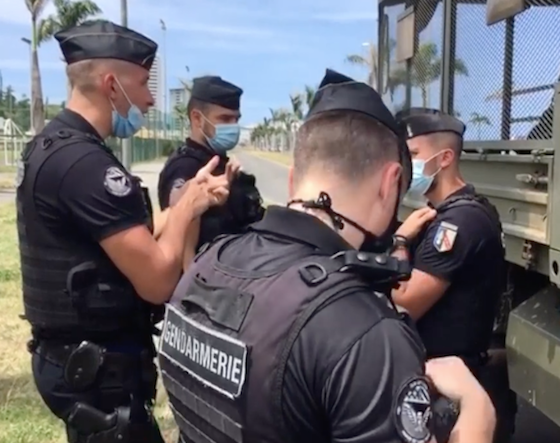
"Keeping the peace" ... French police in Noumea for the third and final independence
referendum yesterday. IMAGE: Caledonia TV screenshot APR
 
ANALYSIS: By DAVID ROBIE

“Loyalist” New Caledonians handed France the decisive victory in the third and final referendum on independence it wanted in Sunday’s vote.

But it was a hollow victory, with pro-independence Kanaks delivering Paris a massive rebuke for its three-decade decolonisation strategy.

The referendum is likely to be seen as a failure, a capture of the vote by settlers without the meaningful participation of the Indigenous Kanak people. Pacific nations are unlikely to accept this disenfranchising of Indigenous self-determination.

In the final results on Sunday night, 96.49 per cent said “non” to independence and just 3.51 per cent “oui”. This was a dramatic reversal of the narrow defeats in the two previous plebiscites in 2018 and 2020.

However, the negative vote in this final round was based on 43.9 per cent turnout, in contrast to record 80 per cent-plus turnouts in the two earlier votes. This casts the legitimacy of the vote in doubt, and is likely to inflame tensions.

Tuesday, October 6, 2020

Victory in defeat for Kanak independence movement in latest referendum


A display of Kanaky independence flags on referendum day.
Image: Al Jazeera/PMC screenshot

ANALYSIS:
By David Robie

WHILE pro-independence Kanak supporters rued another defeat in the second referendum on independence for New Caledonia at the weekend, it was even narrower than the loss two years ago. Now there is a real prospect of a win in 2022.

“The path to independence and sovereignty is inevitable,” pledges the Front de Libération Nationale Kanak et Socialiste (FLNKS) – the umbrella group of the pro-independence parties and the struggle will go on.

Roch Wamytan, president of New Caledonia’s parliamentary Congress and a key leader of the FLNKS’ Union Calédonienne, vows the independence lobbying will press for the third referendum in two years’ time – and even later if needed.

If there is a third defeat, “we’ll talk, and we’ll figure something out”.

Tuesday, April 16, 2019

Don’t despair about Notre Dame - a rebuilt cathedral could be just as wonderful

The moment the spire collapses while flames are burning the roof of Notre-Dame Cathedral in Paris, France.
Image: AG Photographs via Flickr
By Claire Smith and Jordan Ralph
 

A wonderful icon has been largely destroyed by fire. However, we should not despair.

Part of the reason this loss is so upsetting is because we are immersed in a Western way of thinking that equates authenticity with preserving the original materials used to create an object or building.

But not all societies think like this. Some have quite different notions of what is authentic.

Iconic buildings such as the Catherine Palace in Russia and Japan’s historic monuments of Ancient Nara have been successfully restored, sometimes after great damage, and are today appreciated by millions of people.

Tuesday, November 6, 2018

New Caledonia blockade tension fails to mar French PM’s talks on future

French security forces arrive in force to deal with protesters demonstrating over the independence vote
defeat near St Louis, Noumea. Image: Screenshot - Les Nouvelles Caledoniennes
By David Robie in Nouméa

French security forces moved in today to clean up the main road near an indigenous Kanak tribal area after a day of tension and rioting failed to mar a lightning visit by French Prime Minister Édouard Philippe and post-independence referendum discussions.

Philippe flew in yesterday morning from Vietnam for a day of meetings with political leaders, customary chiefs and voting commission officials to take stock of the historic referendum on Sunday.

While the people of New Caledonia voted to remain French with a resounding 56.4 percent of the vote, it was a lower winning margin than had been widely predicted in the face of an impressive mobilisation by pro-independence groups.

The yes vote was 43.6 percent but Kanak voters were already a minority of the restricted electorate for this vote that included Caldoche (settlers), descendants of a French penal colony for Algerian and Paris commune dissidents, and people of Asian and Wallisian ancestry.

A record 80.63 percent turnout with 141,099 voters in a largely calm and uneventful referendum day has opened the door for serious negotiations about the future of New Caledonia.

READ MORE - David Robie's analysis of the referendum:
Part 1: New Caledonia vote stirs painful memories – and a hopeful future
Part 2: Kanaky independence campaign rolls on ... encouraged by ballot result

Saturday, June 10, 2017

Celebrating 30 years of Nuclear-Free Aotearoa -- the Pacific connection

Auckland mayor Phil Goff admiring a photograph by John Miller taken of the politician when he was a student activist campaigning for a nuclear-free New Zealand. Goff spoke at the "Celebrating 30 Years of Nuclear-Free Aotearoa/New Zealand" at the Depot Artspace in Devonport today. Image" David Robie
Reflections from David Robie

CONGRATULATIONS everybody for that tremendous achievement three decades ago. And thank you to WILPF Aotearoa and Ruth Coombes for inviting me. It was literally a David and Goliath struggle to make New Zealand nuclear-free against United States and global pressure – not just David Lange, prime minister at the time, although he was vital too.

The real “David” was the ordinary people of New Zealand who exerted extraordinary pressure on the government to deliver. The barrages of letters from citizens, constant lobbying by peace campaigners, local councils – such as right here in Devonport -- declaring themselves nuclear-free, the door-knocking petitioners – and, of course, the spectacular protests.

However, in my few minutes I would like to talk about the Pacific context, as this was my background. While the New Zealand campaign and success was tremendously inspirational for the Pacific, it should not be forgotten that some small Pacific countries and communities were actually ahead of the game.

Some examples:

Thursday, January 7, 2016

2015: The year Charlie Hebdo was hailed, blasted and misunderstood

This picture taken on January 18, 2015 shows a giant half-broken pencil
near the headquarters of French satirical newspaper  
Charlie Hebdo in Paris. Image: Joël Saget/AFP/France 24
By Benjamin Dodman in France 24

IN THE 12 months since the gruesome attacks on its Paris office, Charlie Hebdo has been praised, mourned, cursed and debated by a global panel of commentators, politicians and religious zealots - most of whom have never read it it, let alone understood it.

By all accounts it has been a tumultuous year for the satirical weekly – one that began with carnage, brought the cash-strapped paper fame and scrutiny, and left its traumatised survivors holed up in a bunker with more subscribers than they ever dreamt of having.

Charlie had been a household name in the French media landscape, its notoriety surpassed by that of its most illustrious cartoonists, including Jean Cabut (known as Cabu) and Georges Wolinski, two icons of French popular culture, both of whom were murdered a year ago by jihadist gunmen, along with six other staff members.

And yet its actual readership, barely reaching the tens of thousands, was a tiny – and shrinking – minority in a country where few people still read the papers, least of all in print.

Saturday, November 14, 2015

Beirut and Paris: Two terror attacks with different tales

Mourners at the Auckland, New Zealand, vigil for Paris at the weekend. Photo: David Robie
By Belen Fernandez

AS NEWS arrived of terror attacks in Paris that ultimately left more than 120 people dead, US President Barack Obama characterised the situation as “heartbreaking” and an assault “on all of humanity.”

But his presidential sympathy was conspicuously absent the previous day when terror attacks in Beirut left more than 40 dead. Predictably, Western media and social media were much less vocal about the slaughter in Lebanon.

The Independent's weekend front page, UK.
And while many of us are presumably aware, to some degree, of the discrepancy in value assigned to people's lives on the basis of nationality and other factors, the back-to-back massacres in Beirut and Paris served to illustrate without a doubt the fact that, when it comes down to it, “all of humanity” doesn't necessarily qualify as human.

Of course, there's more to the story than the relative dehumanisation of the Lebanese as compared with their French counterparts. There's also the prevailing notion in the West that — as far as bombs, explosions, and killings go — Lebanon is simply One of Those Places Where Such Things Happen.

The same goes for places like Iraq, to an even greater extent, which is part of the reason we don't see Obama mourning attacks on all of humanity every time he reads the news out of Baghdad.

Thursday, August 6, 2015

Rainbow Warrior ... launch of the new 'last voyage' and bombing book


DELAYED video of last month's launch of David Robie’s new Eyes of Fire edition about the last voyage and the bombing of the original Rainbow Warrior, marking the 30th anniversary of the sabotage in New Zealand.

This fifth edition (following two others in New Zealand and one each in the United States and United Kingdom) tells the story of the voyage of the first Rainbow Warrior, a Greenpeace vessel protesting against nuclear testing in the South Pacific, to Rongelap Atoll and the Marshall Islands.

Coinciding with the anniversary of the bombing by French secret agents on 10 July 1985, the launch brought together many of those who had been involved with the vessel over the years, including chief engineer Davey Edward, now head of the Greenpeace global fleet, who travelled out from the Netherlands for the reunion.

Thursday, July 9, 2015

Rainbow Warrior legacy 30 years on - Eyes of Fire book launch


TODAY is the 30th anniversary of the Rainbow Warrior bombing in Auckland Harbour on 10 July 1985. Cafe Pacific brings you Selwyn Manning's wide-ranging interview on Evening Report with David Robie about the Rainbow Warrior's Pacific voyage - its last - the Rongelap evacuation, the legacy of nuclear testing by the three nuclear powers in the Pacific and looking forward to the challenges of climate change.

The book launching of Eyes of Fire by outgoing Greenpeace New Zealand executive director Bunny McDiarmid, is at The Cloud on Queen's Wharf at 4.30pm today, just near to where the environmental ship was bombed by French secret agents.

Sunday, February 1, 2015

Samoa's 'Rochelais monster' adds beef to the French Roosters

Profile (in French) on La Rochelle captain Uino Atonio. Source: Pierre Ammiche

FORMER Samoan and New Zealand prop Uini Atonio - the man they call the "Rochelais monster" - looks set for his Six Nations debut, making the 23-man French squad for this Saturday's assignment in Paris which his coach predicts will be an emotional moment in the wake of the country's recent terrorism attacks.

The 24-year-old, born in Timaru and a former Samoan under-20 international, gained his residency eligibility last year after joining French club La Rochelle in 2011 and made his debut against Fiji in November.

Unio Atonio
He made three appearances for France in that international window and has held his favour with coach Philippe Saint-André.

He's unofficially the biggest man to pull on a French jersey. So big in fact, that they had to get a special jersey made to accommodate his 1.97-metre and 146-kilogram frame.

For comparison's sake that makes Atonio shorter than the Wallabies' Will Skelton (2.03m tall, weighing 135kg), lighter than former Wellington and Fiji prop Bill Cavubati (1.89m tall, weighing 165kg), but all-around bigger than All Blacks loosie Jerome Kaino (1.96m tall, weighing 113kg).

Tuesday, January 13, 2015

‘Je suis Charlie’? Not I. Here’s why…


A profile on the role of satire in France a la Charlie Hebdo via Vox.

By Richard Fidler at Canada's Life on the Left


MILLIONS of people took to the streets in France and elsewhere in Europe and North America to protest the brutal murderous attacks by Islamist extremists on the French satirical weekly Charlie Hebdo and a Kosher supermarket in Paris.

At Charlie Hebdo, the death toll of 12 included the paper’s editor and some of its major cartoonists; a further 23 staff members were wounded. Several more were murdered at the Jewish grocery store.

The unifying slogan of these protests is “Je suis Charlie!” - I am Charlie, the implication being that the targeted publication — notorious in France for its ridicule of minority religious beliefs, especially Islam — had merely been exercising its right to “freedom of expression.”

That is the theme being propagated by the establishment media and politicians. Many on the left have chimed in. NDP [New Democrats] leader Thomas Mulcair in Canada says it was a “terrible attack against democracy and freedom of the press.” Québec Solidaire leader Amir Khadir, speaking for the party, said it was a “black day for free speech".

Free speech?

Wednesday, January 7, 2015

RSF calls on media outlets to publish Charlie Hebdo cartoons in defiance of ‘barbarity’

 
Charlie Hebdo getaway video from Trung Tâm VBig.

THE PARIS-based media freedom organisation Reporters Sans Frontières has called on global media editors to publish Charlie Hebdo’s political and religious cartoons as a response to the shocking “black Wednesday” attack on the weekly satirical magazine.

Renowned internationally for its scathing and hilarious cartoons, Charlie Hebdo has always put its fight for freedom of information first, says RSF.

And now its staff has been “decimated by an unspeakable act of violence that targets the entire press. Journalism as a whole is in mourning".

Many social media posters are asking is this a new “freedom of speech war”. Supporters are declaring "Je suis Charlie" - "I am Charlie" in vigils of solidarity.

“But,” warns RSF, “freedom of information cannot shrink in the face of barbarity and yield to blackmail by those who assail our democracy and what our republic stands for. In the name of all those who have fallen in the defence of fundamental values, let us continue Charlie Hebdo’s fight for free information.

Tuesday, January 6, 2015

Bula ... Fiji flyer Matanavou shows off his Toulouse rugby brand


Timoci Matanavou scores his fourth try in a Top 14 match against Lyon Olympique. Video: Stade Toulousain


By Shayal Devi in Toulouse, France

Many people often believe that when it comes to rugby, no one can hold a candle to the zealousness of Fijian fans.

And while this is evidently true in the way that Fijians follow the game, people in other parts of the world are equally captivated by the game.

Take the people of the south-western French city Toulouse, for example.

Fortunate enough to be part of a media group that travelled to France courtesy of Fiji Airways and the French Embassy in Fiji, I was able to see a different side of this beautiful European nation.

Slightly warmer than Paris, the fourth largest city of France felt just like home the moment we landed.

Friday, March 7, 2014

Libération newspaper now fighting for its own ‘liberation’

Not a "brand" ... 40 years of Libération on display in a gallery near les Halles, Paris,
last October. Photo: David Robie

By DAVID ROBIE
JEAN-PAUL SARTRE would have turned in his grave over the fate of his cherished daily newspaper.

Founded by Sartre and Serge July more than four decades ago in the aftermath of the 1968 student riots in Paris, the left-leaning Libération has fallen on hard times.

But the company’s new shareholders came up with a plan to rescue it that has been greeted with derision by staff.

Founded on a non-conformist editorial policy that shunned commercialisation, the paper’s headquarters would be turned into a multimedia cultural centre, with a bar, restaurant, a TV studio and a social network “hub”.

This new proposal followed failed negotiations to put the Libération’s online edition behind a paywall.

Monday, March 3, 2014

Struggle for editorial independence at Noumea daily as Kanaks await promised referendum

Protesters supporting editorial independence for Les Nouvelles Calédoniennes say:
"Yes to information - No to propaganda!" Photo: NC Journalists Facebook
FEARS last year that drove journalists working for New Caledonia's only daily newspaper to go on strike have been borne out. At the time, journalists were worried about what would happen when Les Nouvelles Calédoniennes faced resale last April with a loss of journalistic independence.

According to Economist and Pacific Scoop reports, they wanted any new owners to sign an agreement guaranteeing their freedom.

The paper was being bought by New Caledonian business interests with reportedly close links to the territory's pro-French, anti-independence political forces. 

This followed the sale of the paper in December 2012 by its owners, Groupe Hersant Media, to a group including French businessman Bernard Taipe, which snapped up several newspapers across France and its overseas territories.

Since last May 17, when the assets were finally transferred to New Caledonian ownership,  Les Nouvelles Calédoniennes has been controlled by three local business interests.

Tuesday, December 17, 2013

'Scary' Caveman delivers the rugby knockout - officials see red


THE "Caveman" rugby star Sebastien Chabal has been a real knockout this week. He hit the headlines in France over for this KO blow on number eight Marc Giraud during the second division ProD2 match between Lyons and Agen at the weekend.

Giraud was carried off on a stretcher. Now aged 35, the former French icon is still playing rugby, plying his sporting prowess with Lyons in France.

He built a reputation for not only looking like one of the scariest men in the sport, but playing like it too, famously breaking All Black Ali Williams' jaw and knocking out Chris Masoe.

Not too long ago he announced that this would be his final season of rugby due to his body starting to feel the aches and pains that come with playing professionally for so long.

He clearly hasn't lost any of the competitive spirit though, as was seen, and felt by Agen eighthman Giraud.

Wednesday, September 11, 2013

Say fromage! AFP 'self-censorship row' highlights thin-skinned politicians

A visitor takes a picture of the artwork entitled "Travesty" depicting Valdimir Putin
and Dmitry Medvedev at an exhibition in St Petersburg, 15 August 2013. Photo: IOC/R
By Milana Knezevic of Index on Censorship/IFEX

FRENCH news agency AFP has been caught up in a self-censorship row after attempting to retract a photo of President Francois Hollande flashing a gormless smile. The whole debacle has gone viral, forcing AFP to make a statement denying they had caved to government pressure.

Rather, they cited internal editorial guidelines "not to transmit images that gratuitously ridicule people". However, politicians are not strangers to banning (or trying to ban!) images that make them look a bit silly.

You'd think that Vladimir Putin, used to being in the public eye, captured in completely random and non-staged situations like this, wouldn't mind being the inspiration for some fine art.

That turned out not to be the case when a St Petersburg gallery exhibited a painting of Putin and PM Dmitry Medvedev - the former sporting a fetching pink negligee, the latter a black lace push-up bra.

Russian police raided the gallery and removed the picture in question, as well as three others depicting Russian political leaders. The reason given was that the images 'violate existing legislation'.

Sunday, July 28, 2013

French nuclear tests 'showered vast area of Polynesia with radioactivity'

The French Licorne thermonuclear test at Moruroa Atoll on 3 July 1970. Photo: CTBTO
Flashback to a story earlier this month: Declassified papers show extent of plutonium fall-out from South Pacific tests of 60s and 70s was kept hidden, reports French paper

By Angelique Chrisafis in Paris for The Guardian

FRENCH nuclear tests in the South Pacific in the 1960s and 1970s were far more toxic than has been previously acknowledged and hit a vast swath of Polynesia with radioactive fallout, according to newly declassified Ministry of Defence documents which have angered veterans and civilians' groups.

The papers, seen by the French paper Le Parisien, reportedly reveal that plutonium fallout hit the whole of French Polynesia, a much broader area than France had previously admitted. Tahiti, above, the most populated island, was exposed to 500 times the maximum accepted levels of radiation. The impact spread as far as the tourist island, Bora Bora.

Thousands of veterans, families and civilians still fighting for compensation over health issues have insisted France now reveals the full truth about the notorious tests whose impact was kept secret for decades.

From 1960 to 1996, France carried out 210 nuclear tests, 17 in the Algerian Sahara and 193 in French Polynesia in the South Pacific, symbolised by the images of a mushroom cloud over the Moruroa atoll.

Saturday, July 20, 2013

Rugby - sorry, football's - Le Choc match more than crunch charity winner

Toulon's Pierrick Gunther tackles Olympique Marseille's Mathieu Valbuena
in the hybrid football/rugby charity match. Photo: AFP
SURELY this could only happen in France. And with the balmy Mediterranean air massaging the brain. Olympique Marseille, one of France's top football teams, has defeated European rugby champions Toulon in a a hybrid rugby/football charity match by - yes, one point.

And then as a side-piece of entertainment, co-referee Eric Cantona showed why he is "still the king" by lobbing over a trick rugby penalty goal that scraped the crossbar.

The other co-referee was former France coach Marx Lievremontwho almost steered Les Bleus to a shock World Rugby Cup win over the host New Zealand All Blacks in 2011.

This mad entertainment at Toulon's Stade Felix Mayol last Thursday was billed "Le Choc".

Thanks to Chris Wright of Who Ate All the Pies website for the report:

Wednesday, June 5, 2013

New Caledonian rugby star in French line-up against New Zealand

                               Benjamin Fall and other French rugby players speak out. 

NEW CALEDONIAN lock Sébastien Vahaamahina, 21, will play his fourth rugby test for France in the start of the the three-match series against the New Zealand All Blacks at Auckland's Eden Park on Saturday.

Sébastien Vahaamahina ... test debut.
The Perpignan player toured Argentina last year but this is his first run-on test.

Bordeaux-Bègles fly-half Camille Lopez - who almost singlehandedly demolished European champions Toulouse 41-0 in February will also make his test debut.

Coach Philippe Saint-André has also handed Perpignan wing Adrien Planté his first international start while on the other wing Maxime Médard returns to win his 33rd cap, almost four years to the day since scoring the winning try in Dunedin - the last time France beat the All Blacks in New Zealand.

Les Bleus will have a fresh faced half-back pairing as Racing Metro scrum-half Maxime Machenaud joins Lopez in the starting XV. Both are just 24.

Luc Ducalcon is at tighthead prop in the absence of stalwart Nicolas Mas, who is still recovering from injury.

>>> Popular Café Pacific Posts