Showing posts with label pacific media centre. Show all posts

Tuesday, March 1, 2022

Flashback: The future of the Pacific Media Centre - David Robie talks

Interview with Radio 531pi

RADIO 531pi's Ma'a Brian Sagala talks to the retired founding director of the Pacific Media Centre, Professor David Robie, and Tahitian researcher and advocate Ena Manuireva on the Pacific Days With Brian show about uncertainties over the centre's future a year ago. 

Since then the centre has remained in limbo -- if it even still exists after all the pledges by the AUT University administration to continue its pioneering cultural diversity media work into the future.  

And in spite of the talented staff who worked hard to keep the centre going in spite of management obstacles. 

PMC Online as it was in December 2020 - nothing has been changed or updated since.

This interview was broadcast on a Pacific Media Network (PMN) podcast, 26 March 2021. 

Saturday, June 19, 2021

How the 'voice of the voiceless' kaupapa became derailed at the Pacific Media Centre


Screenshot from the Pacific Media Centre video The PMC Project
by former student project editor Alistar Kata.

COMMENT: By DAVID ROBIE, founding director of the Pacific Media Centre

It really is bizarre. After 26 months of wrangling, stakeholders’ representations and appeals by the Pacific Media Centre participants to Auckland University of Technology management, in the end the innovative unit remains in limbo.

In fact, sadly it seems like a dead end.

In my 28 years as a media educator across four institutions in four countries I have never experienced as something as blatant, destructive and lacking in transparency as this.

Six weeks after I retired as founding director of the centre last December, the PMC office in AUT’s Sir Paul Reeves building was removed by packing up all the Pacific taonga, archives, books and files supporting student projects without consulting the stakeholders.

And then the award-winning staff running the centre on a de facto basis were apparently marginalised. 

As former Green Party MP Catherine Delahunty noted: “I am really shocked that a vibrant well developed centre is being treated like this - what is wrong with this institution?”

Wednesday, March 31, 2021

Future of AUT’s Pacific Media Centre under spotlight following director’s departure

AUT City Campus. Image: AUT

One of AUT’s Pacific research centres has been without a director since the end of last year and a lack of clarity around its future is causing division among staff and supporters. Teuila Fuatai reports for The Spinoff.  

SINCE 2007, AUT’s Pacific Media Centre has built a considerable portfolio and solid reputation for its research and reporting on issues throughout the Asia Pacific region, and as a training ground for Pasifika journalists and academics.

However, a month after veteran Pacific correspondent and researcher Professor David Robie retired as director late last year, the centre was packed up without any formal notification or explanation to the remaining AUT staff members associated with it.

The move prompted a social media outcry among supporters and regional journalists, who raised concerns about the centre’s closure and the lack of communication from the university.

Wednesday, February 24, 2021

Concern grows over PMC after shock office ‘closure’ and no director


The Sepik storyboard plaque marking the 2007 opening of the Pacific Media Centre
by then Pacific Affairs Minister Luamanuvau Winnie Laban  – gone, relocated?
IMAGE: CAFÉ PACIFIC

February 16, 2021

PACIFIC journalists, media researchers, students and other stakeholders have expressed concern about the future of New Zealand’s Pacific Media Centre after more than two months without a director and a recent shock “closure” of the centre’s office.

The centre, founded in 2007 and described by an external review as a “jewel in the AUT crown”, had worked in its current Communication Studies office in the Sir Paul Reeves Building at the Auckland University of Technology’s city campus since it opened eight years ago.

It was abruptly emptied earlier this month of more than a decade of awards, books, files, publications, picture frames and taonga, including a traditional carved Papua New Guinean storyboard marking the opening of the centre by then Pacific Affairs Minister Luamanuvao Winnie Laban in October 2007.

The official line is that it is a “move” for the centre but there is confusion over the actual location of any replacement space.


It is understood that none of the centre’s staff or the PMC Advisory Board members were consulted, nor were they notified before the removal took place. None were present at the removal.

Friday, July 12, 2019

'Pacific Media Watch - the Genesis', a new freedom, ethics and plurality doco


The new video produced by Blessen Tom and Sri Krishnamurthi for AUT's Pacific Media Centre.

By


“It’s a bit of a lighthouse” for vital regional news and information, says former contributing editor Alex Perrottet summing up the value of the Pacific Media Centre’s Pacific Media Watch freedom project for New Zealand and Pacific journalism.

The Radio New Zealand journalist is among seven international media people involved in the 23-year-old project featured in a new video released this week.

Pacific Media Watch – The Genesis is a 15-minute mini documentary telling the story of the project launched by two journalists at the University of Technology Sydney (UTS) and the University of Papua New Guinea (UPNG) in 1996 and adopted by Auckland University of Technology’s Pacific Media Centre in 2007.

READ MORE: The Pacific Media Watch freedom project

The video was released this week to coincide with the global media freedom conference in London this week.

Pacific Media Watch has become a challenging professional development opportunity for AUT postgraduate students seeking to develop specialist skills in Asia-Pacific journalism.

Friday, July 13, 2018

Nauru, Fiji and Pacific Facebook gags criticised in Asia-Pacific media freedom summit


Reporters Without Borders secretary-general Christophe Deloire talks about the global threat against journalists.
Video:
Café Pacific

By David Robie in Paris
WHEN Reporters Without Borders chief Christophe Deloire introduced the Paris-based global media watchdog’s Asia-Pacific press freedom defenders to his overview last week, it was grim listening.

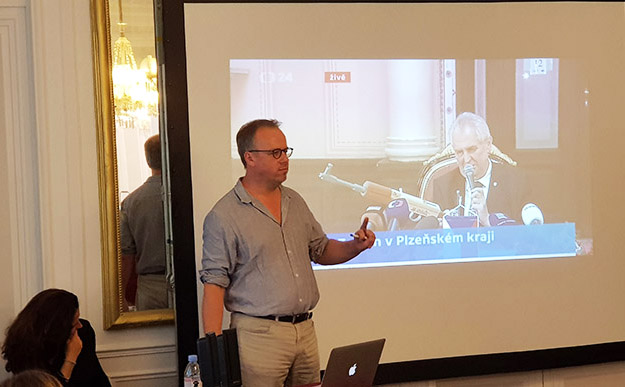
First up in RSF’s catalogue of crimes and threats against the global media was Czech President Miloš Zeman’s macabre press conference stunt late last year.

However, Zeman’s sick joke angered the media when he brandished a dummy Kalashnikov AK47 with the words “for journalists” carved into the wood stock at the October press conference in Prague and with a bottle of alcohol attached instead of an ammunition clip.

RSF’s Christophe Deloire talks of the Czech President’s anti-journalists gun “joke”.
Image: David Robie/PMC
Zeman has never been cosy with journalists but this gun stunt and a recent threat about “liquidating” journalists (another joke?) rank him alongside US President Donald Trump and the Philippines leader, Rodrigo Duterte, for their alleged hate speech against the media.

Saturday, October 21, 2017

Indonesian academic exchange an opportunity for unique collaboration

Universitas Gadjah Mada's Centre for Southeast Asian Social Studies (CESASS)
meets AUT's Pacific Media Centre with a Sky Tower backdrop. Photo: PMC
From AUT University

Pacific Media Centre director Professor David Robie will next week join academics from around the world in a global professorial exchange with Indonesia's Universitas Gadjah Mada. In return, six academics from the progressive Yogyakarta university have visited Auckland University of Technology for the first communication and publication research collaboration of its kind in New Zealand.

The academics from Yogyakarta, led by Gadjah Mada University's Centre for Southeast Asian Social Studies (CESASS) director Dr Hermin Indah Wahyuni, arrived in Auckland earlier this month for a two-week visit featuring workshops, seminars and joint research projects related to climate change.

They will also be collaborating with their newly published research journal IKAT, the PMC's 23-year-old Pacific Journalism Review and AUT Library's Tuwhera research platform on a major project involving ecological communication and Asia-Pacific maritime disasters.

Dr Robie is one of six academics invited by CESASS as part of the Indonesian government's World Class Professor (WCP) programme to strengthen international publication and research studies.

Friday, April 7, 2017

LIVE: CAFCA’s Murray Horton on NZ independence and foreign policy

Graphic: Concept art for Planet of the Apes

Courtesy of the Pacific Media Centre and Asia Pacific Report


TIME FOR INDEPENDENCE FROM A CRUMBLING US EMPIRE - Murray Horton
The advent of President Donald Trump in the US provides an unprecedented opportunity to take a good, hard look at Aotearoa's place in the world.  And to ask the question - why are we still a loyal member of the American Empire?

As the old saying goes, you are judged by the company you keep.

CAFCA Murray Horton says it's time for this country to pull the plug, to finish the business started in the 1980s, which saw us out of ANZUS, and break the chains -- military, intelligence, economic and cultural -- that continue to bind us to the American Empire.

Speaker: Murray Horton, national organiser of the Christchurch-based Campaign Against Foreign Control of Aotearoa (CAFCA). Video in two parts.

Saturday, July 23, 2016

‘That day I saw the power of media, and how it can be tragic’


University of Papua New Guinea's Emily Matasororo ... in the background, images of heavily armed police
shortly before they opened fire on peaceful students. Image:" Del Abcede/PMC

By DAVID ROBIE


SURPRISING that a conference involving some of the brightest minds in journalism education from around the world should be ignored by New Zealand’s local media.

Some 220 people from 43 countries were at the Fourth World Journalism Education Congress (WJEC) conference in Auckland.

The range of diversity alone at the Auckland University of Technology hosted event was appealing, but it was the heady mix of ideas and contributions that offered an inspiring backdrop.

Topics included strategies for teaching journalism for mobile platforms – the latest techniques; “de-westernising” journalism education in an era of new media genres; transmedia storytelling; teaching hospitals; twittering, facebooking and snapchat -- digital media under the periscope; new views on distance learning, and 21st century ethical issues in journalism are just a representative sample of what was on offer.

Keynote speakers included Divina Frau-Meigs (Université Sorbonne Nouvelle) with a riveting account on how "powerful journalism" makes "prime ministers jump", the Center of Public Integrity’s Peter Bale (a New Zealander) on the need to defend press freedom, and Tongan newspaper publisher and broadcaster who turned “inclusivity” on its head with an inspiring “include us” appeal from the Pacific,"where we live in the biggest continent on planet Earth".

Thursday, January 28, 2016

Asia Pacific Report - a new venture for independent journalism


Alistar Kata's video about the Pacific Media Centre.

By David Robie


Comments from the AsiaPacificReport.nz and video launch in Auckland tonight.

OUR new adventure really began back in 2007 when Selwyn Manning joined the Pacific Media Centre as the founding advisory board chair, but really took a big leap forward when he initiated the Pacific Scoop concept and we developed that together, launching it at the 2009 Māori Expo.

Over the next six years, Pacific Scoop played an inspiring role in independent journalism alongside the main Scoop Media website, providing a range of Asia and Pacific stories and analyses.

A significant core of this project was its role as the official output from AUT’s postgraduate Asia Pacific Journalism course. We have sent students all over the Pacific on key story and research assignments over the years. Some of these stories have won awards.

While at AUT, Selwyn did two innovative postgraduate honours degrees – producing ground-breaking documentaries for both, Morality of Argument and Behind the Shroud, which are featured on AsiaPacificReport.

Friday, May 8, 2015

The Israeli architecture of destruction – and the 'hidden violence' against Palestine


 Alistar Kata's report on the visit by Amira Hass. Video: Pacific Media Centre

COINCIDING with the visit by renowned Haaretz journalist Amira Hass to New Zealand in the past couple of weeks, Al Jazeera has been running a repeat of the brilliant programme “The Architecture of Violence” in the Rebel Architecture series.

In this, architect and communicator par excellence Eyal Weizman explains how Israel has transformed urban warfare and how the techniques are used to subjugate Palestinians.

Travelling across the illegal settlements and roads of the West Bank and also along the Separation Wall, Weizman shows how the controlled use of architecture is deployed to consolidate the Israeli grip on Palestine.

"Architecture and the built environment is a kind of a slow violence,” he says.

“The occupation is an environment that was conceived to strangulate Palestinian communities, villages and towns, to create an environment that would be unliveable for the people there."

Friday, October 3, 2014

Politics, human rights and asylum seekers media conference lined up for NZ


An update on Ces Oreña-Drilon and the Maguindanao massacre investigation. Her justice corruption allegations have led to a National Bureau of Investigation inquiry. Video: GMA News


PACIFIC JOURNALISM REVIEW, the only politics and media research journal in New Zealand and the Pacific, will host an international conference late next month marking its 20th anniversary of publication.

With the overall theme of “Political journalism in the Asia-Pacific”, many editors, investigative journalists, documentary makers, human rights advocates, media freedom activists and journalism educators and researchers will be converging on Auckland for the event at AUT University on November 27-29.

One of the keynote speakers at PJR2014, television journalist Ces Oreña-Drilon of ABS-CBN and an anchor for the celebrated current affairs programme Bandila, will give an address on the killings of journalists with impunity in the Philippines.

She has been investigating the 2009 massacre of 34 journalists by private militia while they were accompanying a candidate’s entourage to register for elections and she has a grim story to tell in her “Losing the landmark Maguindanao massacre case” presentation about the legal and political fallout from the tragedy.

She is attending the conference with the support of the Asia New Zealand Foundation.

Saturday, September 27, 2014

From Fiji's dictatorship to 'democracy' – the AUT student team on the job


Mads Anneberg's profile on Ricardo Morris and Repúblika.


THREE STUDENTS from AUT University covered Fiji's historic “from dictatorship to democracy” general election this month.

While the election arguably legitimised Voreqe Bainimarama’s so-called 2006 “coup to end all coups”, the students performed something of a coup themselves.

Not only were they providing the first ever comprehensive coverage of a Pacific national election by a New Zealand journalism school, but their reportage was far superior to much of the Kiwi media that was ill-prepared for the occasion.

In fact, some were unashamedly parachute journos covering a complex event on September 17 that was overshadowed by New Zealand’s own election three days later.

All three students were reporting as a “package” for Pacific Scoop, the course outlet for AUT’s postgraduate Asia-Pacific Journalism course run by the Pacific Media Centre. But while two were on the ground in Fiji, the third was an “anchor” - monitoring, writing and editing stories to provide an overall contextualised story.

Thursday, July 24, 2014

Walkley review: The complex notion of news in the Pacific

Brent Edwards in The Walkley Magazine looks at journalist and academic David Robie’s scrutiny of the Pacific region’s governance and journalism. Cartoon by David Pope.

DAVID ROBIE has spent 35 years working as a journalist and journalism academic in the Asia- Pacific region. In Don’t Spoil My Beautiful Face: Media, mayhem and human rights in the Pacific, Robie summarises his reportage on many of the significant events that have marked his years working in the Pacific. It is part autobiography, part history and part journalism treatise.

As well as providing his perceptive analysis of human rights and democracy, or lack of, in the Pacific, Robie also spends time commenting on journalistic practices, particularly as they relate to reporting on our immediate neighbourhood. For someone like me, who is not an expert on the Pacific, the book is a valuable reference to the significant issues that continue to bedevil the region.

Robie’s book is broad in its compass. It covers the Kanaky struggle for self-determination in New Caledonia, the rise of the Flosse dynasty in Tahiti, coups in Fiji, Chinese influence in Tonga, the struggle in Bougainville, the fight for independence in Timor Leste, the ongoing struggle in West Papua and the bombing of the Rainbow Warrior in Auckland in New Zealand. His stories range as far away as covering indigenous struggles in Canada to the violence in the Philippines. And always he is concerned with human rights in the Pacific.

Robie includes articles he has written over the past 30 years or so, updated by his contemporary analysis of what is happening now. Take New Caledonia for instance. That chapter includes an article Robie wrote for the New Zealand Listener in 1984 titled “Blood on their banner”.

He writes that his reporting on New Caledonia led to a protracted and acrimonious dispute with Fiji’s Islands Business publisher Robert Keith-Reid, when the magazine accused him in 1989 of alleged “leftist” support of Kanak activists. It is just one example of the pressure that has been exerted on Robie and other journalists over their coverage of independence movements in the region.

But it is Robie’s comments on the practice of journalism that should excite the most debate. He makes no bones about his distaste of the tendency of regimes and other vested interests in the region trying to suppress press freedoms, often by intimidation and threats.

His views on journalism in the region have not just been shaped by his experience as a journalist. He has also been the head of journalism at both the universities of Papua New Guinea and the South Pacific and he is now journalism professor and director of the AUT University’s Pacific Media Centre in Auckland.

He praises those journalists throughout the region who struggle to do their job in the face of intimidation, legal restraints and poor pay. But he is less effusive about the role of Western journalism in covering the Pacific. He questions whether the Western notion of news is appropriate to covering the many complex issues in the region. And, before some journalists protest too loudly, this is not a cry for the media to go soft. But Robie does raise some interesting questions about the role of journalism and whether its approach could be altered.

Robie puts forward the case for journalists practising what he calls critical deliberative journalism in the region. He argues that Pacific journalists now have a greater task than ever in encouraging democratisation of the region and informed insights into development, social justice and peace issues facing related island states. In other words, he says journalists should be part of the solution, not part of the problem.

Robie says this does not mean allowing politicians’ slogans, such as “cultural sensitivity”, to be used as a smokescreen for the abuse of power and violations of human rights. Instead, he says the approach he advocates will put greater pressure on journalists to expose the truth and report on alternatives and solutions.

Robie sums it up this way: “Critical deliberative journalism also means a tougher scrutiny of the region’s institutions and dynamics of governance. Answers are needed for the questions: Why, how and what now?”

Those questions do not just apply to the island states. Here in Australia and New Zealand we, too, might consider a different approach to the way we practise journalism.

Thursday, May 15, 2014

David Robie on ‘critical development journalism’

Media in Jayapura pictured in a photograph from Don't Spoil My Beautiful Face featured during a course
in "Safe Witness Journalism". Photo: West Papua Media
Media with Gavin Ellis – Radio New Zealand National

REVIEW: WHAT makes the book Don’t Spoil My Beautiful Face: Media, Mayhem and Human Rights in the Pacific really interesting is that it’s not just the reprinting of David Robie’s very good investigative pieces of reporting, but he weaves into it his autobiographical story and that gives context to his various pieces that he has gathered together.

A wide range of stories from the Kanak uprising of the 1980s, the Fiji coups, Moruroa - really the whole breadth of events in the Pacific over the last 30 or 40 years ...  And it’s deep journalism …

It gets rights inside the issues and shows the trust that was placed in David Robie by people who really wanted their stories told. So it is well contextualised and I think it is a real contribution to Pacific journalism by collecting it all together.

The final part of the book is about his role as a journalism educator, and also his perceptions of the way that journalism in the Pacific has developed. He has a very interesting model that he calls critical development journalism. It is a little bit like investigative journalism.

Saturday, December 7, 2013

Fiji torture series wins Pacific Media Watch editor trauma journalism prize

Torture of the captured Fiji fugitive being filmed on mobile phones.
Photo: Pacific Media Watch/Freeze frame from video
A MULTIMEDIA news report series about the torture of a fugitive prisoner and his suspected accomplice by Fiji prison officers has won a Pacific Media Watch editor a coveted international prize in trauma journalism.

Daniel Drageset, a Norwegian journalist interned at the Auckland University of Technology’s Pacific Media Centre and a postgraduate student in the School of Communication Studies, won the Dart Asia-Pacific Centre for Journalism and Trauma Prize for reporting on violence, disaster or trauma in society at the 2013 Ossie Awards for student journalism in Mooloolaba, Queensland, this week.

Drageset has been contributing editor of the PMC’s Pacific Media Watch freedom project for the past year, and has also been a student intern editor on the associated independent Pacific Scoop news website.

Judge Cait McMahon, director of Melbourne's Dart Asia-Pacific Centre, said Drageset’s winning Fiji entry had showed an “impressive investigation into alleged police torture”.

“Daniel had to straddle important ethical issues and clarify potential bias of sources to produce an impressive piece of reporting,” she said.

Thursday, November 7, 2013

Scandinavian media and press freedom travels

A light-hearted moment for a police squad during a demonstration in Vilnius. Image from
the Lithuanian National Press Agency exhibition at the Helsinki Town Hall, Finland.
Photo: David Robie
CAFÉ PACIFIC’S publisher David Robie has been travelling widely on sabbatical across Scandinavia and France in the past few weeks, meeting media freedom campaigners (such as at Reporters Sans Frontières), giving guest lectures at journalism schools such as at Stockholm University and the Danish School of Media and Journalism, and on various research projects.

David Robie 'reading' Norway's
Aftonbladet Söndag.
Some of his images can be seen on his Facebook page and watch for other reports at the Pacific Media Centre.

Tuesday, September 3, 2013

Fossil fuel industry 'needs to back down - not the Pacific' on climate change


Pacific Media Watch contributing editor Daniel Drageset interviews Marshall Islands Journal editor
Giff Johnson in Majuro.

By Michael Sergel of Pacific Scoop and the AUT journalism programe

CLIMATE CHANGE is top of the agenda in Majuro as the Pacific Islands Forum meets for the 44th time.

The Marshall Islands is calling for strong committed action on preventing and responding to climate change, as it welcomes delegates from 16 member states (minus suspended Fiji) to the renewable village that will play host to the next four days of talks.

Marshall Islands Forum Minister Phillip Muller said the Majuro Declaration was about “tangible action” rather than a “you-go-first” approach to climate policy.

“In the Pacific, we cannot afford to wait. We want the Forum to set the stage for a new, bolder approach,” he wrote in a Washington Post op-ed in June.

“We call on not just governments but also intergovernmental organisations, the private sector and civil society to sign on to our declaration with their own measurable commitments aimed at averting a climate catastrophe.”

Monday, June 17, 2013

Turkey's ‘woman in red’, global protest and the Pacific media


An interview with David Robie on the Pacific at the Protest and Media conference in London. Video report by Sumy Sadurni

'The woman in red'. Photo: Clip from vimeo.com video
THE SO-CALLED “woman in red” became a reluctant icon of a people’s revolt in Turkey this month.

Ceyola Sungur, an academic at Istanbul’s Technical University, was projected into instant global fame because of media images of her being blasted at point blank-range with pepper spray by security police. 

Dressed in a red summer dress, the unarmed and defenceless woman’s defiance in the face of state assaults on protesters demonstrating over plans to remove the city’s central Gezi Park adjoining Taksim Square to make way for mega property development has become an iconic symbol of resistance.

Violence against journalists has been mounting and Turkish police have arrested dozens in a series of nation-wide raids in the latest crackdown.

“There are a lot of people who were at the park and they were also tear-gassed,” the uncomfortable heroine told Turkey’s TV24. “There’s no difference between them and me.”

While the protests raged on amid concerns among many Turkish women that Prime Minister Recep Tayyip Erdogan plans a major roll back of women’s rights, Turkish issues were among the many being explored at an international “protest and media” conference in London, jointly organised by the University of Westminster’s Communication and Media Research Institute (CAMRI) and the British Journalism Review.

Thursday, May 23, 2013

New models of funding needed, say NZ investigative journalists

Pacific Media Centre's David Robie ... “We need to educate the universities."
Photo: Jamie Small/Te Waha Nui
INVESTIGATIVE journalists are calling for new models of funding to fill a gap in the industry where the private sector has failed.  

By Jamie Small of Te Waha Nui

Nicky Hager, author of The Hollow Men and Other People’s Wars, says there is not enough support for investigative journalists in countries like New Zealand.

“I hope that one day there will be a return to serious public funding for investigative journalism,” he says.

Hager says most investigative journalists do not have much industry training or support. They are often citizens who begin investigating a crime or wrongdoing and do not realise they have become a journalist.

Professor David Robie, director of AUT University’s Pacific Media Centre, believes he has an answer.

“As the mainstream media reduces its reporting skills, universities should be picking up the slack,” he says.

>>> Popular Café Pacific Posts