Showing posts with label reporters sans frontieres. Show all posts

Monday, August 17, 2020

Facebook censorship on West Papua – then deafening silence

Facebook censorship on West Papua ... a "cruel irony". Image: RSF/PMC

By David Robie

THE SILENCE from Facebook is deafening and disturbing.

At first, when I lodged my protests earlier this month to Facebook over the immediate removal of a West Papua news item from the International Federation of Journalists shared with three social media outlets, including West Papua Media Alerts and The Pacific Newsroom, I thought it was rogue algorithms gone haywire.

The “breach of community standards” warning I also received on my FB page was unacceptable, but surely a mistake?

However, with subsequent protests by the Paris-based Reporters Without Borders (RSF) media freedom watchdog and the Sydney office of the Asia-Pacific branch of the International Federation of Journalists (IFJ), the world’s largest journalist organisation with more than 600,000 members in 187 countries, falling on deaf ears, I started wondering about the political implications of this censorship.

READ MORE: Melanesia: Facebook algorithms censor article about press freedom in West Papua

We had all complained separately to the FB director of policy for Australia and New Zealand, Mia Garlick, and were ignored.

Sunday, May 3, 2020

Jailing of Jakarta Six fuels virus fears over Papuan political prisoners

A past protest in London demanding the release of Papuan political prisoners. Image: Survival International
PACIFIC PANDEMIC DIARY: By David Robie, convenor of Pacific Media Watch

THE JAILING of the Jakarta Six – five Papuans and the first Indonesian to be convicted for a Papuan protest – in Indonesia last month has focused global attention on the plight of political prisoners in the face of a failing struggle against the coronavirus pandemic.

Already several analysts are warning that both Indonesia and Papua New Guinea are at risk of becoming coronavirus “failed states” and this will be of concern to Australia and New Zealand.

While Papua New Guinea has had only eight confirmed covid-19 cases so far – a spike is expected this month in spite of the state of emergency, Indonesia already has 10,843 cases with 831 deaths and the real toll is feared to be higher and climbing.

READ MORE: Tough coronavirus controls threaten Pacific, global media freedom


Coronavirus
ASIA PACIFIC REPORT CORONAVIRUS UPDATES

Friday, April 24, 2020

Tough coronavirus controls threaten Pacific, global media freedom

Reporters Without Borders has just published its annual World Press Freedom Index ranking
countries over censorship. Video: Hannah Cleaver/DW

PACIFIC PANDEMIC DIARY:  By David Robie

Against a backdrop of many governments using tough controls under cover of fighting the covid-19 coronavirus pandemic to strengthen “creeping authoritarianism”, a global media freedom watchdog has signalled draconian virus reactions as a major threat.

From Papua New Guinea where media briefings have been curtailed with a lockdown of the national information and operations “nerve centre” at Morauta Haus, to Fiji where media personalities have been arrested, to the Philippines where state troll armies “weaponise” disinformation on social media, and to Indonesia where street artists have stepped in fill an information void, the signs are really worrying for defenders for media freedom.

The pandemic is “highlighting and amplifying the many crises”, already casting a shadow on press freedom, says the Paris-based Reporters Without Borders watchdog, which released its annual World Media Freedom Index this week.

READ MORE: The Reporters Without Borders 2020 World Press Freedom Index

While China and Iran have been singled out for strong criticism for suppressing details of the coronavirus outbreak early in the crisis, several countries traditionally strong on media freedom in the Asia-Pacific region have slipped down in the rankings – including Australia, New Zealand and Papua New Guinea.

Saturday, May 4, 2019

Pacific media freedom and news ‘black holes’ worsen for World Press Freedom Day

World Press Freedom Day coverage on the Pacific Media Centre's Asia Pacific Report. Image: PMC screenshot
 By David Robie 

While Pacific countries have got off rather lightly in a major global media freedom report last month with most named countries apparently “improving”, the reality on World Press Freedom Day is that politicians are becoming more intolerant and belligerent towards news media and information “black holes” are growing.

The Pacific is at the milder end on the scale of media freedom violations – there are no assassinations, murders, gaggings, torture and disappearances.

But the global trend of “hatred of journalists [degenerating] into violence, contributing to an increase of fear” warned about by the Paris-based global watchdog Reporters Without Borders is being reflected in our region.

READ MORE: Pacific countries score well in media freedom index, but reality is far worse

Lack of safety for journalists is a growing concern for media organisations around a world where 80 journalists were killed last year, with 348 being jailed and 60 held hostage.

Wednesday, October 24, 2018

A future in Pacific journalism in the age of 'media phobia' - USP media awards

Fiji Sun managing editor business Maraia Vula (middle) flanked by USP Journalism coordinator
Dr Shailendra Singh (left), joint winners Koroi Tadulala and Elizabeth Osifelo
and Professor David Robie (right). Image: Harry Selmen/Wansolwara
Keynote address by Pacific Media Centre director Professor David Robie at The University of the South Pacific Journalism Awards,19 October 2018, celebrating 50 years of the university's existence.

Kia Ora Tatou and Ni Sa Bula

For many of you millennials, you’re graduating and entering a Brave New World of Journalism … Embarking on a professional journalism career that is changing technologies at the speed of light, and facing a future full of treacherous quicksands like never before.

When I started in journalism, as a fresh 18-year-old in 1964 it was the year after President Kennedy was assassinated and I naively thought my hopeful world had ended, Beatlemania was in overdrive and New Zealand had been sucked into the Vietnam War.

And my journalism career actually started four years before the University of the South Pacific was founded in 1968.

Being a journalist was much simpler back then – as a young cadet on the capital city Wellington’s Dominion daily newspaper, I found the choices were straight forward. Did we want to be a print, radio or television journalist?

The internet was unheard of then – it took a further 15 years before the rudimentary “network of networks” emerged, and then another seven before computer scientist Tim Berners-Lee invented the World Wide Web and complicated journalism.

Friday, July 13, 2018

Nauru, Fiji and Pacific Facebook gags criticised in Asia-Pacific media freedom summit


Reporters Without Borders secretary-general Christophe Deloire talks about the global threat against journalists.
Video:
Café Pacific

By David Robie in Paris
WHEN Reporters Without Borders chief Christophe Deloire introduced the Paris-based global media watchdog’s Asia-Pacific press freedom defenders to his overview last week, it was grim listening.

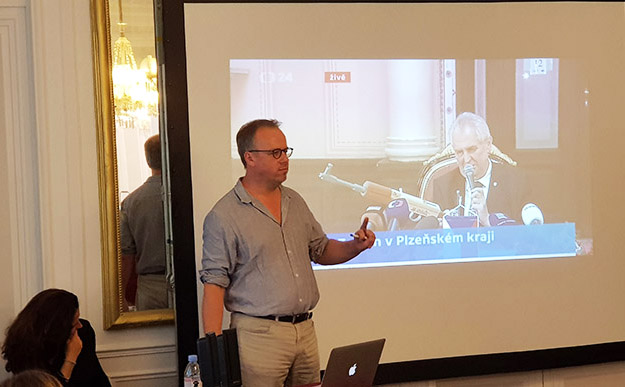
First up in RSF’s catalogue of crimes and threats against the global media was Czech President Miloš Zeman’s macabre press conference stunt late last year.

However, Zeman’s sick joke angered the media when he brandished a dummy Kalashnikov AK47 with the words “for journalists” carved into the wood stock at the October press conference in Prague and with a bottle of alcohol attached instead of an ammunition clip.

RSF’s Christophe Deloire talks of the Czech President’s anti-journalists gun “joke”.
Image: David Robie/PMC
Zeman has never been cosy with journalists but this gun stunt and a recent threat about “liquidating” journalists (another joke?) rank him alongside US President Donald Trump and the Philippines leader, Rodrigo Duterte, for their alleged hate speech against the media.

Wednesday, May 2, 2018

'Free media' week killings - but don't forget crimes against Papuans


"Save Papuan Journalists" - a theme poster from last year's May 3 World Press Freedom Day event in Jakarta, Indonesia.
West Papuan media freedom issues tend to be "lost" in the standard press freedom reports on Indonesia.
Image: David Robie/Pacific Media Centre
By David Robie

MONDAY – just three days before today’s World Press Freedom Day – was the deadliest day for news media in Afghanistan in 17 years. The killing of nine journalists and media workers among 26 people who died in dual suicide bomb attacks in Kabul was the worst day for the press since the fall of the Taliban.

Five other journalists were wounded and a 10th journalist was shot and killed in a separate attack outside the capital.

Among the dead was Agence France-Presse chief photographer Shah Marai who left behind an extraordinary legacy of images.

READ MORE: Hatred of journalism threatens democracies

It was the also the most horrendous day for global media since the Ampatuan massacre on the southern Philippines island of Mindanao on 23 November 2009. A shocking 32 journalists were murdered that day, most of the total death toll of 58 in an ambush on a pre-election cavalcade.

To date nobody has been successfully brought to justice. The scores of private militia “owned” by the Ampatuan family alleged to have carried out the killings have got away with their vile crime almost scot-free.

Thursday, December 11, 2008

Why UN bodies are failing over human rights

THE world marked the 60th anniversary of the Universal Declaration of Human Rights this week. Media freedom group Reporters San Frontières issued its own report on December 10, giving a poor mark to the Geneva-based Human Rights Council, the main UN body concerned with the issues. Says the RSF:

The UN Human Rights Council is doing little better than its predecessor, the now-abolished Commission on Human Rights, which was completely discredited over
the years, especially when it named a Libyan as its president. The council has the failings of all UN bodies, where member-states are both judges and judged.
States with repressive governments are elected to the council and thus tasked with ensuring respect in other countries for rights they themselves are abusing on a daily basis. Until this absurd situation is ended, the United Nations cannot be said to be fulfilling its goal of protecting human rights.
The use of human rights by countries for their own purposes will not end until the UN Security Council and the whole system of world governance is reformed and enlarged. This issue has been highlighted by the present economic and environmental crisis.
If the UN does not manage to end it, the council will
fail in its mission.

Check out the full RSF report.
Human rights in post-coup Fiji - Why might is not right
Pacific media human rights issues
The Witness take on human rights

Thursday, April 10, 2008

Journo killing season begins again in Philippines

A newspaper columnist has been gunned down in Manila suburb - the first journalist to be murdered this year. Journalists have been murdered or assaulted with some alarming frequency that authorities established a special police unit to investigate cases of violence against the media.
Reporters Without Borders has been quick to put out a statement that it is "shocked" by the murder of newspaper journalist Benefredo Acabal in Pasig City on April 7 and calls on the authorities to do everything possible to establish the motives and bring those responsible to justice. Acabal, 34, was a columnist for The Pilipino Newsmen, a Cavite tabloid.
He was shot five times at close range by a man on a motorcycle and was pronounced dead on arrival at a hospital. The police officer in charge of the case, Lardy Ignacio, said it was too soon to say if the murder was linked to the victim's work as a journalist. The police are looking into the possibility that it was linked to Acabal's involvement in a trucking business.

Wednesday, September 5, 2007

Global search for the BOBS - best blogs!

I've had some positive feedback from Vincent Brossel of RSF in Paris about Cafe Pacific. Good one. Thanks. And a word about RSF's partnership with Germany's public broadcaster Deutsche Welle in the annual search for the best blogs. Some of those bloggers that stirred up recent strife with Fiji's military regime should have a shot. “BOBs - Best of the Blogs” is running for the fourth year running.
What are The BOBs?
For the next four weeks, internet users are invited to go to www.thebobs.com to nominate the best blogs in 15 categories. The competition is open to blogs, podcasts and videoblogs in the following 10 languages - Arabic, Chinese, Dutch, English, Farsi, French, German, Portugese, Russian and Spanish.
The BOBs are the world’s biggest international blog awards and offer a broad overview of the blogosphere, the rapidly evolving world of weblogs, videoblogs and podcasts. The winners are chosen by the public and a jury. Last year, more than 5,500 blogs were nominated and more than 100,000 Internet users took part in the online voting.

All bloggers and blog fans can go to the BOBs website until 30 September to nominate their favourite blogs. An international jury of journalists, media specialists and bloggers will then choose a shortlist of finalists. The winners will be determined by a combination of online voting from 23 October to 15 November and jury decision.

Good luck bloggers!

More detail on The Bobs website or at Deutsche Welle.

>>> Popular Café Pacific Posts