Showing posts with label journalism. Show all posts

Saturday, March 25, 2023

The 'death' of journalism – may its memory be a blessing


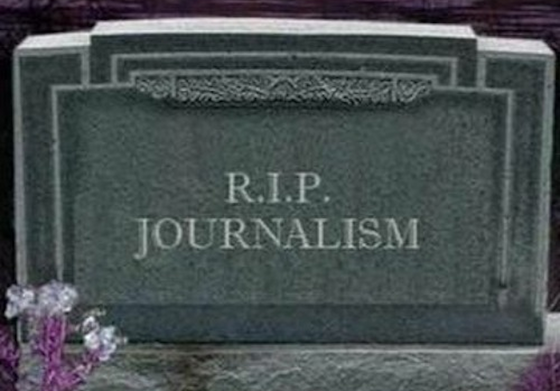
R.I.P. Journalism . . . with "thanks" to ChatGPT. IMAGE: CP

A SNIPPET shared about the ChatGPT debate from one of the gurus of investigative journalism, Sheila Coronel, at New York’s Columbia School of Journalism. She reports on social media about a recent assignment brief given by a student to ChatGPT: “Write an obituary for journalism.”

The less than 500-word result churned out by the chatbot was too close for comfort.

“It is with heavy heart that we must announce the passing of journalism, a once-vital industry that served as a cornerstone for democracy and truth-seeking around the world.

“Born in the early days of print media, journalism grew and evolved alongside society, providing a critical lens through which we could understand the events and people shaping our world. From the rise of the penny press in the 19th century to the advent of television news in the mid-20th century, journalism adapted to new technologies and mediums, but always remained committed to its fundamental purpose: informing the public and holding those in power accountable.

Saturday, June 19, 2021

How the 'voice of the voiceless' kaupapa became derailed at the Pacific Media Centre


Screenshot from the Pacific Media Centre video The PMC Project
by former student project editor Alistar Kata.

COMMENT: By DAVID ROBIE, founding director of the Pacific Media Centre

It really is bizarre. After 26 months of wrangling, stakeholders’ representations and appeals by the Pacific Media Centre participants to Auckland University of Technology management, in the end the innovative unit remains in limbo.

In fact, sadly it seems like a dead end.

In my 28 years as a media educator across four institutions in four countries I have never experienced as something as blatant, destructive and lacking in transparency as this.

Six weeks after I retired as founding director of the centre last December, the PMC office in AUT’s Sir Paul Reeves building was removed by packing up all the Pacific taonga, archives, books and files supporting student projects without consulting the stakeholders.

And then the award-winning staff running the centre on a de facto basis were apparently marginalised. 

As former Green Party MP Catherine Delahunty noted: “I am really shocked that a vibrant well developed centre is being treated like this - what is wrong with this institution?”

Tuesday, December 22, 2020

'Empowerment is really important. Journalism isn't just about writing a good story ... but empowering people with information in a democracy'

As well as playing a role in critical moments of history as a journalist in the region,
Professor David Robie's students have also covered landmark events
that helped shape some Pacific nations. Image: AUT Pasifika
By Laurens Ikinia

A JOURNALIST who sailed on board the bombed environmental ship Rainbow Warrior, was arrested at gunpoint in New Caledonia while investigating French military garrisons in pro-independence Kanak villages, and reported on social justice issues across the Pacific has stepped down as founding director of the Pacific Media Centre.

Professor David Robie, 75, an author, academic, independent journalist and journalism professor at Auckland University of Technology, retired last week after more than 18 years at the institution.

He has been working as a journalist for more than 46 years and as an academic for more than 27 years.

As well as playing a role in critical moments of history as a journalist in the region, his students have also covered landmark events that helped shape some Pacific nations, especially in Melanesia – such as the 1997 Sandline mercenary crisis in Papua New Guinea and the George Speight coup in Fiji in May 2000.

But a journalism or academic career were not always clearcut pathways for Dr Robie. During his studies in high school, he was heavily involved in outdoor pursuits and he became a Queen’s Scout.

Saturday, May 4, 2019

Pacific media freedom and news ‘black holes’ worsen for World Press Freedom Day

World Press Freedom Day coverage on the Pacific Media Centre's Asia Pacific Report. Image: PMC screenshot
 By David Robie 

While Pacific countries have got off rather lightly in a major global media freedom report last month with most named countries apparently “improving”, the reality on World Press Freedom Day is that politicians are becoming more intolerant and belligerent towards news media and information “black holes” are growing.

The Pacific is at the milder end on the scale of media freedom violations – there are no assassinations, murders, gaggings, torture and disappearances.

But the global trend of “hatred of journalists [degenerating] into violence, contributing to an increase of fear” warned about by the Paris-based global watchdog Reporters Without Borders is being reflected in our region.

READ MORE: Pacific countries score well in media freedom index, but reality is far worse

Lack of safety for journalists is a growing concern for media organisations around a world where 80 journalists were killed last year, with 348 being jailed and 60 held hostage.

Tuesday, February 28, 2017

Worlds of Journalism global research project produces NZ findings

The latest Pacific Journalism Review ... publishing for 22 years. Image: Hans Tommy/AUT
From Asia Pacific Report

NEW ZEALAND journalists are working longer hours, and feeling more pressure, both ethically and resource-wise, than they were only two years ago, a new research survey has found.

A survey of New Zealand professional journalists, published today in Pacific Journalism Review, also shows for the first time that women journalists are paid less than men, despite making up the bulk of the workforce.

The survey shows female journalists, despite predominating in the profession, are significantly disadvantaged in terms of promotion and income.

The average before tax income of all journalists was $69,400 (in 2015 dollars) but the median after-tax salary of women was 26 percent lower than that of men of equivalent rank and experience.

READ MORE: Pacific Journalism Review on the new Tuwhera platform

Friday, June 10, 2016

History repeats itself with tragic impact in Papua New Guinea


Student footage as the Papua New Guinean police tried to arrest the leader, Kenneth Rapa, moments before opening fire on the crowd. Video: Cafe Pacific on YouTube


By DAVID ROBIE

BARELY had the whiff of teargas and gunshot smoke drifted away from the University of Papua New Guinea campus this week when the blame game started in earnest with the O'Neill government pointing the finger at the parliamentary opposition and also international media.

The media were blamed for initial reports by some reputable international brands that up to four people had been killed. There were no deaths, but four of the 23 people reported to be injured were taken to Port Moresby General Hospital critically wounded and stabilised.

It could have been an even worse tragedy.

Sadly, the scenes of chaos shown on campus and chaotic news reports are not uncommon.

I lived in Papua New Guinea for five years during the 1990s when I headed the journalism programme at UPNG.

There were at least two occasions when I was there when police came onto campus - a provocation in itself as there is an understanding that police don't do that, if not actually illegal - and fired teargas at protesting students.

Thursday, November 6, 2014

Ricardo Morris ... stripping away the hidden agendas and media myths

Publisher of Repúblika Media Limited Ricardo Morris (second from left) with
University of the South Pacific journalism award recipients. Image: USP
This is the keynote message from Repúblika publisher Ricardo Morris at the University of the South Pacific/Wansolwara journalism awards 2014.

JOURNALISM is an act of faith in the future. That’s what the American television correspondent Ann Curry wrote in a 2010 cover essay in Guideposts magazine. Journalism, she argued, should do more than inform. It should make you care.

Ann’s essay, titled "Telling Stories of Hope", marked her long-deserved promotion to co-host of NBC’s Today show. Ann describes the lure of journalism for her as “a call, an urgency” to report because she knew that doing so would “give voice to those who need to be heard".

Not only do the people affected deserve to be heard, the media-consuming public also deserved to hear about what was happening in other parts of the world because it gave us “a chance to care, and it is that empathy that offers the greatest hope".

In today’s world, with short attention spans, competing media outlets and platforms and a world of information – not all of it edifying – at ordinary people’s fingertips, journalism can still be a way to inject some hope into our world.

Thursday, October 16, 2014

Why The Australian is un-Australian: all ego and little heart

The headline on The Australian media editor Sharri Markson's 'undercover' beat-up about journalism schools
that sparked off the latest attacks on journalism educators.

By Professor Mark Pearson

OPINION: FIRST they came for journalism educator Julie Posetti, for simply tweeting some critical comments made publicly by a former staffer of The Australian. [That time I did write a commentary in Crikey about why editors shouldn’t sue for defamation.]

Then they came for Matthew Ricketson, Greg Jericho, Margaret Simons, Wendy Bacon, Martin Hirst and Jenna Price and to my shame I said very little.

Well, this week they came for a good friend and colleague, Penny O’Donnell from the University of Sydney, and I refuse to remain silent. Enough is enough.

She is one of the most committed and respected journalism educators I know – in both research and teaching – and has shown the greatest courage in her personal life in recent years that has elevated my esteem for her even higher.

Sadly, the reputation of The Australian newspaper has followed the opposite trajectory. It is celebrating its 50th birthday this year, and my view is that the first 40 were far better than the last ten.

>>> Popular Café Pacific Posts