A Gabriela poster honouring martyred women during the Marcos martial law
years in the Philippines on display at the AUT film screening. IMAGE:
David Robie/APR
Seven weeks ago the Philippines truth-telling martial law film Katips
was basking in the limelight in the country’s national FAMAS academy
movie awards, winning best picture and a total of six other awards.
Last week it began a four month “world tour” of 10 countries starting
in the Middle East followed by Aotearoa New Zealand on Sunday – hosted
simultaneously at AUT South campus and in Wellington and Christchurch.
The screening of Vincent Tañada’s harrowing – especially the graphic
torture scenes – yet also joyful and poignant musical drama touched a
raw nerve among many in the audience who shared tears and their
experiences of living in fear, or in hiding, during the hate-filled
Marcos dictatorship.
The martial law denunciations, arbitrary arrests, desaparecidos (“disappeared”),
brutal tortures and murders by state assassins in the 1970s made the
McCarthy era red-baiting witchhunts in the US seem like Sunday School
picnics.
Filipinos in the Wellington meeting make their pledge simultaneously
with the Auckland group for “history, truth and democracy” in the
Philippines. IMAGE: Del Abcede/APR
MIGRANTS and overseas Filipinos in Aotearoa New Zealand have called
on the governments of both Australia and New Zealand to halt all
military and security aid to the Philippines in protest over last
month’s “fraudulent” general election.
At simultaneous meetings in Auckland and Wellington, a new broad
coalition of social justice and community campaigners endorsed a
statement pledging: “Never forget, never again martial law!”
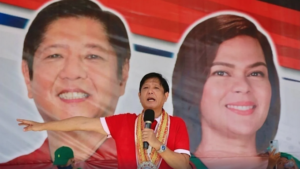
“Bongbong” Marcos Jr, the son of the late dictator Ferdinand Marcos
Sr, was elected President in a landslide ballot on May 9 and will take
office at the end of this month.
Philippine
President-elect Bongbong Marcos Jr wooing voters at a campaign rally in
Borongan, Eastern Samar. Image: Rappler/Bongbong FB
His father ruled the Philippines with draconian leadership —
including 14 years of martial law — between 1965 and 1986 until he was
ousted by a People Power uprising.
Sadly, the Philippines has sold its soul. Thirty six years ago a
People Power revolution ousted the dictator Ferdinand Marcos after two
decades of harsh authoritarian rule.
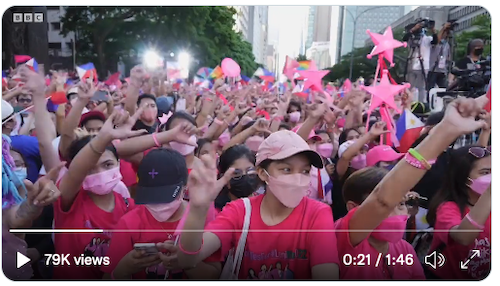
Yesterday, in spite of a rousing and inspiring Pink Power would-be
revolution, the dictator’s only son and namesake “Bongbong” Marcos Jr
seems headed to be elected 17th president of the Philippines.
And protests have broken out after the provisional tallies that give Marcos a “lead of millions” with more than 97 percent of the vote counted. Official results could still take some days.
The Anonymous view of the Filipino digital danger.
IN HIS recent AUT University inaugural professorial about global media truth, transparency and accountability, David Robie condemned the new so-called e-Martial Law in the Philippines, saying it was a warning for the Pacific.
“The most disturbing trend in the digital age is electronic martial law - a draft new law in the Philippines which criminalises e-libel in an extreme action to protect privacy,” he said.
“The Supreme Court has ruled to temporarily suspend this law. But what happens next? Will it be ruled unconstitutional or will the politicians prevail?
“This Cybercrime Prevention Act 2012 is like something out of the Tom Cruise futuristic movie Minority Report. An offender can be imprisoned for up to 12 years without parole and the law is clearly a violation of Article 19 of the International Covenant on Civil and Political Rights.
“And truth is not recognised as a defence.
“It would be disastrous if any Pacific country, such as Fiji, wanted to do a copycat law and gag cyberspace.”
Professor Robie highlighted the fact that in the Philippines at least 165 journalists have been murdered since 1986 – 32 of them in the Ampatuan massacre in Mindanao in 2009, the world’s worst single killing of journalists.
Three years later nobody has been convicted for these atrocities.
“The Philippines is a far more dangerous place for the media under democracy than it was under the Marcos dictatorship,” Professor Robie said. “There is a culture of impunity.”
In a joint statement by independent digital and online media, communications and journalism schools and media people in the Philippines, a strong attack has been made on the “cyberspace outrage”.
As outrage against the Cybercrime Prevention Act 2012 continues to snowball and create unprecedented unity and defiance among netizens, the Aquino administration has not backed down in its resolve to implement a clearly draconian measure designed to curtail our most basic civil liberties—the right to freedom of expression, of speech, and of the press.
As alternative media practitioners, filmmakers, bloggers, and artists who maximise the new media to bring to the public information, opinion and analysis, as well as works of art that serve to illuminate social conditions and present ideas for social change, we believe that the government’s repression of the medium is the message. With the Cybercrime Act, the government wants to ensure that no avenue for expression exists that is free from control by the rich and powerful elite.
The existing law on libel has long been used by powerful public figures mostly to harass and prosecute journalists for doing their job. Instead of decriminalising libel as urged by international human rights and media institutions, the government has even increased penalties. Worse, it now considers each and every citizen who uses Information and Communications Technology (ICT) as potential criminals.
With the rise of new media, ordinary citizens have been given the extraordinary power to reach large audiences, a power that has previously been the monopoly of the government and corporate media. The new media has been the recourse of citizens who see, report, and interpret social realities that traditional institutions ignore, hide or obliterate.
Citizens have long been marginalised from discourse on national issues through the agenda-setting powers of the government and corporate media. Through the new media, citizens have the opportunity to counter this marginalisation—to give voice to the poor and oppressed, to gain an audience without the need for huge capitalization, to criticise freely and creatively.
We believe that the Cybercrime Law is primarily a tool that exploits the rise of the new media and the use of ICT to suppress dissent and spy on citizens. The way the law is being defended by those who crafted it, and especially by the President who signed it, reveals that they enjoy, and will use to their own interest, the immense powers that the Cybercrime Law has given the government, such as the ability to take down websites, undertake surveillance, and seize electronic data.
Abuses that will surely arise from such powers will undermine any gains that this law claims to have against “cybercrimes.” For instance, online child pornography and sex trafficking should be addressed by the strict implementation and strengthening of existing laws to reflect the developments in ICT.
It is still debatable if hacking and cracking, spamming, online piracy, and cyberbullying are indeed crimes or if they can be covered under a single piece of legislation. What is clear is that these “cybercrimes” will not be addressed by a law makes expressing oneself online punishable by a jail term, or one that assumes that authorities can dip their hands into private electronic communication.
In other words, a law that throws us back to the dark ages won’t protect our women and children, nor our personal identities and safety. On the contrary, it makes every citizen using ICT vulnerable to abuse by the biggest band of criminals: a government that is corrupt, loathes criticism (as can be judged by President Aquino’s reaction to the online phenomenon ‘Noynoying’), and uses all of its resources to crush dissent.
Even the US government—the footsteps of which the government only follows—did not confer such broad powers unto itself when it attempted, but failed, to pass its Stop Online Piracy Act and Protect Intellectual Property Act.
However, the Cybercrime Law probably pleases the US government, as it strengthens their existing network of surveillance in the country, and boosts the counter-insurgency programme Oplan Bayanihan. The said law also pleases local and foreign big businesses that operate in utter secrecy in this country, further shielding them from public accountability and oversight while penalising those who use ICT to expose wrongdoing and abuses in the private and public sectors.
For e-martial law only reflects the de facto martial law already in place. Under Oplan Bayanihan, more than 100 citizens have been killed for their advocacies, forever silenced by bullets. More than 350 are imprisoned for their political beliefs. The Cybercrime Law makes it even easier to slap dissidents with trumped-up charges and send them to jail. After all, it now takes so little to be considered a cybercriminal.
Repression and lack of freedom is a daily reality for millions of Filipinos in the militarised countryside, violently demolished urban poor communities, and highly controlled workplaces and schools. Now it has become a daily reality as well for netizens who seek comfort in the freedom, however limited, of the new media.
As poverty, exploitation, and repression worsen, the duty to speak up and express ourselves through new media is more necessary than ever. As we begin to feel the grip of Aquino’s iron fist rule, it becomes more urgent to struggle to break free through actions both online and offline. E-martial law has been declared, and as those who fought the Marcos dictatorship taught us, the only way to end it is to start defying it.
Junk the Cybercrime Prevention Act of 2012! Don’t criminalise criticism! Defend our freedom of expression, speech and the press! Resist tyranny!
Independent digital media supporters: Pinoy Weekly Online/ PinoyMedia Center Bulatlat.com Davao Today Northern Dispatch Weekly Burgos Media Center Mayday Multimedia Tudla Productions Kodao Productions Southern Tagalog Exposure UPLB Zoomout