Showing posts with label asia-pacific reportage. Show all posts

Friday, September 9, 2022

Late Queen Elizabeth’s 1953 Pacific royal tour teaches us much about how we saw the world

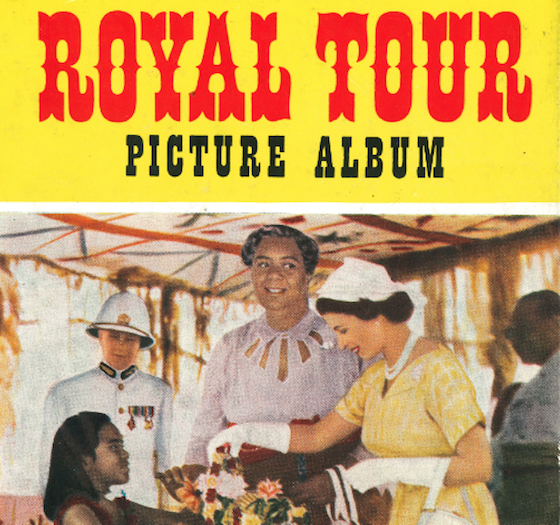
The Sunday Graphic's 1953 Royal Tour Picture Album ... "The tour seems to have been
a strange affair, a tour of places rarely visited by royalty alongside some more important,
but equally far-flung outposts of the Commonwealth. It was rather like
Iron Maiden playing in Christchurch or Caracas." IMAGE: PJR screenshot

As global tributes pour in for Queen Elizabeth II, who has died at 96 after an extraordinary reign of 70 years, my colleague PHILIP CASS, editor of Pacific Journalism Review, reflects on the late Queen’s first — of many — royal tours of the Pacific and what it reveals about colonial attitudes of the time.

One of the joys of travelling the world and collecting books is the historical oddities that turn up in the most unexpected places.

I have a splendid copy of the complete works of Shakespeare dating to the Second World War, completely re-set, so the frontispiece notes, due to the original plates having been “destroyed by enemy action”. One wonders at the perfidy of the Luftwaffe in trying to blow up the Bard.

I have a copy of Grove’s encyclopaedia of music from the 1930s which notes with disdain that attempts to make jazz respectable by using an orchestra have failed—and this written several years after Gershwin’s Rhapsody in Blue. The same volume also contains a section on the influence of Jews in classical music, noting such important ‘Hebrew’ composers as Mahler.

Both these volumes came from a secondhand bookseller near the bus station in Suva: relics, I suppose, of a long departed British colonial administrator.

Each of these volumes is a window into the past and into attitudes and ideas that have long vanished.

In the year of the Platinum Jubilee of the late Queen Elizabeth II—who died yesterday aged 96 after a 70-year reign—it was therefore timely to find a copy of the Royal Tour Picture Album, a lavishly illustrated record of her 1953 tour of the Commonwealth in my local Salvation Army shop.

The 1953 tour seems to have been a strange affair, a tour of places rarely visited by royalty alongside some more important, but equally far-flung outposts of the Commonwealth. It was rather like Iron Maiden playing in Christchurch or Caracas.

Thursday, January 28, 2016

Asia Pacific Report - a new venture for independent journalism


Alistar Kata's video about the Pacific Media Centre.

By David Robie


Comments from the AsiaPacificReport.nz and video launch in Auckland tonight.

OUR new adventure really began back in 2007 when Selwyn Manning joined the Pacific Media Centre as the founding advisory board chair, but really took a big leap forward when he initiated the Pacific Scoop concept and we developed that together, launching it at the 2009 Māori Expo.

Over the next six years, Pacific Scoop played an inspiring role in independent journalism alongside the main Scoop Media website, providing a range of Asia and Pacific stories and analyses.

A significant core of this project was its role as the official output from AUT’s postgraduate Asia Pacific Journalism course. We have sent students all over the Pacific on key story and research assignments over the years. Some of these stories have won awards.

While at AUT, Selwyn did two innovative postgraduate honours degrees – producing ground-breaking documentaries for both, Morality of Argument and Behind the Shroud, which are featured on AsiaPacificReport.

Thursday, December 18, 2014

Video insights into Asia-Pacific political journalism


ASYLUM SEEKERS in the Pacific, media freedom issues, post-elections Fiji, climate change, the climate of impunity in the Philippines and investigative documentaries in Timor-Leste, Australia and New Zealand were among the wide-ranging topics featured at a three-day political journalism in the Asia-Pacific conference last month.

The conference marked 20 years of publishing the research journal Pacific Journalism Review.

This video features the conference opening, video premiere Sasya Wreksono's min-doco The Life of Pacific Journalism Review, the Ampatuan massacre in the Philippines, and media freedom issues in the Pacific and Fiji. Speakers include: Walter Fraser (AUT's Head of Pacific Advancement), Sasya Wreksono (NZ/Indonesia), Del Abcede (Philippines), Barbara Dreaver (NZ/Pacific), Ricardo Morris (Fiji).

Monday, August 11, 2014

Young reporters offer fresh insights into Pacific 'truths'

REFRESHING to see some younger journos not weighed down by the political baggage of the Asia-Pacific region giving some fresh insights into media challenges - such as Fiji barely a month away from facing its first election in eight years, and also West Papua.

Coup master Voreqe Bainimarama's fleeting visit to New Zealand at the weekend, for the first time since he staged his military putsch in 2006, was crowned by a heady FijiFirst "festival" in Manukau.

Several mainstream media organisations would have us believe that this event was dominated or disrupted by hecklers and protesters.

The truth, unpalatable as it may seem, was actually a resounding success for Bainimarama with most of the 1000 crowd barracking for him, and this was more accurately depicted by Radio Tarana.

A couple of journalists on the Inclusive Journalism Initiative (IJI) programme and Asia-Pacific Journalism course, including a Pasifika broadcast journalist, with a fresh approach, provided a much more balanced and nuanced print story and video report. Well done Alistar Kata and Mads Anneberg!

On a similar theme, Struan Purdie, also at IJI and APJ, filed an excellent report on the realities of media freedom and human rights in the Indonesian-ruled West Papua region. This followed comprehensive and quality news features from Pacific Media Watch editor Anna Majavu. Kudos to you both too!

Sunday, June 1, 2014

Timor-Leste raises bar in media suppression with new law

Graphic from the latest edition of Index on Censorship with a profile on the new law.
Image: Shutterstock/Index on Censorship
JOURNALISTS and civil society critical of the flawed Fiji mediascape in the lead-up to the first post-coup general election in September should also be up in arms over the attempts to muzzle the press in Timor-Leste.

A new law passed by the National Assembly in Dili early last month raises the Asia-Pacific bar in suppression tactics against probing media.

The law, not yet endorsed by the president, severely limits who can qualify to be “journalists” and could potentially curb overseas investigative journalists and foreign correspondents from reporting from the country as they would need advance state permission.

It also sidelines independent freelancers and researchers working for non-government organisations in quasi media roles.

In a fledgling country where the media has limited resources, media officers and other researchers working for NGOs have been providing robust reporting and analysis of the country’s development progress – especially over the oil producing industry.

Saturday, May 10, 2008

Asia-Pacific reporting with a fresh angle

Student journalists at AUT University are digging up some good stories these days, especially on diversity topics that barely get a look in with the mainstream Pakeha/Palagi press. A group of them working on the Asia-Pacific Journalism postgrad paper have just turned in the following batch:
Overcoming the ‘dairy owner’ and other gender stereotypes
Migrant women have had to struggle against stereotypes for years. Carly Tawhiao talks to an author whose new book Sari challenges these stereotypes and offers a message for the future.
West Papuans forge alliance to push for independence
Groups seeking independence for West Papua have in the past been divided. Now, reports James Murray, unity is the buzzword and activists have joined forces.
The Jayapura Mama Mamas, a group of women market workers, face eviction from their trading place in the centre of West Papua’s capital city. Carolyn Thomas talks about their lives to Judith Crimmins, who has recently returned from West Papua.
And Dylan Quinnell is on his way back from Jakarta after some remarkable experiences in Indonesia over the past few months. He even speaks passable Bahasa, I'm told. I'll check it out when he gets back. Next stop for him? China. Who said New Zealand j-schools should only be training for NZ media? In these days of globalisation, our graduates go anywhere - wherever the market is ready for their well-developed skills.
Check out Dylan's account of his experiences.
The student journo Asia-Pacific stories (another batch will be online at the Pacific Media Centre on Monday) are also featured under the PMC logo on Scoop World.

Friday, October 19, 2007

NZ's Pacific minister praises AUT over Pasifika boost

Opening AUT University's new Pacific Media Centre officially last week, NZ Associate Minister for Pacific Island Affairs Luamanuvao Winnie Laban was full of praise for the university's diversity media initiatives. She says AUT has "stepped up to the plate" to take the lead in the sector. She acknowledged the efforts being made in media research and curriculum development and challenged other j-schools, media and universities to follow a similar path. AUT has:

Says Laban: "This centre demonstrates commitment to our cultural diversity, but also to critical thinking and the pursuit of excellence." Pictured: Luamanuvao and PMC director David Robie at the unveiling of the PMC plaque. Photo: Alan Koon.

Friday, September 28, 2007

Global citizens and the al Jazeera experience

Nightly catching up on the al Jazeera English perspective on world events is so refreshing, especially after the mundane stuff being served up on Television NZ and TV3. So it was a cool experience for those of us who had the chance to share with four feisty Asia-Pacific woman journos this week, especially al-Jazeera's pair, Kuala Lumpur-based presenter Veronica Pedrosa and Trish Carter (actually now exAJ). Trish talked about the immense challenges about starting the Asia-Pacific bureau of the Qatar-based satellite channel from scratch. Veronica, daughter of a famous exiled mum who fell out with Imelda Marcos over a no-holds-barred book about the totalitarian era first lady, gave a superbly entertaining and insightful look behind the scenes at al Jazeera. There is a determined commitment by its dedicated staff to report the many under-reported stories ignored by other media. Veronica describes herself as a "global citizen - Filipina by heart, Euro by habit"! The quartet were rounded off by Sagarika Ghose from India and Charlotte Glennie, dumped by TVNZ and NZ's only Asian resident television correspondent, and now based in Beijing for the ABC in Oz. Thanks to Charles Mabbett and the Asia:NZ Foundation, many journos and a sprinkling of j-students from AUT University got the chance to be inspired by their experiences and insights. But what happened to the 40-odd journos who signed up for the seminar but were no-shows? No wonder NZ media is so depressingly parochial and smug. Pictured: Veronica Pedrosa and Russell Brown. Photo: Jomine Neethling (AUT Journalism - Pacific Media Centre)

Thursday, July 12, 2007

Our ignorance of Asia is off like old sushi

Louise Williams, of the SMH, who recently spoke at the Pacific Media Centre, took a sideswipe at the Australian ignorance of Asia in an interesting piece in her newspaper (she must have filed from NZ): "The first step towards solving a problem is admitting you have one. But, what's not so useful is getting stuck standing up the front, confessing your weaknesses over and over again. In the case of Australians' [... read Kiwi] scant knowledge of Asia, we've had decades of tut-tutting committees and urgent recommendations, but too little to show for them." Her advice to journo graduates wanting to report on the Asia-Pacific region is in the Global Watch section on the PMC website.

>>> Popular Café Pacific Posts