Showing posts with label pacific islands forum. Show all posts

Friday, July 22, 2022

‘Doorstops’ at the Pacific Forum – why no tough questions on West Papua?

Bodies of civilians being evacuated after an attack by an armed group
at Nogolaid Village, Kenyam District, Nduga Regency, Papua,
last Saturday. IMAGE: Jubi

By DAVID ROBIE

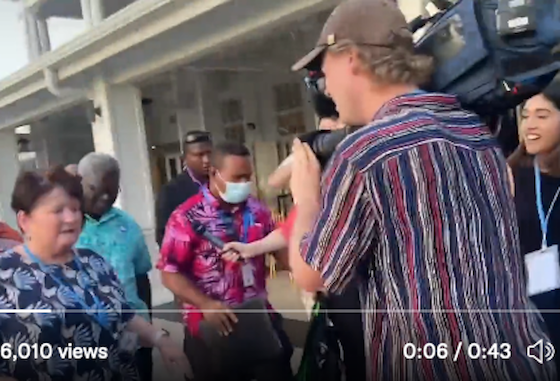
A LIVELY 43sec video clip surfaced during last week’s Pacific Islands Forum in the Fiji capital of Suva — the first live leaders’ forum in three years since Tuvalu, due to the covid pandemic.

Posted on Twitter by Guardian Australia’s Pacific Project editor Kate Lyons it showed the doorstopping of Solomon Islands Prime Minister Manasseh Sogavare by a melee of mainly Australian journalists.

An aloof Sogavare was being tracked over questions about security and China’s possible military designs for the Melanesian nation.


A doorstop on security and China greets Solomon Islands Prime Minister Manasseh
Sogavare (in blue shirt) at the Pacific islands Forum in Suva last week.
IMAGE: Twitter screenshot @MsKateLyons
 
But Lyons made a comment directed more at questioning journalists themselves about their newsgathering style:

“Australian media attempt to get a response from PM Sogavare, who has refused to answer questions from international media since the signing of the China security deal, on his way to a bilateral with PM Albanese. He stayed smilingly silent.”

Sunday, August 25, 2019

West Papua’s road to 'independence', following the Timorese lead?


An Al Jazeera report on the protests and rioting in Papua this week in response to the racist attack in Surabaya. 

The groundswell of regional support continues to grow in the Pacific - and also globally - for West Papuan self-determination, writes DAVID ROBIE. The latest repression only adds to this momentum.

INDONESIA’s harsh policies towards West Papua ought to be scrapped. Whatever happened to the brief window of enlightenment ushered in by President Joko “Jokowi” Widodo in 2015 with promises of a more “open door” policy towards foreign journalists and human rights groups?

They were supposed to be seeing for themselves the reality on the ground. But apart from a trickle of carefully managed visits by selected journalists after the grand announcement – including two multimedia crews from RNZ Pacific and Māori Television in 2015 – no change really happened.

And the serious media freedom and human rights violations remain rampant.

Friday, March 28, 2014

Corruption, illegal tuna fisheries and a ‘lifestyle tsunami’ trouble Pacific business editors


Sean Dorney's presentation ABC report on illegal tuna fishing in the Pacific on 28 October 2013.

HOW IRONIC. For two days this week, veteran Pacific affairs correspondent Sean Dorney from Australia Network was contributing hugely to an inaugural regional business media summit organised by the Asian Development Bank.

His final contribution to the seminar was a rundown on “tunanomics” and how illegal fishing was, for him, the biggest economic story confronting the Pacific.

He punctuated this presentation with an ABC video report from last October which exposed how lack of cooperation by at least six Pacific countries was undermining the Forum Fisheries Agency’s surveillance efforts.
Anthony Bergin, the Deputy Director of the Australian Security Policy Institute, estimates that about US$1.7 billion is lost through illegal and unregulated fishing activity in the Pacific. He’s proposing that the Australian patrol boat programme should not only be a Defence Department commitment but that Australian aid should also contribute to the programme now being developed to replace those 22 patrol boats that Australia has donated to Pacific countries but which are coming to the end of their work life.
No sooner than his fine contribution and the ADB seminar was over, Dorney found himself in the gun again with Fiji media "control freaks" - Dorney's description - who seem determined to use the controversial 2010 Media Industry Development Decree to gag anything deemed to be “un-Fijian”.

Tuesday, September 3, 2013

Fossil fuel industry 'needs to back down - not the Pacific' on climate change


Pacific Media Watch contributing editor Daniel Drageset interviews Marshall Islands Journal editor
Giff Johnson in Majuro.

By Michael Sergel of Pacific Scoop and the AUT journalism programe

CLIMATE CHANGE is top of the agenda in Majuro as the Pacific Islands Forum meets for the 44th time.

The Marshall Islands is calling for strong committed action on preventing and responding to climate change, as it welcomes delegates from 16 member states (minus suspended Fiji) to the renewable village that will play host to the next four days of talks.

Marshall Islands Forum Minister Phillip Muller said the Majuro Declaration was about “tangible action” rather than a “you-go-first” approach to climate policy.

“In the Pacific, we cannot afford to wait. We want the Forum to set the stage for a new, bolder approach,” he wrote in a Washington Post op-ed in June.

“We call on not just governments but also intergovernmental organisations, the private sector and civil society to sign on to our declaration with their own measurable commitments aimed at averting a climate catastrophe.”

Wednesday, September 21, 2011

Forum flagship initiative for homegrown Pacific journalism


MELBOURNE-based Fiji academic and commentator Dr Mosese Waqa (caricature) had some kind words to say about the Pacific Scoop coverage of the 42nd Pacific Islands Forum earlier this month. He wasn't alone, a heap of praise was thrown towards our postgraduate students who were on the job. Some 47 stories (many of them in-depth) were filed along with a couple of video reports and photojournalism packages. See the above VJ report by Christopher Chang and Alexander Winkler as an example. Waqa writes:

Without Pacific Media Watch [read Pacific Scoop], the overall media coverage of the PIF annual meeting at Auckland would have been mediocre at best.

What I like about your coverage is the diversity in the issues covered by your team (big and small, ones that have a "traditional fit" and ones "outside the box" etc). Most interesting and most encouraging indeed in terms of demonstrating institutional commitment in capacity building for the long term, you committed yourselves in supporting actual journalism students in asking the questions (some of them ground breaking, like the West Papua question to UN Gen Sec., that the mainstream media quickly dropped) and being the reporters themselves.


I truly think, this is a flagship initiative for homegrown Pacific journalism in the region and hopefully you can also create similar platforms in the future for creating synergies for Asia-Pacific collaborations, helping our neighbours have a better understanding of the Pacific - now that the United Nations (and indeed the international community) has adopted a more inclusive tag for the Asia group of nations to become Asia-Pacific Group.


Vinaka Vakalevu to the all the
Pacific Media Watch team members. Bring it on guys!!!!

Many thanks Mo. And just a quick word of clarification:

The credit is due to the Pacific Scoop project team done in partnership between the independent Scoop Media group and AUT University's Pacific Media Centre. Pacific Media Watch is another PMC project, which included carrying summaries of the student daily Forum file. The team (part of the postgraduate Asia-Pacific Journalism course) was led by Alex Perrottet, PMW's contributing editor, who was chief reporter for the team. The accredited student journalists were: International students involved in the coverage (NZ unless listed otherwise) were: Karen Abplanalp, Kim Austin, Christopher Chang, Chen Bei (China), Nigel Moffiet, Idoko Ojabo (Nigeria), Sarah Robson, Alexander Winkler (Germany), Henry Yamo (Papua New Guinea) and Victoria Young. Kiribati Independent editor Taberannang Korauaba, an AUT graduate, was also part of the team. Take a bow, guys.

Also worth mentioning is Scoop co-editor and general manager Alastair Thompson's message to the students:

David, Congratulations to you and your team on the coverage. I think this has been the best reported Pacific Islands Forum ever - by your team in particular. And in doing such a marvellous job you have set a new bar of professionalism for student/industry journalism projects.

I would also note that you have more than doubled Pacific Scoop's regular traffic for the period ... Finally I think it is worth making the point that while the PIF is important, it is unfortunately very underplayed and misunderstood by the New Zealand media.

The contrast of the sympathic and engaged coverage which you have provided has filled a gap and in many ways shown the professionals how the job ought be done. Sadly resources like those which you provided to this forum are seldom available for any media event in NZ.


Moreover, by providing such a comprehensive window on the myriad of issues facing the nations of the Pacific as you have done - while the diplomatic communities of NZ, Australia, the UN and the EU are watching closely - you have done the Pacific and its peoples a fantastic service.


Thank you and best regards

Alastair Thompson

Scoop.co.nz
Co-Editor

Friday, September 9, 2011

Pacific Islands Forum shuns West Papuan issue


Photo: Del Abcede / PMC

THE MOST astonishing unreported story in this week’s Pacific Island Forum in Auckland was a remarkable shift by the United Nations chief over West Papua. And the local media barely noticed. For all the hoo-ha about “converting potential into opportunity” at the predictable annual political talkfest, this was the most dramatic moment.

It was thanks to the probing of a young Papua New Guinean journalist studying in New Zealand who knew the right question to ask. But the significance was lost on local journalists – and even the Pacific and international journalists present. Secretary-General Ban Ki-moon suggested that the West Papuan issue should be discussed by the Decolonisation Committee of the United Nations General Assembly.

What? Coming in the wake of the Indonesian repression in West Papua throughout August in the face of a wave of unrest by Papuans more determined than ever for self-determination, this was almost unbelievable.
Question: [unclear] With regards to human rights - for more than 42 years, there’s a struggle in West Papua as people seeking their [own] government in the province of West Papua.

What is the United Nations stand on that?


BKM: This issue should also be discussed at the Decolonisation Committee of the United Nations General Assembly. And when it comes again, whether you are an independent state or a non-self-governing territory or whatever, the human rights is inalienable and a fundamental principle of the United Nations.


We will do all to ensure that people in West Papua, their human rights will be respected.


Question: Does a human rights fact-finding mission has be dispatched to West Papua at some time?


BKM: That is the same answer [to a previous question on Fiji] that should be discussed at the Human Rights Council amongst the member states.
Normally the Secretary General acts on the basis of a mandate given by inter-governmental bodies.
Because journalist Henry Yamo’s question was overshadowed by queries about Fiji, it probably slipped below the media radar. Was it a slip-up that officials were keen to brush aside? However, NGOs such as the Auckland-based Indonesia Human Rights Committee were quick to seize on the moment. Overnight a media declaration was produced by 15 Australian and NZ NGO signatories with the help of four West Papuans being hosted on the AUT University marae.

They called for the UN Secretary-General to:
  • appoint a Special Representative to investigate the situation in West Papua – to review the circumstances and outcome of the 1969 ‘Act of Free Choice’, as well as the contemporary situation; and

  • use his good offices to persuade the Indonesian government to allow free access to West Papua for media representatives from the international community and for non-governmental human rights organisations.
The statement also called on the Pacific Islands Forum to:
  • send a fact-finding mission to West Papua to investigate the human rights situation;

  • support the West Papuan people in their call for peaceful dialogue with the Indonesian government;

  • grant observer status to West Papuan representatives who support the people of West Papua’s right of self-determination; and

  • recommend to the United Nations General Assembly that West Papua be put back on the agenda of the Decolonisation Committee.
But the Forum simply ignored the West Papua issue.

In spite of a West Papuan protest outside the Forum opening and later at the summit hotel, the local media were only interested in a parallel protest against the Fiji military regime and the Forum communiqué failed to mention West Papua. Hypocrisy. While the Forum has already welcomed New Caledonia and French Polynesia as associate member status, and Timor-Leste (another former Indonesian former colonial possession) as an observer and is now granting American Samoa the same privileges, it remains silent about the atrocities and human rights violations in a Melanesian territory of the Pacific.

At the West Papuan protest, Green MP Catherine Delahunty grabbed a protest placard and tried to attract the interest of Pacific delegates in the plight of the Papuans. A gagged young man who was symbolically “locked up” in a bamboo cage, also had a story to tell. He was Amatus Douw, one of 43 Papuan political asylum seekers who fled to Australian in 2006. The other marae-based activists were Dr John Ondawame (West Papua People’s Representative Office in Vanuatu); Rex Rumakiek (secretary-general of the West Papua National Coalition for Liberation - WPCNL); and Paula Makabory ( Institute of Papuan Advocacy and Human Rights – IPAHR).

The absence of West Papua from the final communiqué was not the only blot on the Forum’s outcomes. While New Zealand was busy talking up the success of the Forum – “[Murray] McCully scores with his A-list forum”, as the New Zealand Herald billed it – most social justice and human rights issues were sidelined. There were structural problems too.

Violence against women
Although the issue of Sexual and gender-based violence against women was cited in the communiqué again this year, it was remarkable that media took little notice. Amnesty International collected a petition of 21,000 signatures and to his credit, President Anote Tong, accepted this while no other Pacific leader did.

But the media took even less interest, apart from reports by the student journalist team from Pacific Scoop. Jocelyn Lai of the Young Women’s Christian Association spoke harrowing tales and provided case studies of violence against women and girls in the Solomon Islands, a culture of silence and impunity because of the stigma. A report about Solomon Islands slums denied sanitation and safety was devastating, yet no SI journalist turned up for this let alone any other Forum journalists. Two thirds of women and girls aged between 15 and 49 had experienced physical or sexual violence from their partners and other family members.

In fact, the Forum’s engagement with civil society was dismal. While Pacific leaders recognised in the communiqué many of the issues identified by civil society were ones already on the regional agenda. There is still much rhetoric and not enough action. Female representation, or rather lack of it, is nothing short of “scandalous”. Move over Gulf Arab states, the Pacific is far worse. Six out of the world’s 10 countries without female representation are in the Pacific.

Little will change politically in the Pacific region without more women and greater diversity in the parliamentary representation. Yet women’s and other civil society groups were largely marginalised, if not actually excluded, by the Forum establishment elite. Next year in the Cook Islands an actual “dialogue” is needed between the region’s political leaders and the NGOs.

Think tank excluded
An independent think tank, the Pacific Policy Institute based in Vanuatu, was actually excluded from the Forum. While the conservative Australian-based Lowy Institute enjoyed a privileged position, including having a day-long conference in an Auckland hotel just two days before the Forum opened and had the opportunity to launch a controversial Fiji opinion poll, its opposite number – a real Pacific think tank, was being denied any accreditation.

It is believed that this is because of its policy on Fiji where it seeks “positive engagement”.

The Forum wasn’t all negative by any means. It certainly put the “Pacific” of Aotearoa on a world map with the presence of UN and European Union at the top level – plus the largest Chinese and US delegations - in a manner that has never been achieved previously in four decades of leader summits. The opening Pacific Showcase at the Cloud on Queens Wharf is a drawcard. And NZ Minister of Foreign Affairs Murray McCully can take the credit for this.

Also some NGOs welcomed the “responsiveness” of Forum leaders to climate change needs, civil society involvement in the future and the UN Arms Trade Treaty. Trade still remains a problem – it has been a very thorny issue in the past – and while Fiji will now be allowed back into the Pacer Plus (a pragmatic decisions based on necessity rather than any “softening up” of policies by Australia and NZ), negotiations are still likely to be delicate. Fiji has achieved some diplomatic successes in recent months and may force Australia and New Zealand to take a more pragmatic line rather than leaving a regional political void to China.

Tuesday, September 6, 2011

Pacific violence against women – an ‘epic’ human rights disaster left on the Forum margins


Peering into a contaminated water well: The Solomon Islands report on sanitation and safety in the Solomon Islands. Pictured below: Joycelyn Lai of the SI Young Women's Christian Association and the 20,000 signatures of the Amnesty International petition in support of Pacific women's human rights.

HARDLY surprising for the Pacific cynics. At the beginning of the Pacific Islands Forum week, Wadan Narsey warned in an article for Pacific Scoop about five "real" issues important to the region but unlikely to get too much attention in the Auckland 40th anniversary talkfest in the shadow of the World Cup. How right he was, by the end of the week many of the issues were still marginalised. Top of his list:

1. The liberation of West Papua: “It is a sad indictment of the past few years of PIF gatherings that 'Big Power Diplomacy' has emasculated the Forum Island Countries (FIC) from expressing their solidarity with the oppressed Melanesian people of West Papua.” Out of the 192-odd Forum accredited journalists, only three were present for a major public about the 'forgotten' issue with an outpouring from three West Papuan human rights activists.

2. Labour mobility: Only two locally accredited journalists were present for a seminar attended by 20 Pacific journalists about NZ’s recognised seasonal employment (RSE) scheme involving more than 7000 workers.

3. Defence cooperation: No serious discussion about this topic, which involves a proposal for a surplus of Pacific islands labour being recruited for the Australian and NZ military forces and navy, especially Tuvaluans and i-Kiribati.

4. Ending rugby colonialism: For all the hype about the Rugby World Cup, there was previous little debate about a better deal for Pacific rugby in Fiji, Samoa and Tonga from the white-dominated Australia and NZ rugby administrations and governments. (Wouldn't it be a delight if Tonga actually beat the All Blacks like Samoa dealt to Australia in July).

“But Canberra and Wellington don’t mind refusing visas to any rugby player related to anyone in the military regime [of Fiji]. Rugby in the Pacific is not just sports, but also part of the economy, and trade earning valuable foreign exchange. It could also become a great boost to Pacific tourism. But with lack of support from Canberra and Wellington, their rugby unions have let a great opportunity fort FICs go begging for more than a decade."

5. PACER Plus: “It is guaranteed that PACER Plus negotiations will drag on for years. Pacific Island politicians and civil servants won’t mind because they are guaranteed endless free trips to meetings and conferences, while endless compromises are sought on every little issue. Someone needs to do a PhD on the endless trivial negotiations over the dead PICTA horse.”

But as Nic Maclellan reported for Islands Business: “As leaders gather in Auckland there are serious obstacles to regional trade talks, including the resignation of Chief Trade Adviser Chris Noonan, allegations of Australian bullying over OCTA’s funding and a recommendation from Forum officials that leaders reject OCTA’s bid for observer status with the Forum.

"The OCTA (Office of the Chief Trade Adviser) crisis comes at the same time as political developments in Fiji complicate trade policy for the regional organisation.”

Languishing in the sidelines outside the shortlist of Dr Narsey – who incidentally was recently forced to step down from his economics professorship from the University of the South Pacific in scandalous circumstances after pressure from the Fiji regime over his outspokenness – was another thorny issue: the trampling of human rights of women and girls in the Pacific.

At the launching of Amnesty International’s report on the plight of women in the Solomon Islands “Where is the dignity in that?” before a packed audience at AUT University, there was no journalist to be seen. Wrong. Two young journalists were actually there - Victoria Young attached to the Pacific Media Centre, who wrote an excellent article, and a Nigerian male journalist Myles Idoko Ojabo, who also filed a good piece. Some comments from the address by Amnesty International Aotearoa’s chief executive Patrick Holmes are worth noting here:

The issue of violence against women in the Pacific is a human rights issue of epic proportions and the need to address it is urgent. As leaders meet for the Forum leaders’ meeting in Auckland this week, daughters, sisters, mothers and wives continue to be beaten, raped and killed. Many of the accounts that Amnesty International has received are truely horrific and yet so often the issue does not make headlines. This violence is not only a reality; it is our reality and it is one we all have a responsibility to address.

Gender discrimination in the region is systemic and permeates through all levels of society. Violence against women is the ultimate physical manifestation of this entrenched discrimination and the human rights violations that occur are perpetuated by inadequate and outdated legislation throughout the region. Some Pacific Island constitutions even fail to prohibit discrimination based on “sex” or “gender” and in those countries whose constitutions do prohibit discrimination, it is not enforced. In many Pacific nations marital rape is not a crime.

Simply put, it is not illegal for men to rape their wives. In Papua New Guinea cultural practices such as bride prices, polygamy and sorcery all serve to deepen the discrimination and violence felt by women. If you are considered a piece of property, it is very difficult to instil the understanding that you have rights, that you are part of the fabric of humanity. But this understanding is not impossible to achieve. While the issue is complex and at times seems overwhelming, effective legal protection for women can be achieved.

The reality is that violence against women in the region is rife with some nations having the worst rates out of any country on earth. On average two out of every three Pacific women have suffered abuse. In Kiribati 68 percent of women have been abused and violence against women in the Marshall Islands has been reported to be at almost 90 percent. With figures such as these, it is sadly unsurprising that sexual and gender based violence is considered standard practice by many in the region.

Amnesty International has statistics from a recent survey in Samoa showing that 85 percent of women who had been abused never asked any formal agency for help. Of these, the same percentage failed to do so because they thought such abuse was the “norm”, or “not serious enough”.
...
In recent years some small progress has been made. In Cairn’s in 2009 at the Pacific Island Forum leaders’ meeting, Pacific leaders recognised gender-based violence as a risk to human security and a potential destabilising factor for communities and societies alike. In a milestone decision for Pacific women, Pacific leaders pledged to take action to eradicate sexual and gender based violence.

For the first time in 40 years, the widespread issue of violence against women in the region was taken seriously by Pacific leaders. In 2010 in Vanuatu Pacific leaders commended actions in the region to take forward the directions from Cairns and acknowledged the initiative of the Forum Regional Security Committee to establish a Reference Group on sexual and gender based violence to support the Forum Secretariat and national efforts to address the issue.
Since then, the Reference Group has met in Fiji and conducted country visits to Tonga and the Solomon Islands; meeting with a range of stake holders and interest groups.

But these promises, policies and draft bills, while significant for setting the foundations to address the issue, nevertheless, do nothing to protect Pacific women and their families from violence.

In Amnesty International’s largest petition ever in New Zealand, well over 20,000 individuals have called on Pacific leaders to: make their country a safe and secure place for women and their families; to put in place laws to prevent violence, punish offenders, and compensate survivors; and to sign, ratify and put into practice international human rights conventions that protect women from violence.

This number of signatures is one fifth of the population of Tonga, two times the population of Nauru and over 10 times the population of Niue. The size of this petition shows the depth of concern of the public for Pacific women to have real protection from violence.

Wednesday, March 11, 2009

Anzac stranglehold on the 'free' Forum

By Dr Roman Grynberg

"Is the Pacific Islands Forum a place where free nations can exchange their views openly which is what the founding fathers wanted when they broke away from SPC? Freedom, as the Americans quite rightly remind us, is not free. The increasing power and domination of the islands by Australia and New Zealand is the real price the islands nations pay for Australia and New Zealand financial support."


IN THE early 1970s recently independent Pacific island leaders balked at their enforced silence in what was then the South Pacific Commission where they were unable to discuss French nuclear testing because of the opposition of the French government.

They decided as a group to create a new forum where independent nations would be free to talk. At the time Pacific island leaders were divided over whether the new 'Forum' should include Australia and New Zealand or not.

Ostensibly because of the huge resources these two countries could bring to the table they were grudgingly included.

Initially the Forum and its secretariat, then called the South Pacific Economic Community (SPEC), was there to provide technical assistance to the islands, hand out small bits of cash for training and workshops and to service the annual meetings of leaders.

However, the Pacific Islands Forum (PIF) quickly grew to become the region's paramount political organisation where all major issues of the day are discussed.

It has replaced the Secretariat of the Pacific Community which now performs an essentially technical role. The two organisations co-exist but the highly contentious political issues are largely handled at the Forum.

By the late 1990s the Forum, under pressure from Australia and New Zealand, began to evolve as a policy making body rather than a technical body assisting the islands.

Regrettably the change in the function of the Forum was never accompanied by an increase in its capacity to set the policy.

At the beginning of the current decade this role as a policy making body became even more important when the 'ethnic tensions' occurred in the Solomon Islands.

'Regional cover'
The very important and beneficial Australian lead intervention to save the Solomon Islands from the possibility of civil war and total collapse meant Australia needed what is called 'regional cover' from the Forum for the Regional Assistance Mission to the Solomon Islands.

This sort of intervention could not be done bilaterally and needed the support of other island states through the Forum.

But whereas RAMSI started as a truly positive intervention to save the Solomon Islands it has evolved into creeping control of economic policy by the young Australian 'babycrats' as they have dubbed in Honiara.

Some of the commercial policies they have advocated and implemented will directly benefit Australia.

The wags in Honiara now say the RAMSI mission will continue for many years and will only ever come to an end once the last overpaid 'babycrat' in Honiara pays his last mortgage installment in Australia.

If the Forum is a policy body then who establishes the policy? These decisions over policy are made by ministers on advice from officials.

Ministers then seek endorsement from leaders.

But where does the actual policy come from? The answer is very simple. In theory it is the technical people at the Forum secretariat who prepare the papers and the advice.

In reality, however, there is simply no capacity within the Forum secretariat to establish independent policy on most economic issues.

Aid 'thank you'
The policy either comes directly or indirectly from Canberra and Wellington or through its 'multilateral cover', that is the IMF, the World Bank and the Asian Development Bank.

If you look at almost every study undertaken in the region by the international financial institutions you will find a thank you on page 2 or 3 for the funding provided by AusAID or NZAID.

These organisations have Australian and New Zealand staff seconded to them and Canberra vigorously and jealously controls their trust accounts.

Only very occasionally do any of these institutions dare give advice that Canberra and Wellington explicitly disapprove of. This did occur recently with the World Bank's courageous and successful push to get Australia and New Zealand to open up their horticultural labour markets to Pacific island temporary workers.

Who sets the Forum agenda? In the Forum as in all international bodies, a draft agenda for every meeting is sent out to all members and they must all agree.

In reality in most cases only Australia and New Zealand have the capacity to review these documents and make substantive comments and hence they very largely set the Forum's agenda.

Not one Pacific island country, even PNG, the largest, has one dedicated official whose sole job it is to work only on Pacific island affairs.

Australia and New Zealand have scores of officials and desk officers in Canberra and Wellington with experts on each Forum island country.

Pacific island officials work on so many areas they have to be a 'jack of all trades' but because they are so busy they rarely even have time to read the meeting papers prior to an international meeting.

Outgunned
As a result they are almost invariably outgunned by their Australian and New Zealand counterparts at any meeting.

So if the Forum's policy and the agenda are by and large set in Canberra and Wellington why do Pacific island officials, ministers and leaders continue to accept it?

The answer to this is fairly complex. The first reason is that some of the advice provided by Australia and New Zealand is basically sound.

Whether it is democracy and the rule of law or the liberalisation of telecommunication and air transport few Pacific islanders would doubt that the advice provided by Canberra and Wellington either directly or through their regional or international surrogates has done anything other than benefit the people of the region.

However, there are many glaring examples in the past of policy advice which Canberra and Wellington would not be so proud of.

But this is not the point really. I have witnessed Pacific island officials and ministers sit there and agree to policy they know is not in their country's interest.

You will often hear outsiders ask why they remain silent? The usual response is a cultural explanation. Many Pacific island cultures, though by no means all, have no tradition of engaging in the sort of direct confrontation needed to achieve their foreign policy objectives.

I don't like this explanation because it portrays Pacific islanders as victims and I have seen another type of more subtle calculus occurring.

Many Pacific islanders remain silent for what are often good self interested reasons.

Courageous questions
It takes a courageous official to question Canberra and Wellington when Australia and New Zealand provide two-thirds of the income of the Forum Secretariat and a very large part of their national aid budget. Careers of officials can be terminated. Prime Ministers will receive letters of complaint about recalcitrant ministers and pressure can be brought to remove governments where they are too strident. All this is part of the normal use of power to retain effective control of countries in Australia and New Zealand's lake.

But in the final analysis what buys the silence of the islands in Forum meetings stems from the 'original sin' of the Forum leaders who included the aid donors as members and created a Forum where the poor and vulnerable are better off remaining silent.

There is an ancient proverb that goes, more or less 'He who eats the food of others shall grow weak in the mouth and he who takes the goods of others shall grow weak in the arms'.

This I believe explains much of the silence that is observed at forum meetings.

Whenever a Pacific island leader or minister sits there and accepts policy that is not in their national interests they know that speaking up too loudly may risk the aid flows to their country.

There is, however, even a dirtier secret about the Forum that all ministers and leaders know.

They can sit there at Forum meetings and nod silently to a policy which they have no intention of implementing when they go home and there is no-one to force them to do so.

So what happens are an endless cycle of meetings with quiescent ministers who agree silently to things because they know it will cost them too much to object publicly or they have no intention of implementing when they get home.

Implementation of decisions has simply never been a great priority for the Forum.

So if the purpose of creating the Forum 35 years ago was to have a place where free and independent countries could speak freely then the silence of island ministers means that the Forum is really no longer fit for its purpose - because of the disproportionate power and wealth of Australia and New Zealand.

'Original sin'
There are some Pacific islanders who dream of reversing the 'original sin' of the forum's founding fathers.

The Forum Secretariat with its six figures incomes, manicured lawns and its cycle of largely fruitless meetings (which provide very profitable daily subsistence allowances) will not change and Pacific islanders are never likely to throw Australia and New Zealand out of the Forum. International organisation do not change - they simply become irrelevant or less relevant, witness the UN over 60 years.

More to the point, Pacific islanders irrespective of how they feel about the Forum still need a place to talk to their neighbours Australia and New Zealand.

But is the Forum a place where free nations can exchange their views openly which is what the founding fathers wanted when they broke away from SPC? Freedom, as the Americans quite rightly remind us, is not free. The increasing power and domination of the islands by Australia and New Zealand is the real price the islands nations pay for Australia and New Zealand financial support.

For the larger Melanesian states which constitute 85% of the Pacific island population there is the realisation that if they want independent and unbiased advice then they have to form their own secretariat.

Hence with Chinese and possibly EU funding the Melanesians are creating a Melanesian Spearhead Group secretariat in Vanuatu.

The Melanesians want the freedom to get independent advice but they want the Chinese and the Europeans to pay.

This will also probably not work in the longer term but at least for the moment Chinese and EU interests in the region are profoundly different from that of Australia and New Zealand and will give the Melanesian states much greater policy space.

Things will only change with the circumstances. In the last generation it was France which silenced the islands. The present culture of silence in the Forum stems from the nature of the relationship with Australia and New Zealand. It is perverse and will never lead to a healthy relationship. There may yet come a generation of Pacific island leaders who have a genuine vision and intestinal fortitude to lead their countries and the region. I do not see it yet but I wish the Pacific islands, the region that has been my home for 25 years the very best in raising them.

Dr Roman Grynberg was - until last week - Director of Economic Governance at the Pacific Islands Forum Secretariat. This article was originally published in The Fiji Times under the title "Who owns the Forum?" and reproduced on Café Pacific with the author's permission.

>>> Popular Café Pacific Posts