Popular original 1987 coup leader Sitiveni Rabuka . . . back as prime minister in Fiji but with promises of a more democratic and transparent era. Image: FIJIVILLAGE
The Pacific year started with a ferocious eruption and global tsunami in Tonga, but by the year’s end several political upheavals had also shaken the region with a vengeance.
A razor’s edge election in Fiji blew away a long entrenched authoritarian regime with a breath of fresh air for the Pacific, two bitterly fought polls in Papua New Guinea and Vanuatu left their mark, and growing geopolitical rivalry with the US and Australia contesting China’s security encroachment in the Solomon Islands continues to spark convulsions for years to come.
It was ironical that the two major political players in Fiji were both former coup leaders and ex-military chiefs – the 1987 double culprit Sitiveni Rabuka, a retired major-general who is credited with introducing the “coup culture” to Fiji, and Voreqe Bainimarama, a former rear admiral who staged the “coup to end all coups” in 2006.
And pundits had been predicting that the 74-year-old Rabuka, a former prime minister in the 1990s, and his People’s Alliance-led coalition would win. However, after a week-long stand-off and uncertainty, Rabuka’s three-party coalition emerged victorious and Rabuka was elected PM by a single vote majority.
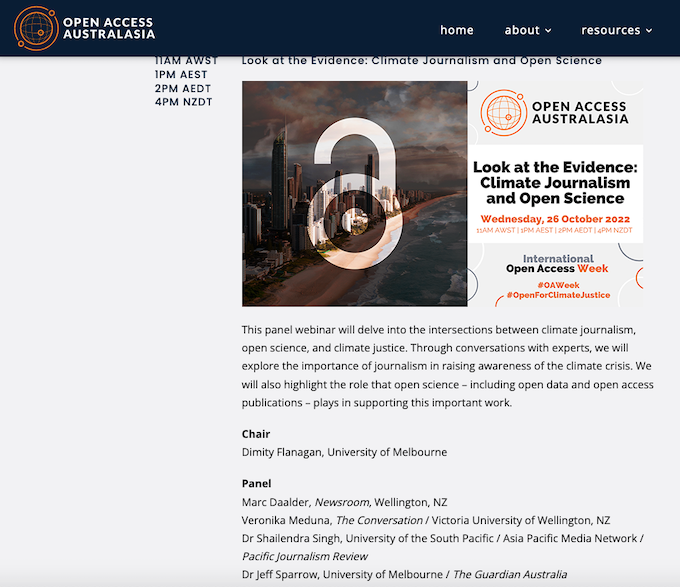
Open Access Australasia deputy chair Dimity Flanagan . . . moderating
the "look at the evidence" webinar on the media and climate crisis. IMAGE: Open Access screen shot APR
A Fiji-based academic challenged the Pacific region’s media and
policymakers today over climate crisis coverage, asking whether the
discriminatory style of reporting was a case of climate injustice.
Associate Professor Shailendra Singh,
head of the journalism programme at the University of the South
Pacific, said climate press conferences and meetings were too focused on
providing coverage of “privileged elite viewpoints”.
“Elites have their say, but communities facing the brunt of climate change have their voices muted,” he told the Look at the Evidence: Climate Journalism and Open Science
webinar panel exploring the role of journalism in raising climate
awareness in the week-long Open Access Australasia virtual conference.
Dr Singh, who is also on the editorial board of Pacific Journalism Review and was speaking for the recently formed Asia Pacific Media Network (APMN), threw open several questions to the participants about what appeared to be “discriminatory reporting”.
“Is slanted media coverage marginalising grassroots voices? Is this a form of climate injustice?” he asked.
“Are news media unknowingly perpetuating climate injustice?”
He
cited many of the hurdles impacting on the ability of Pacific news
media to cover the climate crisis effectively, such as lack of resources
in small media organisations and lack of reporting expertise.
‘Jack-of-all-trades’
“We are unable to have specialist climate reporters as in some other
countries; our journalists tend to be a jack-of-all-trades, and master
of none,” he said.
He did not mean this in a “disparaging manner”, saying “it’s just our reality” given limited resources.
Key Pacific media handicaps included:
• The smallness of Pacific media systems;
• Limited revenue and small profit margins;
• A high attrition rate among journalists (mostly due to uncompetitive salaries);
• Pacific journalists “don’t have the luxury” of specialising in one area; and
• No media economies of scale.
“Our journalists don’t build sufficient knowledge in any one topic
for consistent or in-depth reporting,” he said. “And this is more deeply
felt in areas such as climate reporting.”
He cited pioneering research on Pacific climate reporting by Samoan climate change journalist Lagipoiva Dr Cherelle Jackson, saying such Pacific media research was “scarce”.
‘Staying afloat in Paradise’
A research fellow with the Reuters Institute and Oxford University, Dr
Jackson carried out research on how media in her homeland and six other
Pacific countries were covering climate change. The 2010 report was
titled Staying Afloat in Paradise: Reporting Climate Change in the Pacific.
Pacific journalists and editors “have a responsibility to inform
readers on how climatic changes can affect them, she argued. But this
did not translate into the pages of their newspapers.
“Climate change is simply not as high a priority for Pacific
newsrooms as issues such as health, education and politics which all
take precedence over even general environment reporting,” Dr Jackson
wrote.
“For a region mainly classified by the United Nations as ‘least
developed’ and ‘developing’ countries, it is apparent that there are
more pressing issues than climate change.
“But the fact that the islands of the Pacific are already at the
bottom end of the scale in regards to wealth and infrastructure, and the
fact that climate change is also threatening the mere existence of some
islands, should make it a big story. But it isn’t.”
She has continued her advocacy work on climate change as climate
editor of the Associated Press and completing a doctorate on the topic.
Newsroom’s
Marc Daalder . . . “we need this [open access] to happen for climate
reporting”. IMAGE: Open Access Week 2022 screenshot APRThe Open Access Australasia media panel today also included Newsroom’sMarc Daalder, The Conversation’s New Zealand science editor Veronica Meduna, and Guardian
columnist Dr Jeff Sparrow of the University of Melbourne. It was
chaired by Open Access Australasia deputy chair Dimity Flanagan.
Critical of paywalls
Daalder spoke about how open access to scientific papers was vitally
important for journalists who needed to read complete papers, not just
abstracts. He was critical of the paywalls on many scientific research
papers.
Open access enabled journalists to do their job better and this was
clearly shown during the covid-19 pandemic — “and we need this to happen
for climate reporting”.
Meduna said it took far too long for research, such as on climate
change, to filter through into public debate. Open access helped to
reduce that gap.
She also said the success of The Conversation model showed
that there was a growing demand for scientists communicating directly
with the public with the help of journalists.
Dr Sparrow called for a social movement for meaningful action on the
climate crisis and more scientific literacy was needed to enable this.
Highly critical of the “dysfunctional” academic publishing industry,
he said open access would contribute to “radically accessible” science
for the public.
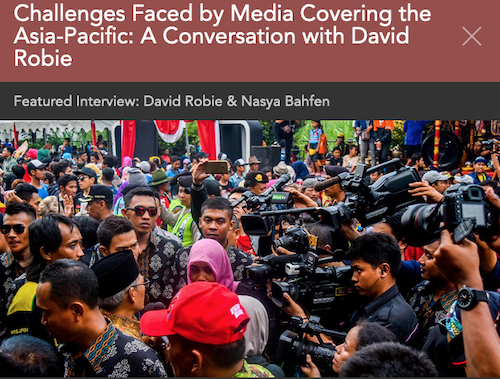
Media educator and Asia Pacific Report editor Professor David Robie tells of the resilience and courage of Pacific journalists faced with many challenges. IMAGE: MediAsia Iafor/La Trobe screenshot
New Zealand journalist and academic David Robie has covered the Asia-Pacific region for international media for more than four decades.
An advocate for media freedom in the Pacific region, he is the author
of several books on South Pacific media and politics, including an account of the French bombing of the Greenpeace flagship Rainbow Warrior in Auckland Harbour in 1985 — which took place while he was on the last voyage.
In 1994 he founded the journal Pacific Journalism Review examining media issues and communication in the South Pacific, Asia-Pacific, Australia and New Zealand.
He is also convenor of the Pacific Media Watch media freedom
collective, which collaborates with Reporters Without Borders in Paris,
France.
Until he retired at Auckland University of Technology in 2020 as that
university’s first professor in journalism and founder of the Pacific Media Centre, Dr Robie organised many student projects in the South Pacific such as the Bearing Witness climate action programme.
Watch the conversation between Dr Nasya Nahfen and Asia Pacific Report editor Professor David Robie. VIDEO: MediAsia Iafor/Café Pacific Media
In this interview conducted by Mediasia organising committee member Dr Nasya Bahfen of La Trobe University for this week’s 13th International Asian Conference on Media, Communication and Film
that ended today in Kyoto, Japan, Professor Robie discusses a surge of
disinformation and the challenges it posed for journalists in the region
as they covered the covid-19 pandemic alongside a parallel “infodemic”
of fake news and hoaxes.
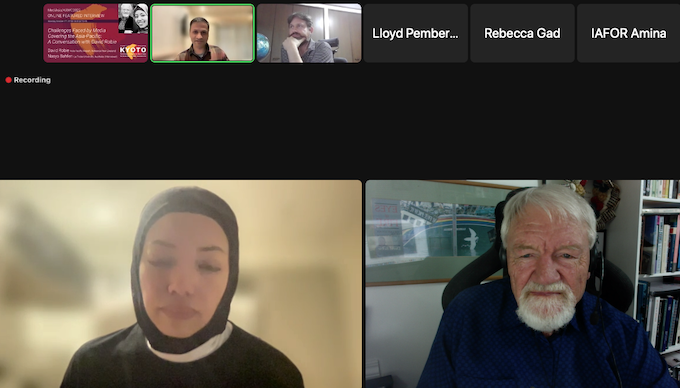
The MediAsia “conversation” on Asia-Pacific issues in Kyoto, Japan. IMAGE: Iafor screenshot APRHe also explores the global climate emergency and the disproportionate impact it is having on the Asia-Pacific.
Paying a tribute to the dedication and courage of Pacific
journalists, he says with a chuckle: “All Pacific journalists are
climate journalists — they live with it every day.”
Challenges
facing the Asia-Pacific media . . . La Trobe University’s Dr Nasya
Bahfen and Asia Pacific Report’s Dr David Robie in conversation. IMAGE:
Iafor screenshot APR
Bodies of civilians being evacuated after an attack by an armed group at
Nogolaid Village, Kenyam District, Nduga Regency, Papua, last Saturday. IMAGE: Jubi
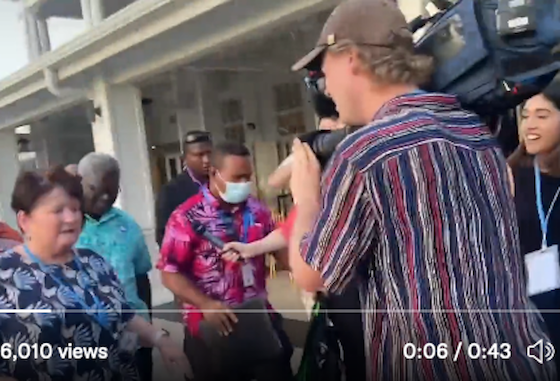
A LIVELY 43sec video clip surfaced during last week’s Pacific Islands
Forum in the Fiji capital of Suva — the first live leaders’ forum in
three years since Tuvalu, due to the covid pandemic.
Posted on Twitter by Guardian Australia’s Pacific Project
editor Kate Lyons it showed the doorstopping of Solomon Islands Prime
Minister Manasseh Sogavare by a melee of mainly Australian journalists.
A
doorstop on security and China greets Solomon Islands Prime Minister
Manasseh Sogavare (in blue shirt) at the Pacific islands Forum in Suva
last week. IMAGE: Twitter screenshot @MsKateLyons
But Lyons made a comment directed more at questioning journalists themselves about their newsgathering style:
“Australian media attempt to get a response from PM Sogavare, who has
refused to answer questions from international media since the signing of the China security deal, on his way to a bilateral with PM Albanese. He stayed smilingly silent.”