Independence and self-determination in the Pacific ... contrasting
referendum experiences between Bougainville, Kanaky New Caledonia and
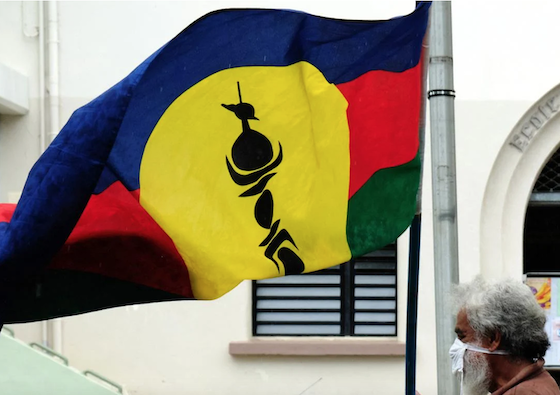
West Papua. IMAGE: Screenshot of the Kanak flag in Middle East Eye
THE PACIFIC year has closed with growing tensions over sovereignty and self-determination issues and growing stress over the ravages of covid-19 pandemic in a region that was largely virus-free in 2020.
Just two days before the year 2021 wrapped up, Bougainville President Ishmael Toroama took the extraordinary statement of denying any involvement by the people or government of the autonomous region of Papua New Guinea being involved in any “secret plot” to overthrow the Manasseh Sogavare government in Solomon Islands.
Insisting that Bougainville is “neutral” in the conflict in neighbouring Solomon Islands where riots last month were fuelled by anti-Chinese hostilities, Toroama blamed one of PNG’s two daily newspapers for stirring the controversy.
“Contrary to the sensationalised report in the Post-Courier (Thursday, December 30, 2021) we do not have a vested interest in the conflict and Bougainville has nothing to gain from overthrowing a democratically elected leader of a foreign nation,” Toroama said.
The frontpage report in the Post-Courier appeared to be a beat-up just at the time Australia was announcing a wind down of the peacekeeping role in the Solomon Islands.
AFTER three decades of frustratingly slow progress but with a measure
of quiet optimism over the decolonisation process unfolding under the
Noumea Accord, Kanaky New Caledonia is again poised on the edge of a
precipice.
Two out of three pledged referendums from 2018 produced higher than
expected – and growing — votes for independence. But then the delta
variant of the global covid-19 pandemic hit New Caledonia with a
vengeance.
Like much of the rest of the Pacific, New Caledonia with a population
of 270,000 was largely spared during the first wave of covid
infections. However, in September a delta outbreak infected 12,343 people with 280 deaths – almost 70 percent of them indigenous Kanaks.
With the majority of the Kanak population in traditional mourning –
declared for 12 months by the customary Senate, the pro-independence
Kanak and Socialist National Liberation Front (FLNKS) and its allies
pleaded for the referendum due this Sunday, December 12, to be deferred
until next year after the French presidential elections.
WHILE pro-independence Kanak supporters rued another defeat in the
second referendum on independence for New Caledonia at the weekend, it
was even narrower than the loss two years ago. Now there is a real
prospect of a win in 2022.
“The path to independence and sovereignty is inevitable,” pledges the
Front de Libération Nationale Kanak et Socialiste (FLNKS) – the
umbrella group of the pro-independence parties and the struggle will go
on.
Roch Wamytan, president of New Caledonia’s parliamentary Congress and
a key leader of the FLNKS’ Union Calédonienne, vows the independence
lobbying will press for the third referendum in two years’ time – and
even later if needed.
French security forces arrive in force to deal with protesters
demonstrating over the independence vote
defeat near St Louis, Noumea.
Image: Screenshot - Les Nouvelles Caledoniennes
French security forces moved in today to clean up the main road near an indigenous Kanak tribal area after a day of tension and rioting failed to mar a lightning visit by French Prime Minister Édouard Philippe and post-independence referendum discussions.
Philippe flew in yesterday morning from Vietnam for a day of meetings with political leaders, customary chiefs and voting commission officials to take stock of the historic referendum on Sunday.
While the people of New Caledonia voted to remain French with a resounding 56.4 percent of the vote, it was a lower winning margin than had been widely predicted in the face of an impressive mobilisation by pro-independence groups.
The yes vote was 43.6 percent but Kanak voters were already a minority of the restricted electorate for this vote that included Caldoche (settlers), descendants of a French penal colony for Algerian and Paris commune dissidents, and people of Asian and Wallisian ancestry.
A record 80.63 percent turnout with 141,099 voters in a largely calm and uneventful referendum day has opened the door for serious negotiations about the future of New Caledonia.
AN EXTRAORDINARY story of mining skulduggery and a courageous struggle by indigenous Kanak environmental campaigners has been captured in a poignant new documentary, Cap Bocage – described by the filmmaker as a tale of “when a mountain fell into the sea”.
The culprit in this case is Ballande, one of the oldest nickel mining companies in New Caledonia with a record of three decades laying waste a coastal environment in north-east Grande Terre.
The documentary, made by director Jim Marbook, filmmaker and also a television and screen production lecturer in AUT University’s School of Communication Studies, is an astute piece of cinematography.
Made over a period of seven years, it patiently peels away all the complexities and subtleties of the environmental struggle against a hard-nosed mining company that employs most of the people in the remote Kanak community.
It also tells the story of articulate and charismatic campaigner Florent Eurisouké – who visited Auckland for the global premiere at this week’s New Zealand International Film Festival – and his environmental organisation Mèè Rhaari take on Ballande through boycotts and finally the lawcourts.
Kanak militant leader Alphonse Dianou … “played superbly by his cousin Iabe Lapacas”. Image: Rebellion
WHEN THE headlines hit France in April 1988 about the latest saga in “les évènements” down under in New Caledonia, filmmaker Mathieu Kassovitz was just 18. He remembers the gritty images of the Gossanna cave siege on television.
Indigenous Kanaks had massacred a quartet of gendarmes with machetes and shotguns and taken 27 others hostage.
There were also false reports of alleged decapitations and rape on Ouvéa in the remote Loyalty Islands.
But 13 years ago, Kassovitz’s father handed him the League of Human Rights report on the cave siege and he read the chilling real story for the first time.
A French military force of some 300 had been deployed in a retaliatory “invasion” of the island and the report detailed atrocities and summary executions that had left 19 Kanak hostage-takers dead in a dawn assault on 5 May 1988.
Kassovitz (La Haîne and Café au Lait) noted then how an elite police counter-terrorism unit negotiator, Captain Philippe Legorjus of the CIGN, was a central character in the disturbing events.
“I knew then there was the material for a wonderful movie and the script was virtually written,” Kassovitz recalled in a Femail interview. “The dramatic structure was in the report of those 10 days.”
Director Mathieu Kassovitz as the negotiator Captain Philippe Legorjus … “inspirational and credible”. Image: Rebellion
Many obstacles
On his first trip to Ouvéa to explore the possibility of making the movie, it seemed many obstacles could block getting such a project off the ground.
“Ten years had passed but people were still withdrawn into their grief. The subject was tabu. There had been no closure,” he says.
“There was a lot of religious and political in-fighting within the Kanak community.”
A decade on and 25 film scripts later, against all the odds and being forced to make the film on the French Polynesian island of Anaa instead of Ouvéa, a courageous 136min testimony to the Kanak struggle and search for justice has been finally achieved.
The film was released in France last November with the title L’Order et La Morale– a play on words from the title of the Legorjus autobiography, La Morale et l’Action, and on a statement by the hated Minister of Overseas Territories Bernard Pons, who said rather cynically: “Sometimes some deaths are necessary to uphold order and morality.”
Last night, the gripping docudrama was screened for the first time at the New Zealand International Film Festival – under the English-language title Rebellion, which loses the nuances of the French name.
But the film was never shown in New Caledonia on general release in the largest cinema chain. The Pacific territory's French operator refused to screen it.
Smaller cinemas played the film to packed audiences, both Kanak and French.
Inspirational performances
The movie succeeds with the inspirational and credible performances of both director Kassovitz as the frustrated but professional lead character Legorjus – who tried hard to seek a peaceful solution to the hostage crisis – and the Kanak pro-independence militant leader Alphonse Dianou, played superbly by his cousin Iabe Lapacas, aged only six at the time of the tragedy.
Negotiator Legorjus – who is also taken captive – and Dianou ironically form a trusting bond of fraternity and understanding and the French officer is released in a bid to broker a deal.
But tension builds as the film covers the 10 days of negotiations until the expediency of the power struggle between rightwing Prime Minister Jacques Chirac and socialist President François Mitterrand in Paris over the imminent outcome of the presidential elections takes over. Mitterrand calls for negotiations – but in reality orders the full catastrophe assault on the cave to free the hostages.
He wins the election.
Legorjus feels betrayed and subsequently resigns from the elite force after the assault. Dianou feels betrayed and is horrendously allowed to die from his wounds from the cave firefight.
Other Kanak prisoners were simply killed in cold blood.
And the Kanak community feel betrayed by both Legorjus and the pro-independence FLNKS. This sense of betrayal ultimately led to the assassination of charismatic FLNKS leader Jean-Marie Tjibaou and his deputy Yéiwene Yéiwene a year later in a ceremony marking the anniversary of the martyrs.
History lesson
Pastor Djubelly Wea, whose character features in the film giving Legorjus a Kanak history lesson while manacled to a coconut tree, was the assassin. He never forgave the FLNKS leadership for failing to negotiate on their behalf. (Although the FLNKS villain portrayed in the film is Franck Wahuzue).
Wea (played by relative Macki Wea) in turn was gunned down by Tjibaou’s bodyguard.
Having reported on the Kanak independence struggle for several years, watching Rebellion was an emotional rollercoaster for me. (In fact, I shared a hotel room in Manila at a “peace brigade” conference with Wea just months before the assassination).
Gossanna cave was tabu – and the film portrays traditional “custom” and beliefs very evocatively. In Kanak tradition, a promise made face-to-face is never broken.
Legorjus promised that the militants that they would live, a pledge that his superiors sabotaged for political capital.
I don’t believe the militants ever intended to harm their captives – they were simply negotiating leverage after things went wrong in the Fayaoué hostage-taking. In fact, as portrayed in the film, the hostages were about to be freed anyway.
At the time, I wrote an account in my book Blood on their Banner – the blood being that symbolised by the Kanak flag as being shed by the martyrs of more than a century of French rule.