Showing posts with label png. Show all posts

Monday, June 6, 2022

Ramos-Horta challenges Pacific’s biggest threat to media freedom – China’s gatekeepers

Showing how it's done ... a "more open" media conference in Dili
with China's Foreign Minister Wang Yi. IMAGE: TL Presidential Palace media
 

 By DAVID ROBIE

Timor-Leste, the youngest independent nation and the most fledgling press in the Asia-Pacific, has finally shown how it’s done — with a big lesson for Pacific island neighbours.

Tackle the Chinese media gatekeepers and creeping authoritarianism threatening journalism in the region at the top.

In Dili on the final day of Chinese Foreign Minister Wang Yi’s grand Pacific tour to score more than 50 agreements and deals — although falling short of winning its Pacific region-wide security pact for the moment — newly elected (for the second time) President José Ramos-Horta won a major concession.

Enough of this paranoid secrecy and contemptuous attitude towards the local – and international – media in democratic nations of the region.

Under pressure from the democrat Ramos-Horta, a longstanding friend of a free media, Wang’s entourage caved in and allowed more questions like a real media conference.

Monday, February 21, 2022

Jack Lapauve: Why we walked out in protest over EMTV news independence


Jack Lapauve Jr.  IMAGE: FB

COMMENTARY: EMTV’s deputy news editor Jack Lapauve Jr in Port Moresby writes in defence of the newsroom’s decision to walk out in protest over the suspension of head of news and current affairs Sincha Dimara on February 7.

The EMTV News editorial decision to run the two stories [about the court cases involving Australian hotel businessman Jamie Pang] was based on two important points in our line of work:

Impartiality and Objectivity.

Impartiality cannot be achieved by the measure of words in a story, it is achieved by:

  • Avoiding bias towards one point of view
  • Avoiding omission of relevant facts
  • Avoiding misleading emphasis

All of which are stated in the EMTV News and Current Affairs Manual 2019 in section 17.5 under standard operations of the television code.

By running the stories, the team was accused of bias.

Sunday, April 12, 2020

Police Minister Bryan Kramer blasts two journalists in virus reporting row


PNG's Treasurer Ian Ling-Stuckey (left) ... in the middle of a furore between two senior journalists,
Gorethy Kenneth and Freddy Mou, and Police Minister Bryan Kramer over media ethics.
Image: Kramer Report
By Pacific Media Watch

PAPUA New Guinea’s Police Minister Bryan Kramer has published an extraordinary attack on two leading journalists over their reporting of the Covid-19 coronavirus pandemic, accusing them of “misrepresenting” a financial update this week and suggesting they ought to be sacked.

He claimed in an Easter weekend posting on his Kramer Report – a Facebook publication dedicated to being the “inside story through in-depth investigative reporting and critical analysis” with more than 127,000 followers – that Loop PNG political and business editor Freddy Mou and senior PNG Post-Courier journalist Gorethy Kenneth “can’t be trusted”.

“Both journalists have close ties to the former Prime Minister Peter O’Neill. Both have also been accused of publishing biased and misleading reports,” Kramer alleged.

The commentary was headlined: “Who got it wrong? PNG Loop or the Treasurer?”

 READ MORE: RSF criticises minister's sacking call

Kramer accused Mou of misrepresenting a one-on-one interview with Treasurer Ian Ling-Stuckey in alleging that the bulk of the 23 million kina (almost NZ$11 million) released by the government for Covid-19 operations was being used to hire cars and media consultants.

Sunday, April 5, 2020

Creeping authoritarianism in Pacific not the answer to virus pandemic

The USS Theodore Roosevelt docked in Guam ... local critics unhappy about a "dangerous" gamble
with coronavirus. Image: US Navy screenshot
PACIFIC PANDEMIC DIARY: By David Robie, self-isolating in Auckland under New Zealand’s Covid-19 lockdown as part of a Pacific Media Watch series.

A RATHER beautiful Guåhan legend is rather poignant in these stressed pandemic times. It is one about survival and cooperation.

In ancient times, goes the story, a giant fish was eating great chunks out of this western Pacific island. The men used muscle and might with spears and slings to try to catch it.

This didn’t work. So, the women from many villages got together while washing their hair in a river. They wove their locks into a super strong net, caught the fish and saved the island.

Friday, October 12, 2018

Paga Hill iconic human rights documentary banned from PNG festival

Activist lawyer Joe Moses as he appears in a Frontline Insight item about the Paga Hill struggle for justice
in Papua New Guinea. Video: Reuters Foundation
By Pacific Media Watch

An internationally acclaimed investigative documentary about Paga Hill community’s fight for justice from the illegal eviction and demolition of their homes in Papua New Guinea’s capital of Port Moresby has been banned from screening today at the PNG Human Rights Festival.

“The ban highlights the lingering limits on free speech in our country and the continued attempts to censor our story of resistance against gross human rights violations,” claimed Paga Hill community leader and lawyer Joe Moses, the main character in The Opposition film who had to seek exile in the United Kingdom after fighting for his community’s rights.

“This censorship comes as a deep disappointment for my community who have suffered greatly over the past six years.”

The Opposition tells the David-and-Goliath battles of a community evicted, displaced, abandoned – their homes completely demolished at the hands of two Australian-run companies, Curtain Brothers and Paga Hill Development Company, and the PNG state.

What was once home to 3000 people of up to four generations, Paga Hill is now part of the Asia-Pacific Economic Co-operation (APEC) summit “AELM Precinct” which will take place this November.

Wednesday, June 20, 2018

Former military chief warns PNG soldiers could be ‘outgunned’ in Mendi strife

Deadly MAG 58 Model 60-20 machine guns mounted on a cabin-top truck in the Southern Highlands.
Image: PNGAttitude
From Asia Pacific Report
A FORMER Papua New Guinea military commander has warned that he is “concerned, if not frightened” that the PNG Defence Force may be deploying police and soldiers in the troubled Southern Highlands province facing a deadly weapon.

Ex-Brigadier-General Jerry Singirok , a former commander of the PNGDF who arrested mercenaries deployed by the Sir Julius Chan government for the Bougainville war in the so-called Sandline crisis in 1997, has made his views known in independent media.

In an item published by PNG Attitude and EMTV journalist Scott Waide’s blog, Singirok described Prime Minister Peter O’Neill’s government response to last week’s Mendi riots as a “premature state of emergency” and a “cheap, reckless and knee-jerk option”.

His comments have come at a time when the nation has been shocked by the display of high powered assault weapons by protesters since last week’s Mendi rioting.

It is clear that the government’s guns amnesty last year did little to encourage people to surrender their weapons, reports Loop PNG.

Sunday, March 11, 2018

Harsh response lessons abound in wake of PNG’s ‘invisible’ quake

Timu village from the top showing the site where 11 people were buried by landslips during the earthquake on
26 February 2018. Four of the bodies have been recovered, seven are still buried, including five children.
Image: Sylvester Gawi/Graun Blong Mi- My Land
By David Robie

Tomorrow Papua New Guinea is marking two weeks since the devastating 7.6 magnitude earthquake that devastated parts of Hela, Southern Highlands and Western Highlands provinces on February 26. Officials still have little idea of the full scale of the death and damage, because of the remote rugged terrain involved in what has been described by the BBC as the “invisible quake” – at least to the outside world. However, more than 100 people have died with landslides engulfing entire villages.

Some Papua New Guinean journalists have been doing an admirable job reporting the disaster to international media as well as their own people in difficult and risky circumstances – journalists such as EMTV’s deputy editor Scott Waide and NBC’s Sylvester Gawi. When communications were difficult through mainstream media connections, they have used their personal blogs. Here is the latest blog from Gawi republished from Asia Pacific Report:

BRIEFING: By Sylvester Gawi in Tari, Papua New Guinea


Papua New Guinea’s Highlands earthquake disaster has brought to light some of the many things that need to be considered in assisting those affected by disaster and restoring vital infrastructures and communication links between relief agencies and the people.

The response to the 7.5 magnitude earthquake on February 26 took almost a week for the National Disaster Centre to find out statistics of people who were affected, casualties, homes and food gardens destroyed and how to deliver relief supplies to those affected.

Saturday, July 15, 2017

PNG activist blogger Martyn Namorong protests online in defiance of gag order

PNG blogger Martyn Namorong ... gagged but not silenced. Image: MN Twitter
By Mong Palatino of Global Voices

A Papua New Guinea court has issued a gag order against Martyn Namorong, a prominent political blogger and activist accused of defaming Patilias Gamato, the country’s Electoral Commissioner.

Gamato this week sued Namorong after Namorong compared him to a "fruit" (tomato) on social media, as reported by Pacific Media Watch. When Namorong learned about the court order, he posted this image on Twitter before adding the above blue gag selfie image:


He added that he also needed a lawyer.

Sunday, July 2, 2017

Gary Juffa: Why these PNG elections are taking us towards dictatorship

Oro Governor Gary Juffa speaking at a PNG campaign gathering ... explaining the qualities to look for in
national leadership. Image: JuffaFB
By Gary Juffa, Oro Governor and an opposition MP writing for Asia Pacific Report.

I SUSPECT that these Papua New Guinea elections have been so deliberately set to fail, leaving much room for fraud and confusion, and distracting from what is really going on – the establishment of a dictatorship.

Already Prime Minister Peter O’Neill has his own special police unit that flies around Papua New Guinea escorting him in his private airlines, he has a special army unit of 40 exclusively for his callout, he controls the media and Public Service, and, it seems, the Police and Defence commands — and perhaps the judiciary -- the signs and red flags are blinking bright red now…

Yet many people do not see it. We are inching closer towards dictatorship and the ensuing bloodshed and violence that must come from the hostility towards it. But, like lemmings and sheep, we are led to that reality with little resistance at all. Is this the Papua New Guinea we all believed in once upon a time?

Last Wednesday in Oro province, provided a demonstration of how much the PNG government is not for PNG.

Sunday, June 28, 2015

Fiji, PNG lead betrayal, but still West Papuans triumph

A massive crowd at Timika, Papua, greets the MSG decision to grant West Papuans observer status.
Image: Free West Papua Campaign
COMMENT By David Robie

THE Melanesian Spearhead Group leaders’ summit in Honiara this week must go down as the most shameful since the organisation was founded two decades ago.

It had the opportunity to take a fully principled stand on behalf of the West Papuan people, brutally oppressed by Indonesia after an arguably “illegal” occupation for more than a half century.

Host nation Solomon Islands Prime Minister and chair Mannaseh Sogareve set the tone by making an impassioned plea at the start of the summit, predicting a “test” for the MSG. He said it would be an issue of human rights and the rule of law.

In the end, the MSG failed the test with a betrayal of the people of West Papua by the two largest members. Although ultimately it is a decision by consensus.

Instead, the MSG granted Indonesia a “promotion” to associate member status – an Asian country, not even Melanesian?

Thursday, February 19, 2015

Improving Pacific media freedom record … but let’s get real

Pacific press freedom ... maybe not as bloody as elsewhere in the world, but vigilance still needed. Image: AFP/RSF
IT’S GREAT to get some bouquets on media freedom issues instead of brickbacks in the Pacific for a change. But let’s not get carried away. Instead of all the backslapping, what is needed is more vigilance because really it is all about more than watching this space.

Tonga did best in the latest Reporters Sans Frontières World Press Freedom Index, climbing some 19 places to 44th (yes, actually above the United States, but still below the best-paced Pacific island Samoa at 40th).

You would expect a healthy climb during the year, especially with former school teacher and public broadcaster (not to mention publisher of the pro-democracy Koe Kele’a) ‘Akilisi Pohiva finally becoming prime minister of Tonga.

This was an encouraging result in the November 2014 election following the first “democratic” election in 2010.

And it was expected that Fiji would also improve in the rankings after the “return to democracy” election in September – first since the 2006 military coup – flawed though that might be.

Friday, October 3, 2014

Politics, human rights and asylum seekers media conference lined up for NZ


An update on Ces Oreña-Drilon and the Maguindanao massacre investigation. Her justice corruption allegations have led to a National Bureau of Investigation inquiry. Video: GMA News


PACIFIC JOURNALISM REVIEW, the only politics and media research journal in New Zealand and the Pacific, will host an international conference late next month marking its 20th anniversary of publication.

With the overall theme of “Political journalism in the Asia-Pacific”, many editors, investigative journalists, documentary makers, human rights advocates, media freedom activists and journalism educators and researchers will be converging on Auckland for the event at AUT University on November 27-29.

One of the keynote speakers at PJR2014, television journalist Ces Oreña-Drilon of ABS-CBN and an anchor for the celebrated current affairs programme Bandila, will give an address on the killings of journalists with impunity in the Philippines.

She has been investigating the 2009 massacre of 34 journalists by private militia while they were accompanying a candidate’s entourage to register for elections and she has a grim story to tell in her “Losing the landmark Maguindanao massacre case” presentation about the legal and political fallout from the tragedy.

She is attending the conference with the support of the Asia New Zealand Foundation.

Saturday, April 26, 2014

Dangerous trend in copycat cybercrime laws in the Pacific [video]

             Video by Pacific Media Watch editor Anna Majavu.

COPYCAT cybercrime laws designed to curb freedom of expression on social media and independent blog news sites are becoming a major threat to the Asia-Pacific region.

Café Pacific today publishes a video from the book launch of David Robie's new book Don't Spoil My Beautiful Face: Media, Mayhem and Human Rights in the Pacific, which raises these issues.

Speakers at the event included the AUT Dean of Creative Technologies, Professor Desna Jury; Wiremu Tipuna, Takawaenga Māori at AUT (Ngati Kahungunu); Dr Steven Ratuva, president of the Pacific Islands Political Studies Association (PIPSA); publisher Tony Murrow of Little Island Press; and Pacific Islands Media Association (PIMA) chair Sandra Kailahi.

TV New Zealand's Pacific correspondent, Barbara Dreaver, sent a "launch" message which was read out by Kailahi.

Monday, April 14, 2014

Fighting PNG corruption and social media gags with … outspoken blogs

Graphic: shutterstock.com
THE BLOGGING war is hotting up in Papua New Guinea – just when things are getting riskier with draconian proposals over cybercrime law on the horizon. The state target for Prime Minister Peter O’Neill’s government appears to be social media. Trample on any possible dissent.

O’Neill is seen as a proxy for Canberra’s strategic interests in the region. As PNGexposed claimed in one posting, the Australian government “has already assumed the role of regional sheriff and wants to sit astride a region of compliant states and micro-states”.
“This means other countries markets and resources should be open to foreign capital without barriers such as the muscular protection of landowner rights, or strong environmental laws. Australia is targeting its aid spending to ensure Bougainville fits this model.

“Whatever the future for Bougainville, Australia wants to ensure the island is a subservient neighbor providing a supporting role to Australia’s own economic and political interests. Australia is therefore targeting its aid spending to ensure that outcome, placing consultants in key political and financial roles and neglecting health and other people-centered sectors.”
According to figures released by the Australian Department of Foreign Affairs and Trade (see table here) show that more than 90 percent of $2.9 million a year spent on the salaries or commissions of consultants working for Australia on Bougainville is directed at ensuring Australian political structures, policy priorities, economic models, and security interests dominate in the new Bougainville government and bureaucracy.

Sunday, April 13, 2014

Border ‘butchers’, absentee poll reps and West Papua’s growing strife

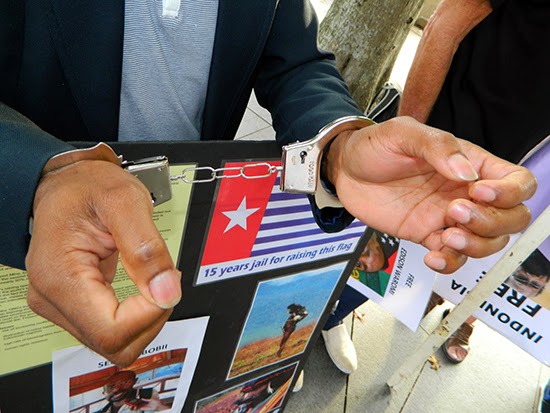
A West Papuan in handcuffs at a recent “Free West Papuans” rally in Auckland. Photo: Del Abcede/PMC
THE INDONESIAN parliamentary elections this week were disappointing on a number of fronts, especially for presidential frontrunner Jakarta Governor Joko “Jokowi” Widodo. His Democratic Party of Struggle (PDI-P) which gained just 19 percent of the vote, was far less than the expected 25 percent. But the presidential vote is not until July.

What about West Papua? What was the fate of representation for the two Melanesian provinces bordering Papua New Guinea this week? Who among the Jakarta hopefuls really have the future of the Papuan region at heart?

Bobby Anderson, one of the rare journalists filing from West Papua, wrote in New Mandala:
In Papua, where state sovereignty and legitimacy is deeply contested, representation matters. So in this national election, who purports to represent Papua?

Candidate residence is one way of sizing up the candidates and the results are telling. Sixty three out of 114 candidates running for the DPR (National House of Representatives) seats in Papua province live within the greater Jakarta area.

Tuesday, August 27, 2013

PNG money laundering - 59 charged over corruption, alleges Today Tonight


By James Thomas of Today Tonight


Billions of dollars in foreign aid going to PNG are being siphoned off by corrupt politicians and officials - and into Aussie companies.

The Australian property market, casinos, and the banks are playing host to millions of dollars in foreign aid allegedly being siphoned off by corrupt Papua New Guinea politicians and officials.

The money trail ends up in Australian companies, caught up in the multi-million dollar corruption ring.

Sam Koim, head of PNG's Anti-Corruption Task Force, is on a mission to lift the lid on billions of dollars of dirty money leaving PNG to be laundered in Australia.

About 59 people have already been charged with corruption offences in PNG, and it is alleged much of their illegally obtained money is spent in Cairns.

Koim says Australia contributes about $500 million to the PNG budget, and 40 percent of that budget is lost to corruption annually.

Friday, August 2, 2013

Australia complicit in PNG's Bougainville blight


Pacific conflict: Associate Professor Tarcisius Kabutaulaka, of the University of Hawai'i, and others speak about conflict and transition. How can conflict-affected countries break cycles of violence, low trust or weak institutions? A Praxis panel seminar series.

OPINION by Ellena Savage of Eureka Street

THE PNG Solution is in breach of international law. It doesn't serve the best interest of the asylum seekers it will affect.

And Australia's Department of Immigration and Citizenship is taking grossly insufficient responsibility for the safety and security of its detainees on Manus Island.

But the PNG Solution is just another in a long line of "border control" solutions which are in breach of legality and morality. There is nothing new about it.

Much has been made of PNG's poverty and gender-based violence, but even more disturbing is its military and police human rights record.

Evidence of abuses in the form of a military blockade, massacres, rape and torture during the Bougainville Crisis, the civil war that spanned the 1990s, are well-documented.

Saturday, July 20, 2013

Is Australia's new Asia-Pacific asylum policy the harshest in its history?

Australian protesters rail against the new Rudd asylum-seekers policy outside the
Sydney Town Hall today. Photo: Peter Boyle/Socialist Action
FOLLOWING Australian Prime Minister Kevin Rudd's announcement, asylum seekers who arrive in Australian waters by boat will no longer have the chance to be settled in Australia.

Instead, asylum seekers arriving by boat will be held in an expanded facility at Papua New Guinea's Manus Island and those who are found to be genuine refugees will be settled in PNG under a surprise agreement with the Peter O'Neill government in Port Moresby.

Announcing the changes yesterday, Rudd admitted it was "a very hardline decision".

 Protests in Sydney greeted the new policy.

The Conversation spoke to three policy analysts for their response to Rudd's announcement:

ALISON GERARD, senior lecturer in justice studies at Charles Sturt University, Bathurst: Prime Minister Kevin Rudd's "Pacific Solution #3" is irreconcilable with our international refugee obligations. Like other proposals put forward by this government, it is likely to be robustly contested in court as a breach of basic human rights.

Friday, June 21, 2013

Asia-Pacific faces 'alarming scenario' in latest global warming report


THE RISING possibility of a warmer world in the next two decades is magnifying the development challenges South-East Asia is already struggling with, and threatens to reverse hard-won development gains, says a new scientific report just released by the World Bank Group cited on Pacific Scoop.

Turn Down the Heat: Climate Extremes, Regional Impacts and the Case for Resilience was prepared for the World Bank by the Potsdam Institute for Climate Impact Research and Climate Analytics. It builds on a World Bank report released late last year, which concluded the world would warm by 4 degrees Celsius above pre-industrial levels by the end of this century without concerted action now.

This new report looks at the likely impacts of present day (0.8°C), 2°C and 4°C warming on agricultural production, water resources, coastal ecosystems and cities across Sub-Saharan Africa, South Asia and South-East Asia.

"South East Asia" includes the western Pacific (PNG and Timor-Leste) - Brunei, Cambodia, Indonesia, Laos, Malaysia, Myanmar, Papua New Guinea, the Philippines, Singapore, Thailand, Timor-Leste and Vietnam.

“This new report outlines an alarming scenario for the days and years ahead ¬ what we could face in our lifetime,” says World Bank Group president Jim Yong Kim.

Sunday, March 17, 2013

'Melanesia isn't free until West Papua is free'


In the face of state repression and international indifference by Indonesian authorities, West Papuan
activists have been locked in a life or death struggle for independence.
Al Jazeera's People & Power reports on one of the most forgotten conflicts in the world.

Airi Ingram and Jason MacLeod trace the upsurge in regional Pacific support for the free West Papua movement. They conclude that even if politicians have traditionally been slow to respond, "ordinary people in this part of the Pacific are painfully aware that the West Papuan people continue to live under the gun". And the good news is that even politicians are now starting to wake up and support the cause, especially in neighbouring Papua New Guinea.

MELANESIAN support for a free West Papua has always been high. Travel throughout Papua New Guinea and you will often hear people say that West Papua and Papua New Guinea is "wanpela graun" – one land – and that West Papuans on the other side of the border are family and kin.

In the Solomon Islands, Kanaky, Fiji and especially Vanuatu, people will tell you that “Melanesia is not free until West Papua is free”. This was the promise that the late Father Walter Lini, Vanuatu’s first prime minister, made.

Ordinary people in this part of the Pacific are painfully aware that the West Papuan people continue to live under the gun. It is the politicians in Melanesia who have been slow to take up the cause.

But that may be changing.

>>> Popular Café Pacific Posts