Showing posts with label pmc. Show all posts

Wednesday, March 31, 2021

Future of AUT’s Pacific Media Centre under spotlight following director’s departure

AUT City Campus. Image: AUT

One of AUT’s Pacific research centres has been without a director since the end of last year and a lack of clarity around its future is causing division among staff and supporters. Teuila Fuatai reports for The Spinoff.  

SINCE 2007, AUT’s Pacific Media Centre has built a considerable portfolio and solid reputation for its research and reporting on issues throughout the Asia Pacific region, and as a training ground for Pasifika journalists and academics.

However, a month after veteran Pacific correspondent and researcher Professor David Robie retired as director late last year, the centre was packed up without any formal notification or explanation to the remaining AUT staff members associated with it.

The move prompted a social media outcry among supporters and regional journalists, who raised concerns about the centre’s closure and the lack of communication from the university.

Wednesday, February 24, 2021

Concern grows over PMC after shock office ‘closure’ and no director


The Sepik storyboard plaque marking the 2007 opening of the Pacific Media Centre
by then Pacific Affairs Minister Luamanuvau Winnie Laban  – gone, relocated?
IMAGE: CAFÉ PACIFIC

February 16, 2021

PACIFIC journalists, media researchers, students and other stakeholders have expressed concern about the future of New Zealand’s Pacific Media Centre after more than two months without a director and a recent shock “closure” of the centre’s office.

The centre, founded in 2007 and described by an external review as a “jewel in the AUT crown”, had worked in its current Communication Studies office in the Sir Paul Reeves Building at the Auckland University of Technology’s city campus since it opened eight years ago.

It was abruptly emptied earlier this month of more than a decade of awards, books, files, publications, picture frames and taonga, including a traditional carved Papua New Guinean storyboard marking the opening of the centre by then Pacific Affairs Minister Luamanuvao Winnie Laban in October 2007.

The official line is that it is a “move” for the centre but there is confusion over the actual location of any replacement space.


It is understood that none of the centre’s staff or the PMC Advisory Board members were consulted, nor were they notified before the removal took place. None were present at the removal.

Friday, July 13, 2018

Nauru, Fiji and Pacific Facebook gags criticised in Asia-Pacific media freedom summit


Reporters Without Borders secretary-general Christophe Deloire talks about the global threat against journalists.
Video:
Café Pacific

By David Robie in Paris
WHEN Reporters Without Borders chief Christophe Deloire introduced the Paris-based global media watchdog’s Asia-Pacific press freedom defenders to his overview last week, it was grim listening.

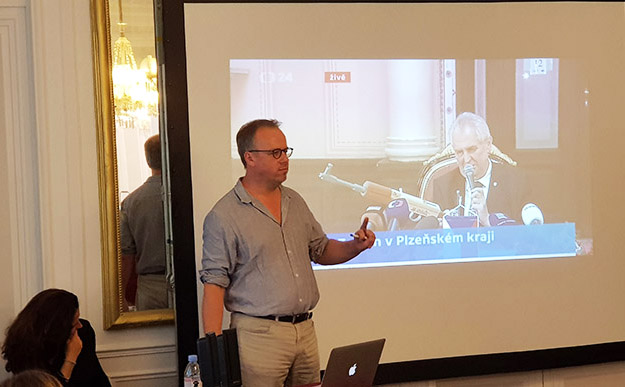
First up in RSF’s catalogue of crimes and threats against the global media was Czech President Miloš Zeman’s macabre press conference stunt late last year.

However, Zeman’s sick joke angered the media when he brandished a dummy Kalashnikov AK47 with the words “for journalists” carved into the wood stock at the October press conference in Prague and with a bottle of alcohol attached instead of an ammunition clip.

RSF’s Christophe Deloire talks of the Czech President’s anti-journalists gun “joke”.
Image: David Robie/PMC
Zeman has never been cosy with journalists but this gun stunt and a recent threat about “liquidating” journalists (another joke?) rank him alongside US President Donald Trump and the Philippines leader, Rodrigo Duterte, for their alleged hate speech against the media.

Saturday, October 21, 2017

Indonesian academic exchange an opportunity for unique collaboration

Universitas Gadjah Mada's Centre for Southeast Asian Social Studies (CESASS)
meets AUT's Pacific Media Centre with a Sky Tower backdrop. Photo: PMC
From AUT University

Pacific Media Centre director Professor David Robie will next week join academics from around the world in a global professorial exchange with Indonesia's Universitas Gadjah Mada. In return, six academics from the progressive Yogyakarta university have visited Auckland University of Technology for the first communication and publication research collaboration of its kind in New Zealand.

The academics from Yogyakarta, led by Gadjah Mada University's Centre for Southeast Asian Social Studies (CESASS) director Dr Hermin Indah Wahyuni, arrived in Auckland earlier this month for a two-week visit featuring workshops, seminars and joint research projects related to climate change.

They will also be collaborating with their newly published research journal IKAT, the PMC's 23-year-old Pacific Journalism Review and AUT Library's Tuwhera research platform on a major project involving ecological communication and Asia-Pacific maritime disasters.

Dr Robie is one of six academics invited by CESASS as part of the Indonesian government's World Class Professor (WCP) programme to strengthen international publication and research studies.

Friday, April 7, 2017

LIVE: CAFCA’s Murray Horton on NZ independence and foreign policy

Graphic: Concept art for Planet of the Apes

Courtesy of the Pacific Media Centre and Asia Pacific Report


TIME FOR INDEPENDENCE FROM A CRUMBLING US EMPIRE - Murray Horton
The advent of President Donald Trump in the US provides an unprecedented opportunity to take a good, hard look at Aotearoa's place in the world.  And to ask the question - why are we still a loyal member of the American Empire?

As the old saying goes, you are judged by the company you keep.

CAFCA Murray Horton says it's time for this country to pull the plug, to finish the business started in the 1980s, which saw us out of ANZUS, and break the chains -- military, intelligence, economic and cultural -- that continue to bind us to the American Empire.

Speaker: Murray Horton, national organiser of the Christchurch-based Campaign Against Foreign Control of Aotearoa (CAFCA). Video in two parts.

Friday, May 8, 2015

The Israeli architecture of destruction – and the 'hidden violence' against Palestine


 Alistar Kata's report on the visit by Amira Hass. Video: Pacific Media Centre

COINCIDING with the visit by renowned Haaretz journalist Amira Hass to New Zealand in the past couple of weeks, Al Jazeera has been running a repeat of the brilliant programme “The Architecture of Violence” in the Rebel Architecture series.

In this, architect and communicator par excellence Eyal Weizman explains how Israel has transformed urban warfare and how the techniques are used to subjugate Palestinians.

Travelling across the illegal settlements and roads of the West Bank and also along the Separation Wall, Weizman shows how the controlled use of architecture is deployed to consolidate the Israeli grip on Palestine.

"Architecture and the built environment is a kind of a slow violence,” he says.

“The occupation is an environment that was conceived to strangulate Palestinian communities, villages and towns, to create an environment that would be unliveable for the people there."

Wednesday, March 11, 2015

Climate change, environmental journalism and better media ethics

Pacific Media Watch editor Alistar Kata interviewing Kiribati Independent editor Taberannang Korauaba
about his climate change research in Micronesia at last night's seminar. Photo: Del Abcede/PMC
FIVE YEARS ago, as an environmental journalist and journalism educator, I attended “Oceans, Islands and Skies” – the Oceanic Conference of Creativity and Climate Change – at the University of the South Pacific in Fiji.

I found this a very moving, stimulating and inspiring experience. Until then, I had largely worked on the global and Pacific political dimensions of climate change.

There Once Was An Island
At that conference I found myself thrust among a tremendously talented group of people from all over the globe. And it was where I first encountered Briar March’s remarkable documentary There Once Was An Island: Te Henua e Nnoho about the plight of the people of Takuu, a tiny Polynesian atoll in Papua New Guinea, also known as Takuu Mortlock.

The islanders were confronted with the harsh reality of rising seas and climate change and were forced to make a decision about whether to abandon their traditional Pacific homeland for the coast of Bougainville. (They were divided, some left for Bougainville - mostly younger people, others stayed).

In many ways this is an iconic storytelling of the reality of climate change told by the islanders themselves.

Saturday, September 27, 2014

From Fiji's dictatorship to 'democracy' – the AUT student team on the job


Mads Anneberg's profile on Ricardo Morris and Repúblika.


THREE STUDENTS from AUT University covered Fiji's historic “from dictatorship to democracy” general election this month.

While the election arguably legitimised Voreqe Bainimarama’s so-called 2006 “coup to end all coups”, the students performed something of a coup themselves.

Not only were they providing the first ever comprehensive coverage of a Pacific national election by a New Zealand journalism school, but their reportage was far superior to much of the Kiwi media that was ill-prepared for the occasion.

In fact, some were unashamedly parachute journos covering a complex event on September 17 that was overshadowed by New Zealand’s own election three days later.

All three students were reporting as a “package” for Pacific Scoop, the course outlet for AUT’s postgraduate Asia-Pacific Journalism course run by the Pacific Media Centre. But while two were on the ground in Fiji, the third was an “anchor” - monitoring, writing and editing stories to provide an overall contextualised story.

Friday, September 12, 2014

'I'll not be intimidated ... by cowards,' says Fiji death threat journalist

Fiji Sun's Jyoti Pratibha ...death threats via fake Facebook profiles. Image: Pacific Scoop
THE PARIS-based media freedom advocacy organisation Reporters Sans Frontières and the Pacific Media Centre have condemned threats and intimidation against political reporters covering Fiji’s first parliamentary election campaign since the  2006 coup.

Pacific Media Watch reports from Paris:

Two women journalists – Vosita Kotowasawasa of the Fiji Broadcasting Corporation (FBC) and Jyoti Pratibha of the Fiji Sun newspaper – received death threats on Tuesday over their previous day’s coverage of the cancellation of a live TV debate between the leading contenders for the post of prime minister.

According to Pacific Scoop, a news website affiliated with the Pacific Media Centre, Kotowasawasa received several threatening phone calls while Pratibha was threatened via fake Facebook user profiles.

Both had covered the previous day’s last-minute decision by Ro Teimumu Vuikaba Kepa, the Roko Tui Dreketi and head of the Social Democratic Liberal Party (SODELPA), to pull out of the debate with interim Prime Minister Josaia Voreqe “Frank” Bainimarama.

Sunday, September 22, 2013

Activist charged with illegally screening No Fire Zone doco about Sri Lanka's 'Killing Fields'

Callum Macrae, filmmaker and journalist, has been at the forefront of a campaign to bring the government of Rajapaksa to the International Court of Justice for crime against humanity. Malaysiakini.tv spoke to Macrae about his film.

 From The Nation in Kuala Lumpur
 
A HUMAN rights activist has been charged at the magistrate's court in Kuala Lumpur with the screening of a controversial documentary, which was not cleared by the Film Censorship Board, on the alleged atrocities by the Sri Lankan army during the country's civil war.

An excerpt from the documentary was shown at AUT University in Auckland last week with the launching of the Asia-Pacific Human Rights Coalition (APHRC) in association with the Pacific Media Centre.


An Amnesty International spokesperson and other activists spoke at the Auckland meeting.

Lena Hendry, 28, a Komas programme coordinator, claimed trial to screening the film No Fire Zone: The Killing Fields of Sri Lanka at the Kuala Lumpur and Selangor Chinese Assembly Hall, Jalan Maharajalela, at 9pm on July 3, 2013.

She was charged under the Film Censorship Act 2002 and is liable to a maximum fine of RM30,000 (about NZ$11,000) or three years jail, upon conviction.

Tuesday, July 16, 2013

Rainbow Warrior, state terrorism and 'paranoid' French politicians


 Total Recall interview with David Robie by programme host Sam Bloore.


Thanks to Pacific Media Watch:

PACIFIC MEDIA CENTRE director Professor David Robie has spoken out about the 1985 Rainbow Warrior state terror attack in a recent interview on the Newstalk ZB programme Total Recall.

July 10 marked the 28th anniversary of the French attack, which Professor Robie wrote about in his 1986 book Eyes of Fire and also Blood on their Banner on Pacific independence struggles in 1989.

"The whole attack was outrageous in the first instance. It's just inconceivable that an attack like that could have been launched against a major nation in the world, a peaceful nation," Dr Robie said.

"It's bad enough that they did that, but then the French government at the time also blackmailed New Zealand over trade."

Dr Robie was on the Rainbow Warrior voyage more more than two months as a journalist, but had left the ship three nights before it was bombed in Auckland's Waitemata Harbour.

Tuesday, April 23, 2013

Media ignores major 'young leaders' Pacific politics forum

New Zealand Labour MPs Louisa Wall and Kris Fa'afoi, a former journalist, speaking about the Marriage Amendment Bill and Pacific culture in Parliament. The bill, designed to amend the 1955 Marriage Act to enable gay couples to marry, decisively passed its third reading. The MPs also spoke at this week's Pacific Parliament and Politics Forum in Wellington. Video: Tagata Pasifika/NZ Parliament

Thanks to Pacific Media Watch:

By Michael Sergel and Finian Scott, two AUT University student journalists on the Asia-Pacific Journalism course reporting for the Pacific Media Centre and Pacific Scoop

GOVERNMENT and opposition MPs and NGO representatives from 18 countries made a significant commitment to gender equality and sustainable development last weekend, but the forum received limited coverage from New Zealand and international media.

Barred West Papuan leader Benny Wenda with
PMC journalist Henry Yamo.
Image: Del Abcede/PMC
More than 70 delegates from across the Pacific were in Wellington for the Pacific Parliamentary and Political Leaders Forum, including New Zealand’s Deputy Prime Minister Bill English and other National, Labour, Green and independent MPs.

Delegates agreed on the need for greater action around gender equality, climate change and healthcare - but overwhelmingly rejected a push from the World Bank to free up trade conditions and deregulate economies.

NZAid invested $330,000 in the forum - the first of its kind in New Zealand history - but media coverage was scarce.

Sunday, April 14, 2013

Rebuilding the foundations of independent public interest journalism


Scoop editor and general manager Alastair Thompson (left)
and Pacific Media Centre’s director Professor David Robie
at the Scoop Foundation launch. Image: Del Abcede/PMC
An address by Scoop editor and general manager Alastair Thompson for the launch of the Scoop Foundation project and Pacific Scoop Internship at AUT's Pacific Media Centre.

By Alastair Thompson

In a push to offer new support and momentum for public interest journalism, New Zealand's leading independent news provider, Scoop Media, is lending its weight to two initiatives being announced for the first time.

The first initiative, the Scoop Foundation Project, brings Scoop.co.nz together with a group of New Zealand’s leading practitioners of public interest journalism to create a charitable trust to fund investigative journalistic work.

This coincides with the launch by Scoop of a $5000 Pacific Scoop internship being awarded in conjunction with AUT University’s Pacific Media Centre (PMC). The first recipient, Danish radio journalist Daniel Drageset, was named at the School of Communication Studies Awards event held at the newly opened Sir Paul Reeves Building at AUT last week.

The name for Scoop's "Scoop Foundation Project" plays on the associated ideas of "foundation" and "construction". It is clear that we now need to build a new journalism.

The one that we have has been struggling for some time, and a key component of it - print - is now on life support.

And to build a new journalism we need to start by (re)constructing some foundations. And that is what the Scoop Foundation project will do.

The first important thing to understand about the Scoop Foundation Project is that it is a completely separate entity from Scoop Media Limited, publisher of the Scoop.co.nz.

Sunday, March 31, 2013

John Miller, an icon and a treasure for Aotearoa, Pacific political protest

Pacific Media Watch's Daniel Drageset and Karen MacKenzie interview
photographer John Miller at the AUT seminar. Image: Del Abcede/PMC
JOHN MILLER is an extraordinary icon in New Zealand activist and social justice circles. Not only has he as a photographer captured in striking images many of the most critical social movements in Aotearoa, from the Nga Tamatoa struggles from 1971 and the hikoi to the 1981 anti-apartheid Springbok tour protests that polarised the nation to the 1980-90s Nuclear-Free and Independent Pacific (NFIP) movement, he is also something of a walking encylopaedia who can tell an intriguing story about almost every individual in his pictures. He has a prodigious memory.

Whina Cooper, Eva Rickard and Titiwhai Harawira at Waitangi, February, 1985. Photo: © John Miller:
Café Pacific was fortunate to be at his recent seminar at AUT University about the NFIP through a reflection around his images. Inspiring stuff.

Saturday, March 23, 2013

Digital media building a milestone for NZ’s AUT University

The $98 million Sir Paul Reeves building at AUT University ... a digital
media boost for the journalism school. Photo: Del Abcede/PMC
By Nicholas Jones

ONE OF New Zealand's major universities has opened a new digital media age building which has transformed its campus and significantly altered Auckland city's learning quarter.

Auckland University of Technology's new $98 million precinct, the Sir Paul Reeves building, was officially opened by Prime Minister John Key on Friday.

Vice-chancellor Derek McCormack, speaking as he gave the New Zealand Herald a tour of the new building, which was named after a former AUT Chancellor, the late Sir Paul Reeves, said it was a huge moment in the development of the campus.

"AUT has been the fastest growing university in the country. There have been big challenges. And we are only on the way, this is a milestone in a long process."

The $98 million building is the latest in a line of major building projects since AUT gained university status in 2000. Many of those projects, such as the business building, completed in 2005, had suffered from being slightly isolated.

Friday, February 15, 2013

Media freedom in the Pacific - the threats exposed

Fiji Times editor Fred Wesley talking in the Media Freedom in the Pacific documentary. Image: Café Pacific
THREATS to the media have got a strong airing in a new 23-minute documentary, Media Freedom on the Pacific, from the University of the South Pacific journalism programme.

Funded by the International Federation of Journalists and initiated by the Pacific Freedom Forum, the USP crew has interviewed many editors, journalists, media advocates and educators around the region, including PFF’s coordinator Lisa Williams-Lahari, Pacific Media Watch co-founder and Café Pacific publisher David Robie, Fiji Times editor Fres Wesley, Vanuatu Independent’s Hilaire Bule, Taimi ‘o Tonga’s publisher Kalafi Moala, Savali’s Tupuola Terry Tevita of Samoa, Blaire Philips of Oceania TV in Palau, NBC’s Janet Kwalahu of Papua New Guinea, investigative journalist Haivetia Kivia of the PNG Post-Courier, Pacific Islands News Association (PINA) president Moses Stevens and Vanuatu Media Association president Evelyne Toa.

The programme also features what was believed to be the last major media interview with veteran Solomon Star publisher John Lamani before he died last year.

All the interviews were conducted at PINA's Second Pacific Media Industry Summit at Pacific Harbour, Fiji, last March.

The programme was directed and produced by US television media educator Don Pollock, scripted by Pollock and Sorariba Nash, edited and narrated by USP’s Radio Pasifik manager Semi Francis with interviews by Pollock and Radio Djiido’s Magalie Tingal.

The documentary complements an eight-minute video on Pacific media freedom made by the Pacific Media Centre for UNESCO World Press Freedom Day and shown at a New Zealand seminar and in Fiji in 2012.

Student journalist Jordan Puati interviewed New Zealand-based Pacific Islands Media Association (PIMA) chair Iulia Leilua, TVNZ Tagata Pasifika reporter John Pulu and Pacific Media Watch editor Alex Perrottet.

The programme was directed by Danni Mulrennan and produced by the PMC's David Robie.

A high resolution version of the USP video can be obtained by contacting Semi Francis

Friday, December 7, 2012

Monday, October 15, 2012

David Robie talks on Pacific media freedom, politics and public trust

Coups, conflicts and human rights: Pacific media challenges in the digital age

Public lecture by Professor David Robie

Date: Tuesday, 16 October 2012
Time: 4.30pm - 5.30pm
Venue: WA Conference Centre, AUT City Campus

View full lecture at AUT University on demand

PROFESSOR DAVID ROBIE is director of the Pacific Media Centre in AUT’s School of Communication Studies and editor of the international peer reviewed journal Pacific Journalism Review. He holds a PhD in History/Politics (2004) from the University of the South Pacific, Fiji. He has lived and worked as an international journalist and media educator in seven countries for more than four decades.

In this professorial address, Professor David Robie reflects on the challenges in the context of the political economy of the media and journalism education in the Asia-Pacific region. He also explores emerging disciplines such as deliberative journalism, peace journalism, human rights journalism, and revisits notions of critical development journalism and citizen journalism.
 

Wednesday, February 1, 2012

Pacific Journalism Review - a new regional media resource


PACIFIC JOURNALISM REVIEW - the only media research journal in the South Pacific - has been publishing in the region for the past 17 years. It was launched originally at the University of Papua New Guinea and then had a life at the University of the South Pacific. But it is now published by AUT University's Pacific Media Centre.

Apart from the many academic research offerings, the journal has attracted many Pacific journalists, such as the Taimi Media Group's Kalafi Moala in Tonga and Savea Sano Malifa, editor-in-chief of the Samoa Observer. International authors have included John Pilger and Robert Fisk.

Some 679 research articles and reviews have been published by the journal and more are being added to the archives. In the past, the journal articles have been available by subscribing to the hard copy edition or the online databases, but now the archives will also be available on the PJR website (long after publication on the subscriber databases in Australia, New Zealand/Pacific and the USA).

Topics include digital media, Fiji coups, environmental journalism, indigenous media, investigative journalism, media freedom, media law and ethics and media ownership.

Check out the PJR website, but login and create your own account to get access to the best content:
Pacific Journalism Review website
If you want quick access on a Pacific subscriber database, go to Niustext

Friday, December 31, 2010

Café Pacific's New Year Honours list 2010

NEWSPAPER of the Year – The Fiji Times: This is the second year running it has won the Café Pacific newspaper prize. Although The Fiji Times went off the boil under Netani Rika’s leadership and headed for a disastrous demise with it uncomprising but unrealistic stance when dealing with a military regime, the newspaper wins the award again - this time for its change of ownership, change of tactics and a realistic overhaul of its strategic direction. Under the naïve management in the last stages of the News Ltd era, the 141-year-old newspaper was heading for closure under the 10 percent local ownership ultimatum under the regime’s Media Industry Development Decree. This fate would have sealed the end of any credible fightback for an independent media in Fiji.

However, under the new ownership of the Motibhai group (“Mac” Motibhai Patel was a Fiji Times director for about four decades) and with the recall of a previous outstanding Australian publisher, Dallas Swinstead, to the hotseat, the paper now has the chance to fight another day. Neogotiation rather than confrontation seems to be the new approach under editor Fred Wesley. Time will tell whether this succeeds.

But paradoxically The Fiji Times also blots its copy book with the Most Toadying Story of the Year – a front page story on Fiji Water that ran as a sort of advertising wrap around given the marketing image displayed. When the US-based company Fiji Water announced its closure this was a petulant response to a massive tax clampdown on the company, many breathed an “about time” sigh – they regarded the company as having exploiting Fiji for years. While some in the media fraternity expected the regime to cave in – as it had done on a previous attempt to boost the state tax returns - this time it was the company that surrendered with a reversal of its close down edict and a vow of business as usual. The Fiji Times needed to have published a more exhaustive inquiry into the economics of Fiji Water and also ought to have a higher level of scrutiny of other foreign-owned companies operating in the country. This is revelatory about the level of business journalism on the paper at the moment.

Media film – There Once Was an Island: Te Henua e Noho: Strictly speaking, this isn’t a media film at all, but a powerful and heart-rending documentary about the realities of climate change in the Pacific, a film that every journalist working on environmental issues should watch. It is extremely educational about the power relationships between politicians in far-away Pacific capitals and their incompetent functionaries and island communities struggling for survival on remote islands with the political odds stacked against them. Filmmaker Briar March lived with the community on the Polynesian atoll of Takuu (also known as the Mortlock islands) as they wrestled with their life-and-death decisions over a move to the Bougainville autonomous region mainland some 250 km to the south-west.

This film had its premier in the New Zealand International Film Festival in July and was also screened at the Oceans, Islands and Skies creativity and climate change conference at the University of the South Pacific in September. Sadly, not one local Fiji journalist took the trouble of seeing it, let alone write about it. It has already won four awards in 2010 and was the runner-up as the best political film for the AOF Festival 2010.

Media monitoring agency – Reporters sans frontières (RSF): Again, this award is well-deserved globally for 2010, but the agency is also now boosting its Asia-Pacific coverage with several new nations now being included in its Pacific section of the annual media freedom survey. Its coverage of East Timor and Papua New Guinea is particularly welcome. According to RSF's 2010 end-of-year report:

57 journalists killed (25 percent fewer than in 2009)
51 journalists kidnapped
535 journalists arrested
1374 physically attacked or threatened
504 media censored
127 journalists fled their country
152 bloggers and netizens arrested
52 physically attacked
62 countries affected by internet censorship
Check out the full report.

Independent new website - Taimi Media Network Online: This new website is a hybrid offering from both the feisty independent newspaper Taimi ‘o Tonga and the government-owned Tonga Chronicle and TMN-Television 2. Congratulations Kalafi Moala and his team. This could not be better timed as the momentous post-election changes are settling down in Tonga. Scrutiny is needed now more than ever.

Also, a special mention of the Pacific Media Centre’s new revamped regional website: www.pmc.aut.ac.nz – unlike some of the regional media websites, this is genuinely independent and carries no vested interests baggage.

>>> Popular Café Pacific Posts