NZ
pilot Philip Mehrtens with some of his West Papuan rebel captors . . .
hopes for his release as with the hostages in neighbouring Papua New
Guinea. IMAGE: TPNPB video screenshot APR
TWO countries. A common border. Two hostage crises. But the responses
of both Asia-Pacific nations have been like chalk and cheese.
On February 7, a militant cell of the West Papua National Liberation
Army (TPNPB), the armed wing of the Free Papua Organisation (OPM) — a
fragmented organisation that been fighting for freedom for their
Melanesian homeland from Indonesian rule for more than half a century —
seized a Susi Air plane at the remote highlands airstrip of Paro,
torched it and kidnapped the New Zealand pilot.
It was a desperate ploy by the rebels to attract attention to their
struggle, ignored by the world, especially by their South Pacific near
neighbours Australia and New Zealand.
Many critics deplore the hypocrisy of the region
which reacts with concern over the Russian invasion and war against
Ukraine a year ago at the weekend and also a perceived threat from
China, while closing a blind eye to the plight of the West Papuans – the
only actual war happening in the Pacific.
Papuan independence rebels are playing a desperate game of cat and
mouse with Indonesian authorities over their hostage taking last week
with a New Zealand pilot caught in the middle.
Christchurch-raised Philip Mehrtens, 37, a pilot for the national
feeder airline Susi Air owned by a former cabinet minister and with
Jakarta government supply contracts, was seized by rebels last Tuesday,
February 7, shortly after he had touched down at the remote Paro
airstrip near Nduga in the Papuan highlands.
Five Indigenous Papuans on board the aircraft were set free and the plane was set on fire.
After initial reports saying the authorities were trying to pinpoint
the actual place where the rebels are in hiding and that a rescue
operation is under way, the West Papua National Liberation Army (TPNPB)
played a trump card today by releasing “proof of life” video footage and photos.
“Papua Merdeka!,” said Mehrtens in one of the obviously coached video
messages. “The Papuan military have taken me captive in the fight for
Papuan independence,” he added hesitantly while surrounded by a group of
armed rebels.
When Papuan journalist Victor Mambor visited New Zealand almost nine
years ago, he impressed student journalists from the Pacific Media
Centre and community activists with his refreshing candour and courage.
As the founder of the Jubi news media group, he remained defiant that he would tell the truth no matter what the risk while facing an oppressive and vindictive regime.
“Journalists need to break down the wall and learn freely about our struggle,” he said in a message to New Zealand media via an interview with Pacific Media Watch.
Now the 49-year-old journalist and editor finds that the risks are
growing exponentially as his media network has expanded — with an
English language website and Jubi TV becoming add-ons — and the exposure of his networks have also widened.
He writes for the Jakarta Post, Benar News and contributes to international news services. Two years ago he was also co-producer of an award-winning Al Jazeera 101 East documentary about the plunder of West Papuan forests for oil palm plantations.
Police gather evidence near the site of a bomb explosion that took place
outside the house of Jubi editor Victor Mambor, in Jayapura, Papua,
Indonesia, on 23 January 2023. IMAGE: AJI for BenarNews
By DANDY KOSWARAPUTRA and PIZARO GOZALI IDRUS Pacific Media Watch
A VETERAN journalist known for covering rights abuses in Indonesia’s
militarised Papua region says a bomb exploded outside his home yesterday
and a journalists group has called it an act of “intimidation”
threatening press freedom.
No one was injured in the blast near his home in the provincial
capital Jayapura, said Victor Mambor, editor of Papua’s leading news
website Jubi, who visited New Zealand in 2014.
Police said they were investigating the explosion and that no one had yet claimed responsibility.
Popular original 1987 coup leader Sitiveni Rabuka . . . back as prime minister in Fiji but with promises of a more democratic and transparent era. Image: FIJIVILLAGE
The Pacific year started with a ferocious eruption and global tsunami in Tonga, but by the year’s end several political upheavals had also shaken the region with a vengeance.
A razor’s edge election in Fiji blew away a long entrenched authoritarian regime with a breath of fresh air for the Pacific, two bitterly fought polls in Papua New Guinea and Vanuatu left their mark, and growing geopolitical rivalry with the US and Australia contesting China’s security encroachment in the Solomon Islands continues to spark convulsions for years to come.
It was ironical that the two major political players in Fiji were both former coup leaders and ex-military chiefs – the 1987 double culprit Sitiveni Rabuka, a retired major-general who is credited with introducing the “coup culture” to Fiji, and Voreqe Bainimarama, a former rear admiral who staged the “coup to end all coups” in 2006.
And pundits had been predicting that the 74-year-old Rabuka, a former prime minister in the 1990s, and his People’s Alliance-led coalition would win. However, after a week-long stand-off and uncertainty, Rabuka’s three-party coalition emerged victorious and Rabuka was elected PM by a single vote majority.
West Papua's funeral procession for Filep Karma . . . banned
Morning Star flags in defiance for the man who strove for “justice,
democracy, peace and non-violent resistance" against Indonesian rule. IMAGE: Twitter screenshot APR
A TRAGIC day of mourning. Thousands thronged the West Papuan funeral cortège today and tonight as the banned Morning Star led the way in defiance of the Indonesian military.
There haven’t been so many Papuan flags flying under the noses of the security forces since the 2019 Papuan Uprising.
Filep Jacob Semuel Karma,
63, the “father” of the Papuan nation, was believed to be the one
leader who could pull together the splintered factions seeking
self-determination and independence.
It is still shocking a day after his lifeless body in a wetsuit was found on a Jayapura beach.
Police and Filep Karma’s family say they had no reason to believe that his death resulted from foul play, report Jubi editor Victor Mambor in Jayapura and Nazarudin Latif from Jakarta for Benar News.
“I followed the post-mortem process and it was determined that my
father died from drowning while diving,” Karma’s daughter, Andrefina
Karma, told reporters.
But many human rights advocates and researchers aren’t so convinced.
Bodies of civilians being evacuated after an attack by an armed group at
Nogolaid Village, Kenyam District, Nduga Regency, Papua, last Saturday. IMAGE: Jubi
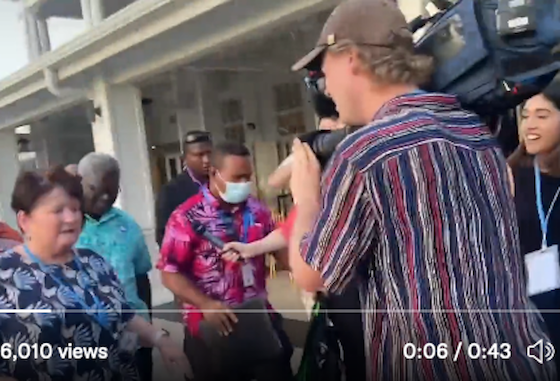
A LIVELY 43sec video clip surfaced during last week’s Pacific Islands
Forum in the Fiji capital of Suva — the first live leaders’ forum in
three years since Tuvalu, due to the covid pandemic.
Posted on Twitter by Guardian Australia’s Pacific Project
editor Kate Lyons it showed the doorstopping of Solomon Islands Prime
Minister Manasseh Sogavare by a melee of mainly Australian journalists.
A
doorstop on security and China greets Solomon Islands Prime Minister
Manasseh Sogavare (in blue shirt) at the Pacific islands Forum in Suva
last week. IMAGE: Twitter screenshot @MsKateLyons
But Lyons made a comment directed more at questioning journalists themselves about their newsgathering style:
“Australian media attempt to get a response from PM Sogavare, who has
refused to answer questions from international media since the signing of the China security deal, on his way to a bilateral with PM Albanese. He stayed smilingly silent.”
Papuan
student advocate Laurens Ikinia ... “We are so grateful to all Kiwis
across the country for their generous support." IMAGE: Del Abcede/Asia
Pacific Report
IT IS unconscionable. A bewildering and grossly unfair crisis for 34
young Papuan students – 25 male and 9 female – the hope for the future
of the West Papua region, the Melanesian half of Papua New Guinea island
ruled by Indonesia.
They were part of a cohort of 93 Papuan students studying in Aotearoa New Zealand
on local provincial autonomy government scholarships, preparing for
their careers, and learning or improving their English along the way.
They were also making Pacific friendships and contacts.
They were fast becoming a “bridge” to New Zealand. Ambassadors for their people.
And then it all changed. Suddenly through no fault of their own, 41
of them were told out of the blue their scholarships were being
cancelled and they had to return home.
Their funds were cut with no warning. Many of them had accommodation
bills to pay, university fees to cover and other student survival debts.
Time is running out for a group of West Papuan students in New
Zealand whose scholarships were cut — out of the blue — by the
Indonesian government
The sudden removal of government funding for the Papuan students has
left many of them in financial dire straits on visas that are running
out.
Forty two students learned of the termination of their scholarships
at the beginning of this year. With deadlines approaching they have
appealed to both the Indonesian government and MPs in New Zealand to see
if they can fix their dashed hopes of a completed education.
Green Party MPs Ricardo Menendez March, Golriz Ghahraman and Teanau
Tuiono penned a letter to Minister of Foreign Affairs Nanaia Mahuta
requesting government to support for the students before they are
deported.
They are calling for a scholarship fund to support the impacted
students, a residency pathway for West Papuan students whose welfare has
been affected, and an assurance that the students will have access to
safe housing in affordable accommodation.
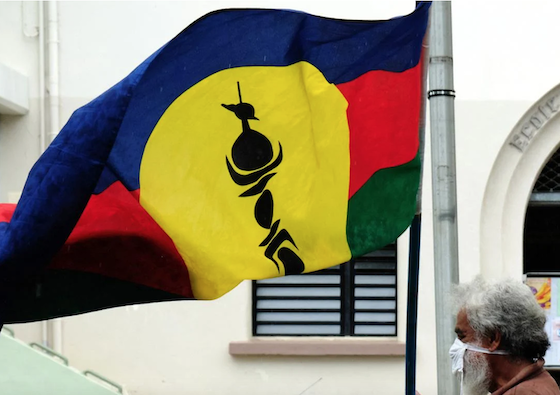
Independence and self-determination in the Pacific ... contrasting
referendum experiences between Bougainville, Kanaky New Caledonia and
West Papua. IMAGE: Screenshot of the Kanak flag in Middle East Eye
THE PACIFIC year has closed with growing tensions over sovereignty and self-determination issues and growing stress over the ravages of covid-19 pandemic in a region that was largely virus-free in 2020.
Just two days before the year 2021 wrapped up, Bougainville President Ishmael Toroama took the extraordinary statement of denying any involvement by the people or government of the autonomous region of Papua New Guinea being involved in any “secret plot” to overthrow the Manasseh Sogavare government in Solomon Islands.
Insisting that Bougainville is “neutral” in the conflict in neighbouring Solomon Islands where riots last month were fuelled by anti-Chinese hostilities, Toroama blamed one of PNG’s two daily newspapers for stirring the controversy.
“Contrary to the sensationalised report in the Post-Courier (Thursday, December 30, 2021) we do not have a vested interest in the conflict and Bougainville has nothing to gain from overthrowing a democratically elected leader of a foreign nation,” Toroama said.
The frontpage report in the Post-Courier appeared to be a beat-up just at the time Australia was announcing a wind down of the peacekeeping role in the Solomon Islands.
FROM Auckland Tāmaki Makaurau in Aotearoa New Zealand to Paris,
France, and from Wellington Te Whanganui-a-Tara to Jayapura and far
beyond, thousands of people across the world today raised the Morning Star flag — banned by Indonesian authorities — in simple acts of defiance and solidarity with West Papuans.
They honoured the raising of the flag for the first time 60 years ago
on 1 December 1961 as a powerful symbol of the long West Papua struggle
for independence.
One of the first flag-raising events today was in Wellington where Peace Movement Aotearoa and Youngsolwara Pōneke launched a virtual ceremony online with most participants displaying the banned flag.
Filmmaker and journalist Max Stahl, 66, has died almost 30
years after capturing images of the Indonesian massacre at Santa Cruz cemetery
in the Timor-Leste capital Dili, which helped accelerate the country’s
struggle for independence.
By coincidence, he died on the same day in 1991 as Sebastião Gomes,
the young man who was buried in Santa Cruz and whose death led to the
protest that ended in the Santa Cruz Massacre.
More than 2000 people went to Santa Cruz to pay tribute to Gomes, who
was killed by Indonesian-backed militia in the Motael neighbourhood.
Filmmaker Max Stahl speaking to the 20th anniversary of Pacific Journalism Review in Auckland in 2014. Image: Del Abcede/APR
The atrocity by the Indonesian military was secretly filmed by Max
Stahl and footage smuggled out of the country. International attention
on East Timor dramatically changed as a result.
At the graveyard, the Indonesian military opened fire on the crowd,
killing 74 people at the scene. Over the next few days, more than 120
young people died in hospital from their wounds or as a result of the
crackdown by occupying forces.
Most bodies were never recovered.
Born on 6 December 1954 in the United Kingdom, journalist and
documentary maker Christopher Wenner, better known as Max Stahl, began
his ties to the country in 1991 when he managed to enter East Timor for
the first time.
He became a Timorese citizen in 2019.
Hiding among the graves
On November 12, hiding among the graves of Santa Cruz cemetery, he
filmed the massacre — one of many during the Indonesian occupation of
the country. Images were circulated around the world’s media and this
changed history.
Decorated with the Order of Timor-Leste, the highest award given to
foreign citizens in the country, the Rory Peck Prize for filmmakers, and
several other rewards, Max Stahl leaves as a legacy the main archives
of images from the last years of the Indonesian occupation of the
country.
The archive was adopted by UNESCO for the World Memory Register and
has been used for teaching and research on Timor’s history under the
framework of cooperation between the University of Coimbra, the National
University of East Timor and CAMSTL.
The original 1991 Dili massacre footage by Max Stahl. Video: Journeyman Pictures
Stahl studied literature at the University of Oxford and he was a
fluent speaker of several languages, including the two official
languages of East Timor — Portuguese and Tetum.
He began his career writing for theatre and children’s television
shows. However, he found his calling as a war correspondent when he
lived with his family. At the time his father was ambassador to El
Salvador where Stahl reported on the civil war between 1979 and 1992.
Stahl covered other conflicts such as those of Georgia, former
Yugoslavia and East Timor (from 30 August 1991), where he arrived as a
“tourist” at the invitation of resistance groups.
“The king is dead. With great sadness, I write to inform you that Max passed away this morning.”
— Max Stahl’s wife Dr Ingrid Brucens
Historic resistance leaders
Throughout his long ties to East Timor, where he lived until he had to
travel recently to Australia for medical treatment, he interviewed
historic resistance leaders such as Nino Konis Santa, David Alex and
others.
Santa Cruz and the 12 November 1991 massacre made the name Max Stahl
known internationally with his images exposing the barbarism of the
Indonesian occupation.
In Portugal, the images made a special impact — both through the
brutality of the violence portrayed and because the survivors gathered
in the small chapel of Santa Cruz, praying in Portuguese while listening
to the bullets being fired by the Indonesian military and police.
The 1999 referendum prompted Max Stahl to return to East Timor when
he covered the violence before the referendum and after the announcement
of independence victory. He also accompanied families on the flight to
the mountains.
News of Max Stahl’s death on Wednesday at a Brisbane hospital quickly
became the most commented subject on social media in East Timor,
prompting condolences from several personalities during the struggle for
independence.
In statements to Lusa news agency, former President José Ramos-Horta
described Max Stahl’s death as a “great loss” to Timor-Leste and the
world. He said it would cause “deep consternation and pain” to the
Timorese people.
“Someone like Max, with a big heart, with a great dedication and love
for East Timor … [has been] taken to another world,” he told Lusa.
Dr Ingrid Brucens, Max Stahl’s wife, and who was with him and the children in Brisbane, announced his death to friends.
“The king is dead. With great sadness, I write to inform you that Max
passed away this morning,” she wrote in messages to friends.
Antonio Sampaio is the Lusa correspondent in Dili.
Pacific
Journalism Review investigation poses questions about the “silence” in
Australia over the controversial Bougainville documentary Ophir that has
won several international film awards in other countries. IMAGE: Ophir
still
A FRONTLINE investigative journalism article on the politics behind
the decade-long Bougainville war leading up to the overwhelming vote for
independence is among articles in the latest Pacific Journalism Review.
The report, by investigative journalist and former academic Professor Wendy Bacon and Nicole Gooch, poses questions about the “silence” in Australia over the controversial Bougainville documentary Ophir that has won several international film awards in other countries.
Published this week,
the journal also features a ground-breaking research special report by
academics Shailendra Singh and Folker Hanusch on the current state of
journalism across the Pacific – the first such region-wide study in
almost three decades.
Griffith University’s journalism coordinator Kasun Ubayasiri has
produced a stunning photo essay, “Manus to Meanjin”, critiquing
Australian “imperialist” policies and the plight of refugees in the
Pacific.
Censured or punished? Conflicting reports about the alleged punishment
of the two Indonesian Air Force military policemen who stomped on the
head of young Papuan Steven Yadohamang at Merauke last week. IMAGE: Yumi
Toktok Stret
IT IS open season again for Indonesian trolls targeting Asia Pacific Report and other media with fake news and disinformation dispatches in a crude attempt to gloss over human rights violations.
Just three months ago I wrote about this issue in my “Dear editor” article
exposing the disinformation campaign. There was silence for a while but
now the fake letters to the editor – and other media outlets — have
started again in earnest.
The latest four lengthy letters emailed to APR canvas the following topics — Jakarta’s controversial special autonomy status revised law for Papua, a brutal assault by Indonesian Air Force military policemen
on a deaf Papuan man, and a shooting incident allegedly committed by
pro-independence rebels – and they appear to have been written from a
stock template.
Two
Indonesian Air Force military policemen stomping on the head of a deaf
Papuan teenager, Steven Yadohamang, in the Merauke region on 26 July 2021. IMAGE: Screenshot
from video
By YAMIN KOGOYA
Shocking video footage showing a brutal and inhumane assault on a
deaf Papuan teenager named Steven Yadohamang has emerged from the Merauke region of
Papua and sparked outrage.
The video shows
an altercation between the 18-year-old and a food stall owner. Two
security men from the Air Force Military Police (Polisi Militer Angkatan
Udara, or POMAU) intervened in the argument.
One of the officers grabbed the young man and pulled him from the food
stall. The victim was slammed to the pavement and then stomped on by
the Air Force officers.
The two men, Serda Dimas and Prada Vian, trampled on Yadohamang’s head
and twisted his arms after knocking him to the ground. The young man was
seen screaming in pain, but the two men continued to step on his head
and body while the officers casually spoke on the phone.
Human rights defender Carmel Budiardjo ... many lives "touched - and
sometimes transformed - by her passionate and determined campaigning for
human rights, justice and democracy in Indonesia, East Timor, Aceh and
West Papua". IMAGE: TAPOL
BRITISH and Indonesian human rights defender Carmel Budiardjo,
founder of TAPOL watchdog and the movement’s driving force for many
decades, has died peacefully aged 96.
TAPOL said in an announcement that she had died on Saturday and would
be greatly missed by an extensive network of people whose lives had been
“touched — and sometimes transformed — by her passionate and determined
campaigning for human rights, justice and democracy in Indonesia, East
Timor, Aceh and West Papua”.
For many, she had been a great mentor as well as a beloved friend, TAPOL said.
International reporting has hardly been a strong feature of New
Zealand journalism. No New Zealand print news organisation has serious
international news departments or foreign correspondents with the
calibre of such overseas media as The Sydney Morning Herald and The Age.
It has traditionally been that way for decades. And it became much worse after the demise in 2011 of the New Zealand Press Association
news agency, which helped shape the identity of the country for 132
years and at least provided news media with foreign reporting with an
Aotearoa perspective fig leaf.
It is not even much of an aspirational objective with none of the 66 Voyager Media Awards categories recognising international reportage, unlike the Walkley Awards
in Australia that have just 34 categories but with a strong recognition
of global stories (last year’s Gold Walkley winner Mark Willacy of ABC Four Cornersreported “Killing Field” about Australian war crimes in Afghanistan).
Aspiring New Zealand international reporters head off abroad and gain postings with news agencies and broadcasters or work with media with a global mission such as Al Jazeera.
Branding armed Papuan resistance groups as “terrorists” has sparked
strong condemnation from human rights groups across Indonesia and in
West Papua, some describing the move as desperation and the “worst ever”
action by President Joko Widodo’s administration.
Many warn that this draconian militarist approach to the Papuan
independence struggle will lead to further bloodshed and fail to achieve
anything.
Many have called for negotiation to try to seek a way out of the spiralling violence over the past few months.
Ironically, with the annual World Press Freedom Day being observed on Monday many commentors also warn about the increased dangers for journalists covering the conflict.
Setara Institute for Peace and Democracy chairperson Hendardi
(Indonesians often have a single name) has criticised the government’s
move against “armed criminal groups” in Papua, or “KKB)”, as the Free Papua Movement (OPM) armed wing is described by military authorities.
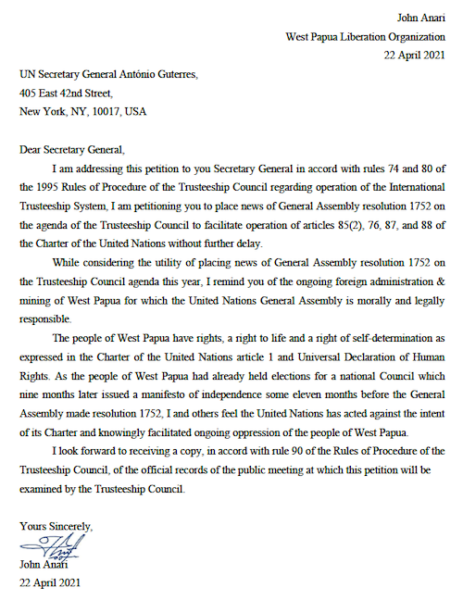
A WEST Papuan envoy who was gagged while addressing the United
Nations Permanent Forum on Indigenous Issues two years ago has been
blocked again while trying to speak out.
For six years, John Anari, leader of the West Papua Liberation
Organisation (WPLO) and an “ambassador” of the United Liberation
Movement for West Papua (ULMWP), has been appealing to the forum to push
for the Indonesian-ruled Melanesian region to be put on the UN
Trusteeship Council.
He was speaking for the two groups combined as the West Papua
Indigenous Organisation (WPIO), or Organisasi Pribumi Papua Barat, when
he attempted to give his address at the forum last Thursday.
ASIA PACIFIC REPORT, the Auckland-based independent news and
analysis website, has been increasingly targeted by Indonesian trolls
over the past three months, involving a spate of “letters to the editor”
and social media attacks.
One of the most frequent letter writers, an “Abel Lekahena”, who
claims to be a “student” or “writing on behalf of the people of Papua”,
has accused APR of “only taking the separatists’ narrative as they played the victim”.
Sometimes he is purportedly a student living in “Yogyakarta”, West
Java; at other times he is a migrant from East Nusa Tenggara “currently
living in Manokwari, West Papua”. He has written to Asia Pacific Report 10 times in the past eight weeks – twice in one day on December 29, 2020.
“Lekahena”, if that is even his real name, claims in his latest
“template” letter on Monday that since January, “the armed separatists
prowled in Intan Jaya” and burned a missionary plane
on January 6 and he has cited several clashes between pro-independence
militants seeking independence for West Papua and the colonial
Indonesian security forces.